by Tom Gurney
Tom Gurney BSc (Hons) is an art history expert with over 20 years experience
Page created on September 3, 2026 / Page updated on September 13, 2026
Email: tomgurney1@gmail.com / Phone: +44 7429 011000
How a Lightly Loaded Brush Lets the Surface Speak through the Paint
Dry brush uses a brush carrying relatively little mobile paint so that colour catches on raised parts of a surface and skips across hollows. The resulting stroke is broken rather than continuous. “Dry” is relative: the brush contains paint, but not enough fluid vehicle to flood the paper tooth, canvas weave or texture of a lower layer.[1]
The technique can produce hair, grass, weathered material, sparkle or atmospheric vibration. Its appearance depends as much on the receiving surface and pressure as on brush shape. It occurs in watercolour, ink, tempera, oil and other paint systems.
At a Glance
- Core actiona relatively dry, lightly loaded brush skips across a textured support or lower paint layer.
- Visible resultbroken deposits reveal paper, canvas weave or underlying colour between catches of paint.
- Medium variesdry-brush handling can appear in watercolour, oil, tempera, ink and other materials.
- Do not confusescumbling describes a lighter veil over a darker dry layer; hatching uses repeated linear marks.
- Cautionabrasion, damaged paint and image compression can imitate a broken stroke in reproduction.
Contents
How a dry-brush mark forms
A lightly loaded brush dragged at a shallow angle touches the peaks of rough paper or canvas first. Greater pressure bends hairs into hollows and makes the deposit more continuous. Speed, viscosity, bristle stiffness and previous texture all change the result. Princeton's art-material glossary describes drybrush through this interaction between scant paint and textured support.[2]
On watercolour paper, dry pigment can leave sparkling reserves of white. In oil, a low-load stroke may catch on dried paint beneath and reveal its colour between deposits. The same broken appearance can also come from a nearly exhausted brush used upright in short touches.
Dry brush is not automatically pale, thick or quick. Dark paint can be dragged dryly, and a thin deposit may take careful repeated control. A dry-brush stroke can sit within a painting otherwise made from washes, wet-in-wet passages and opaque body colour.
Four works to compare
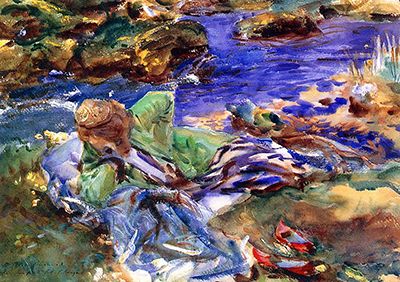
Turkish Woman by a Stream
Sargent's watercolours combine transparent wash, opaque colour, wet joins, reserve and dry marks. In Turkish Woman by a Stream, broad fluid areas coexist with sharper broken descriptions of fabric, bank and vegetation. Met scholarship on Sargent records his use of both wet and dry paper and of dry brush saturated with colour.[3]
The contrast is instructive: fluid paint creates connected shadow and water, while lower-load accents interrupt the surface. Dry brush does not govern the whole image; it supplies specific textures and edges that a wash would soften.
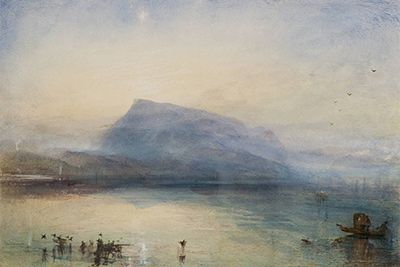
The Blue Rigi Sunrise
Turner's The Blue Rigi: Sunrise builds a mountain and lake from transparent washes, reserved paper, scraping and controlled accents. Tate's object record and National Gallery study of Turner's watercolour methods show how layered wet and dry operations contribute to such luminous effects.[4][5]
Fine darker marks and pale broken touches sharpen boats, shoreline and mountain after broad atmosphere is established. Calling the entire sheet “dry brush” would miss that sequence. The technique gains force precisely because it meets softer, more continuous wash.
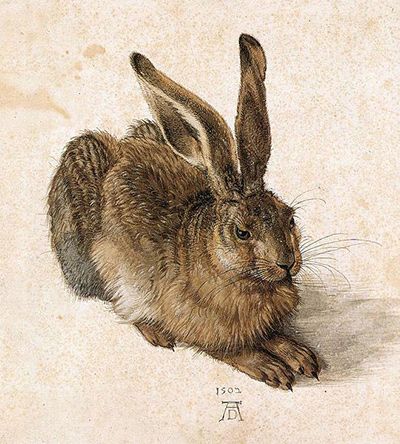
Young Hare
Dürer's Young Hare uses watercolour and bodycolour with extraordinary variation. The Albertina describes the 1502 study's close observation and virtuoso rendering.[6] Short hairs cross a modelled body, changing direction, colour and density.
Some fine marks behave like low-load strokes over lighter preparation, allowing underlying tone to participate in the fur. Others are more continuous. The example shows that dry brush can serve minute natural description rather than broad expressive roughness.
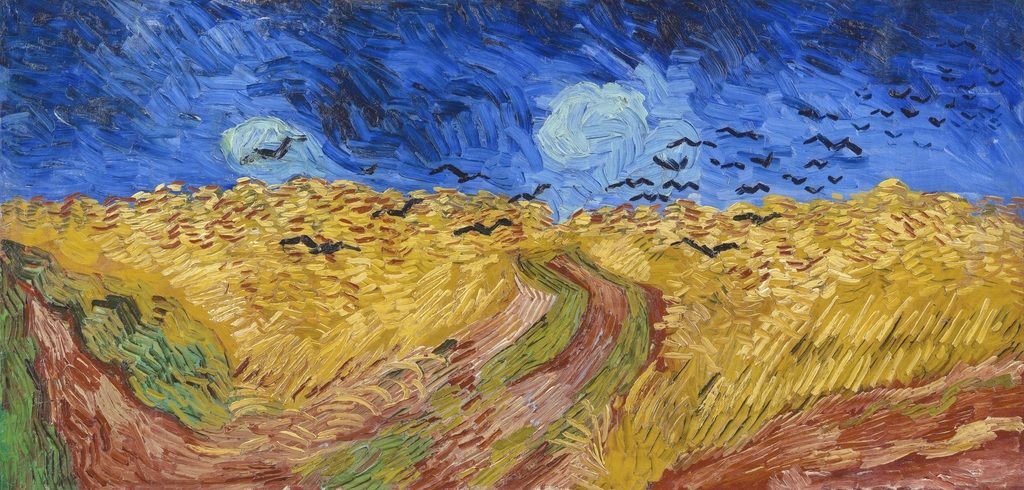
Wheatfield with Crows
Van Gogh's Wheatfield with Crows is a useful counterexample. Its separated directional strokes may look “dry” in a small reproduction, but many are materially loaded and raised. Van Gogh Museum evidence emphasises the artist's purposeful paint thickness, pigments and forceful handling.[7]
Broken colour is therefore not enough to diagnose dry brush. Where strokes carry substantial bodies of paint and retain relief, impasto is the more informative term. The support may still show between marks, but the mechanism differs.
Dry brush, scumbling and hatching
Scumbling usually lays a lighter, semi-opaque veil across a darker dry layer, often over a broader area. Dry brush describes the brush-load and broken deposition that may create such a veil. The techniques can overlap, but dry brush can also draw a dark twig or single line with no scumbling effect.
Hatching builds tone from repeated lines. Those lines may be dry-brushed, fluid or drawn with another tool. Stippling uses dots or short touches rather than dragged broken strokes. Names should track what the marks actually do.
Watercolour guidance from the V&A stresses how paper, water control and lifting shape effects across the medium.[8] This wider system matters: a dry passage is perceived relative to adjacent washes and untouched support.
How to recognise dry brush
Look for a stroke whose deposit repeatedly breaks in response to surface texture. The gaps should relate to paper tooth, weave or underlying relief rather than random digital noise. Follow the stroke: colour often catches, skips and catches again along one direction.
Compare thickness. A dry-brush deposit may be thin even when its edge is rough; impasto produces physical relief. Compare value too: a pale broken film across a dark area may be scumbling, while a dark broken line can be dry brush without being a scumble.
Finally, account for condition and reproduction. Abrasion can remove paint from raised weave, imitating a skipped stroke. Compression can turn continuous texture into speckles. Close museum images, raking light and conservation records provide the best evidence. Dry brush is a relationship among load, tool and surface—not a synonym for every rough-looking mark.
Watch: Dry Brush, Broken Marks and Paper Tooth
Choose two focused dry-brush demonstrations or a museum close reading of physical interventions in Turner's watercolours.
Four Keys to Beautiful Dry Brush Technique in Watercolor
Compare paint load, brush moisture, pressure and surface contact in broken watercolour marks.
Watch on YouTubeFrequently Asked Questions
Dry brush uses relatively little paint or water so the brush catches raised parts of a surface and leaves a broken deposit.
No. The term describes a low-load handling method; the brush may contain paint, but not enough liquid to flood the surface continuously.
Yes. Its appearance and control differ by binder, brush, support and the dryness of underlying layers.
Dry brush names a broken low-load stroke, while scumbling more specifically describes a lighter, relatively opaque veil over a darker dry passage.
Look for paint catching the surface tooth in interrupted deposits, then rule out abrasion, deterioration and reproduction artefacts.
Discussion
Which work on this page makes the texture of its support most active within the finished image?
Reader Insights
The exposed gaps are part of the mark, not empty accidents.
Paper tooth, canvas weave and lower paint change the stroke.
Abrasion and loss can resemble dry handling in a photograph.
Join the Conversation
Share one precise observation or a useful museum example below.
References
- National Gallery of Art, “Explore the Basics of Painting.” https://www.nga.gov/educational-resources/explore-basics-painting
- Princeton University Art Museum, “Drybrush.” https://artmuseum.princeton.edu/learn/art-making/techniques-and-materials/drybrush
- Metropolitan Museum of Art, John Singer Sargent: A Selection of Drawings and Watercolors. https://resources.metmuseum.org/resources/metpublications/pdf/John_Singer_Sargent_A_Selection_of_Drawings_and_Watercolors_from_The_Metropolitan_Museum_of_Art.pdf
- Tate, “The Blue Rigi, Sunrise.” https://www.tate.org.uk/art/artworks/turner-the-blue-rigi-sunrise-t12336
- National Gallery, “Turner's painting techniques.” https://www.nationalgallery.org.uk/paintings/learn-about-art/painting-techniques/turners-painting-techniques
- Albertina, “Albrecht Dürer, Young Hare.” https://www.albertina.at/en/collections/prints-drawings/masterpieces-of-the-collection/albrecht-duerer/
- Van Gogh Museum, “Van Gogh's painting materials and techniques.” https://www.vangoghmuseum.nl/en/art-and-stories/stories/all-stories/van-goghs-materials-and-techniques
- Victoria and Albert Museum, “Watercolour techniques.” https://www.vam.ac.uk/articles/watercolour-techniques