by Tom Gurney
Tom Gurney BSc (Hons) is an art history expert with over 20 years experience
Page created on September 3, 2026 / Page updated on September 13, 2026
Email: tomgurney1@gmail.com / Phone: +44 7429 011000
How a Turning Form Compresses, Overlaps and Projects
Foreshortening is the apparent shortening of a form that points towards or away from the viewer. A reclining body seen from the feet, an arm thrust out of a painting, or a ceiling figure viewed from below may look compressed along its depth axis even though its imagined dimensions have not changed.[1] The artist reorganises visible length, overlap, contour, and scale to describe a direction that cannot be physically extended on the flat surface.
The effect is not simply “bad proportion”. A nearby hand may occupy more of the picture than the torso behind it; an upper arm may almost disappear behind the forearm; a circular end may cover most of a cylinder's long side. Those differences make sense in relation to a viewpoint. Foreshortening can be quiet or spectacular, geometrically measured or freely observed, and it can make a form feel stable, weighty, sudden, awkward, or forceful.
At a Glance
- Core effecta form appears shorter as its axis turns towards or away from the viewer.
- Main cluesoverlap, changing cross-sections, scale and compressed contour.
- Common subjectslimbs, reclining bodies, gestures, ceilings and projecting objects.
- Viewpointthe effect only makes sense relative to an implied observer.
- Important limitunusual proportion is not automatically foreshortening; surrounding spatial evidence matters.
Contents
What changes when a form turns
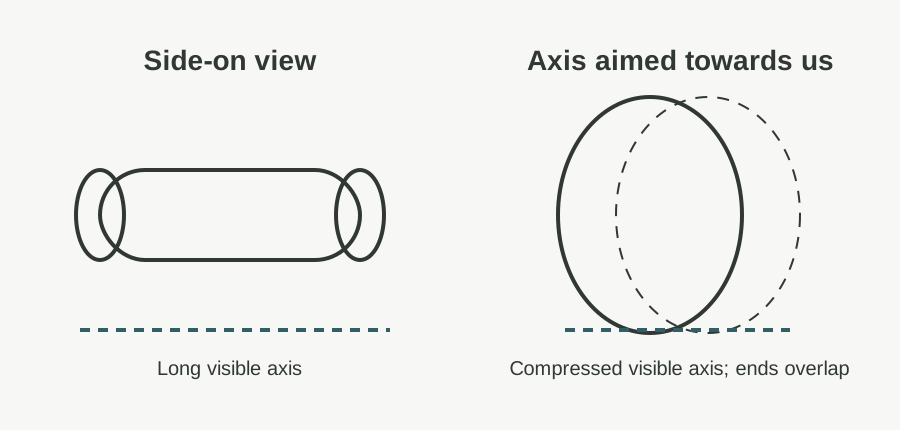
Imagine a cylinder. Seen broadside, its long axis is fully visible and its circular ends appear narrow. Aim that axis towards the eye and the visible length contracts; the near end enlarges and overlaps the farther end. A human limb is more complex, but the same questions help: which segment points through depth, which joint covers another, and where do cross-sections turn?
The diagram compares those conditions without proposing a drawing recipe. At left, the cylinder's long side remains exposed. At right, overlapping ellipses compress the dashed depth axis. Labels, overlap, line weight, and ellipse placement carry the distinction without relying on colour. In artworks, modelling, contour, light, and the surrounding body or architecture provide additional evidence.[2]
Side-on and end-on
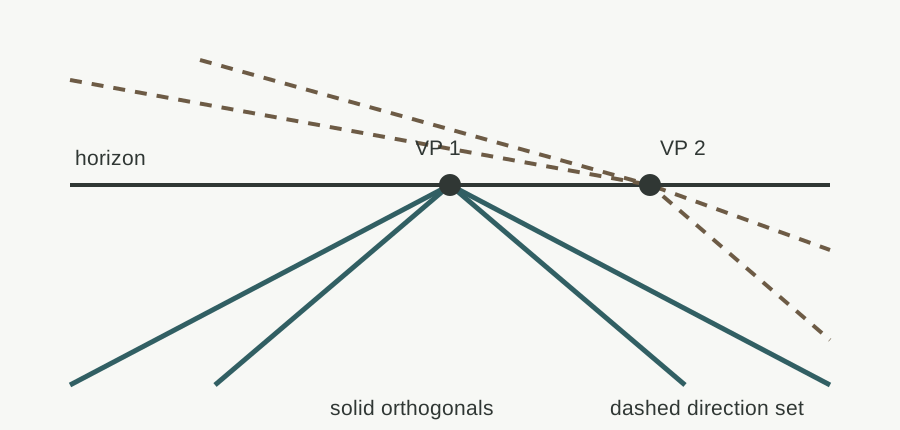
Foreshortening changes appearance relative to the observer, not the represented object's actual dimensions. It may work alongside linear convergence, but it is not the same system: linear perspective coordinates parallel edges across a scene, while foreshortening describes the projected length and cross-sections of an individual form.
Eight examples of foreshortening
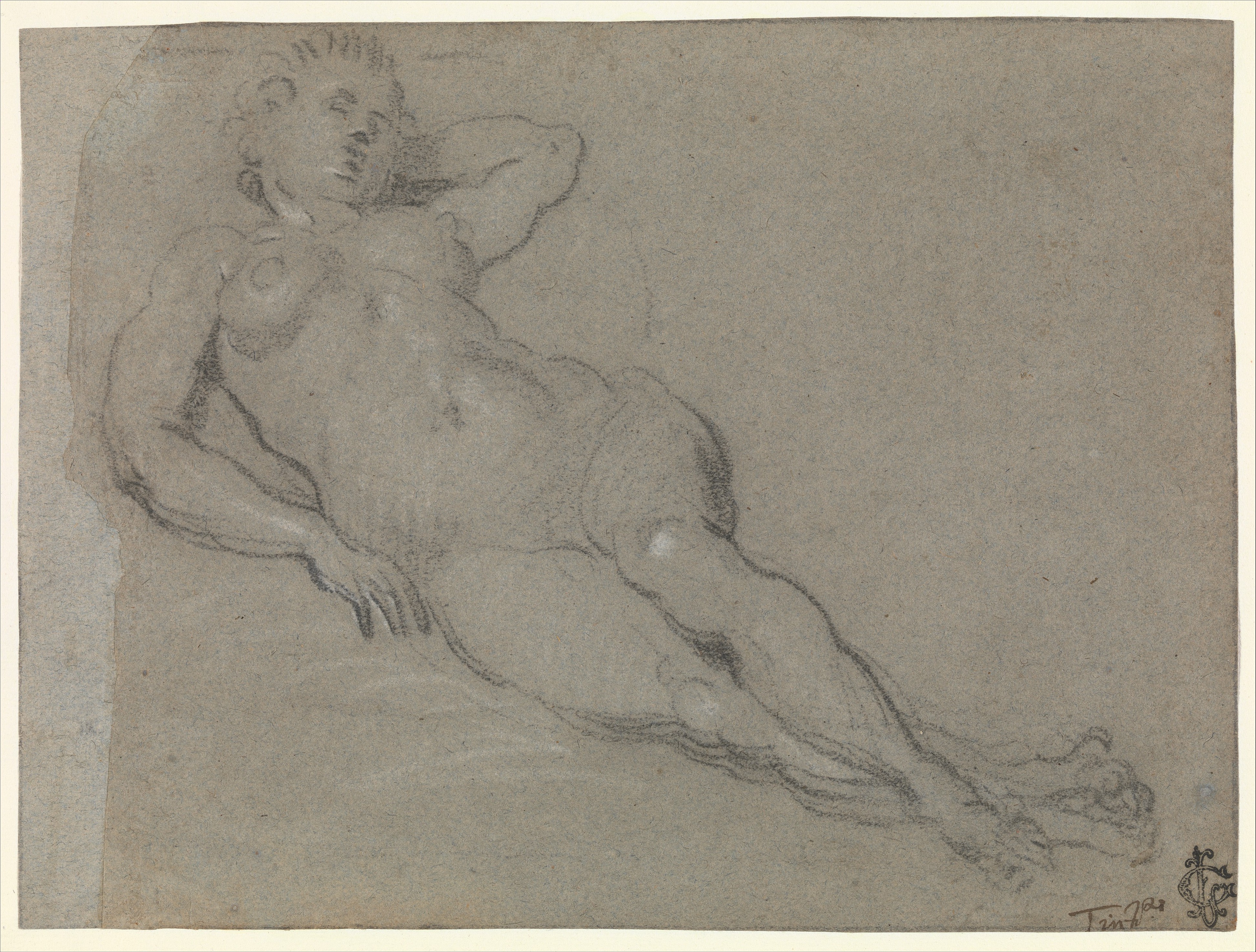
Domenico Tintoretto — Reclining Female Nude
Domenico Tintoretto's early-seventeenth-century chalk study turns a reclining figure through depth. The nearer legs overlap the torso, contours compress, and black and white chalk model volumes that would be hard to understand from outline alone.[5] The Met relates this sheet to a series of heavily foreshortened nudes drawn from live models.
The pose feels observed rather than engineered. Small adjustments in the shoulders, hips, knees, and feet establish a chain of turns. Foreshortening is therefore not one isolated trick at an extremity; it coordinates the body from near to far and makes weight plausible on the support.
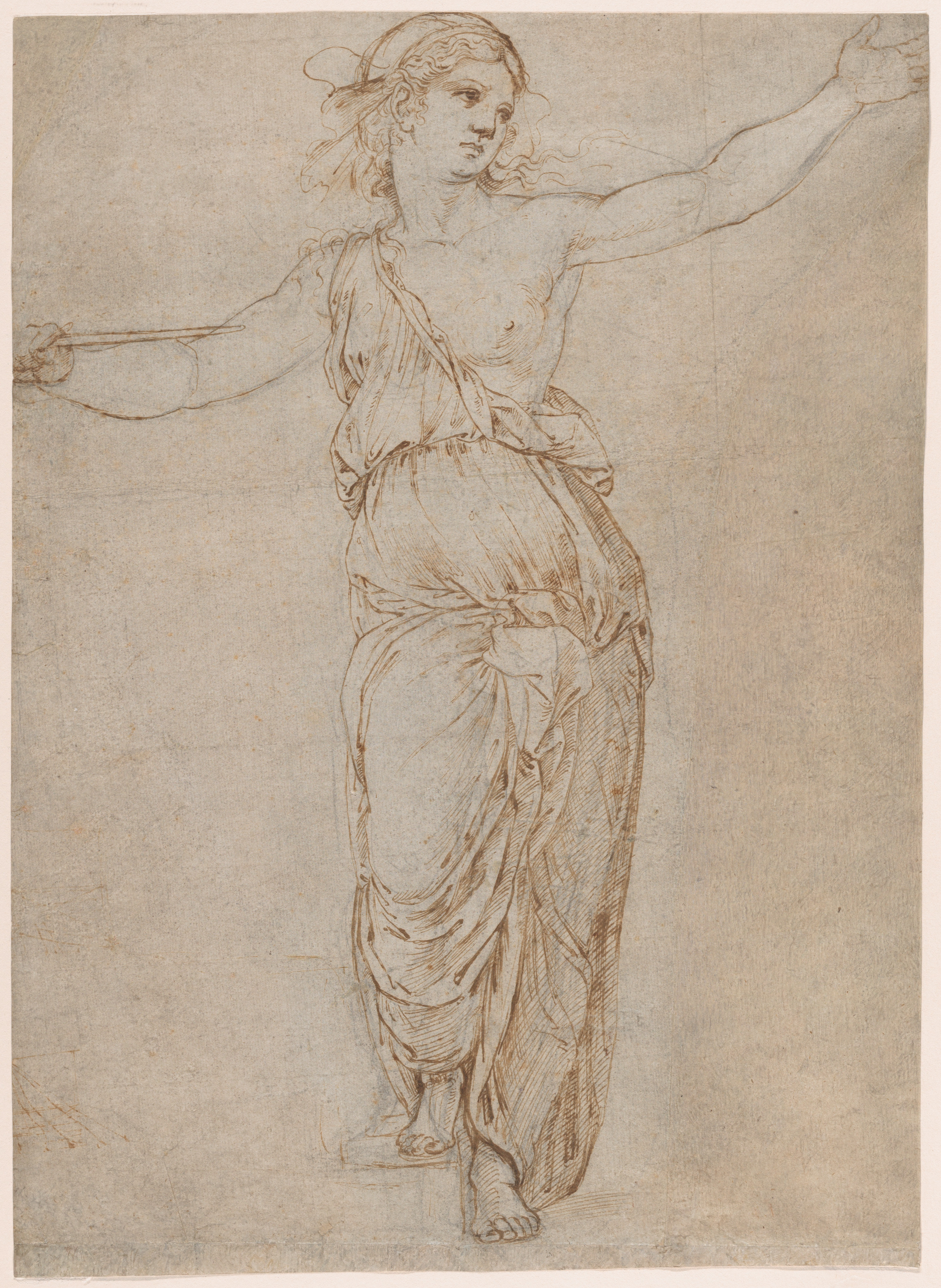
Raphael — Lucretia
Raphael's Lucretia of 1508–10 is upright, yet the figure is not presented as a flat frontal diagram. The head turns and is viewed slightly from below, while shoulders, arms, and drapery occupy different directions through space.[6] The Met associates the head's angle with a sotto in sù—from-below—view.
This restrained example matters because foreshortening need not involve enormous hands or feet. A modest shift in viewpoint can shorten facial planes, change the relation of chin to neck, and make the upper body rise above us. The effect supports Lucretia's monumentality without overwhelming the figure's gesture.
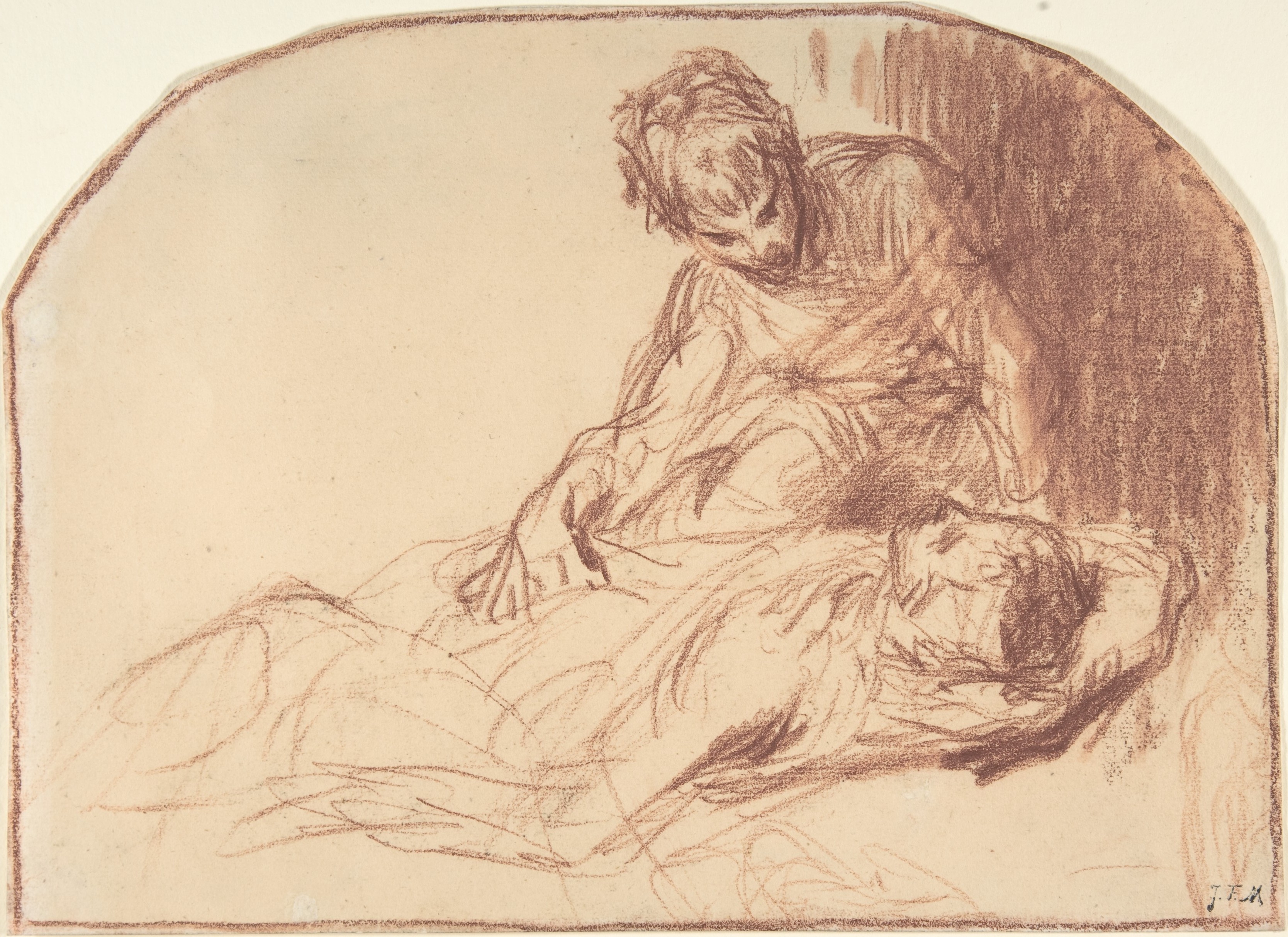
Jean-François Millet — A Young Man Seated, Bent over a Reclining Figure
Millet's red-chalk sheet of about 1845–50 puts one young man bending over another who reclines across the page.[7] Knees, arms, shoulders, and torsos overlap in a compact knot. Parts aimed away from us lose visible length while the surrounding contours and shadows clarify which body passes in front.
Because two figures interlock, foreshortening also becomes compositional. The bent man's curved back and the reclining body's lateral direction hold the group together. The sheet shows how artists can test spatial relationships rapidly in drawing, where a few reinforced edges or patches of tone must make complicated turns legible.
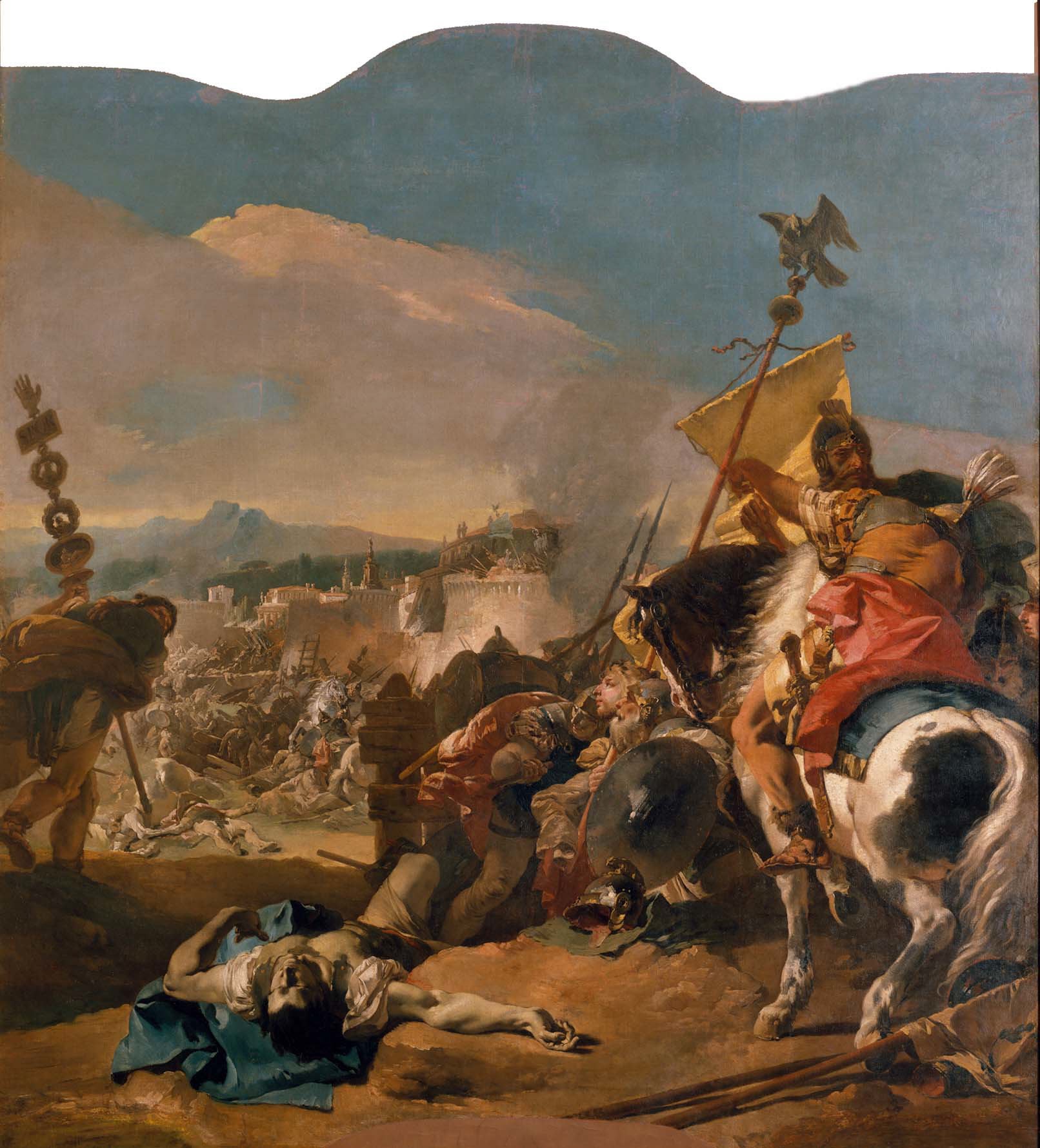
Giovanni Battista Tiepolo — The Capture of Carthage
Tiepolo's vast Capture of Carthage of 1725–29 fills the foreground with bodies, weapons, standards, and fragments of architecture. The Met draws attention to the fallen figure and to a man tipping his standard away from the viewer as instances of daring foreshortening.[8]
Those directions intensify the battle. Instead of arranging every figure parallel to the canvas, Tiepolo sends bodies and objects into and out of depth. Compression makes actions feel sudden and prevents the foreground from becoming a decorative row. Scale, overlap, and tilted axes turn spatial difficulty into narrative pressure.
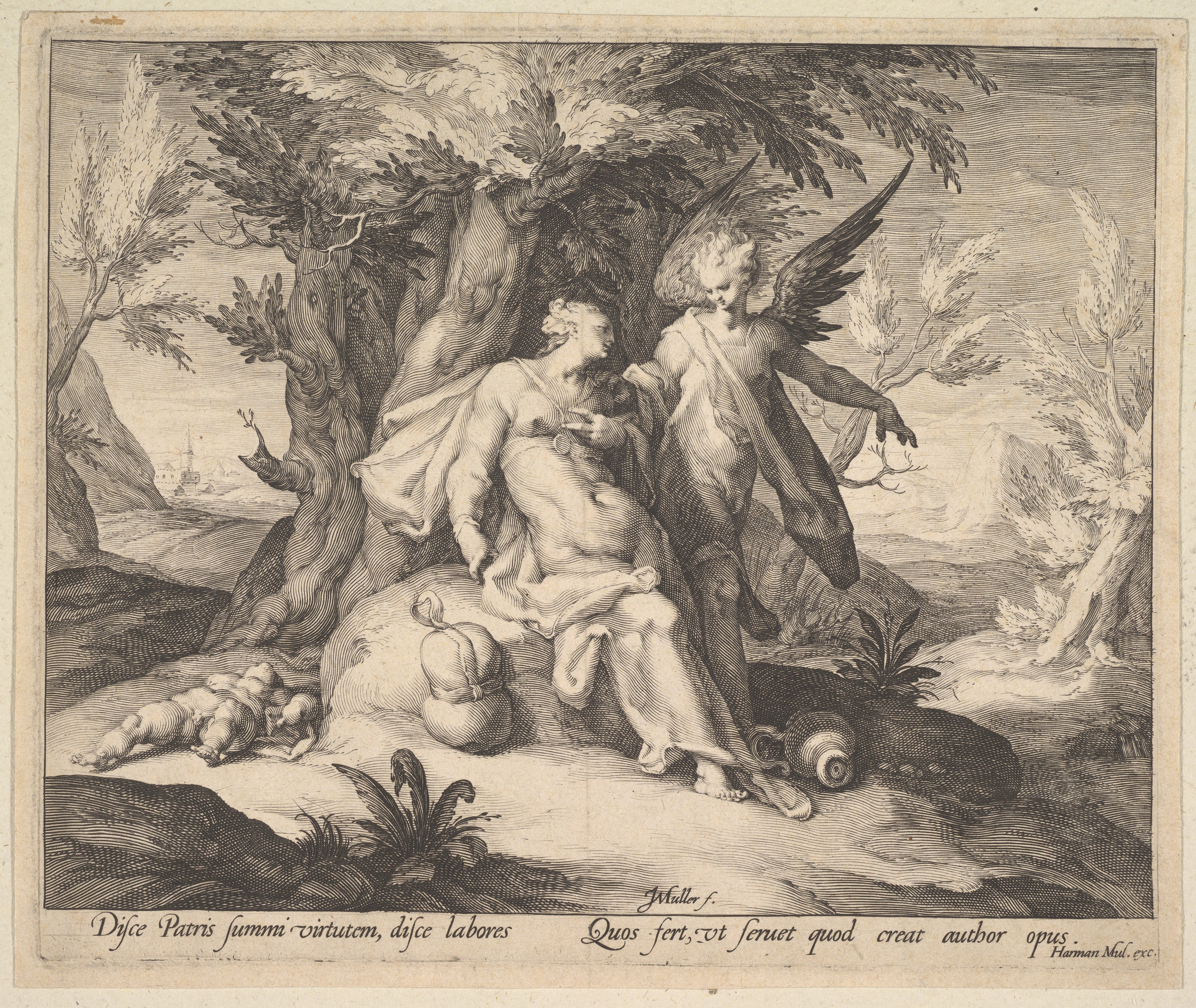
Jan Muller — Hagar in the Desert Consoled by an Angel
Jan Muller's 1591 engraving surrounds Hagar, Ishmael, and an angel with swirling trees and richly varied lines. The Met identifies Ishmael's pose as foreshortened and characteristic of Northern Mannerist display.[9] His body turns away from an easy side view, requiring contour and hatching to distinguish compressed parts.
Engraving makes the achievement particularly visible. Swelling and tapering lines describe muscle and shadow while remaining marks on paper. The pose creates depth, but it also lets Muller demonstrate how line alone can articulate a body whose lengths are partly hidden by its direction.
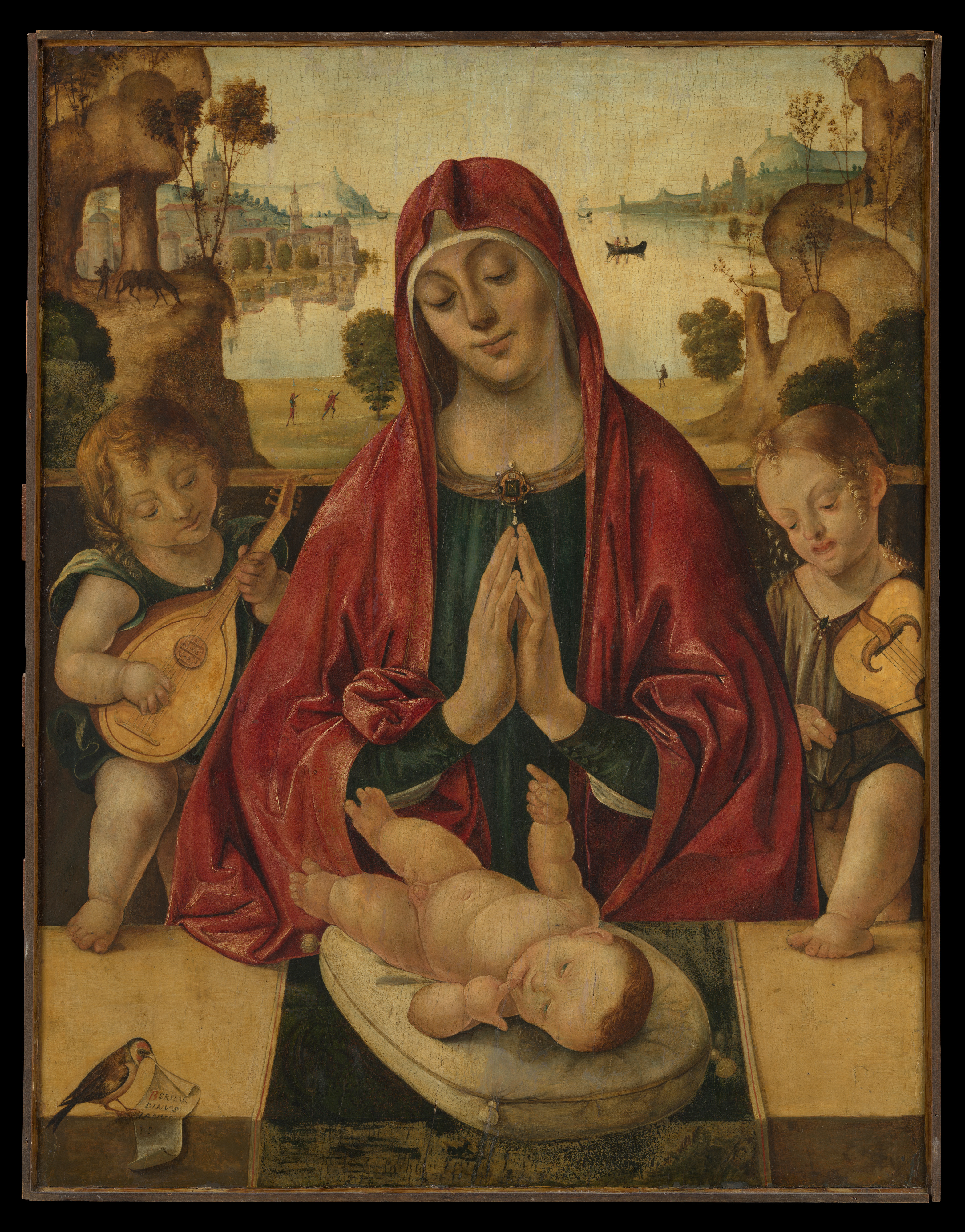
Bernardino da Genoa — Madonna and Child with Angels
In Bernardino da Genoa's Madonna and Child with Angels of 1515, the Christ Child lies across the Virgin rather than sitting upright. The Met calls the figure audaciously foreshortened.[10] Torso and limbs turn through a shallow but emphatic depth, and overlaps prevent the infant from reading as a flat emblem.
The compression serves intimacy and theological presentation at once. The Child's body occupies the foreground, close to the picture surface, while surrounding faces and hands form a protective frame. Foreshortening makes the small body physically immediate without requiring a deep architectural setting.
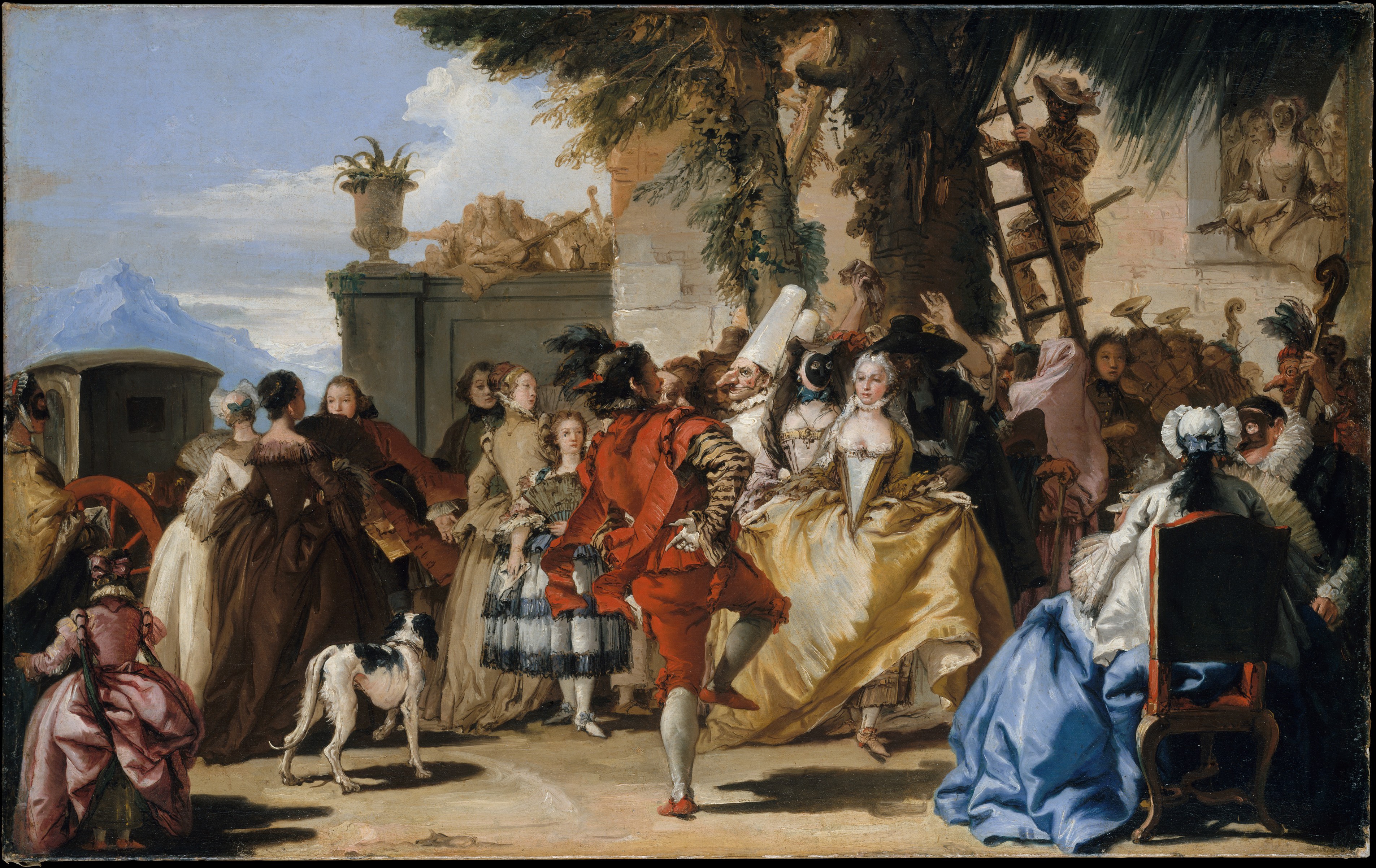
Giovanni Domenico Tiepolo — A Dance in the Country
Giovanni Domenico Tiepolo's A Dance in the Country, about 1755, uses foreshortening playfully. The central Mezzetin balances on one leg and points an elbow towards the viewer; at right a chair turns away at an unexpected angle.[11] Human and object axes disturb the procession across the canvas.
The effect is comic and animated rather than solemn. A projected elbow can briefly become a focal accent, while the rotated chair makes the ground plane more active. The example demonstrates that foreshortening applies beyond heroic anatomy: furniture, tools, and ordinary gestures can all carry direction through depth.
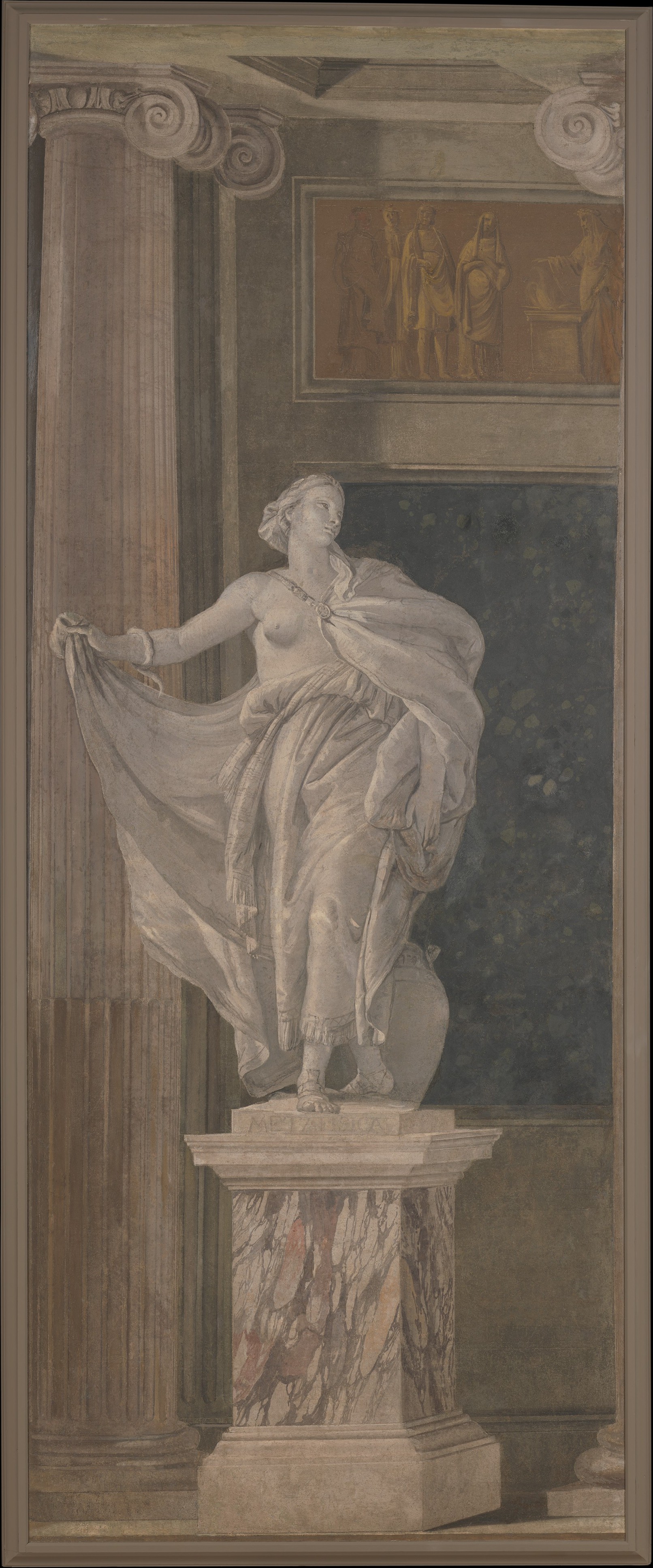
Giovanni Battista Tiepolo and Girolamo Mengozzi — Allegorical Figure Representing Metaphysics
This 1760 fresco fragment once belonged to an immersive room in Vicenza. The painted sculpture and architecture were designed to align for a viewer standing near the room's centre. The Met records that Tiepolo consulted the perspective specialist Girolamo Mengozzi so the foreshortened scheme would work from that site-specific position.[12]
The example makes viewpoint unavoidable. Removed to a museum wall, the fragment remains intelligible, but its original illusion depended on where a real body stood beneath and among the decorations. Such di sotto in sù painting could make figures and ledges appear to project above the spectator.[13] Foreshortening here links represented form to architecture and movement through an actual room.
History and uses
Artists compressed forms in ancient and medieval images, but renewed study of perspective and the body made foreshortening especially prominent in Renaissance Italy.[4] It became central to reclining figures, battle scenes, dramatic gestures, and illusionistic ceilings. This was not a simple march towards correctness: artists selected degrees of compression for clarity, decorum, visual force, and the expected viewing location.
The National Gallery names Uccello's fallen knight in The Battle of San Romano and the disciple's projecting arm in Caravaggio's Supper at Emmaus as notable examples.[1][3] The first turns a body into a strong ground-plane axis; the second pushes gesture towards the viewer. Later ceiling painters multiplied from-below figures, while printmakers and draughtsmen explored the problem in portable media. Modern photography, film, comics, and illustration continue to exploit the same relationship between viewpoint and projected length.
Renaissance teaching resources likewise connect foreshortened ceiling figures with the illusion that painted forms occupy space above the spectator, confirming how closely the device can depend on an intended physical viewing position.[4]
How to recognise foreshortening
Ask which form points through depth. Does a limb seem shorter because one joint overlaps another? Is a near end larger or more exposed than a far end? Do circular cross-sections change shape as the axis turns? Is the viewer implied to be above, below, or directly in front of the form? These questions are more reliable than judging whether a body looks unusual.
Then compare the form with its context. Modelling, cast shadow, contour interruption, and the scale of neighbouring parts may confirm the turn. Strong compression without enough supporting cues can look ambiguous, but ambiguity may itself be expressive. Finally ask what the viewpoint accomplishes: intimacy in Bernardino, kinetic conflict in Tiepolo, observational testing in Tintoretto, or site-specific illusion in the fresco fragment.
Foreshortening belongs within the larger family described on the Perspective in Art page. It can cooperate with overlap, relative scale, and linear or atmospheric systems, yet its distinctive job remains local and directional: making a form aimed through depth intelligible on a surface.
Explore perspective in art
All seven evidence-checked guides are available in this local perspective group.
Watch Foreshortening Move from Perception to Drawing
Choose a concise definition, an anatomy-focused construction lesson, or a longer practical drawing demonstration.
Art Lesson — What Is Foreshortening?
Begin with a compact account of why forms look shorter as they point towards or away from the viewer.
Watch on YouTubeFrequently Asked Questions
Foreshortening is the apparent shortening of a represented form as its main axis points towards or away from the viewer.
It belongs to the wider problem of representing depth, but it describes the projected appearance of an individual form rather than a whole linear grid.
A hand placed close to the implied viewpoint may occupy more of the picture than the arm or torso behind it, while overlap reinforces the direction through space.
Yes. Furniture, weapons, architectural elements, cylinders and almost any solid form can appear compressed when directed through depth.
Not always. Artists may measure, observe from life or adjust the projection for clarity and expression, provided the spatial relationships remain persuasive for the intended image.
Discussion
Which example makes a body or object project most strongly towards you—and which uses quieter compression to support weight, intimacy or site-specific illusion?
Reader Insights
Identify the direction that points towards or away from the viewer before judging whether the visible length is compressed.
Contour interruptions and changing cross-sections often explain a difficult pose more clearly than outline length alone.
Ask whether the projection creates intimacy, force, instability, monumentality or a convincing relationship with an actual room.
Join the Conversation
Share one precise observation or a useful museum example below.
References
- National Gallery, London, “Foreshorten,” glossary. https://www.nationalgallery.org.uk/paintings/glossary/foreshorten
- Ashmolean Museum, Focus on Perspective in Art: Teacher Notes. https://www.ashmolean.org/sites/default/files/ashmolean/documents/media/focus_on_perspective_in_art_teacher_notes.pdf
- National Gallery, London, “The Supper at Emmaus.” https://www.nationalgallery.org.uk/paintings/michelangelo-merisi-da-caravaggio-the-supper-at-emmaus
- National Gallery of Art, The Inquiring Eye: European Renaissance Art, Part Two. https://www.nga.gov/sites/default/files/migrate_images/content/dam/ngaweb/education/learning-resources/teaching-packets/pdfs/european-renaissance-art-tp2.pdf
- The Metropolitan Museum of Art, “Reclining Female Nude,” object 459448. https://www.metmuseum.org/art/collection/search/459448
- The Metropolitan Museum of Art, “Lucretia,” object 337075. https://www.metmuseum.org/art/collection/search/337075
- The Metropolitan Museum of Art, “A Young Man Seated, Bent over a Reclining Figure,” object 359619. https://www.metmuseum.org/art/collection/search/359619
- The Metropolitan Museum of Art, “The Capture of Carthage,” object 437795. https://www.metmuseum.org/art/collection/search/437795
- The Metropolitan Museum of Art, “Hagar in the Desert Consoled by an Angel,” object 374015. https://www.metmuseum.org/art/collection/search/374015
- The Metropolitan Museum of Art, “Madonna and Child with Angels,” object 435659. https://www.metmuseum.org/art/collection/search/435659
- The Metropolitan Museum of Art, “A Dance in the Country,” object 437812. https://www.metmuseum.org/art/collection/search/437812
- The Metropolitan Museum of Art, “Allegorical Figure Representing Metaphysics,” object 437801. https://www.metmuseum.org/art/collection/search/437801
- The Metropolitan Museum of Art, Looking to Connect with European Paintings, “Upward space.” https://resources.metmuseum.org/resources/metpublications/pdf/looking_to_connect_with_european_paintings_visual_approaches_for_teaching_in_the_galleries.pdf