by Tom Gurney
Tom Gurney BSc (Hons) is an art history expert with over 20 years experience
Page created on September 3, 2026 / Page updated on September 13, 2026
Email: tomgurney1@gmail.com / Phone: +44 7429 011000
How Converging Lines Turn a Flat Surface into Organised Space
Linear perspective is a family of systems that uses the apparent convergence of receding parallel lines to organise three-dimensional space on a flat surface.[1] It establishes a relationship among a viewer, a picture plane, and represented directions. The system can make a room seem to continue behind a wall, coordinate figures across a plaza, or deliberately unsettle orientation when several plausible structures conflict.
The best-known version described by Leon Battista Alberti in 1435 gathers receding parallels towards a point on the horizon.[1][2] That account is historically important, but linear perspective is neither the whole of perspective nor a universal test of artistic advancement. Aerial perspective primarily changes tone and colour; foreshortening compresses individual forms; many traditions organise coherent space through overlap, scale, oblique projection, or patterned intervals.[12]
At a Glance
- Core relationshipa fixed viewpoint, picture plane and represented directions.
- Main clueshorizon, vanishing points, orthogonals and diminishing intervals.
- One-pointone dominant set of receding parallels converges on one point.
- Two-pointtwo horizontal direction sets converge towards separate points.
- Important limitlinear perspective is one spatial language, not a universal measure of realism.
Contents
The geometric vocabulary
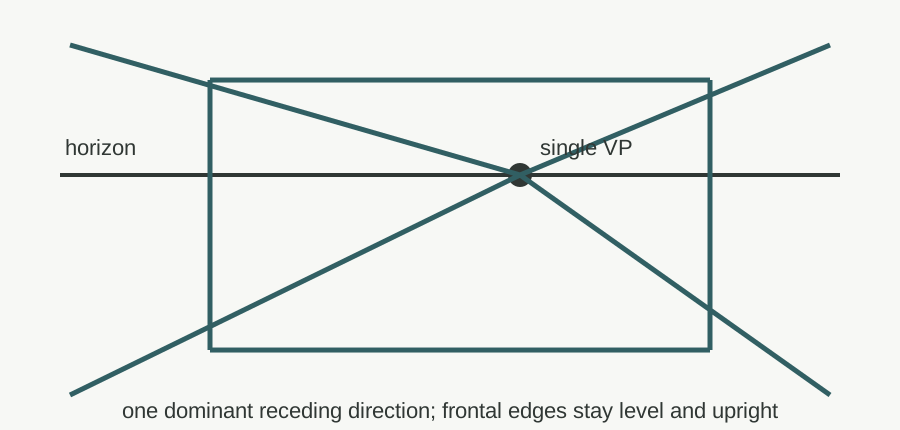
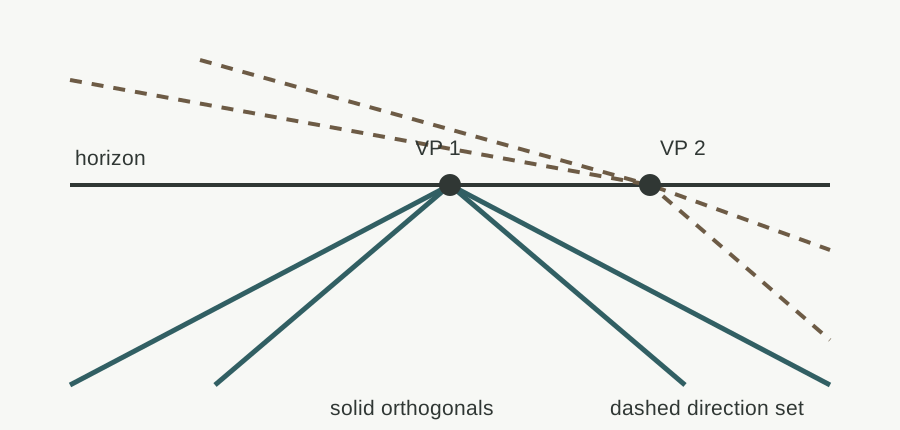
The horizon corresponds to the viewer's eye level in the represented scene. A vanishing point is where one set of receding parallel directions appears to meet. Orthogonals are the represented edges that run away from the viewer towards such a point. Transversals cross them and can help establish repeated intervals. These are analytical terms: an artist need not draw a literal horizon or leave construction lines visible.
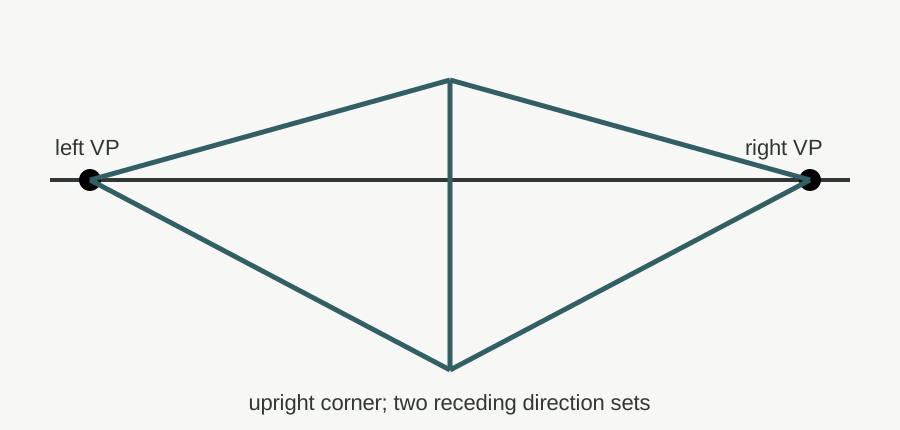
The diagram above separates two direction sets. Solid lines converge on one point; dashed lines aim towards a second point on the same horizon. A scene dominated by the first can be described through one-point organisation, while a turned object or street corner often needs a second direction. Those subtypes receive separate guides; here the important principle is that parallel directions in represented space acquire organised convergence on the picture plane.
Horizon, points, and direction sets
The diagram above is intentionally spare. Real paintings contain irregular buildings, curved bodies, altered measurements, and edges that do not belong to either direction set. A vanishing point is not automatically the narrative focal point, and not every diagonal is an orthogonal.
Eight works and boundary cases
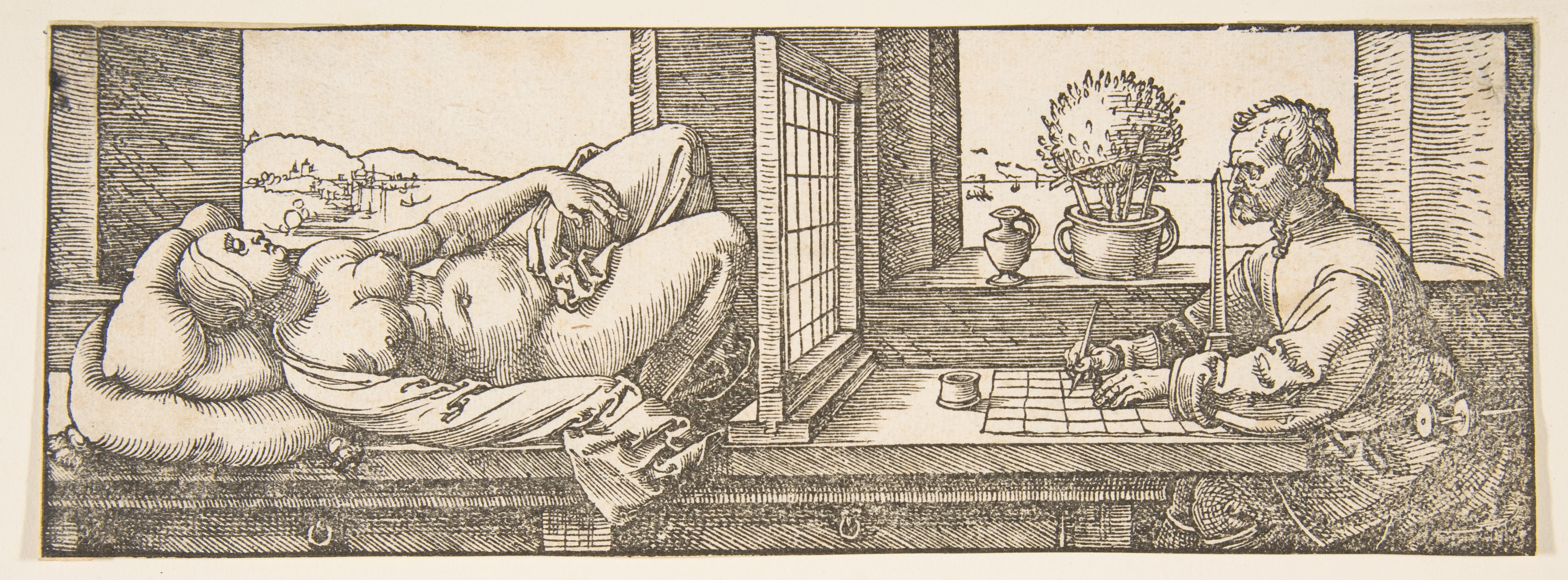
Albrecht Dürer — Draughtsman Making a Perspective Drawing of a Reclining Woman
Dürer's woodcut shows an observer looking through a grid towards a model while transferring the view onto paper.[4] The fixed eye, intervening plane, and measured correspondence make the viewing geometry visible. It does not prove that every artist used this apparatus; it records one method for stabilising projection.
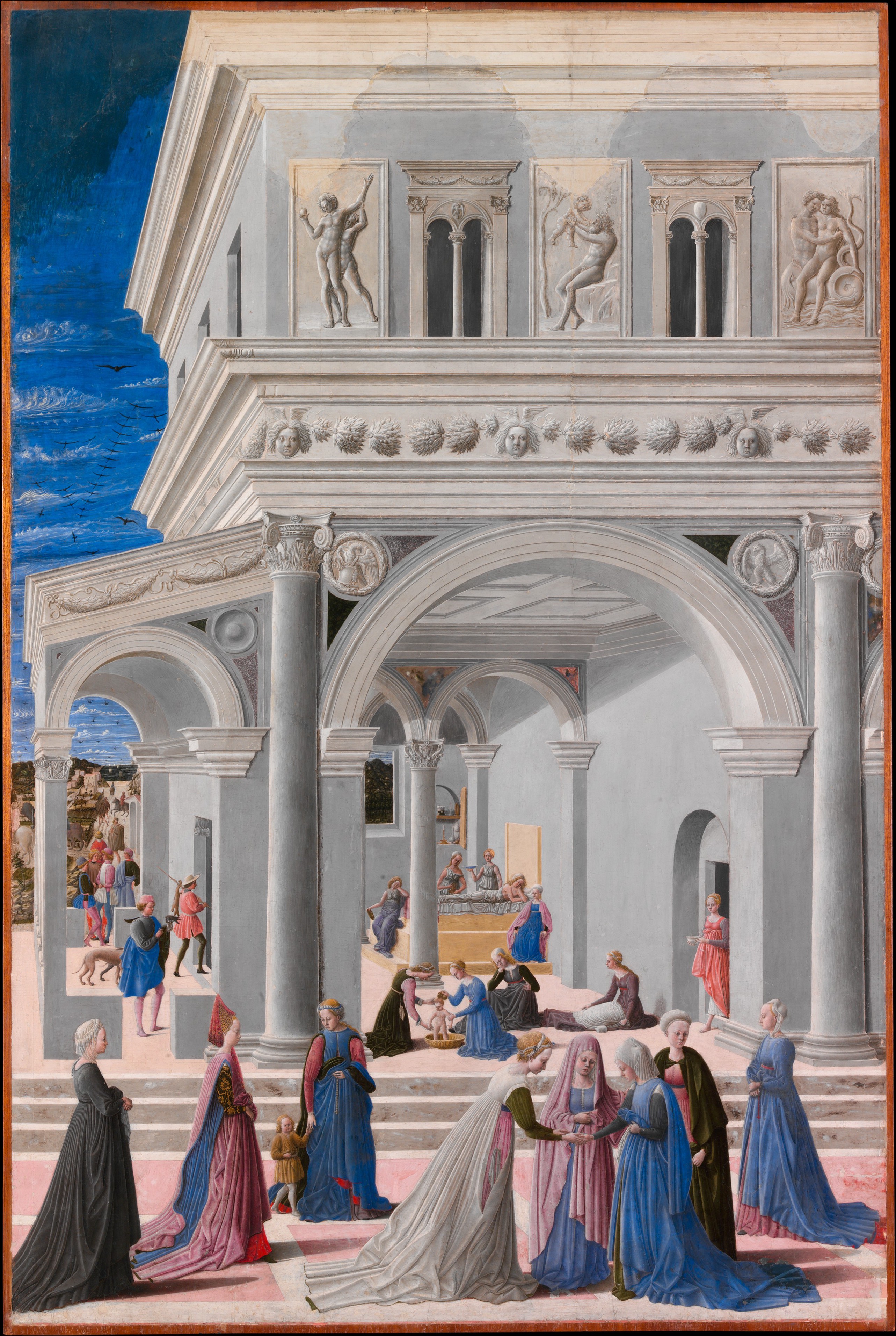
Fra Carnevale — The Birth of the Virgin
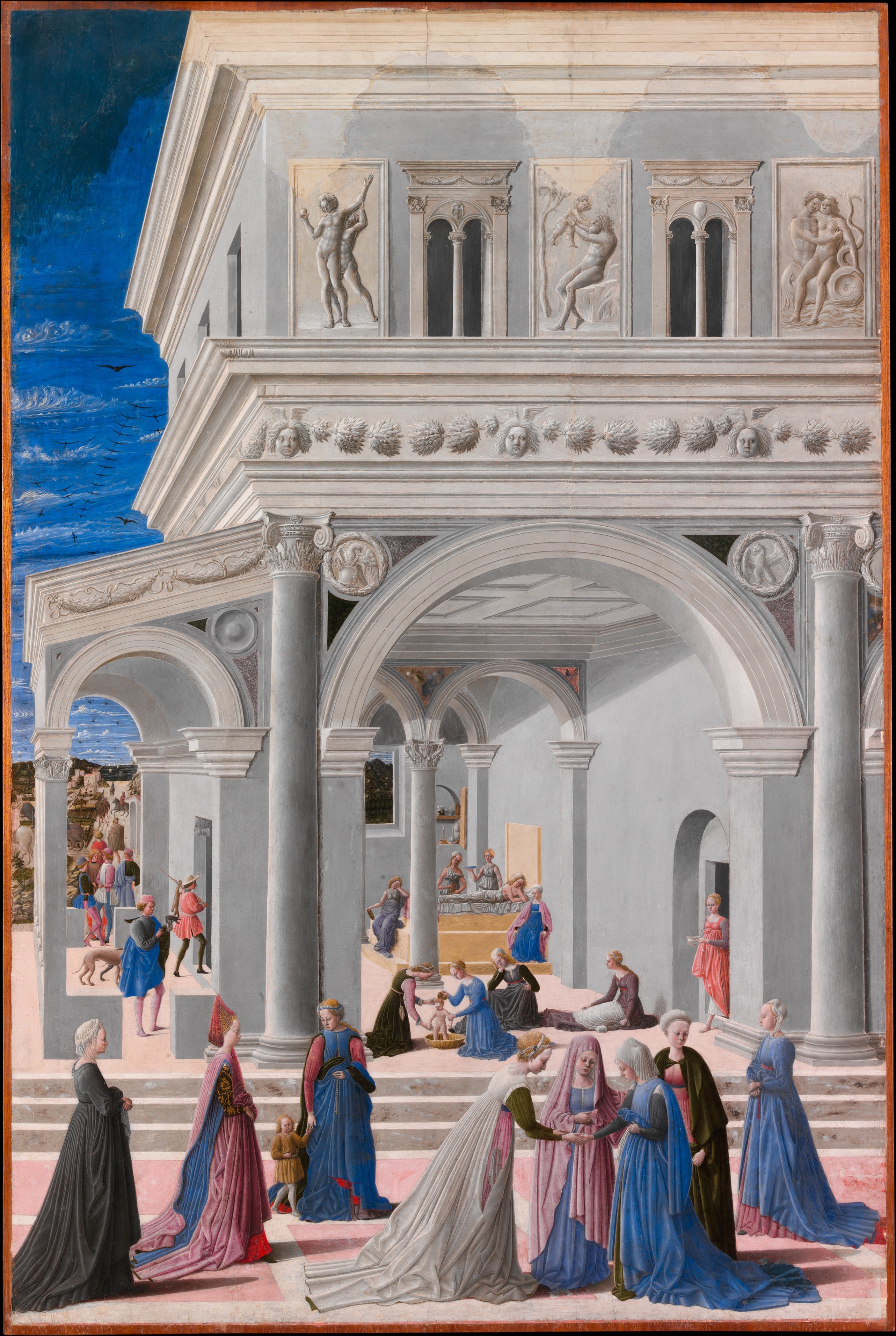
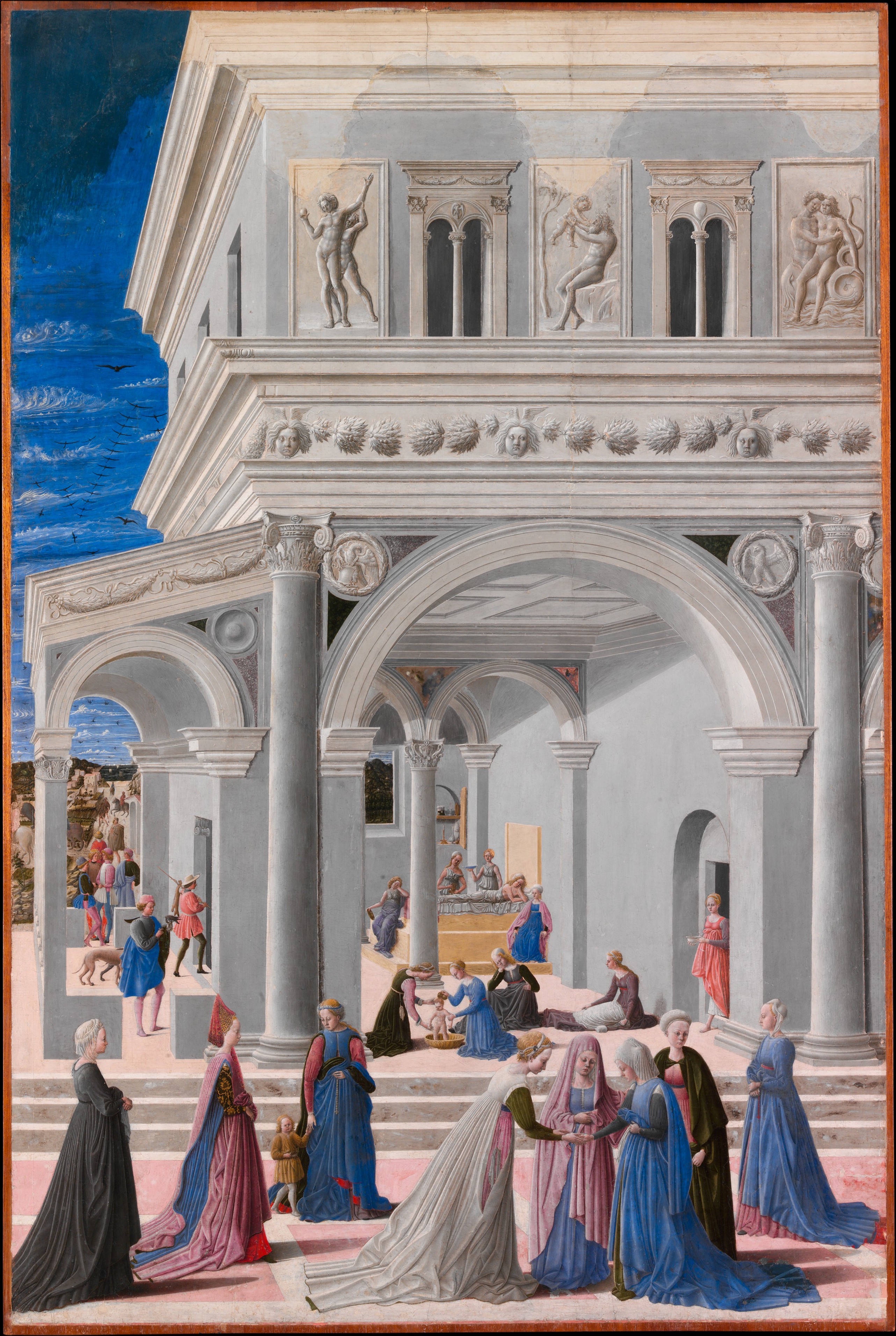
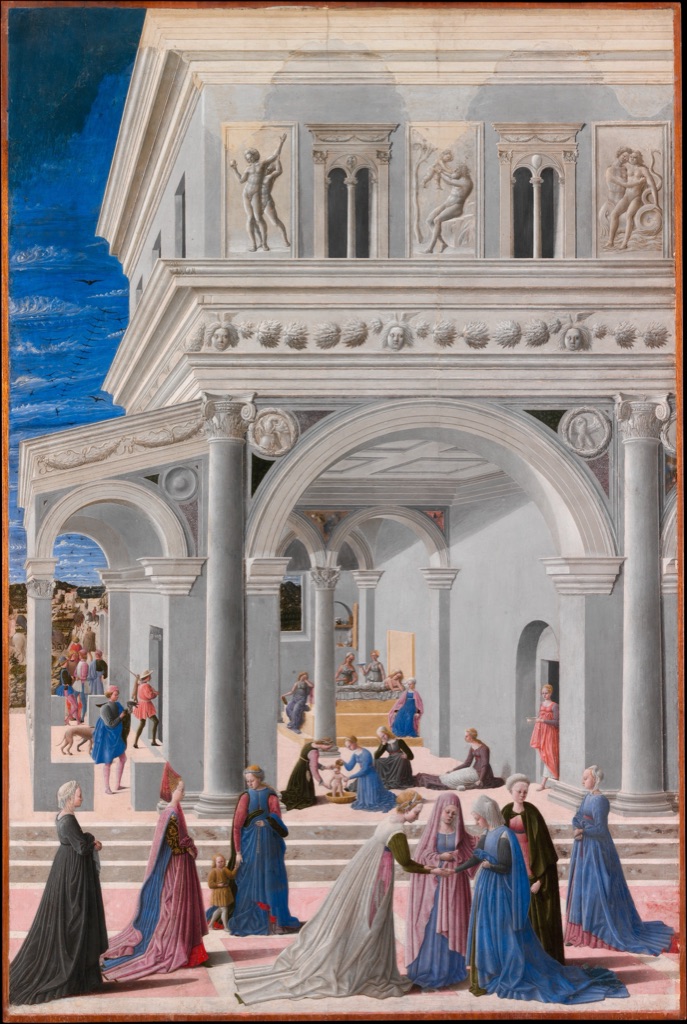
Fra Carnevale's 1467 palace interior coordinates tiles, cornices, arches, and openings into a deep architectural field.[5] Converging edges and diminishing figures bind several narrative incidents to shared ground. The geometry guides attention without making every visible line point to one centre.
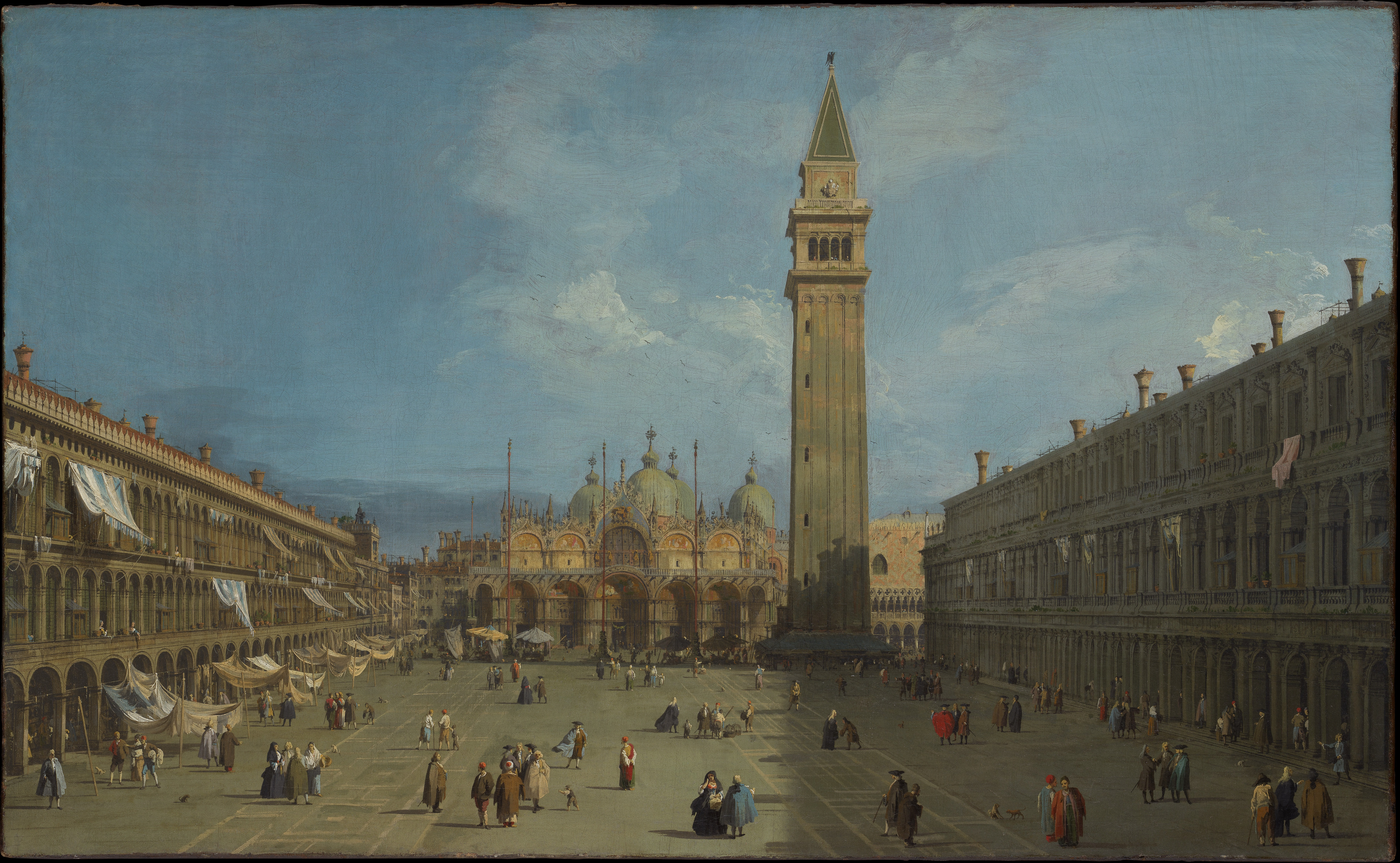
Canaletto — Piazza San Marco
Canaletto's late-1720s Venetian square uses long arcades, paving intervals, and diminishing crowds to make civic space navigable.[6] Several building orientations coexist, so analysis requires grouping edges that would actually be parallel. The work demonstrates that linear perspective can remain precise without looking like a bare diagram.
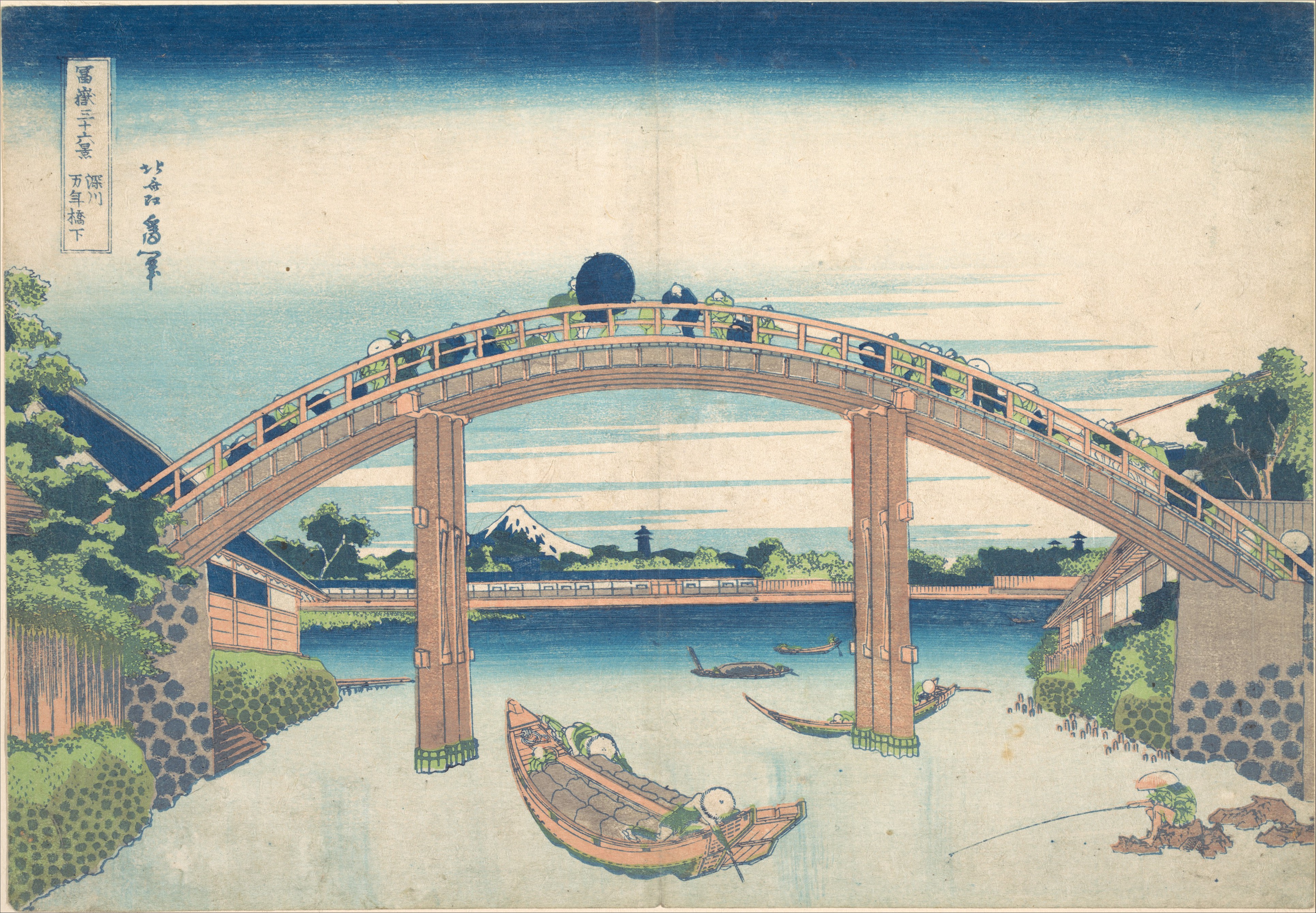
Katsushika Hokusai — Under the Mannen Bridge at Fukagawa
Hokusai's print of about 1830–32 combines an arched bridge, oblique supports, a boat, banks, and distant Fuji.[7] Imported geometric conventions interact with cropping, flat colour, overlap, and scale. The result should not be forced into one Western grid: linear cues are transformed within the woodblock design.
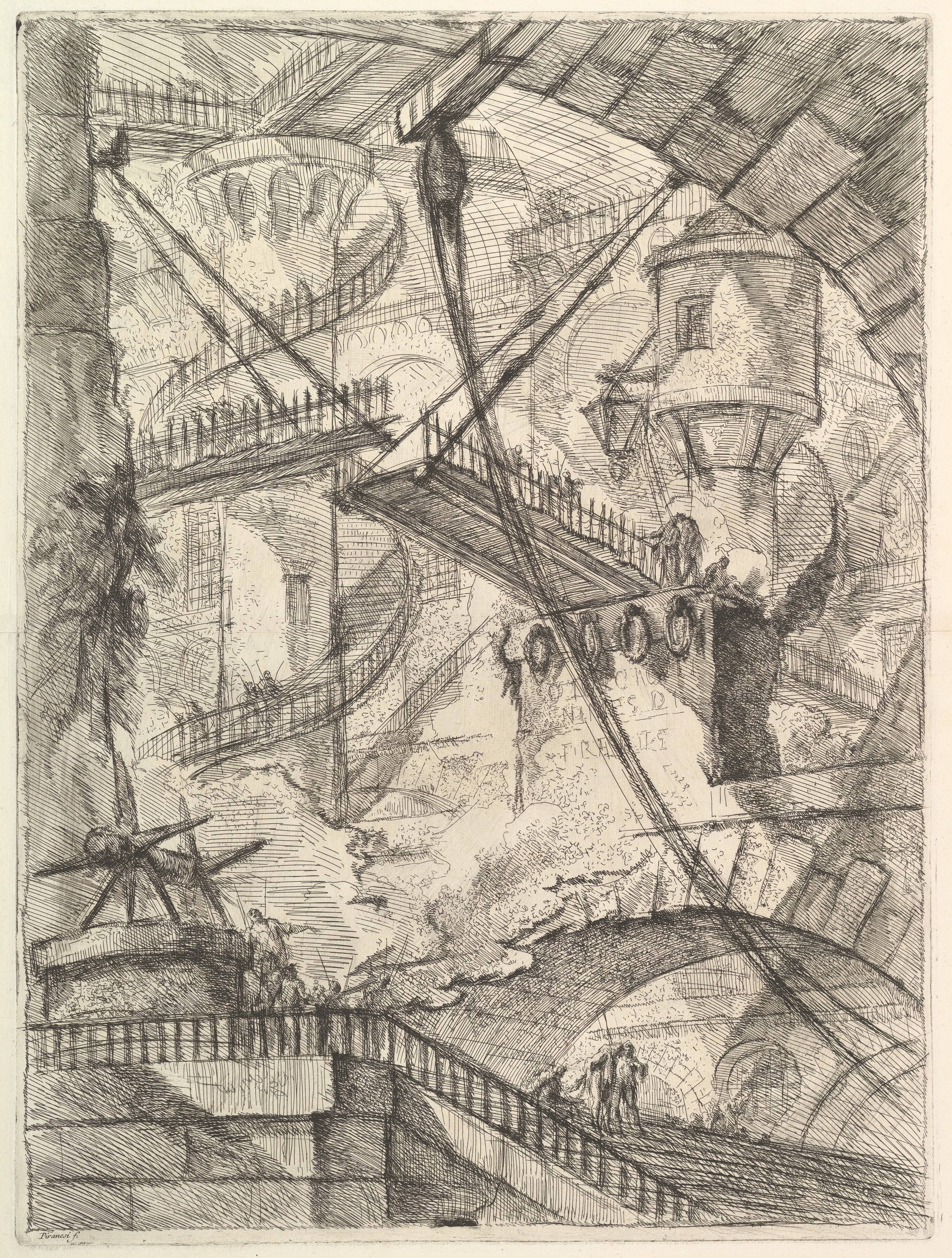
Giovanni Battista Piranesi — The Drawbridge
Piranesi fills The Drawbridge with stairs, platforms, arches, and bridges that each promise spatial order.[8] Yet routes disappear and direction sets compete. Strong linear cues can therefore create instability as well as clarity; perspective becomes the means by which orientation is repeatedly offered and frustrated.
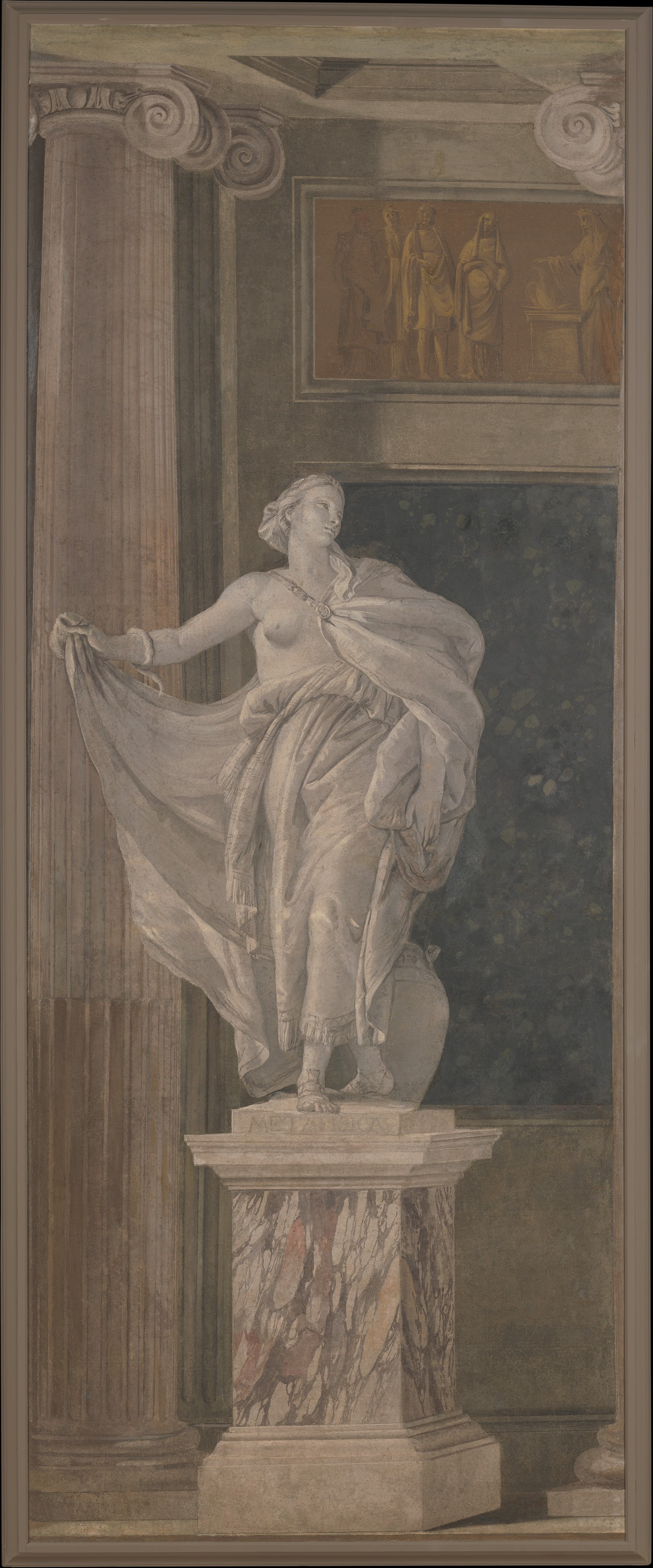
Giovanni Battista Tiepolo and Girolamo Mengozzi — Allegorical Figure Representing Metaphysics
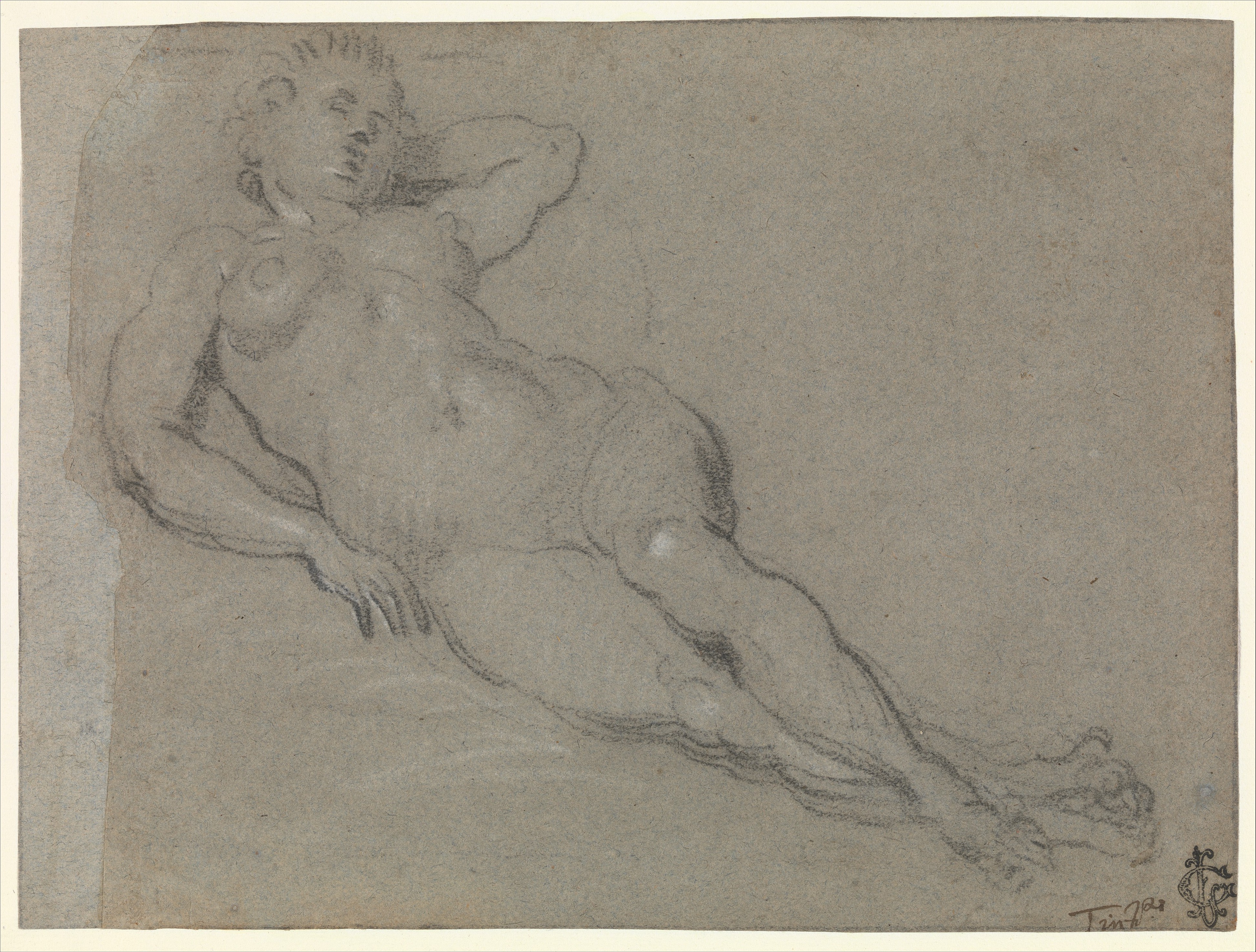
This detached 1760 fresco fragment belonged to a room whose painted architecture and sculpture were aligned for a viewer near its centre.[9] The Met records Tiepolo's collaboration with perspective specialist Girolamo Mengozzi. Linear construction here is site-specific: it joins a fictive structure to the geometry of a real room.
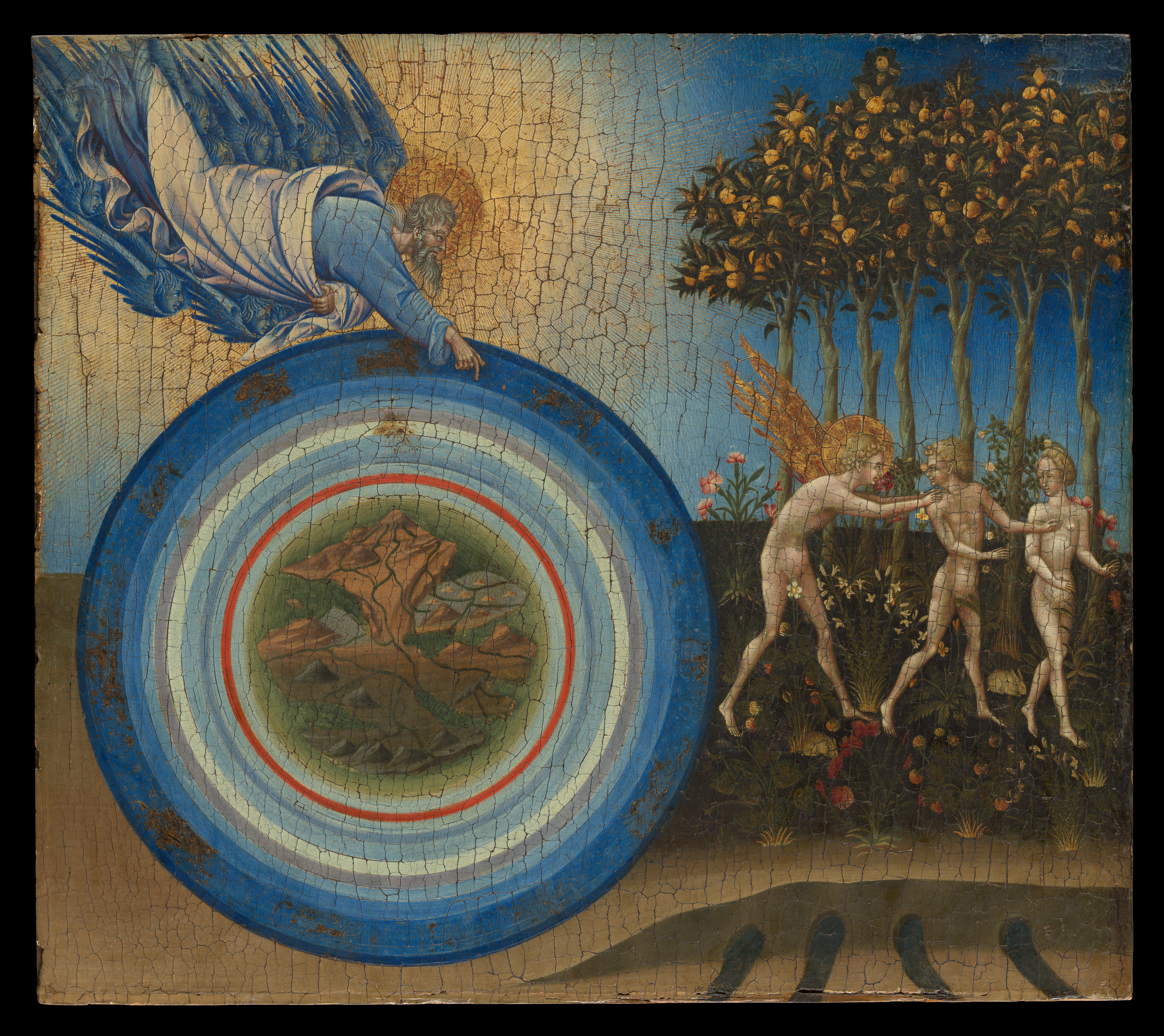
Giovanni di Paolo — The Creation of the World and the Expulsion from Paradise
Giovanni di Paolo's 1445 panel is a deliberate boundary case. Concentric cosmic zones, gold ground, repeated trees, and lateral narrative sequence create a precise order without one continuous optical viewpoint.[10] Its coherence warns against judging all images by Florentine convergence alone.
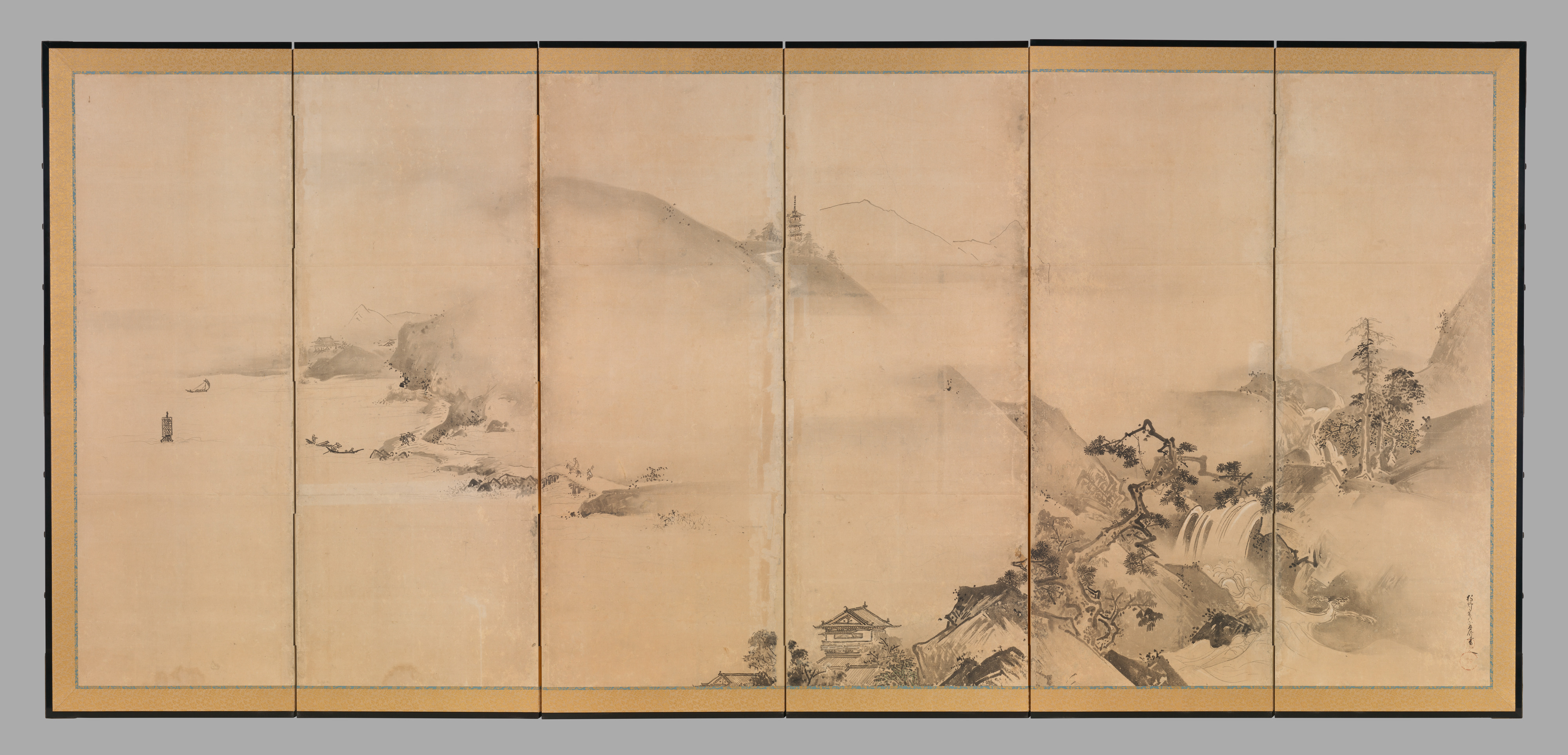
Kanō Tan'yū — Landscapes of the Four Seasons
Kanō Tan'yū's 1630s screens organise shores, mountains, buildings, and boats through overlap, ink value, scale, and open intervals.[11] Their folding support and shifting clusters resist a single window-like view. The screens show why linear perspective is one powerful spatial language among several, not a synonym for space itself.
From Renaissance codification to later use
Techniques for representing depth existed long before fifteenth-century Florence. What changed there was the development and circulation of a mathematically repeatable system linked to a fixed viewer and picture plane. Brunelleschi's celebrated experiments and Alberti's De pictura belong to this history; museum teaching resources show how artists applied measured recession to architecture and narrative.[2][3]
Prints, treatises, workshop practice, and portable instruments helped perspective travel. Painters of churches and cities coordinated increasingly complicated interiors; stage designers and ceiling painters adapted projection to moving viewers and architectural sites. Artists elsewhere selected, transformed, or combined European systems with existing conventions. Modern artists could expose, multiply, or break vanishing structures rather than simply abandon them.
How to recognise linear perspective
Begin with repeated straight edges: paving joints, beams, cornices, shelves, or road boundaries. Group only those that could be parallel in the represented world, then extend their apparent direction mentally. Where would each group meet? Does that point align with the implied eye level? Do repeated intervals shrink consistently?
Next test the explanation against other cues. Overlap and scale may produce depth even where no line converges. Atmospheric change may carry distant landscape. A figure can be foreshortened inside a linearly organised room. Finally ask what the construction accomplishes: stable passage through Fra Carnevale's palace, civic breadth in Canaletto, transformed graphic space in Hokusai, or anxiety in Piranesi.
The Perspective in Art overview places these systems within the broader family, while Aerial Perspective and Foreshortening isolate neighbouring cue types. Linear perspective is most useful when treated as a relationship among viewpoint, surface, and direction—not as a correctness score.
Explore perspective in art
All seven evidence-checked guides are available in this local perspective group.
Watch Linear Perspective Take Shape
Choose Brunelleschi's historical experiment, a concise explanation of one-point construction, or a longer drawing demonstration.
Linear Perspective: Brunelleschi's Experiment
See how a fixed viewpoint, mirror and the Florentine Baptistery clarify the relationship among observer, picture plane and projected space.
Watch on YouTubeFrequently Asked Questions
Linear perspective organises represented depth through the apparent convergence of receding parallel directions on a flat picture plane.
No. The horizon is the represented eye level and may be inferred from vanishing relationships even when no line is drawn across the image.
No. An orthogonal represents an edge or direction receding away from the viewer. Decorative or oblique diagonals may serve entirely different roles.
One-point perspective emphasises one receding direction set; two-point perspective commonly describes a turned object or corner through two horizontal direction sets.
No. Fifteenth-century Italian artists codified influential measured systems, but many cultures and periods organised convincing space through other combinations of overlap, scale, projection and viewpoint.
Discussion
Which work on this page uses linear structure most persuasively—and where do overlap, scale, cropping or atmosphere do equally important spatial work?
Reader Insights
Extend only represented edges that could be parallel before deciding whether they share a vanishing point.
A vanishing point can organise space without being the story's narrative or emotional centre.
Coherent space can use overlap, scale and shifting viewpoints without one continuous Western grid.
Join the Conversation
Share one precise observation or a useful museum example below.
References
- National Gallery, London, “Linear perspective.” https://www.nationalgallery.org.uk/paintings/glossary/linear-perspective
- Getty, “The Geometry of Seeing.” https://www.getty.edu/art/exhibitions/geometry/index.html
- The Metropolitan Museum of Art, The Art of Renaissance Europe. https://resources.metmuseum.org/resources/metpublications/pdf/The_Art_of_Renaissance_Europe_A_Resource_for_Educators.pdf
- The Metropolitan Museum of Art, object 366555. https://www.metmuseum.org/art/collection/search/366555
- The Metropolitan Museum of Art, object 435848. https://www.metmuseum.org/art/collection/search/435848
- The Metropolitan Museum of Art, object 435839. https://www.metmuseum.org/art/collection/search/435839
- The Metropolitan Museum of Art, object 56387. https://www.metmuseum.org/art/collection/search/56387
- The Metropolitan Museum of Art, object 337060. https://www.metmuseum.org/art/collection/search/337060
- The Metropolitan Museum of Art, object 437801. https://www.metmuseum.org/art/collection/search/437801
- The Metropolitan Museum of Art, object 458971. https://www.metmuseum.org/art/collection/search/458971
- The Metropolitan Museum of Art, object 53009. https://www.metmuseum.org/art/collection/search/53009
- Ashmolean Museum, Focus on Perspective in Art. https://www.ashmolean.org/sites/default/files/ashmolean/documents/media/focus_on_perspective_in_art_teacher_notes.pdf