by Tom Gurney
Tom Gurney BSc (Hons) is an art history expert with over 20 years experience
Page created on September 3, 2026 / Page updated on September 13, 2026
Email: tomgurney1@gmail.com / Phone: +44 7429 011000
How One Vanishing Point Can Organise a Whole Pictorial World
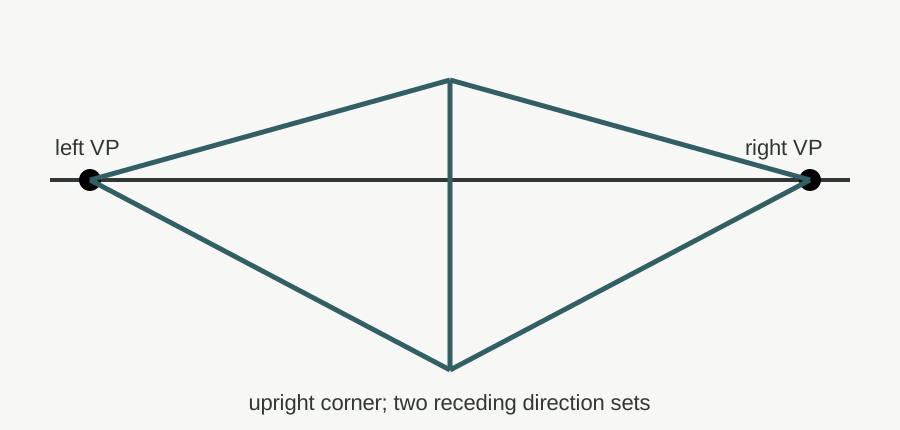
One-point perspective is a linear system in which one dominant family of receding parallel lines appears to converge on a single vanishing point.[1][2] It is especially legible when the viewer faces a room, street, or frontal plane directly: upright edges remain upright, level edges remain level, and lines travelling away from the viewer narrow towards the point.
“One point” does not mean that every line in the artwork meets there. Curves, irregular objects, figures, and edges parallel to the picture plane behave differently. Nor must the vanishing point sit in the centre or coincide with the narrative focus. The term identifies a dominant receding direction, not a rule for every mark.
At a Glance
- Core ideaone dominant receding direction set converges on one vanishing point.
- Eye levelthe horizon records the viewer's represented height.
- Frontal planesedges parallel to the picture plane remain horizontal or vertical.
- Best cluesfloors, ceilings, streets, arcades and repeated intervals.
- Important limitone-point structure can be partial, adjusted or combined with other depth cues.
Contents
Reading the structure
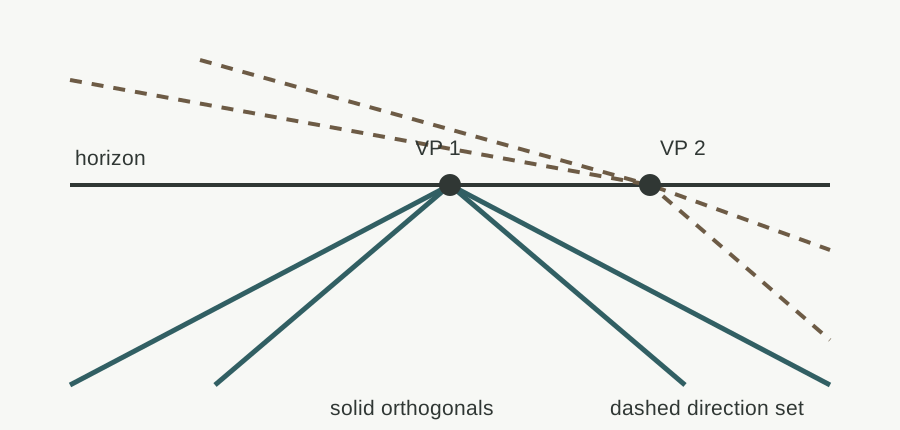
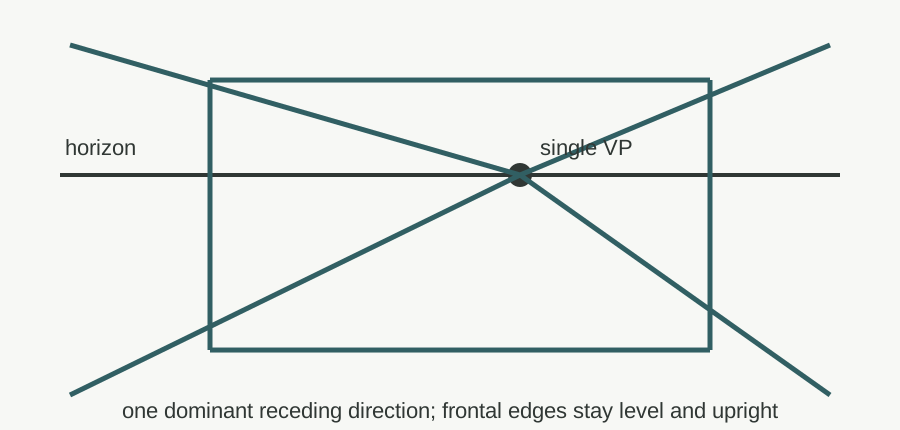
The diagram places an off-centre point on the horizon. Floor, ceiling, and side-wall edges converge there while a frontal rectangle keeps horizontal and vertical sides. Moving the point changes the implied viewer position. Repeated intervals usually become smaller as they approach it.[3]
One dominant receding direction
The solid line directions, labels, and point communicate the system without colour. This is an explanatory comparison, not a construction exercise.
Eight examples and tests
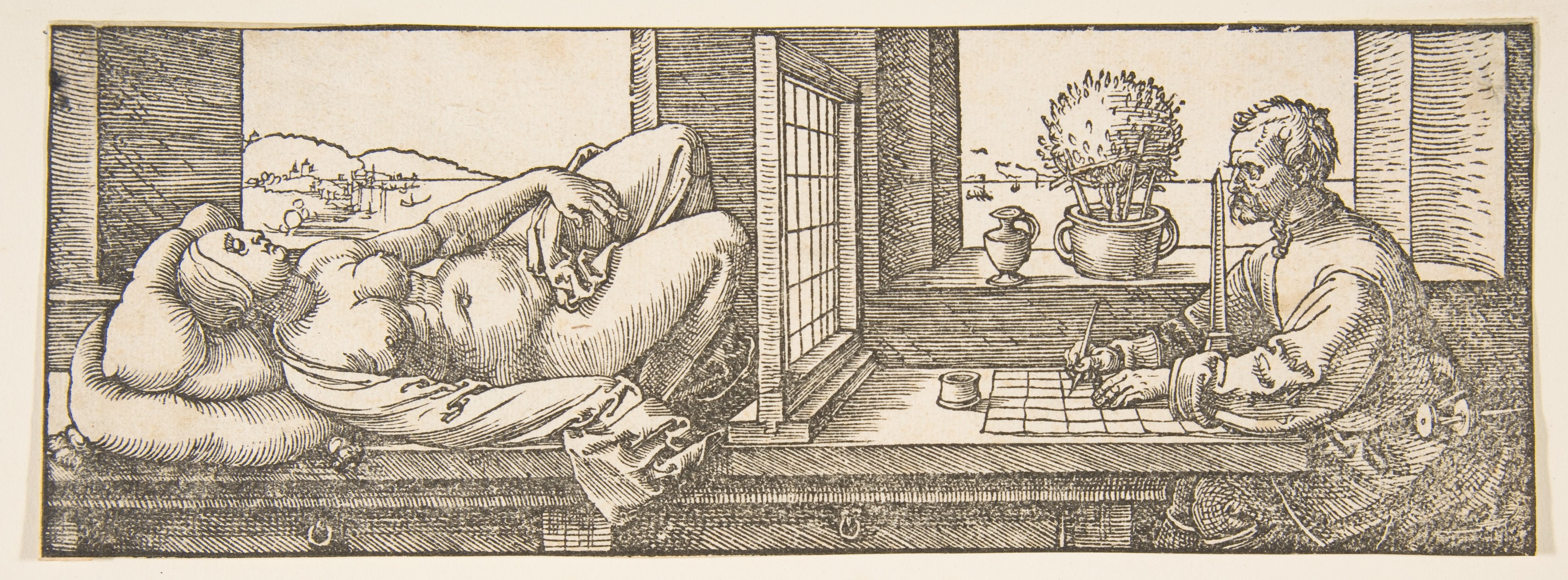
Albrecht Dürer — Draughtsman Making a Perspective Drawing of a Reclining Woman
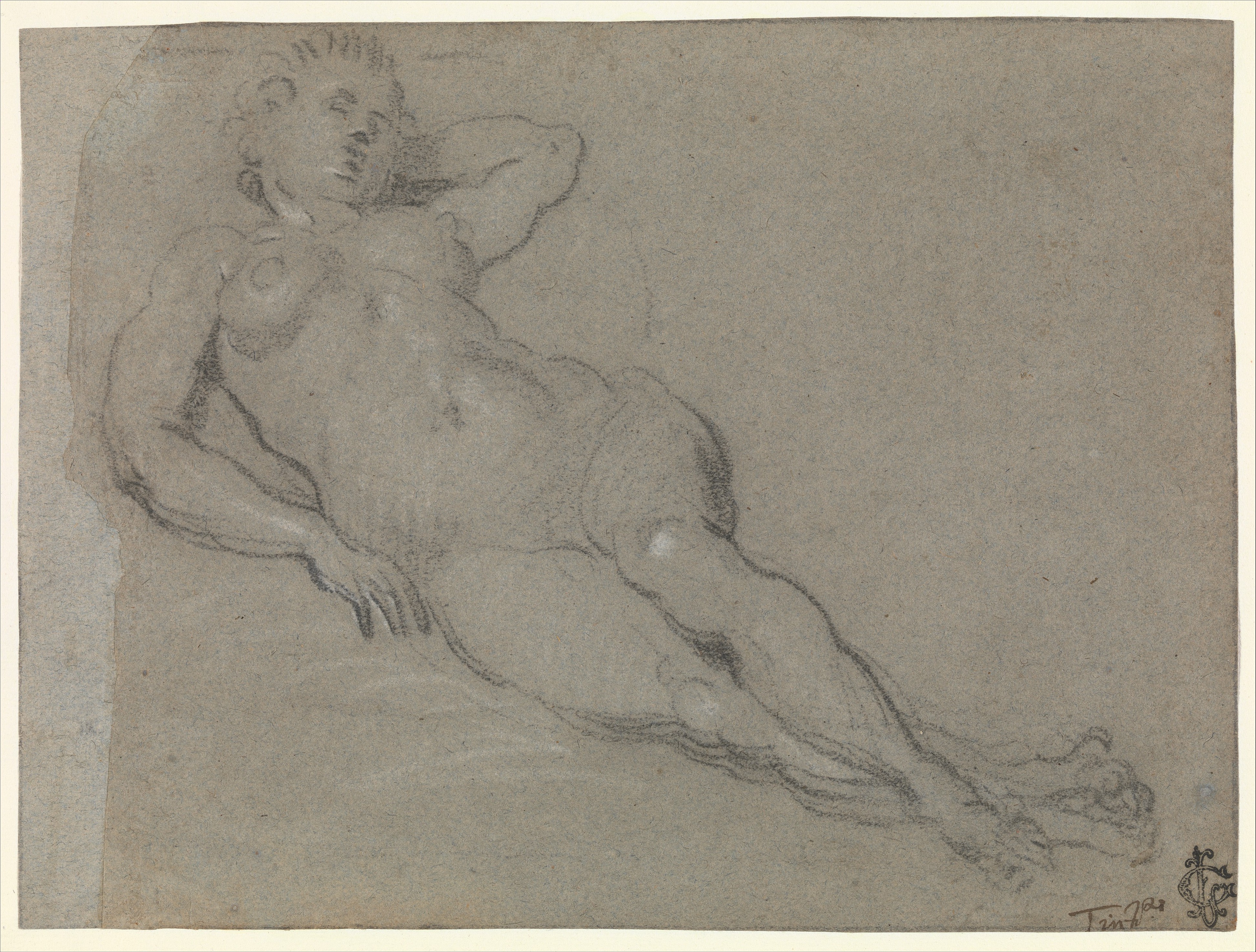
Dürer's device fixes an observer behind a grid and translates a view onto paper.[5] It clarifies the relationship among eye, picture plane, and represented direction, even though the curved body cannot be reduced to one set of orthogonals.
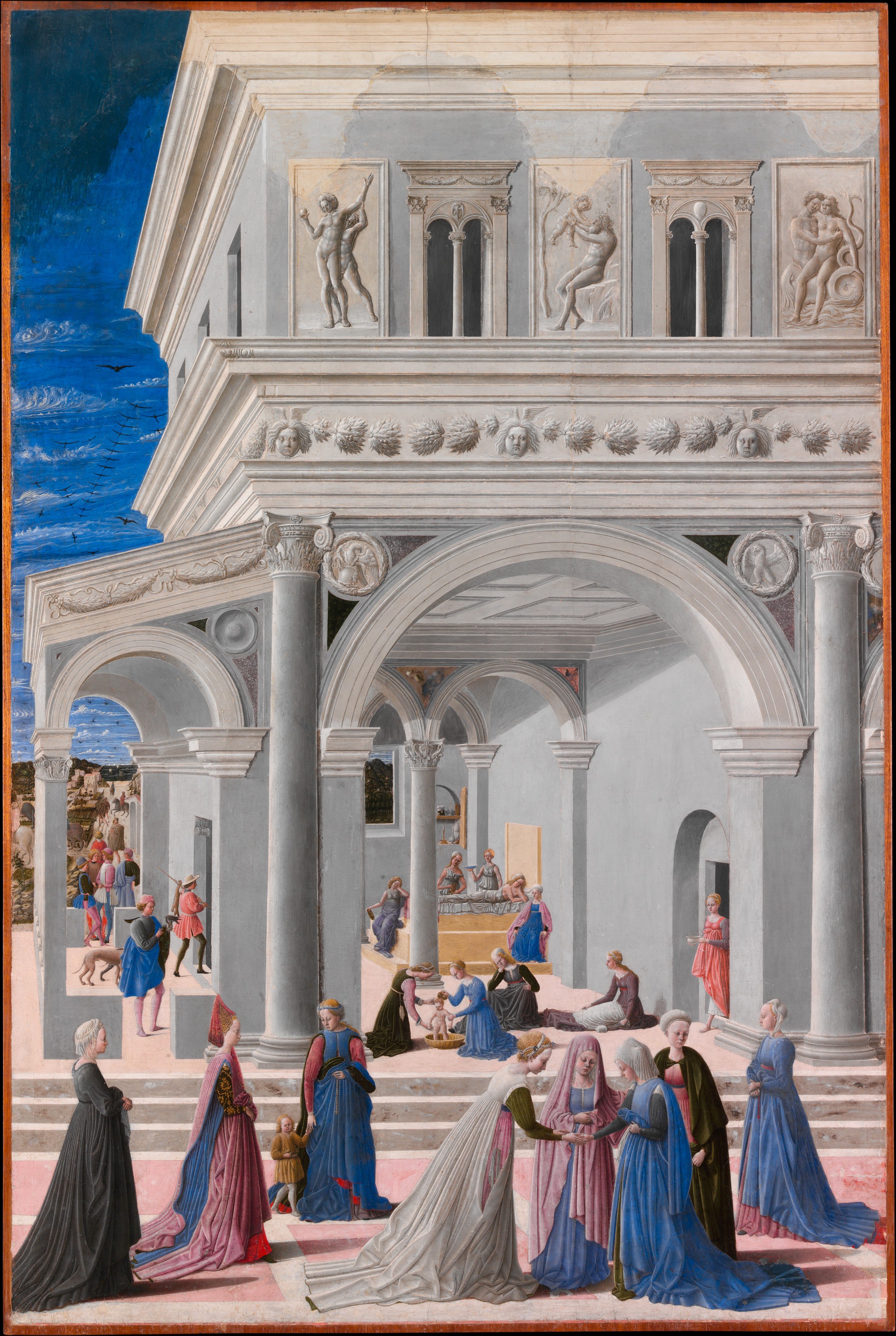
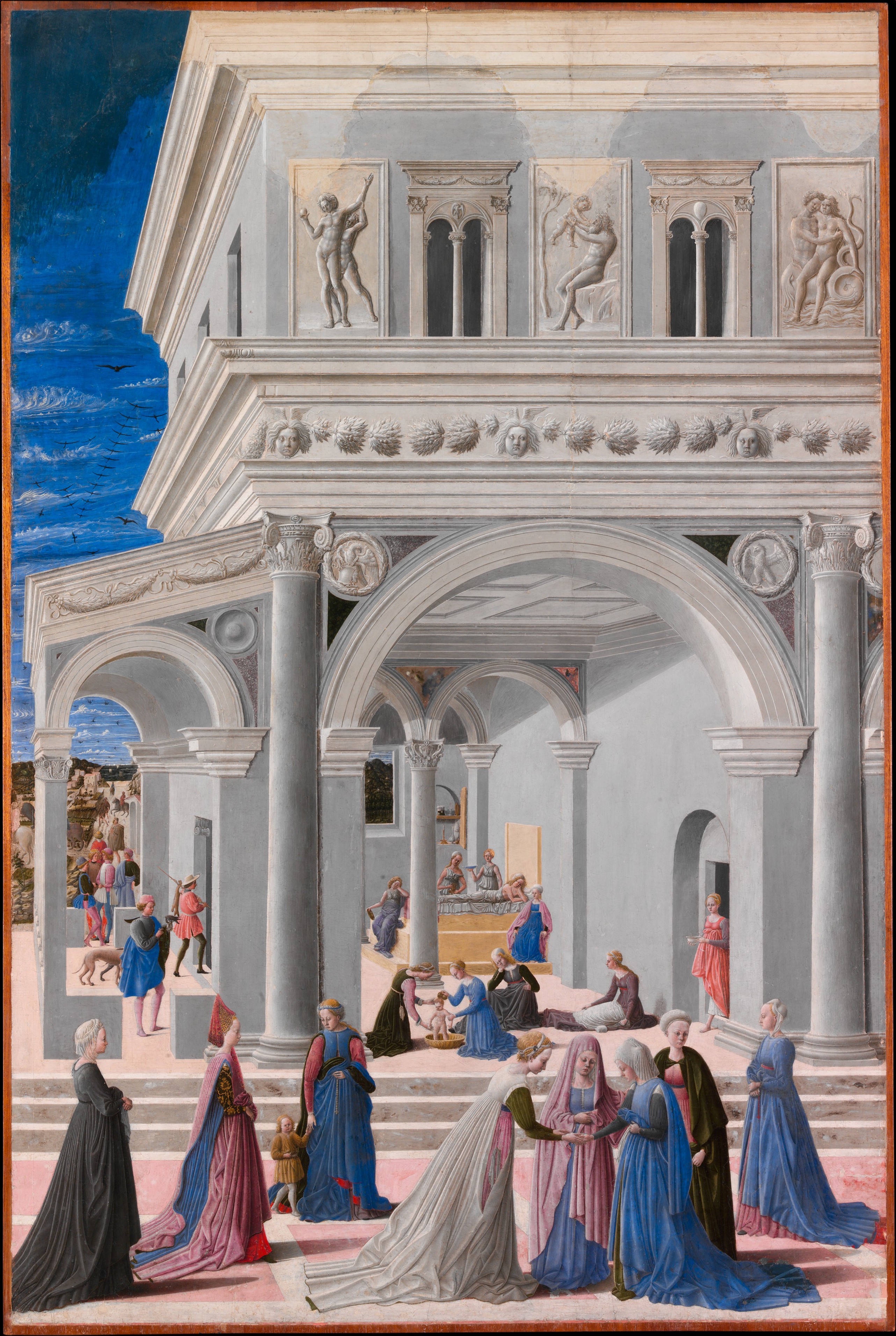
Fra Carnevale — The Birth of the Virgin
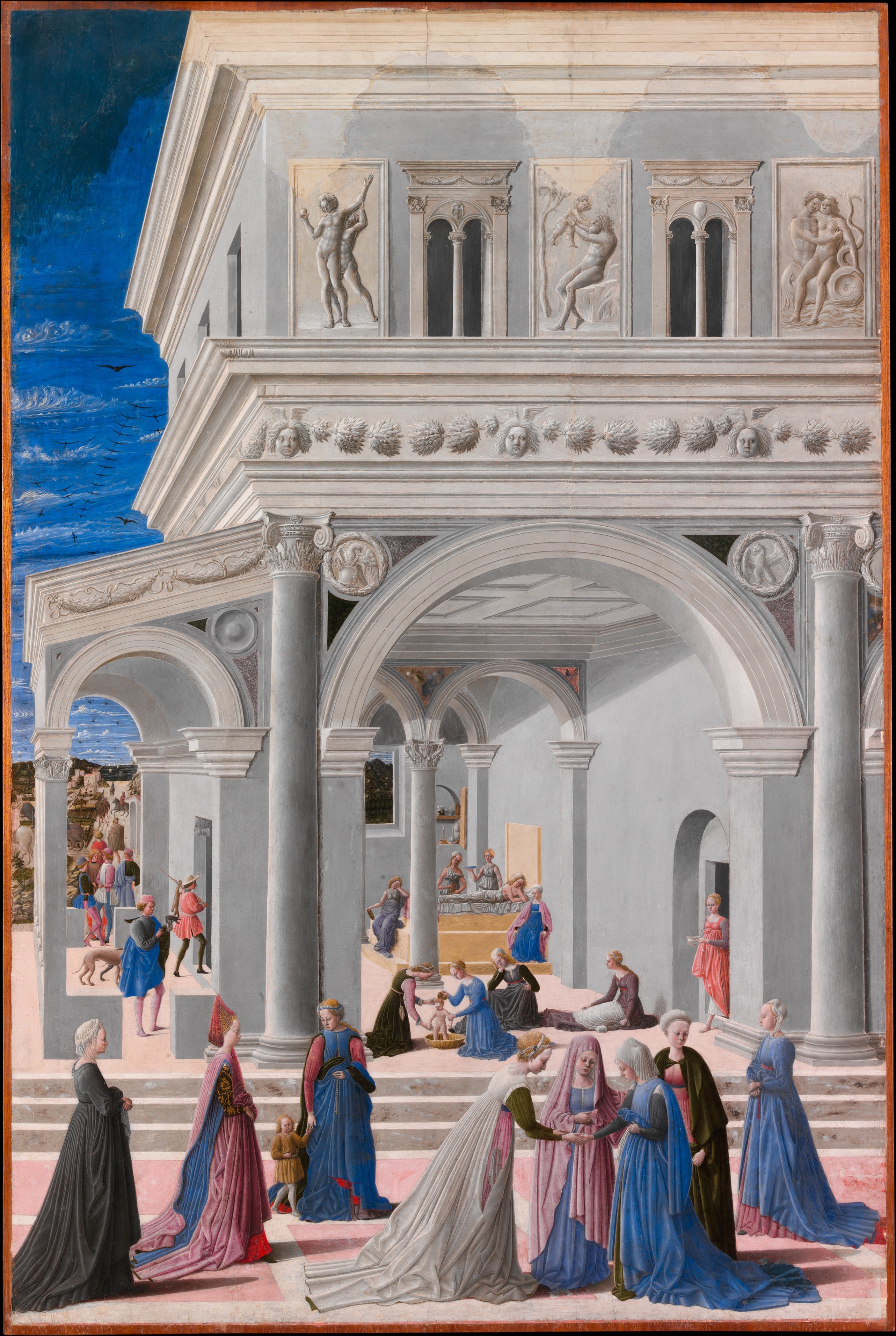
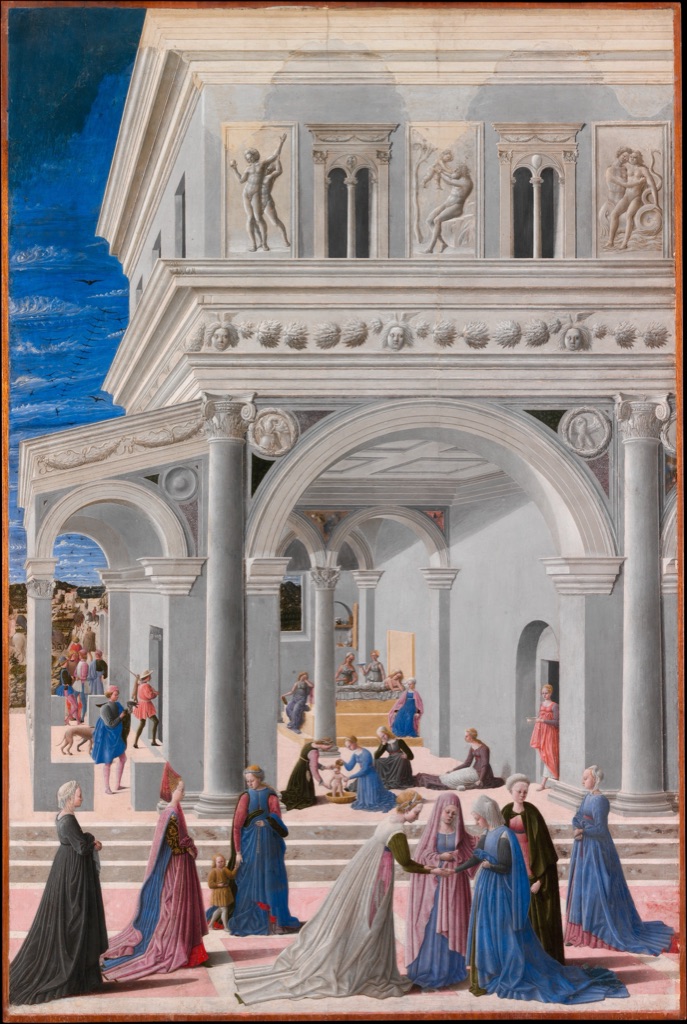
The Met's Renaissance teaching resource uses this 1467 palace to identify linear one-point perspective.[4][6] Tiles, cornices, and arches recede towards a shared area, while figures diminish across a unified interior. The vanishing structure coordinates narrative rather than merely displaying technique.
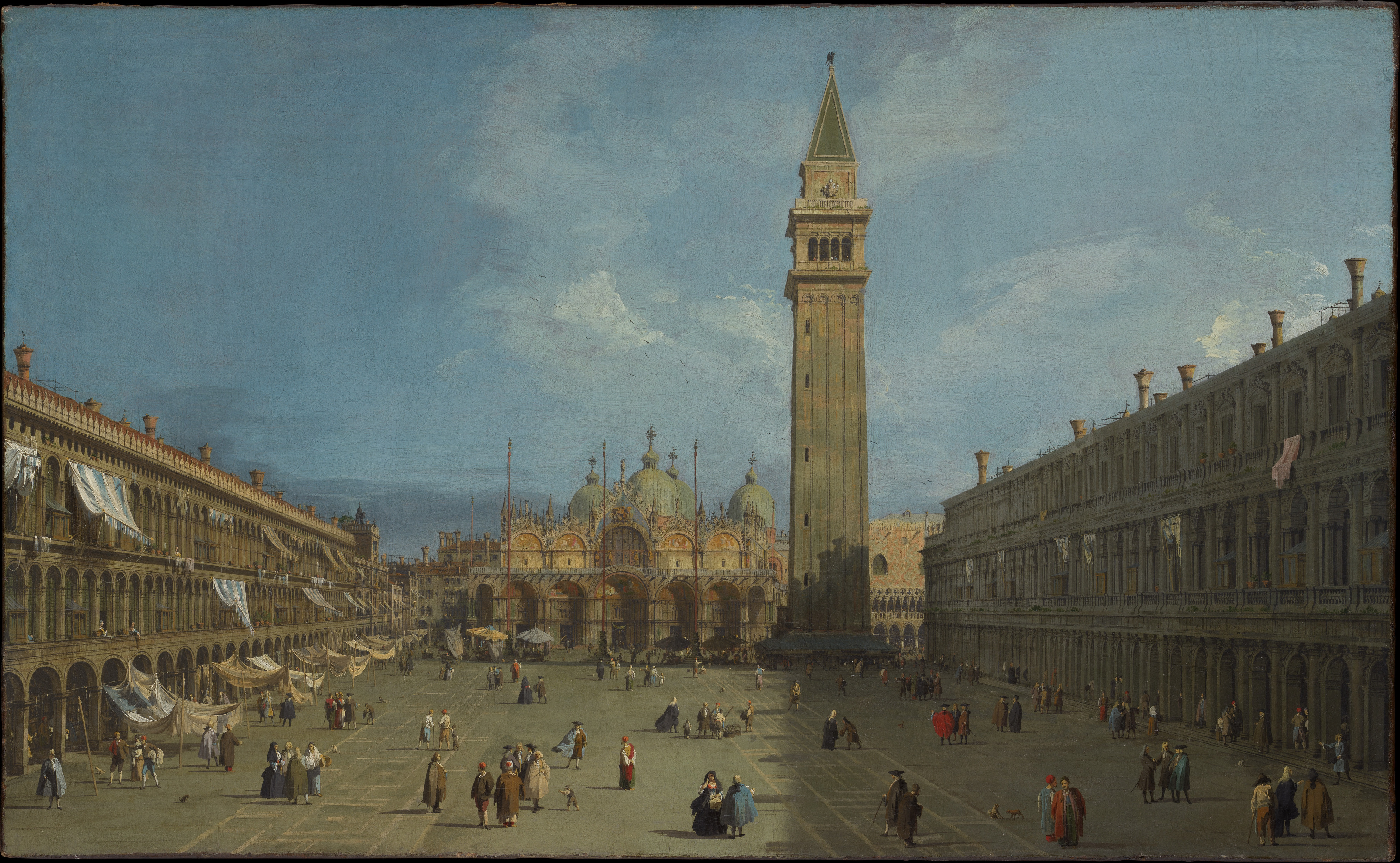
Canaletto — Piazza San Marco
Canaletto faces a broad civic space whose long arcades and paving produce a powerful dominant recession.[7] The square contains other orientations, so “one-point” describes its controlling view rather than every façade. A displaced convergence can still make the route through space immediately legible.
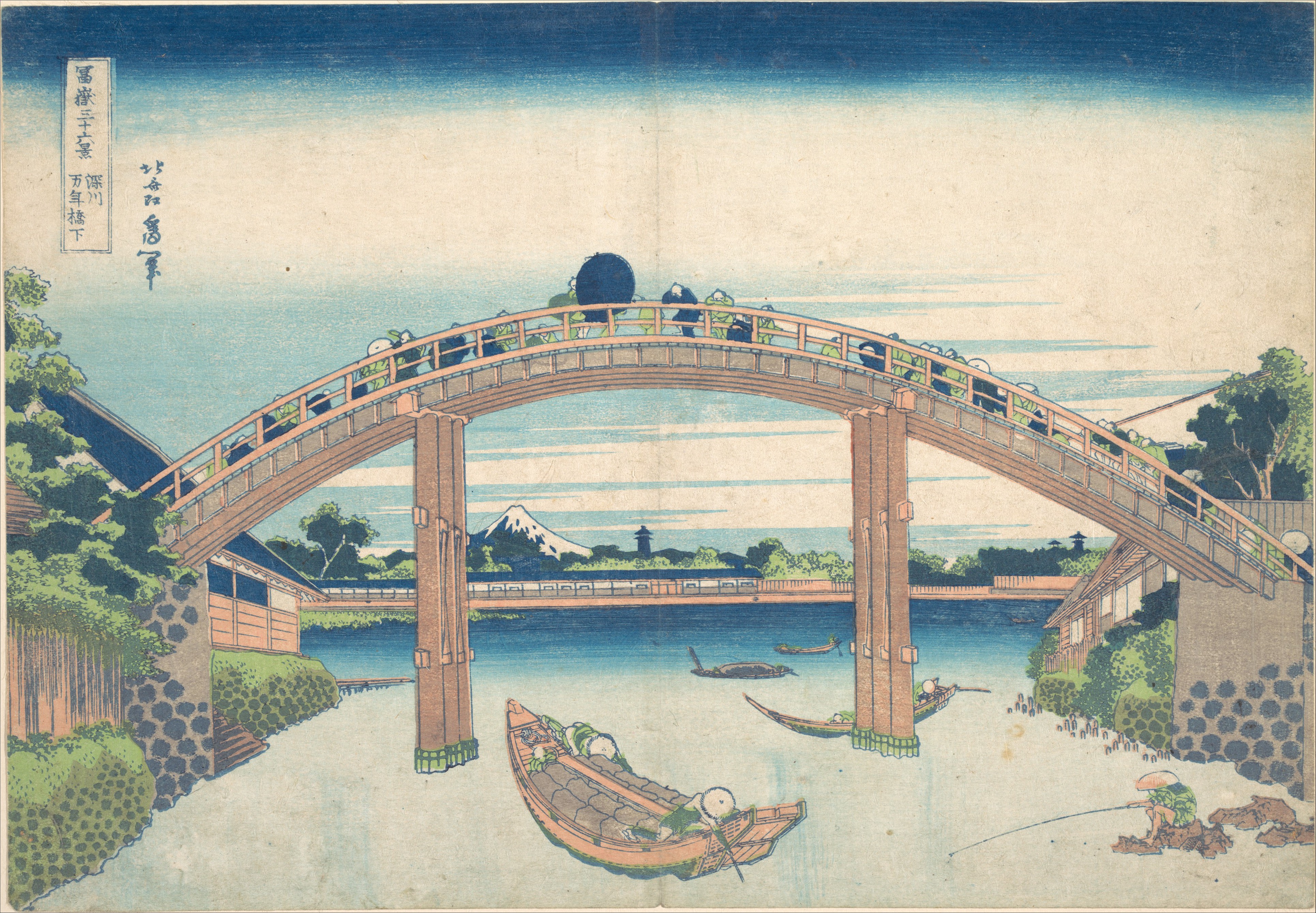
Katsushika Hokusai — Under the Mannen Bridge at Fukagawa
Hokusai combines the bridge's oblique supports, the river, scale changes, and distant Fuji.[8] European-derived convergence is only one contributor: cropping, flat colour, and the great arch remain equally active. The print is a test of how one-point cues can be adapted rather than mechanically copied.
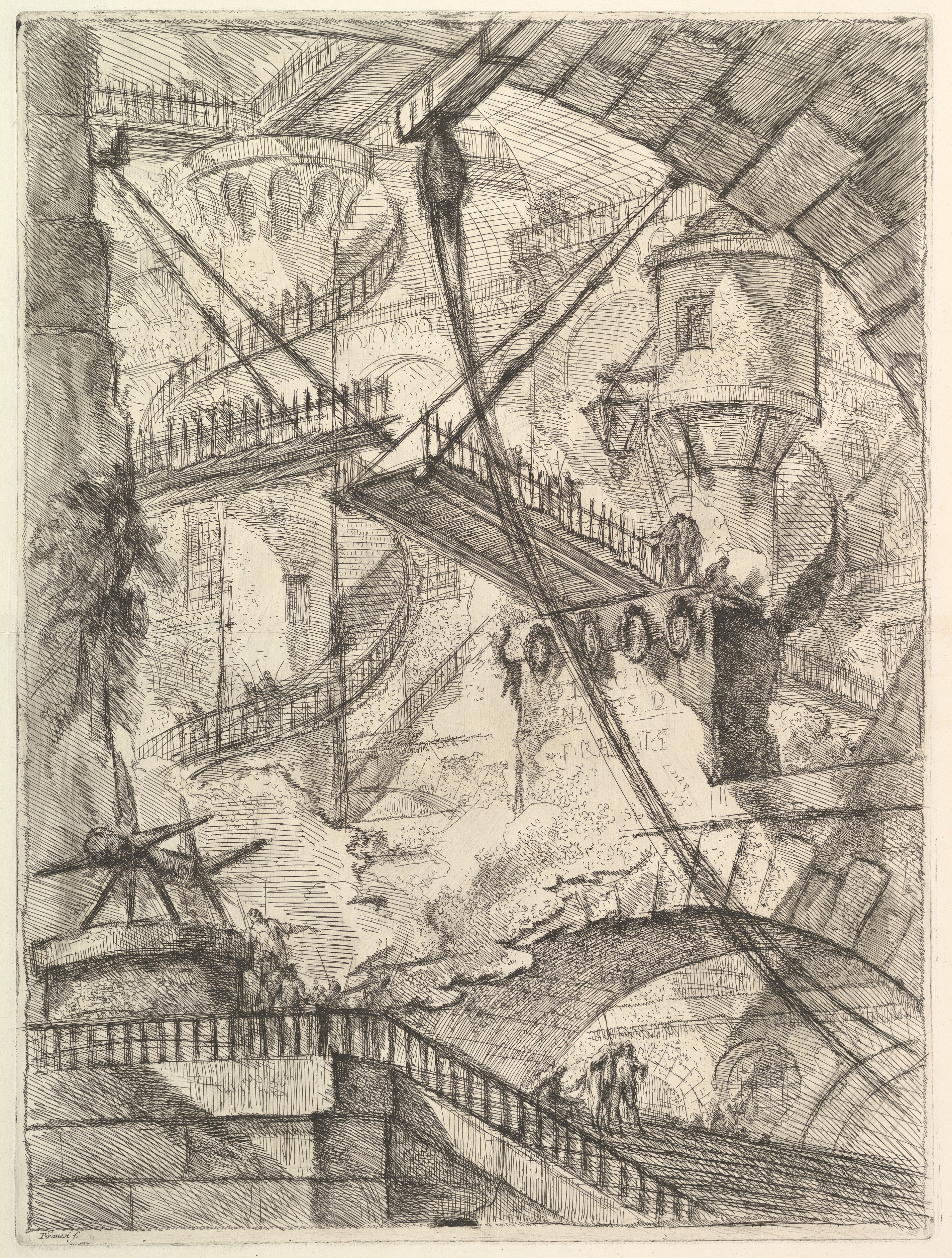
Giovanni Battista Piranesi — The Drawbridge
Piranesi repeatedly offers stairs and platforms that seem to promise a stable vanishing order, then lets competing structures interrupt it.[9] The print shows the expressive opposite of a calm corridor: one-point expectations can be multiplied or frustrated until finding a route becomes difficult.
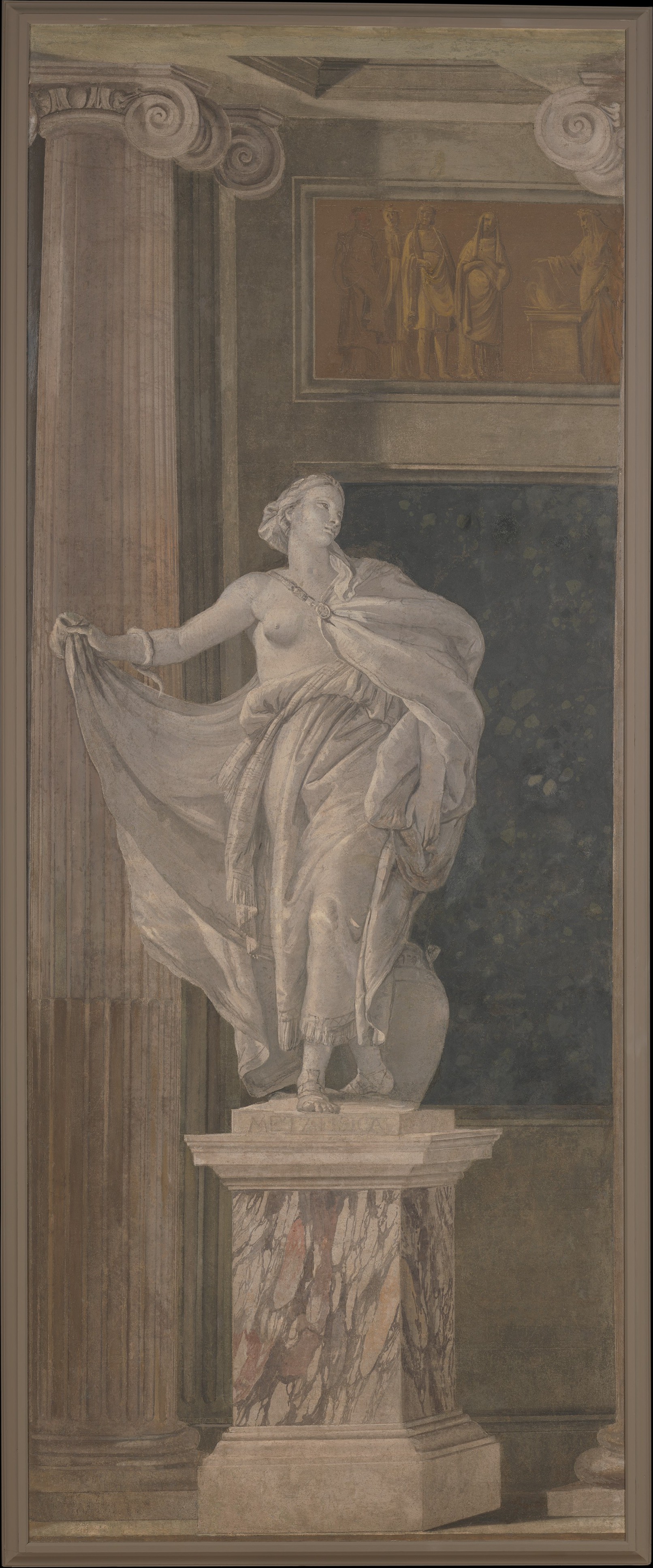
Giovanni Battista Tiepolo and Girolamo Mengozzi — Allegorical Figure Representing Metaphysics
This fresco fragment was designed to align from a particular position in a decorated room.[10] Its fictive architecture reminds us that a projection can be coherent only from an intended station point. The actual viewer's location is part of the work.
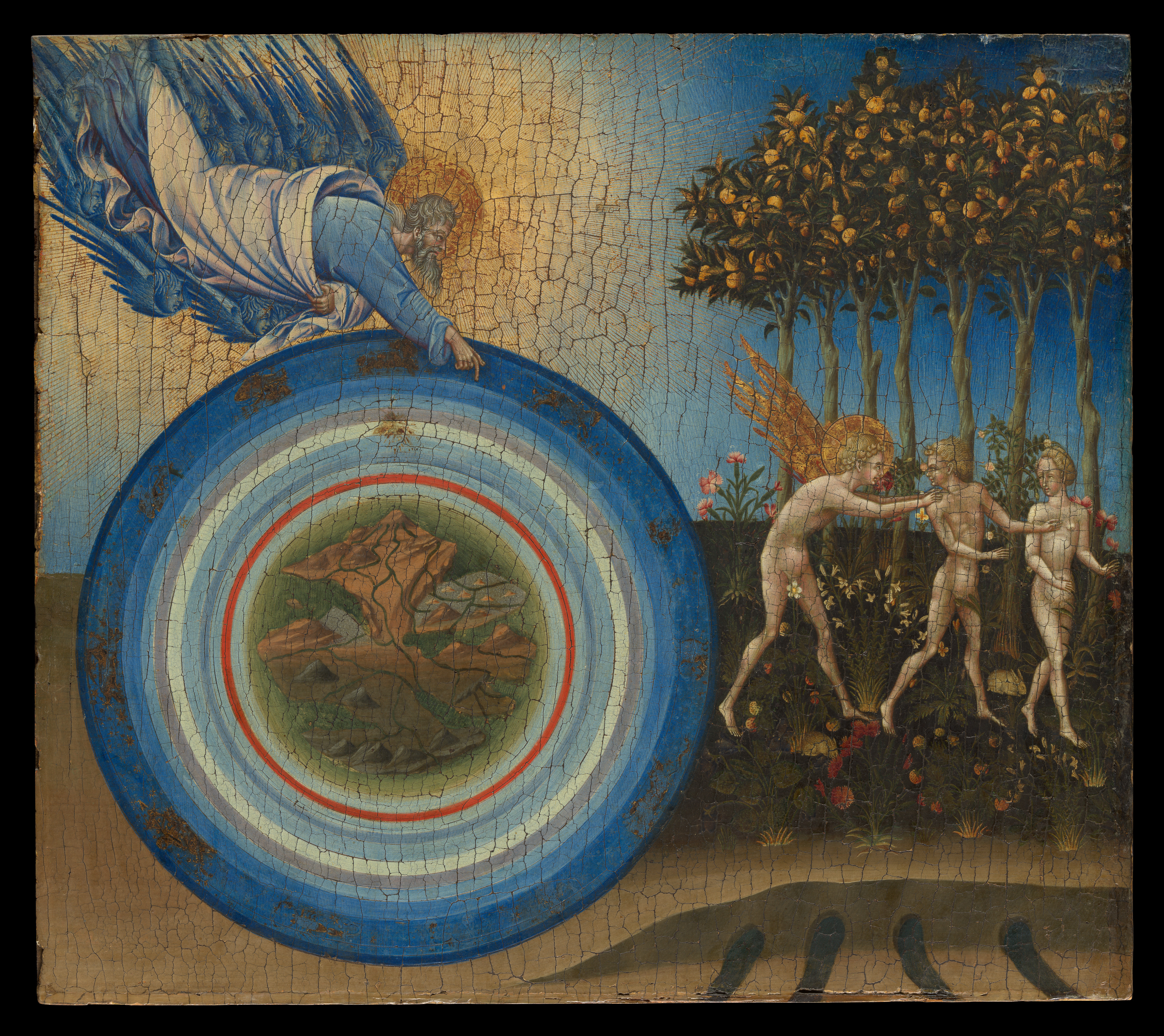
Giovanni di Paolo — The Creation of the World and the Expulsion from Paradise
Giovanni di Paolo offers a deliberate boundary. Concentric cosmos, gold ground, and a lateral garden sequence create exact symbolic order without a single optical viewpoint.[11] The panel is not failed one-point perspective; it pursues another spatial purpose.
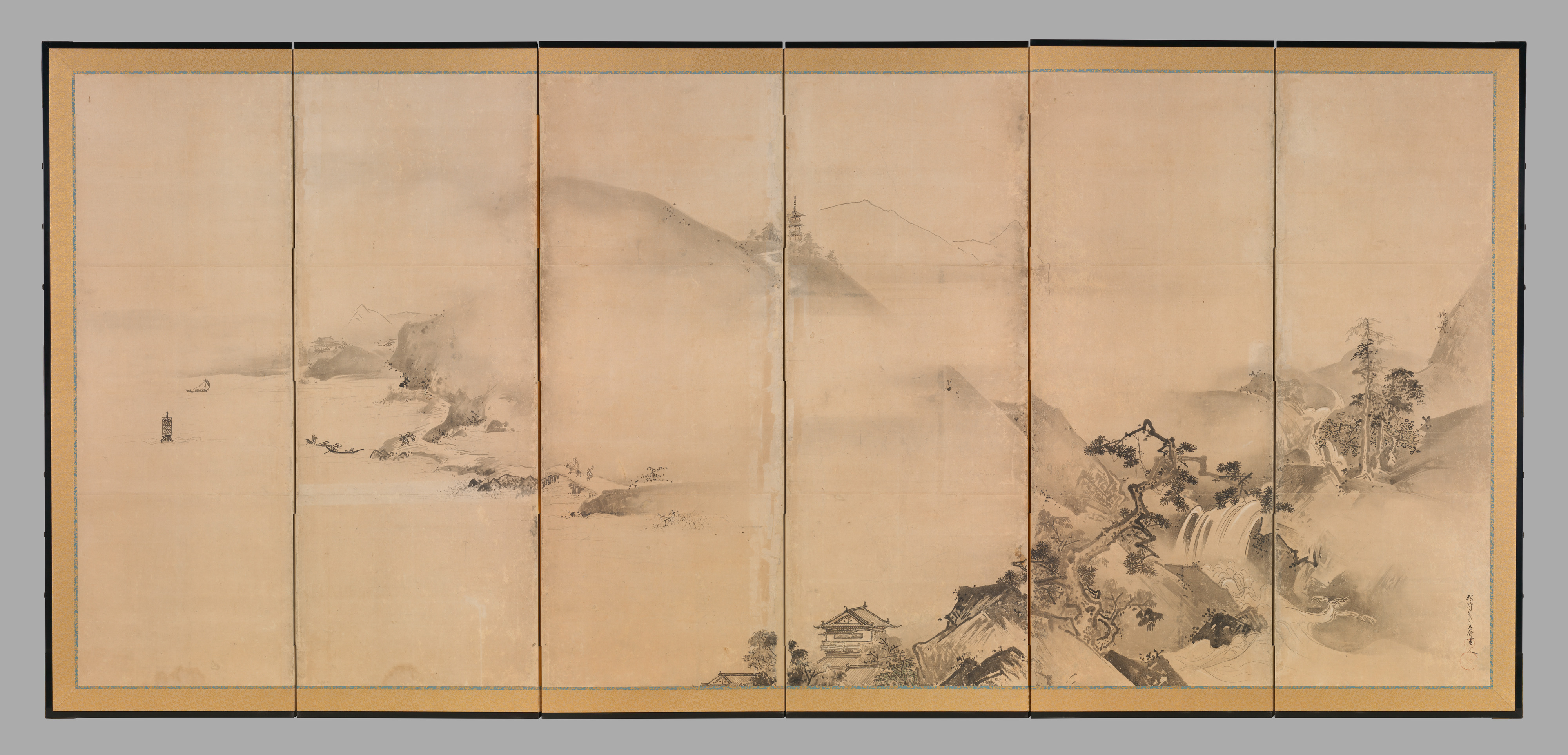
Kanō Tan'yū — Landscapes of the Four Seasons
These folding screens build depth through overlapping clusters, scale, ink value, and pale intervals.[12] The view shifts across folds rather than remaining fixed at one station. They make visible what a one-point system chooses to stabilise—and what other systems allow to remain mobile.
History, recognition, and effect
Single-point projection was codified in fifteenth-century Italy and became central to architectural and narrative painting.[1][3] It offered a repeatable way to coordinate a scene with an implied observer, but artists continued to mix it with older and other spatial traditions.
To recognise it, group straight edges that could be parallel in represented space. Extend the receding family mentally and locate its meeting place. Check whether frontal edges remain level and upright, whether repeated intervals diminish, and whether the inferred horizon matches the viewer's eye level. Then ask what the convergence does: open passage, impose symmetry, direct attention, or create unease.
The Linear Perspective page explains the wider family; Perspective in Art connects it to aerial change and foreshortening. One-point perspective is most revealing as a choice about where the viewer stands and how strongly a picture directs the eye.
Explore perspective in art
All seven evidence-checked guides are available in this local perspective group.
Watch One-Point Perspective in Geometry and Practice
Choose a concise geometric explanation, Brunelleschi's historical experiment, or a longer drawing demonstration.
How One-Point Linear Perspective Works
Follow the horizon, vanishing point and orthogonals in a compact visual explanation of one-point construction.
Watch on YouTubeFrequently Asked Questions
One-point perspective is a linear system in which one dominant set of receding parallel directions appears to converge on a single vanishing point.
No. An off-centre vanishing point can organise a coherent view and may direct attention asymmetrically across the picture.
No. It is a geometric relationship. A figure, colour contrast or narrative event elsewhere can remain the main focus.
No. Only represented lines parallel to the dominant direction recede towards its point; frontal horizontals and verticals stay aligned with the picture plane.
Yes. Overlap, scale, aerial change, texture and foreshortening often reinforce or complicate the linear structure.
Discussion
Which example makes its single receding direction easiest to recognise—and which resists being reduced to a perfect central grid?
Reader Insights
Start with repeated edges that genuinely run away from the viewer, such as paving, beams or arcades.
Horizontals and verticals parallel to the picture plane do not converge on the same point.
Ask whether the geometry creates procession, stillness, authority, intimacy or deliberate instability.
Join the Conversation
Share one precise observation or a useful museum example below.
References
- National Gallery, “Perspective.” https://www.nationalgallery.org.uk/paintings/glossary/perspective
- National Gallery, “Linear perspective.” https://www.nationalgallery.org.uk/paintings/glossary/linear-perspective
- The Met, Lesson Plan: Perspective. https://www.metmuseum.org/-/media/files/learn/for-educators/publications-for-educators/renaissance.pdf
- The Met, The Art of Renaissance Europe. https://resources.metmuseum.org/resources/metpublications/pdf/The_Art_of_Renaissance_Europe_A_Resource_for_Educators.pdf
- The Met, object 366555. https://www.metmuseum.org/art/collection/search/366555
- The Met, object 435848. https://www.metmuseum.org/art/collection/search/435848
- The Met, object 435839. https://www.metmuseum.org/art/collection/search/435839
- The Met, object 56387. https://www.metmuseum.org/art/collection/search/56387
- The Met, object 337060. https://www.metmuseum.org/art/collection/search/337060
- The Met, object 437801. https://www.metmuseum.org/art/collection/search/437801
- The Met, object 458971. https://www.metmuseum.org/art/collection/search/458971
- The Met, object 53009. https://www.metmuseum.org/art/collection/search/53009