by Tom Gurney
Tom Gurney BSc (Hons) is an art history expert with over 20 years experience
Page created on September 3, 2026 / Page updated on September 13, 2026
Email: tomgurney1@gmail.com / Phone: +44 7429 011000
How Early Paint Stages Establish Structure before Later Colour Conceals Them
Underpainting is an early painted stage that lies beneath later paint. It can establish placement, value, colour bias, broad masses or selected details before the upper surface is developed. The term describes position in a sequence rather than one colour or formula. An underpainting may be grey, brown, warm, cool, thinly washed or relatively opaque.[1]
Much of it disappears as the picture advances. Unfinished works, worn passages, cross-sections and imaging techniques therefore provide especially valuable evidence. They also reveal variety: painters did not all move from drawing to monochrome modelling to coloured glaze in the same orderly way.
At a Glance
- Core ideaunderpainting is an early paint stage that establishes placement, value, colour bias or mass before later layers.
- Not underdrawingunderdrawing uses drawn lines; underpainting uses paint.
- Not the groundground or imprimatura prepares and tones the support beneath the image-building layers.
- Historical systems varyunderpainting can be monochrome, coloured, loose, selective or highly resolved.
- Best evidenceunfinished works, infrared imaging, X-radiography and cross-sections reveal stages later paint may conceal.
Contents
Underpainting, ground and underdrawing
The support—panel, canvas, wall or another material—normally receives preparation before pictorial paint. A size may isolate fibres; a ground creates a workable surface; an imprimatura can tint that ground. Underdrawing sets out the design with lines or marks. Underpainting begins when paint establishes elements of the image beneath later passages.[6]
These categories can overlap visually. A brushed brown line may behave like drawing while also containing paint; a coloured preparation can remain active inside the picture. Technical writers use terms with period-specific meanings, so material evidence and authorial context matter more than forcing every layer into a rigid chart.[7]
The early stage can solve several problems. It may map light and shadow, reserve highlights, organise a complex group or provide a chromatic counterweight beneath the final colour. It can also accelerate later work by allowing upper strokes to remain open while a lower tone supplies continuity. Its economy may matter as much as its appearance.
Three unfinished paintings to examine
Adoration of the Magi
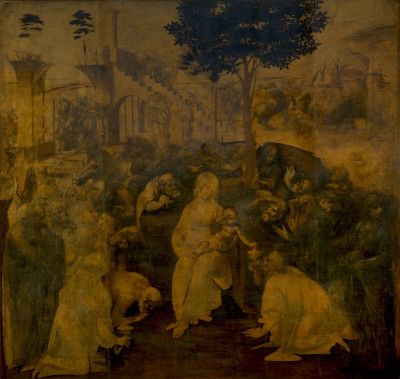
Leonardo's Adoration of the Magi was left unfinished when he departed Florence. The Uffizi's conservation project exposed an extraordinarily complex surface: drawing, adjustments and developing brown paint organise architecture, crowds, horses and the central Virgin and Child.[3] Some forms are built strongly while others remain as searching marks.
The panel warns against calling every brown passage “the underpainting” as though it were one uniform coat. Different areas reached different stages. Washes define mass, lines revise pose and brighter support still participates. The work makes process visible because later colour never concealed it.
The Manchester Madonna
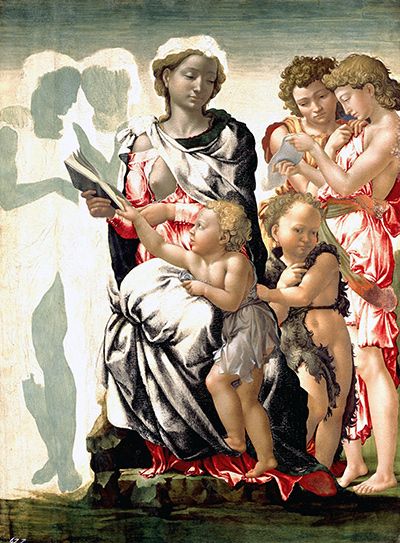
Michelangelo's The Manchester Madonna contains finished, underpainted and scarcely begun areas within one panel. The National Gallery notes that the angels at the left were not carried to completion, allowing the progression from preparation toward modelled bodies and drapery to remain visible.[4]
Some passages have volume but lack their intended finish; elsewhere bare preparation interrupts the group. This unevenness is instructive. Underpainting is not necessarily a complete monochrome version made across the entire panel before colour begins. A painter can advance one figure while another remains at an earlier stage.
Unfinished Portrait of General Bonaparte
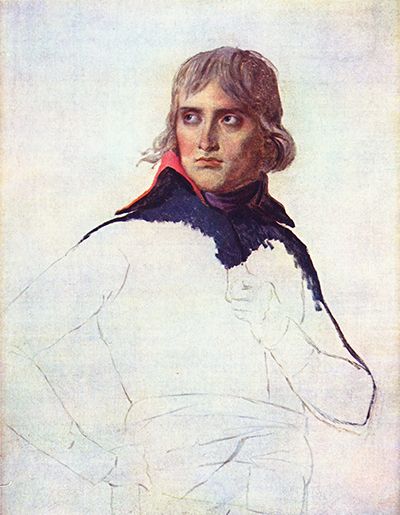
Jacques-Louis David's unfinished portrait concentrates finish in Bonaparte's face and upper body while the lower figure and surrounding field remain broadly stated. The Louvre records the work as an unfinished 1798 portrait, its abrupt ending preserving the contrast between developed likeness and economical lay-in.[5]
Loose ochres and darks hold the body in place without resolving uniform, accessories or background. The visible sequence shows how an underpainted mass can function compositionally even before detail arrives. It also separates incompletion from incompetence: the decisive head depends on the broad structure beneath and around it.
Historical systems varied
European workshop teaching sometimes encouraged staged construction, but materials and priorities changed. The National Gallery of Art's Renaissance overview describes prepared panels, transferred or freehand designs and successive paint applications without reducing them to a single recipe.[6] Northern oil practice, Italian tempera, large decorative canvases and later academy methods each created different sequences.
The Getty Conservation Institute's reconstruction of Jean-Baptiste Oudry's lecture is particularly useful because it links written instruction to practical testing. Oudry described building a painting through controlled stages, yet the modern reconstruction also showed how difficult historical terms and materials can be to translate directly into present practice.[2]
Nineteenth-century evidence adds another warning. Technical study of Monticelli has connected coloured lower layers, varied opacity and vigorous surface handling in combinations unlike a neat Renaissance grisaille-and-glaze stereotype.[8] “Traditional underpainting” is therefore too vague to explain an object.
What underpainting can do visually
A lower colour can unify gaps between upper strokes. Warm earth beneath cooler passages may create vibration, while a grey stage can keep values coherent. A dark block-in can establish silhouettes and make later lights economical. A light underlayer can increase luminosity beneath transparent colour.
The underpainting may remain deliberately exposed. This is different from accidental loss: open upper handling can use glimpsed preparation as an active colour and texture. An exposed lower tone can separate adjacent strokes, warm a shadow, cool a light or prevent a loosely painted passage from feeling empty. Abrasion, overcleaning and ageing can also reveal lower layers, so visibility alone does not establish original intention. The pattern of exposure must agree with the painter's handling and the object's condition.
Nor does a dark first stage guarantee glazing above it. Opaque corrections, wet-in-wet passages and scumbles can all follow. The lower stage is defined by what comes later, not by a prescribed upper technique.
How to identify an underpainting
Begin at edges, reserves and unfinished zones. Look for broad forms that continue beneath more detailed paint or for a lower colour visible consistently through purposeful gaps. Compare the handling of developed and undeveloped areas within the same object.
Then consult technical evidence. Infrared reflectography is often most useful for carbon-containing underdrawing; X-radiography can show density differences; cross-sections reveal physical layer order in tiny samples. None produces a simple photograph of “the underpainting,” but together they can test hypotheses about sequence.[3][7]
Finally, name only what the evidence supports. A warm cast may come from a ground, lower paint, altered varnish or photography. An unfinished painting may preserve several stages rather than one. Underpainting is best understood as a family of lower pictorial operations—hidden foundations whose form and purpose belong to the individual painting.
Watch: Underpainting, Hidden Layers and Built Surfaces
Choose a tempera underpainting demonstration, a Getty reconstruction of a historical panel, or a National Gallery view of what X-rays reveal beneath paint.
Alchemy of Art: Egg Tempera and Under-Painting
See a monochrome preparation organise values before tempera colour is added.
Watch on YouTubeFrequently Asked Questions
Underpainting is an early paint stage used to establish some combination of placement, value, colour bias and mass before later layers are applied.
Underdrawing establishes design with drawn lines, while underpainting uses paint to build early tonal or colour masses.
No. Grisaille can be a finished monochrome work or sculptural illusion as well as a preparatory stage.
No. Historical and individual practices vary widely, from elaborate layered systems to direct painting and selective preparation.
They combine unfinished evidence, infrared imaging, X-radiography, microscopy, cross-sections and documentary research.
Discussion
Which unfinished painting on this page reveals the clearest decision that later layers would have transformed or concealed?
Reader Insights
Ground, drawing, underpaint and final paint have different functions.
Exposed passages show sequence more securely than a finished surface alone.
Do not turn one workshop system into a universal recipe.
Join the Conversation
Share one precise observation or a useful museum example below.
References
- Tate, “Underpainting.” https://www.tate.org.uk/art/art-terms/u/underpainting
- Getty, Reworking the Methods of Jean-Baptiste Oudry. https://www.getty.edu/publications/oudry/
- Uffizi Galleries, “Leonardo's Adoration of the Magi.” https://www.uffizi.it/en/artworks/adoration-of-the-magi
- National Gallery, “Michelangelo, The Manchester Madonna.” https://www.nationalgallery.org.uk/paintings/michelangelo-the-manchester-madonna
- Musée du Louvre, “Portrait inachevé du général Bonaparte.” https://collections.louvre.fr/ark:/53355/cl010062261
- National Gallery of Art, “Italian Painting of the Later Middle Ages and Renaissance.” https://www.nga.gov/educational-resources/italian-painting-later-middle-ages-and-renaissance
- Getty Conservation Institute, Historical Painting Techniques, Materials, and Studio Practice. https://www.getty.edu/conservation/publications_resources/pdf_publications/pdf/historical_paintings.pdf
- National Gallery, “Adolphe Monticelli's Painting Technique.” https://www.nationalgallery.org.uk/research/research-resources/technical-bulletin/adolphe-monticellis-painting-technique