by Tom Gurney
Tom Gurney BSc (Hons) is an art history expert with over 20 years experience
Page created on September 3, 2026 / Page updated on September 13, 2026
Email: tomgurney1@gmail.com / Phone: +44 7429 011000
How Concentrated Illumination Turns Darkness into an Active Pictorial Field
Tenebrism is a way of organising a painting in which deep darkness occupies much of the field and selected forms are struck by concentrated light. Its name comes from the Italian tenebroso, meaning dark or shadowy. The technique does not merely add strong shadows to otherwise even illumination. Darkness becomes an active compositional space: it suppresses secondary information, separates bodies and makes each illuminated face, hand or object carry unusual narrative weight.[1]
Caravaggio is the essential reference point, but tenebrism is neither a synonym for all his painting nor a membership badge for every artist influenced by him. The technique can be traced through the actual distribution of light and dark in a work. The separate Caravaggism and Tenebrism guide follows patrons, centres, followers and transmission; here the question is how darkness works on the painted surface.
At a Glance
- Core structurelarge zones of darkness are organised around concentrated, often abrupt illumination.
- Visual rolelight can isolate faces, hands or decisive actions while compressing surrounding space.
- Relation to chiaroscurotenebrism is a more extreme lighting organisation within the wider field of light-dark modelling and contrast.
- Historical cautionthe label is useful descriptively but should not replace specific evidence about artist, place, date and function.
- Look fordominant darkness, narrow light access, abrupt value transitions and narrative concentration.
Contents
How tenebrist light is organised
A tenebrist painting often withholds a full account of the setting. Large dark zones may merge wall, costume and background, while a narrow band of light selects the decisive action. This compression strengthens figure-ground contrast. It can also alter time: the viewer encounters the revelation before gradually discovering quieter faces or objects within the shadows.
The light source may be outside the frame, as in a beam crossing a room, or inside it as a candle, torch or fire. Sometimes a hand, body or object screens that source. Concealment prevents the brightest point from overwhelming the scene and lets reflected light describe nearby forms. Studies of seventeenth-century candlelight painting stress how artists used such devices to stage both naturalistic effects and calculated visual hierarchies.[7]
Tenebrism works through edges as well as value. A lit forehead may meet darkness abruptly while another boundary disappears. The method can feel theatrical because it resembles a spotlight, yet painted light need not correspond perfectly to optics. It may reach exactly the hand or expression needed for the story. That selectivity is part of its rhetoric.
Four paintings to compare
The Calling of Saint Matthew
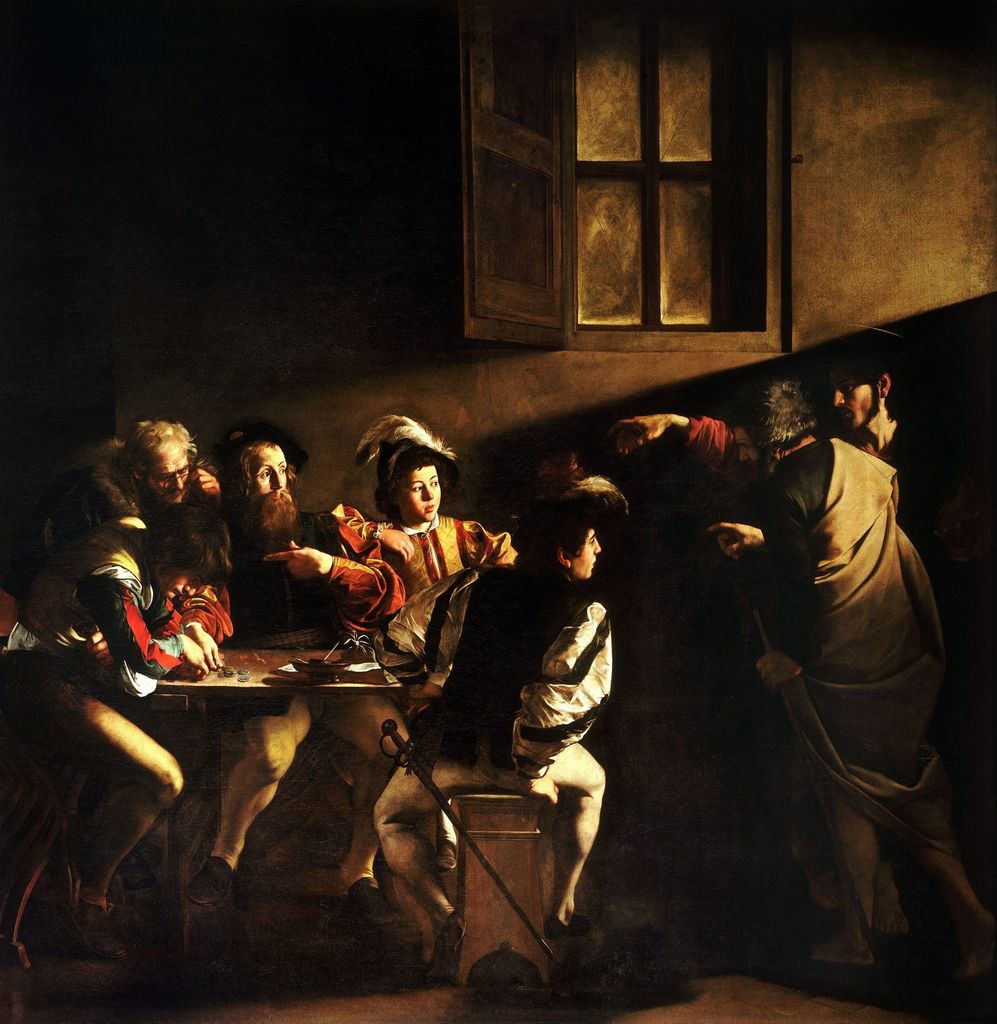
Caravaggio's The Calling of Saint Matthew places a group around a table in a dim, shallow room. A diagonal band enters from the right above Christ's hand, crossing the wall and catching faces one after another. The church setting means actual side light also participates in viewing the canvas, making the painted illumination responsive to its architectural site.[2]
Most of the room remains visually withheld. The beam does not describe everything equally; it identifies the instant of calling. Hands become crucial: Christ points, a seated figure appears to question the choice, and another continues counting money. Because the surrounding field is dark, small variations in gesture and expression become the structure of the narrative.
Judith Slaying Holofernes
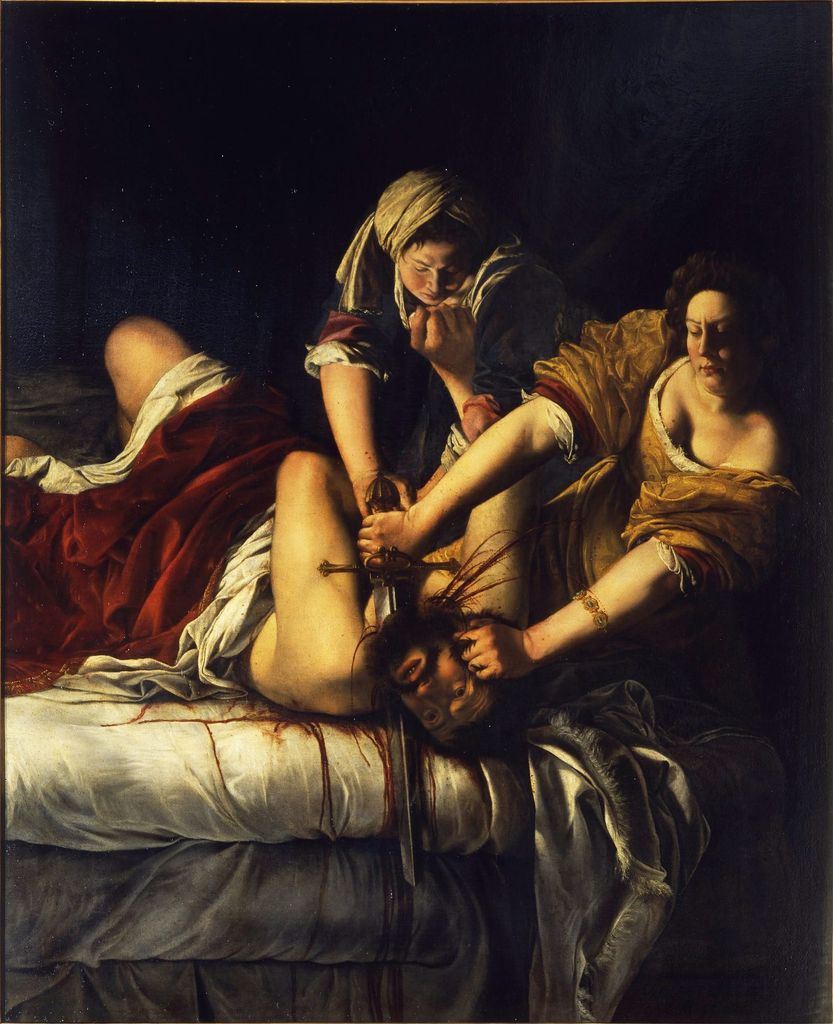
Artemisia Gentileschi's Judith Slaying Holofernes pushes three bodies close to the picture plane. Light catches Judith's arms, Abra's face, white sheets and the violent central action, while the surrounding room scarcely registers. The Uffizi emphasises the painting's concentrated realism and Artemisia's forceful treatment of the biblical subject.[3]
Here darkness removes distance. Viewers cannot retreat into a broad setting, and the pale fabric intensifies the red blood and compressed struggle. Tenebrism is not the sole source of the painting's power—pose, cropping, colour and physical resistance all matter—but it governs what can be seen first and what remains unavailable.
The Matchmaker
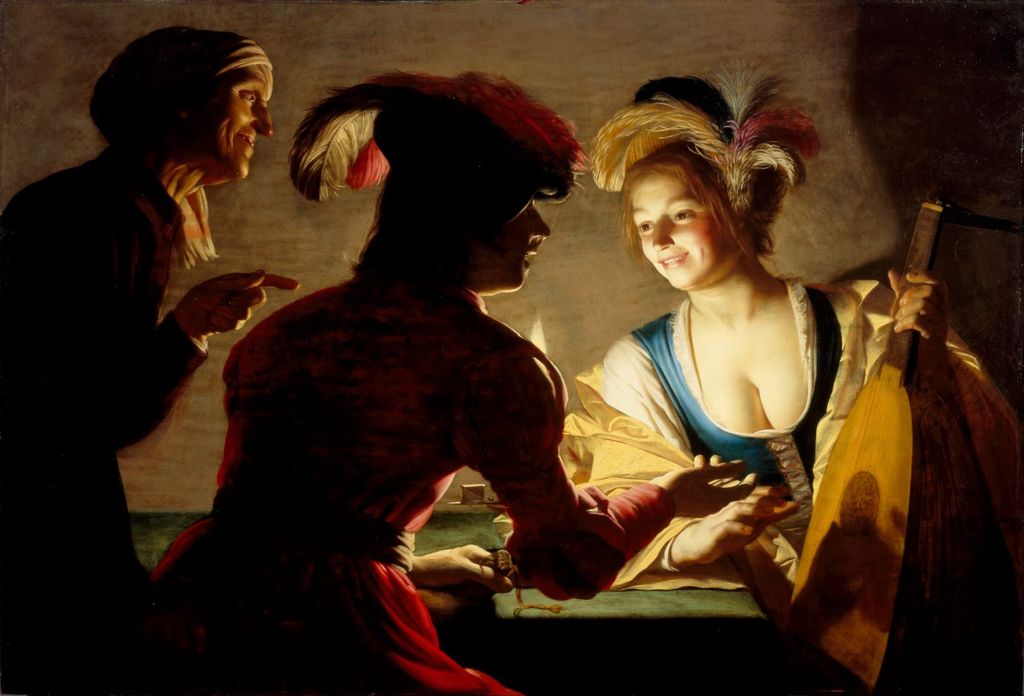
Gerrit van Honthorst earned an Italian reputation for night scenes before returning to Utrecht. In The Matchmaker, a candle is partly screened by the central figure's hand and instrument. Its warm light expands across faces, fabric and the musician's feather, then rapidly loses strength toward the edges. The Centraal Museum connects such artificial-light subjects with Honthorst's Utrecht Caravaggist practice.[4]
Unlike Caravaggio's external beam, this source belongs inside the depicted social world. The figures appear to share a small pool of visibility. Concealment makes the light plausible enough to read as candlelight while still serving a precise compositional purpose: faces and exchanged glances remain legible, background space does not.
The Magdalen with the Smoking Flame
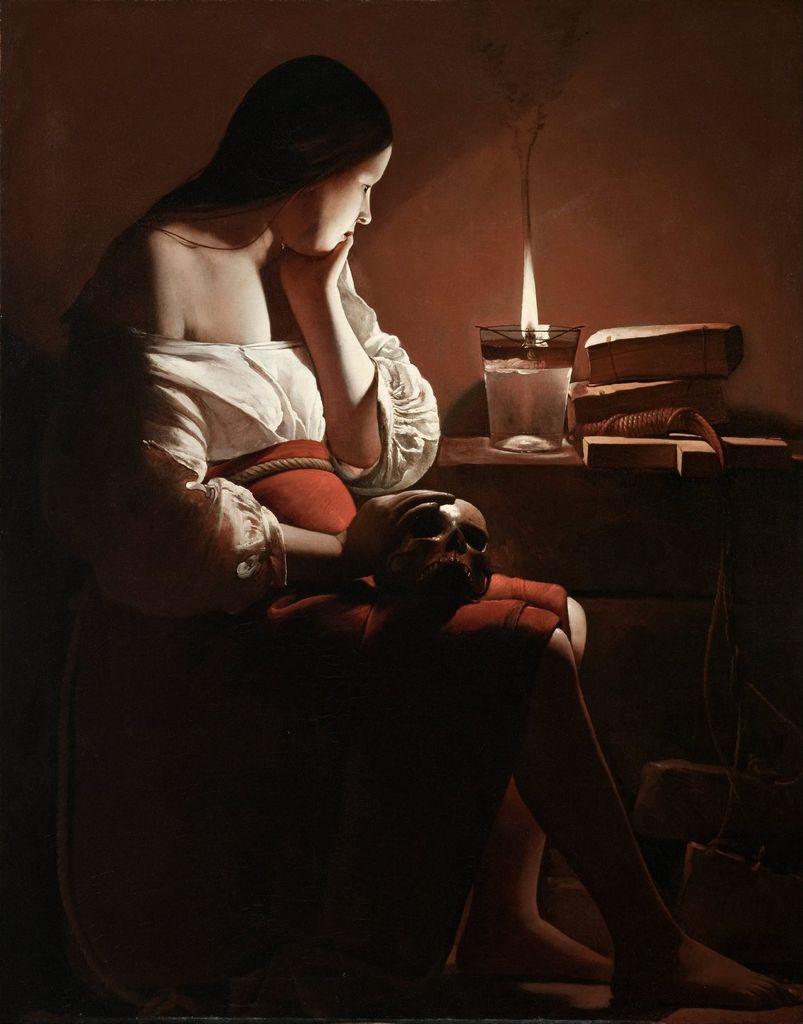
Georges de La Tour's The Magdalen with the Smoking Flame turns the same darkness-light structure toward stillness. A flame illuminates the sitter, a skull and simple objects; the rest of the room is absorbed by black. LACMA identifies the work among La Tour's meditative nocturnal Magdalens, where the candle and skull support reflection on mortality.[5]
The value range is dramatic but the tempo is quiet. Smooth shapes, few objects and a steady profile replace crowded action. This comparison shows that tenebrism is not inherently violent. Darkness can heighten contemplation just as effectively as conversion, music or struggle.
Tenebrism and chiaroscuro
Chiaroscuro is the broader use of light-dark contrast to model volume or organise a composition. The National Gallery describes it as the balance of light and shade used to give three-dimensional form.[8] A softly rounded face can therefore use chiaroscuro without a dominant black field. Tenebrism is the more extreme arrangement in which darkness occupies and controls much of the image.
The distinction is useful rather than absolute. A tenebrist picture also uses chiaroscuro; the terms answer different questions. “How is this cheek made to look round?” points toward modelling. “Why does the entire event appear from a surrounding void?” points toward tenebrist structure. Ribera's Archimedes, for example, uses emphatic light to model weathered skin while the dark ground isolates the philosopher.[6]
A nocturne is simply a night scene, and it need not be tenebrist. Moonlit landscapes can distribute low values gently across a wide space. Conversely, a religious interior may use tenebrism without showing literal night. Black pigment alone is not decisive either: a dark background matters because of how it controls visibility and meaning.
How to recognise tenebrism responsibly
First judge proportion. Does darkness cover a substantial share of the composition, or are there merely strong cast shadows? Then map what the light selects. Faces, hands, pale cloth and instruments often form a chain that guides the reading order. Identify whether the source seems external, visible, concealed or deliberately ambiguous.
Next compare edge behaviour. Tenebrist light can cut a bright sleeve sharply against black, but it can also let a shoulder vanish. Those alternations make the image pulse between disclosure and concealment. Look for information that the painter could have described but chose to suppress: architectural depth, furniture, costume boundaries or bystanders.
Finally separate technique from historical affiliation. An artist may belong to a Caravaggist network yet paint a bright scene; another may use darkness-dominant illumination without direct contact with Caravaggio. Attribution and influence require documentary and comparative evidence. Tenebrism itself is first a visible organisation of the picture—one that turns light into an event and darkness into more than empty background.
Watch: Caravaggio, Tenebrism and Dramatic Darkness
Choose a National Gallery introduction to Caravaggio, a comparison with Wright of Derby, or a film on Caravaggio's wider influence.
Caravaggio: His Life and Style in Three Paintings
Trace direct observation, exposed darkness and concentrated light across three paintings.
Watch on YouTubeFrequently Asked Questions
Tenebrism organises a painting around extensive darkness and concentrated illumination, often with abrupt light-dark transitions.
Chiaroscuro broadly models form or composition through light and dark; tenebrism makes darkness dominant and light more concentrated.
Caravaggio is central to its history and influence, but the later label should not erase other artists, precedents or regional developments.
No. The darkness must have a strong structural relation to concentrated illumination, and historical context still matters.
Map the largest dark field, trace where light enters or appears, identify what it selects, and connect that structure to narrative and historical context.
Discussion
Which painting on this page makes darkness function most actively rather than simply serving as a background?
Reader Insights
Treat darkness as a shaped area with boundaries and depth.
Ask where illumination seems to begin and which actions it selects.
Confirm artist, date, region and function before turning resemblance into attribution.
Join the Conversation
Share one precise observation or a useful museum example below.
References
- Smarthistory, “Caravaggio and Caravaggisti in 17th-century Europe.” https://smarthistory.org/caravaggio-and-caravaggisti-in-17th-century-europe/
- Web Gallery of Art / San Luigi dei Francesi, “The Calling of Saint Matthew.” https://www.wga.hu/html_m/c/caravagg/05/29conta.html
- Uffizi Galleries, “Judith Beheading Holofernes.” https://www.uffizi.it/en/artworks/judith-beheading-holofernes
- Centraal Museum, “The Matchmaker.” https://www.centraalmuseum.nl/en/collection/10786-the-matchmaker-gerrit-van-honthorst
- Los Angeles County Museum of Art, “The Magdalen with the Smoking Flame.” https://collections.lacma.org/node/238070
- Museo Nacional del Prado, “Archimedes.” https://www.museodelprado.es/en/the-collection/art-work/archimedes/0ccfe0b9-a9ba-4a94-b101-2275c9c731cf
- National Gallery of Art, Judith Leyster: A Dutch Master and Her World. https://www.nga.gov/research/publications/pdf-library/judith-leyster-dutch-master-and-her-world
- National Gallery, “Chiaroscuro.” https://www.nationalgallery.org.uk/paintings/glossary/chiaroscuro