by Tom Gurney
Tom Gurney BSc (Hons) is an art history expert with over 20 years experience
Published on June 19, 2020 / Updated on October 12, 2026
Email: tomgurney1@gmail.com / Phone: +44 7429 011000
Nevada Falls, Yosemite by Albert Bierstadt
White water fills a steep channel between dark trees, spreading into spray as it descends towards the foreground. At the lower edge, three visitors occupy a rocky bank beside fallen timber. Albert Bierstadt’s Nevada Falls, Yosemite brings the waterfall’s force close to a scene of looking, walking and resting.
The Metropolitan Museum of Art dates the painting to 1872 or 1873. It is oil on canvas, 99.1 × 76.2 centimetres, and entered the collection as a gift from Mrs. J. Augustus Barnard in 1979. Its accession number is 1979.490.3.[1] The upright format allows the water, trees and visitors to share a view that extends from the distant heights almost to the viewer’s feet.
At a Glance
Where this painting sits in Bierstadt’s career
Dates refer to the paintings, rather than to the journeys behind them. Approximate dates and ranges retain the qualifications in the collection records.
Lake Lucerne
1858Mountain Brook
1863Nevada Falls, Yosemite
1872 or 1873Street in Nassau
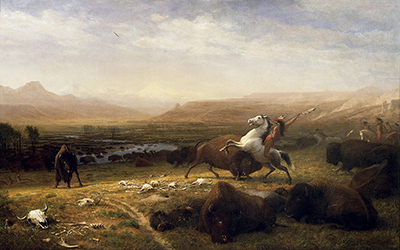
c. 1877–1880The Last of the Buffalo
1888–1889The Golden Gate
1900Contents
A descent through the picture
The most conspicuous water occupies the centre-right. Near the bridge, individual white crests remain visible against darker patches of the channel. Farther down, the distinction between water and spray becomes less clear, and a broad luminous cloud spreads across the central space.
Along its lower edge, the white water forms a long diagonal. The dark bank on the right runs beside it, bringing the descent into relation with the sloping ground occupied by the foreground figures. This arrangement gives the scene a strong downward movement without requiring the whole waterfall to appear as an uninterrupted vertical column.
Higher in the picture, a narrower waterfall appears between trees and a distant ridge. Its pale form is partly veiled by atmosphere, while the surrounding slopes remain subdued. The contrast between that distant fall and the broad foreground torrent establishes different degrees of nearness and force.
The picture rewards following the water through these changing forms: a slender pale shape in the distance, sharper white crests by the bridge, and diffuse spray below. Bierstadt makes moving water visible through a combination of edges, colour and interrupted detail.
Trees that divide the view
The tall tree left of centre is one of the strongest verticals. Its trunk rises through successive layers of foliage and leads towards the upper sky. Smaller trees around it establish a wooded slope whose depth becomes harder to distinguish as mist and shadow soften their outlines.
On the right, a leaning trunk cuts across the brighter water. Its dark silhouette makes the spray behind it appear more luminous. A thinner, nearly bare tree stands farther towards the edge, contributing another vertical form without repeating the fuller canopy beside it.
The trees do more than surround the waterfall. They conceal portions of the slopes and divide the view into irregular openings. Through those gaps, the viewer encounters water, distant forest and pale atmosphere at different depths.
Near the bottom, fallen trunks introduce a different direction. Their rough surfaces stretch across the foreground, placing substantial objects between the visitors and the viewer. The contrast between standing and fallen wood makes this bank feel occupied by particular forms rather than covered with a uniform woodland texture.
The visitors on the bank
Two foreground figures face one another near the fallen timber. One wears a blue dress and holds a slender walking stick; the other wears a dark coat and a light hat, extending a hand towards the companion. A warm-coloured textile hangs over the dark-coated figure’s arm.
Farther right, a seated visitor in a red-orange upper garment rests beside a large rock. That figure’s position supplies a quieter counterpart to the upright pair. The different postures suggest a pause within an excursion, although they do not establish a particular conversation or sequence of events.
The Met identifies the people as sightseers, including two women in hiking clothing. That interpretation makes the foreground part of the waterfall’s historical appeal to visitors. They provide scale, but they also give the landscape a human activity: people have come here to experience and look at it.
The bright garments help these small bodies remain visible against the dark bank. Blue, red-orange and the warm textile provide concentrated colour accents within a scene dominated by green, grey and foaming white.
A bridge within the landscape
A narrow bridge crosses the water in the middle distance. Its horizontal span creates a distinct interruption within the descending channel, while its railing and supports contrast with the trees’ more irregular forms.
Small figures on the bridge extend the theme of visiting beyond the near bank. Their placement gives the viewer another possible position within the scene: standing over the water rather than beside it.
The bridge also complicates an impression of wholly untouched scenery. The painting includes a built crossing within the wooded setting. The landscape’s grandeur and its accessibility to people appear together, each contributing to the way the scene can be understood.
Nevada Fall and seasonal water
Nevada Fall belongs to the Merced River’s course through Yosemite. The Met describes the river plunging over a high ledge onto boulders nearly six hundred feet below. The National Park Service gives the fall’s height as 594 feet, or approximately 180 metres.[2]
The Park Service explains that Nevada Fall flows throughout the year, with peak flow normally in late May or June. More broadly, Yosemite’s waterfalls respond strongly to snowmelt, with spring runoff changing their volume and appearance.
This context helps explain why moving water is such a variable landscape subject. A waterfall retains its site while its breadth, spray and surrounding atmosphere can change. Bierstadt’s image gives particular emphasis to abundant white water, but it cannot establish an exact flow measurement or calendar date from appearance alone.
Ludlow’s account of reaching the falls
Fitz Hugh Ludlow’s The Heart of the Continent, published in 1870, describes an arduous approach to Vernal and Nevada falls.[3] In the selected passage, his party dismounts when the horse trail ends and continues carrying blankets and camp kettles across difficult ground. He then describes climbing ladders near Vernal Fall before proceeding upstream towards Nevada.
At Nevada, Ludlow pays particular attention to the water’s shape. He describes it striking a sloping ledge and spreading sideways like a partly opened fan. That observation gives a historical visitor’s perspective on the relationship between falling water and the rock beneath it.
His height estimates differ from those supplied by the Park Service and should be read as part of a period travel account. The passage is valuable for its experience of terrain, effort and spectacle. It does not identify the painted visitors or prove that this canvas was made at the spot during Ludlow’s journey.
Rock, glaciers and the larger setting
The National Park Service’s geological account explains that glaciers repeatedly reshaped Yosemite’s earlier river-cut valleys, widening and deepening them.[4] Moving ice worked on granitic bedrock, whose fractures influenced patterns of erosion. The resulting landscape includes steep valley walls, domes, waterfalls and glacially polished rock.
That history places the visible relationship between water and stone within a much longer development. The river moves through landforms shaped by processes operating across geological time, while weathering and erosion continue to alter them.
The account concerns Yosemite’s regional formation; it does not assign every rock or slope in Bierstadt’s painting to a measured geological feature. It nevertheless adds substance to the scene’s dramatic contrasts: the foaming torrent occupies a landscape whose apparently solid forms have also undergone change.
Looking from the figures towards the water
Begin with the blue dress and walking stick, then follow the slope past the seated visitor towards the leaning tree. Its trunk rises against the spray and leads the eye towards the bridge and wooded heights.
The view can also be followed downwards. Distant water gives way to the broader torrent; the torrent approaches the bank; the bank returns attention to people and fallen timber. Bierstadt sustains this movement between large natural forms and small, recognisable details, making the waterfall an experience situated within a landscape of trees, rock and human presence.
Watch: Albert Bierstadt
Five perspectives on his paintings and their historical setting.
American Landscape Painting: Albert Bierstadt and the American Land
A Museum of Fine Arts, Boston presentation on American Landscape Painting: Albert Bierstadt and the American Land.
Explore Bierstadt’s artworks
Discussion
The visitors, bridge and torrent offer several positions from which to experience the falls. Where does the composition place you in relation to them?
Reader Insights
How does the water change from a distant pale form to sharp crests and then diffuse spray?
What does the bridge contribute to the picture’s account of access to a seemingly wild landscape?
How do the standing pair, seated visitor and bright garments give the foreground a different rhythm from the waterfall?
Join the Conversation
Share a specific observation, documented connection or comparison from Nevada Falls, Yosemite.
References
- The Metropolitan Museum of Art. Nevada Falls, Yosemite, 1872 or 1873, 1979.490.3. Collection record, gift credit and interpretation of the sightseers. View source text
- National Park Service. Waterfalls, Yosemite National Park. Nevada Fall’s height and seasonal flow, with regional snowmelt context. View source text
- Fitz Hugh Ludlow. The Heart of the Continent, New York: Hurd and Houghton, 1870, pp. 441–444. Selected original account of the approach to Vernal and Nevada falls; digitised copy held by Brigham Young University. View source text
- National Park Service. Geology, Yosemite National Park. Selected discussion of glacial erosion, granitic bedrock and continuing landscape change. View source text