by Tom Gurney
Tom Gurney BSc (Hons) is an art history expert with over 20 years experience
Published on June 19, 2020 / Updated on October 12, 2026
Email: tomgurney1@gmail.com / Phone: +44 7429 011000
On the Platte River, Nebraska by Albert Bierstadt
A low riverbank, dark trees and an orange sky give On the Platte River, Nebraska a concentrated evening atmosphere. Water stretches behind the foreground vegetation, carrying subdued reflections towards the distant bank. The scene's breadth comes from these horizontal passages rather than from the towering mountains that dominate many of Albert Bierstadt's western landscapes.
Gilcrease Museum identifies the work as On the Platte River, Nebraska, accession 01.14, and describes its medium as oil on pasteboard.[1] Its published image matches the composition reproduced here. The accessible image manifest supplies no creation date, so the painting should not automatically receive the 1863 date attached to other Platte River compositions.
At a Glance
Where this painting sits in Bierstadt’s career
Dates refer to the paintings, rather than to the journeys behind them. Approximate dates and ranges retain the qualifications in the collection records.
Lake Lucerne
1858Mountain Brook
1863Street in Nassau
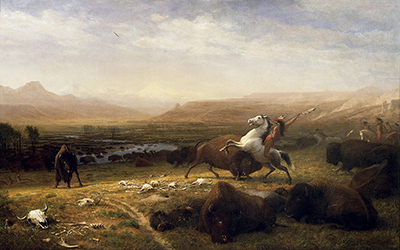
c. 1877–1880The Last of the Buffalo
1888–1889The Golden Gate
1900On the Platte River, Nebraska
Not dated in the cited recordContents
A river seen through the bank
The foreground prevents an uninterrupted view of the water. A rounded rock enters from the left edge, while low shrubs spread across the bottom. On the right, a taller tree rises from the near bank, its trunk standing against a pale strip of river. Broken upright branches beside it add a smaller, more angular accent.
These forms place the viewer close to the vegetation. The river begins beyond them, with the near bank concealing parts of its course. The visible water widens towards the left and continues behind the right-hand tree, making the landscape feel broader than the opening through which it is seen.
The opposite bank carries a succession of tree clumps. Their contours overlap, but individual trunks and gaps remain visible in places. Farther left, the ground flattens into a low ridge beneath the sky. This transition from nearby brush to distant land creates depth without a conspicuous road or a line of travellers leading through the picture.
Warm clouds above cool water
The brightest colour lies above the horizon. Orange and muted red passages spread beneath grey cloud masses, while warmer edges catch the upper contours of clouds farther to the left. The sky contains several kinds of marks: broad horizontal strokes near the distance, broken touches along illuminated edges, and longer strokes within the upper atmosphere.
Below, the river is cooler and paler. Its grey-green and yellowish passages repeat the sky's horizontal movement while softening its stronger colour. Darker streaks beneath the far trees suggest reflections, connecting the bank to the water without turning it into a perfect mirror.
The foreground tree brings these two regions together. Its crown overlaps the warm sky; its trunk crosses the water; its base disappears into the dark bank. Following it downwards takes the eye through the painting's principal layers. The tree's dark mass also makes the adjacent river appear lighter, giving a relatively quiet stretch of water a clear place in the composition.
The contrast creates an evening effect, but appearance alone cannot establish the hour, season or weather of a particular observed sunset.
What the painted surface reveals
Gilcrease's large reproduction makes the handling of paint easier to examine. The river is built from elongated strokes, while the foreground shrubs contain denser, irregular touches. Several cloud passages remain visibly brushed rather than smoothed into continuous transitions. The distribution of these marks helps distinguish water, foliage and atmosphere.
This direct handling gives the image the immediacy often associated with a landscape study. The museum's identification of pasteboard provides useful material information, but neither the support nor the visible brushwork proves that Bierstadt painted it outdoors. No documented connection to a larger finished canvas has been established for this particular work.
Look especially at the change from the left-hand cloud edges to the foreground vegetation. The clouds receive scattered warm accents; the shrubs accumulate darker marks and occasional lighter touches. Bierstadt varies the density of detail across the picture, keeping the sky open while making the nearest ground more intricate.
Bierstadt's journeys and the Nebraska Territory
Bierstadt's western experience gives the subject a broader historical setting. The Metropolitan Museum of Art records that he accompanied Frederick W. Lander's government survey expedition to the Nebraska Territory in early 1859. By summer the party had reached the Wind River Range in present-day Wyoming.[2]
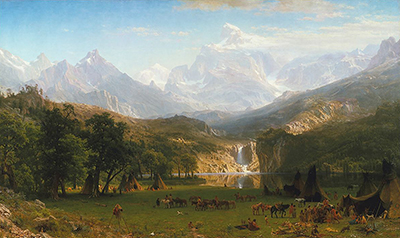
The Met's The Rocky Mountains, Lander's Peak, painted in New York after that journey, demonstrates that western observations could become the basis of later studio pictures. It also shows why a journey date and a painting date need to be distinguished. The documented expedition establishes relevant experience, but does not date Gilcrease's river painting or identify its precise viewpoint.
The Met interprets its own mountain canvas in relation to Manifest Destiny and the displacement of Indigenous peoples. That interpretation concerns a different, much larger composition. It nevertheless raises a relevant question when looking at western landscape painting: what histories become less visible when attention settles primarily on scenery?
An inhabited regional history
The National Museum of the American Indian's evidence resource on the Pawnee treaties of 1833 and 1857 describes communities whose seasonal lives combined village horticulture with journeys west to hunt bison.[3] It also explains that land cessions did not amount to an agreement to abandon Pawnee cultural practices, and records resistance to pressures for assimilation.
This regional history gives substance to land that may look unoccupied within a landscape image. Rivers belonged to networks of settlement, food production, movement and political negotiation. A view concentrating on trees and water cannot represent all those relationships.
The museum resource does not identify the exact bank shown by Bierstadt, and the painting offers no clearly readable people whose identity could settle that question. Its value here is to widen the historical frame without assigning a specific community or event to an undocumented location.
A river whose banks can change
A U.S. Geological Survey study of the Platte's physical habitat describes braided channels, sandbars and wooded islands, and explains that the North and South Platte join near North Platte, Nebraska.[4] Its selected historical discussion connects vegetation growth, sediment accumulation and changing channel widths. It also records the effects of later reservoirs and diversions on river flow.
Those processes help explain why water and vegetation deserve to be considered together. A wooded bank is part of a changing river system: plants can stabilise sediment, while altered flows can influence where vegetation becomes established.
The study concerns surveyed reaches and later river history, rather than Bierstadt's exact site. Its measurements cannot be read backwards from this painting. The picture preserves an arrangement of bank, trees, water and light; it does not provide a survey of the entire Platte or evidence that its channels have remained unchanged.
Following the horizontal view
Begin at the rock on the left, then follow the pale water towards the far trees. Move back across their reflections to the foreground trunk, and from its crown into the orange cloud passages. This circuit draws together the picture's compact range of forms.
Bierstadt gives the river landscape its character through differences in colour, touch and distance. The broad sky expands the view, the foreground vegetation brings it close, and the water holds the two in relation.
Watch: Albert Bierstadt
Five perspectives on his paintings and their historical setting.
American Landscape Painting: Albert Bierstadt and the American Land
A Museum of Fine Arts, Boston presentation on American Landscape Painting: Albert Bierstadt and the American Land.
Explore Bierstadt’s artworks
Discussion
Water, foliage and cloud form a narrow, intimate river view. Which painted marks give the scene its strongest sense of movement?
Reader Insights
How do elongated marks in the water differ from the touches describing vegetation and cloud?
How does distinguishing Nebraska Territory in 1859 from the later state affect the historical questions you bring to the title?
What can you observe in the painted riverbank, and what would require the later hydrological evidence before drawing conclusions about channel change?
Join the Conversation
Share a specific observation, documented connection or comparison from On the Platte River, Nebraska.
References
- Gilcrease Museum. On the Platte River, Nebraska, 01.14. Full image manifest: title, artist, oil-on-pasteboard medium and matching museum reproduction; no date supplied. View source text
- The Metropolitan Museum of Art. The Rocky Mountains, Lander's Peak, 1863, 07.123. Collection record and interpretation of the 1859 expedition and later studio painting. View source text
- National Museum of the American Indian. The Pawnee Treaties of 1833 and 1857: Evidence Kit. Seasonal livelihoods, cultural continuity and treaty interpretation. View source text
- Ronald B. Zelt and Steven A. Frenzel, U.S. Geological Survey. Physical-Habitat Characteristics of the Platte River, Nebraska—Assessment Using Surveys and Spatial Analyses. Selected introduction and historical discussion of channels, vegetation and altered flows. View source text