 by Tom Gurney
Tom Gurney BSc (Hons) is an art history expert with over 20 years experience
Published on June 19, 2020 / Updated on October 12, 2026
Email: tomgurney1@gmail.com / Phone: +44 7429 011000
Albert Bierstadt Prints
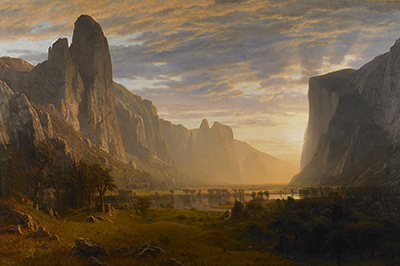
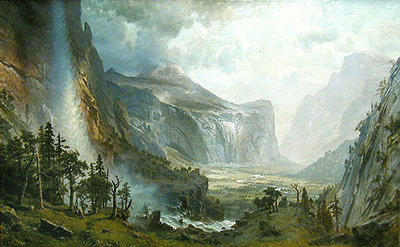
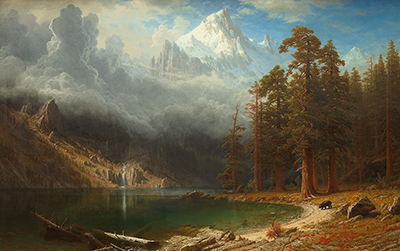
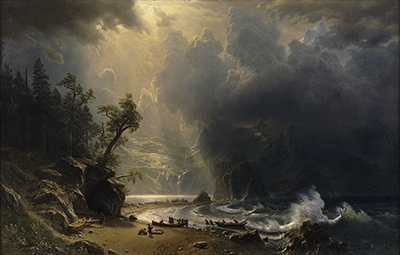
Albert Bierstadt prints offer two different ways of encountering his landscapes: historical reproductions made during his lifetime and modern images of his paintings for display at home. The distinction matters because a nineteenth-century engraving has its own makers, materials and publication history, while a contemporary reproduction should be judged by the painting it reproduces, the completeness of its image and the quality of the finished product.
Bierstadt's pictures invite attention to mountain ridges, illuminated clouds, distant water and small foreground figures. A reproduction can preserve that invitation, but it also changes the scale and surface of the original. Choosing a print begins with understanding which picture—and which kind of object—you are looking at.
Contents
Prints were part of Bierstadt's public career
The Museum of Fine Arts, Houston describes how Bierstadt promoted The Rocky Mountains, Lander's Peak through a travelling exhibition devoted to the painting, an accompanying pamphlet and an engraving. The reproduction extended the picture's public life beyond the canvas itself.[1]
The museum records a chain of collaborators. James Smillie was engaged to make the engraving; his son, James David Smillie, was to prepare a reference drawing using a photograph supplied by Bierstadt's brother Edward. Planning began in 1863, but the travelling painting complicated preparations, and the plate was completed in 1866.
This account makes reproduction part of a coordinated enterprise. Photography, drawing, engraving and exhibition were connected stages, with different people contributing to the result. A print after Bierstadt need not be a print personally engraved by Bierstadt.
The Houston impression is catalogued as an engraving and etching on wove paper, a proof before lettering. That description identifies a particular form of the print. It should not be applied automatically to every impression or to a modern copy of the same composition.
The hand-coloured Lander's Peak engraving
The Metropolitan Museum of Art holds an 1866 version credited to James Smillie and Albert Bierstadt. Its medium is hand-coloured steel-plated etching and engraving. The image measures 42.5 × 69.9 centimetres, while the sheet is larger, at 49.7 × 75.6 centimetres; the object number is 1974.211.[2]
These separate measurements are useful. Image size describes the printed scene, sheet size includes its surrounding paper, and a mount or frame adds further dimensions. A seller's single measurement can therefore leave an important question unanswered: how large will the landscape itself appear?
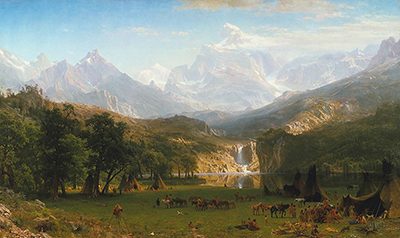
In the Met's image, the lake forms a horizontal pause between a busy foreground and the immense mountain wall. Dark trees occupy the left, while tipis, horses and people gather across the lower part of the composition. The pale high mountain rises through a much lighter atmosphere above them.
Colour and fine detail work together. The foreground contains many small marks and distinct objects; the distant peaks are comparatively subdued. Reducing this composition to a very small print can make the mountain silhouette legible while diminishing the human activity that gives the foreground its character.
The museum's photograph also includes a pale lower margin and lettering below the landscape. Those features belong to the historical printed object. An image cropped to the landscape alone conveys a different view of it, even if the composition inside the border is unchanged.
A separate colour lithograph
The Amon Carter Museum of American Art records a chromolithograph of The Rocky Mountains, Lander's Peak dated 1869, accession 1968.40. Its contributors are Jacob Lutz, who drew the image on stone; Thomas McLean, the publisher; and Kell Bros., the printer.[3]
The same painted composition thus circulated through a different technique and a different team. The Carter print should not be catalogued as the Met's 1866 Smillie engraving simply because its title and mountain are recognisable.
In the Carter's reproduction, warm yellow light crosses the slopes and foreground, while the trees at the left form a deep green screen. The lake remains a narrow reflective band and the distant mountain a pale central presence. The arrangement is familiar, but the appearance of this recorded impression differs from the hand-coloured engraving.
Such differences cannot be assigned to printing technique alone from website photographs. The colouring of an individual impression, its condition and the photography used to record it can also affect what appears on screen. A comparison is most useful when it keeps the identity and medium of each object clear.
The Last of the Buffalo in black ink
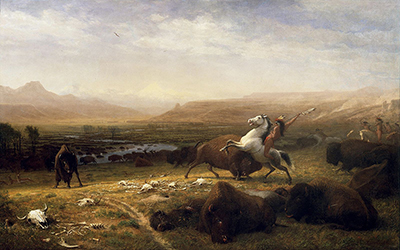
Bierstadt's later compositions also entered print culture. The National Gallery of Art holds an 1891 The Last of the Buffalo, made after Bierstadt and associated with the printer Boussod et Valadon. It is a photogravure in black with chine collé on wove paper, accession 2015.19.3216.[4]
The Gallery's account of photogravure explains the process as a method of etching a photographic image into a copperplate and printing it in ink.[5] This is another route from an image to a printed object, distinct from the engraving and colour lithograph described above.
In this impression, the central encounter between a mounted hunter and a bison stands out through tonal contrast. The horse is pale, surrounding animals are dark, and the distant plains become lighter towards the mountains. Bones and fallen bodies occupy the foreground. The loss of the painting's colours does not remove its dramatic organisation: light and dark carry the conflict across the sheet.
A monochrome print therefore has an identity beyond being an incomplete colour reproduction. It directs attention towards silhouettes, density and the distribution of illumination. Readers comparing versions should consider that effect as well as the subject they share.
Dates, signatures and makers' names
A date visible inside the image is not necessarily the publication date of the print. The Carter chromolithograph is dated 1869 in the museum record, although its inscription reproduces Bierstadt's name and the date 1863. The earlier date belongs to the represented image's inscription and does not turn this particular print into an 1863 object.
Likewise, a name printed within the composition differs from a signature added by hand. The National Gallery's buffalo print has inscriptions in the plate and a separate graphite dedication to Senator Sherman. Those are different kinds of marks on one recorded sheet, not interchangeable evidence of how every reproduction was issued.
For a historical print, useful questions include who made and published it, which technique was used, whether the paper margins survive, what inscriptions are present and whether the object has a documented history. A copied signature on a contemporary poster does not establish that Bierstadt signed that sheet.
Museum records provide examples against which descriptions can be read. They do not authenticate a different object offered for sale. When a listing uses terms such as proof, original, signed or antique, those claims need information about the actual impression being offered.
Choosing the painting and the complete image
For a modern reproduction, identify the painting before selecting a size or frame. Several Bierstadt landscapes have similar titles, and a broad description such as a Rocky Mountain scene may conceal differences between distinct works. Comparing the complete composition with a museum image is more dependable than relying on a familiar title alone.
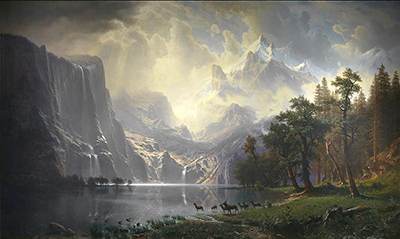
Then look at the image boundary. A print may reproduce the entire painting, crop its edges or place it within an additional decorative border. For a landscape built around wide expanses, trimming the sides changes the relation of foreground trees, open water and distant mountains. In a vertical waterfall picture, removing space above or below can alter the impression of height.
A rectangular painting fitted to a square product deserves particular attention. Check whether the image has been cropped, surrounded by extra space or distorted. None of those choices should remain hidden in a small product photograph.
Choose a composition for the details you want to live with. An expansive mountain panorama and a quiet woodland stream offer different patterns of looking. A room-sized mock-up can help assess overall scale, but a close view of the printed image is needed to judge small figures, foliage and distant rock formations.
Assessing a modern reproduction
Compare image dimensions with the space where the print will hang. Include the proposed mount and frame rather than measuring only the advertised paper or canvas. A broad margin may make a modest image into a much larger wall object.
Request a clear description of the material and printing method. Paper, canvas and other supports give the same image different surfaces; the choice should be visible in the product details. A canvas reproduction does not acquire the painted surface of Bierstadt's original merely by using canvas as its support.
Inspect the seller's close photographs for sharpness and tonal separation. In Bierstadt landscapes, bright sky, cloud and snow should retain distinct shapes, while shaded trees should remain more than an undifferentiated dark mass. These are useful points to examine, although an on-screen preview cannot guarantee the appearance of the delivered object.
If colour fidelity matters, compare the listing with the owning museum's image and ask whether a physical sample or detailed photograph is available. Avoid judging a reproduction solely by how saturated its blue sky or golden light looks in a thumbnail. The relationship among colours and the legibility of the composition matter more than isolated brilliance.
Finally, read the dimensions, framing description, delivery information and return conditions for the specific product. These practical checks support a purchase decision without relying on claims of popularity, investment value or universal quality.
Framing and displaying paper prints
Paper prints benefit from thoughtful placement and framing. The Library of Congress recommends chemically stable framing materials, separation between the work and glazing, and display away from direct sunlight, strong light sources, radiators and working fireplaces. Its guidance applies to reproductions as well as original works on paper.[6]
A mount or suitable spacers can provide the necessary separation from the glazing. Discuss the paper, mounting method and backing materials with the framer, especially for a historical impression whose margins and inscriptions are part of the object.
Protective framing reduces exposure to damaging conditions, but it does not make light harmless. The Library advises against permanent display of valuable paper originals and suggests displaying a well-made reproduction instead. The choice between a historical print and a contemporary copy can therefore affect how the image is used as well as how it is collected.
A Bierstadt reproduction is most rewarding when its identity, format and presentation are understood together. The historical examples show that translating his paintings into prints has long involved choices about technique, colour, scale and audience. A modern buyer can make those choices more consciously by looking closely at the actual image and the object being offered.
Watch: Albert Bierstadt
Five perspectives on his paintings and their historical setting.
American Landscape Painting: Albert Bierstadt and the American Land
A Museum of Fine Arts, Boston presentation on American Landscape Painting: Albert Bierstadt and the American Land.
Explore Bierstadt’s artworks
Discussion
Reproductions can change how a painting is encountered. Which differences of material, date and scale matter most when comparing the examples discussed here?
Reader Insights
What would you look for when comparing the steel engraving, chromolithograph and photogravure described above?
How can a painting’s date and a print’s publication date tell different parts of the same reproduction history?
Which information about the complete image, paper, image dimensions and framing would help you make an informed comparison?
Join the Conversation
Share a specific observation, documented connection or comparison from Albert Bierstadt Prints.
References
- Museum of Fine Arts, Houston. The Rocky Mountains, Lander's Peak, James Smillie after Albert Bierstadt, 1866, B.2019.14. Engraving campaign and proof description. View source text
- The Metropolitan Museum of Art. The Rocky Mountains, Lander's Peak, 1866, 1974.211. Hand-coloured engraving, dimensions and inspected museum image. View source text
- Amon Carter Museum of American Art. The Rocky Mountains, Lander's Peak, 1869, 1968.40. Chromolithograph's makers and inscriptions; image inspected. View source text
- National Gallery of Art. The Last of the Buffalo, 1891, 2015.19.3216. Photogravure's medium, printer and distinct inscriptions; image inspected. View source text
- National Gallery of Art. Etched by Light: Photogravures from the Collection, 1840–1940. Explanation of the photographic copperplate printing process. View source text
- Library of Congress. Preservation Guidelines for Matting and Framing. Materials, glazing separation, light exposure and display guidance for works on paper. View source text