by Tom Gurney
Tom Gurney BSc (Hons) is an art history expert with over 20 years experience
Published on October 12, 2026 / Updated on October 12, 2026
Email: tomgurney1@gmail.com / Phone: +44 7429 011000
Albert Bierstadt: Style and Technique
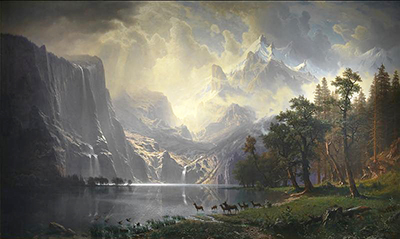
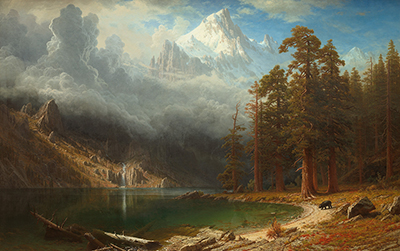
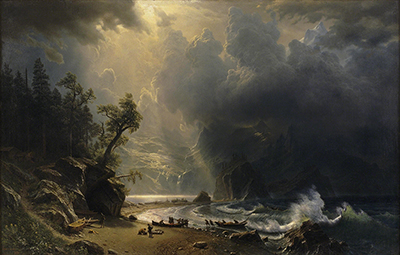
Albert Bierstadt’s landscapes ask for two kinds of attention. From a distance, a mountain range or a luminous valley seems to open beyond the frame. Move closer and the foreground offers individual leaves, broken rocks, water and small figures. The sweep and the detail belong to the same construction: a painting that can absorb the viewer before rewarding inspection. Its effects depend on composition, contrasts of light and shade, and controlled paint handling, as well as on sheer size.[1]
The monumental western panoramas are his best-known expression of that approach, but his practice also includes quick oil studies, enclosed woodland scenes and small Bahamian pictures. Understanding how those works differ is more useful than imagining a single method applied to everything he painted.
Contents
From field studies to studio landscapes
Bierstadt developed his craft in the artistic environment of Düsseldorf during the 1850s. Lisa Strong distinguishes this training from formal enrolment at the Düsseldorf Academy, which he did not attend. His American mentors, Worthington Whittredge and Emanuel Leutze, helped him acquire the detailed naturalism and smooth finish associated with the city’s painters.[2] Extended sketching journeys then supplied material he could develop in the studio. Nancy Anderson traces that method from his European travels into his later American landscapes.[3]
Fieldwork gave him a store of observed forms and colour relationships. A completed panorama required him to decide how those observations would fit together: where a dark tree would interrupt an expanse of light, how a foreground bank would lead toward water, and which distant peak would command the view. Anderson describes his field sketches as memory aids for Lake Lucerne, painted in 1857–58 from material gathered in Switzerland in 1856. He preserved recognisable mountain forms while taking considerable freedom with the arrangement, particularly in the foreground.[3]
Technical examination makes that freedom tangible. In Lake Lucerne, infrared reflectography and X-radiography revealed traces of underdrawing, probably in pencil, and substantial revisions beneath the finished image. At the far left, a rocky cliff became trees; at the far right, the church was moved at least twice. Several mountain profiles also changed. These discoveries show a composition developing on the canvas. They do not establish that every Bierstadt painting began with the same drawing procedure.[3]
His small oils served different purposes, too. Conservators Lance Mayer and Gay Myers describe Mountain Landscape with Sunset as a rapidly painted, wet-into-wet sketch: fresh strokes were worked into paint that had not yet dried. In Italian Costume Studies, the blue paper remains exposed around the figures, while broken strokes make use of its texture. By contrast, the small South Dome, Yosemite Valley is worked over its entire surface with a finish approaching that of a larger picture. Its inscription, “May 1867,” does not securely establish when or where it was painted.[1]
A small size and lively surface, therefore, are clues to how a work was handled, but they cannot by themselves prove outdoor execution. Bierstadt’s studies range from immediate notation to carefully resolved images, and the relationship between a study and a large painting needs to be established for each pair.
Light that organises the view
In Lake Lucerne, the foreground trees and rocky road are relatively dark and sharply articulated. Beyond them, brighter fields and the narrow turquoise lake open the scene, while the mountains become paler and less distinct with distance. The eye moves through successive zones of contrast. Light establishes depth and gives the viewer a route through a complicated landscape.[3]
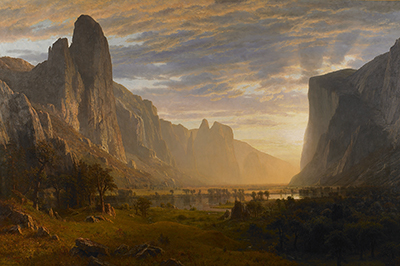
Anderson identifies a related structure in Looking Down Yosemite Valley, California: an elevated foreground, areas of deep shade, water in the middle distance and a distant mountain enclosure. Bierstadt adapted a compositional understanding developed in Europe to the granite landscape of Yosemite. The glowing distance gains force from its relationship to the darker ground in front of it.[3]
He could use the same command of contrast within a much narrower space. In Mountain Brook, the large illuminated boulder, pale birches and white falling water emerge from a dense woodland interior. A small opening of blue sky offers depth, but the principal activity remains close to the viewer. Light makes bark, stone, foliage and water distinguishable within the enclosing shade. This is an intimate encounter with landscape even though the painting is a substantial exhibition canvas.[1]
The Bahamian Street in Nassau offers another variation. Alba Campo Rosillo contrasts its human scale and everyday setting with the sublime panoramas. In her account, recurring colour accents guide the eye around the road, figures, wall and vegetation. The red of the central woman’s skirt, adjoining greens and nearby blue create a rhythm different from the large fields of light and colour in the mountain pictures. Campo Rosillo relates these combinations to Michel Eugène Chevreul’s theory of colour contrast; this is her analysis of the painting, rather than documentary proof that Bierstadt studied a particular treatise.[4]
How far does “Luminism” explain Bierstadt?
The emphasis on light makes the term tempting. Yet light alone is too broad a criterion. In American Paradise, Doreen Bolger Burke and Catherine Hoover Voorsanger discuss Luminism as a later critical category whose definition remains debated. They distinguish the unified, light-filled compositions associated with painters such as Sanford Robinson Gifford and John Frederick Kensett from the more detailed Hudson River School approach.[5]
Bierstadt shares some of those painters’ interest in atmosphere and unobtrusive handling. His panoramic pictures, however, often accumulate detail, heighten differences between darkness and brilliance, and direct attention toward an imposing summit or break in the clouds. “Luminism” can help frame a comparison, but it explains only part of a practice that also embraces theatrical scale and strong contrasts.
What the painted surface reveals
The apparent radiance of a Bierstadt landscape does not necessarily come from transparent layers of paint. Mayer and Myers found largely opaque, straightforward handling in the examined In the Yosemite Valley. Their broader comparison suggests that many of his finished surfaces are relatively even, with brushstrokes serving the represented forms rather than drawing attention to their own movement. They contrast this with Thomas Cole’s more visibly fluid, swirling handling.[1]
Lake Lucerne provides a closely documented example of variation within one surface. Its technical notes describe predominantly opaque paint, thin transparent passages in the darks, and raised highlights—impasto—in the foreground. Numerous brushstrokes remain visible. Smoothness at the scale of the whole image can coexist with local texture and thicker accents.[3]
Such distinctions mattered to nineteenth-century critics. Mayer and Myers argue that objections to Bierstadt’s technique concerned the character of his surfaces as well as the quantity of detail. Viewers who valued more vigorous, expressive brushwork could find methodical handling unsatisfying, even when the image was elaborate. His finish became part of the debate over what landscape painting should offer: a convincing scene, pleasure in the act of painting, or some combination of the two.[1]
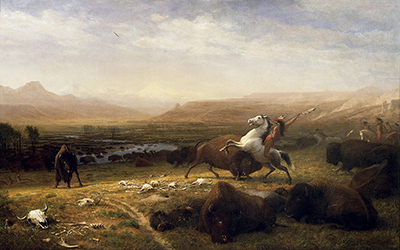
Paint analysis adds precision to this picture when its findings stay attached to the sampled passages. Examination of the two versions of The Last of the Buffalo, for example, identified natural ultramarine, cobalt blue and lead white in sampled sky paint. A sampled dark green from the former Corcoran canvas contained Prussian blue and lead chromate. These results establish something about those paintings; the colours visible in another landscape require their own investigation.[6]
Late experiments and the wish to preserve paintings
Some of Bierstadt’s later pictures complicate the idea of a consistently smooth, technically orthodox practice. Dare Myers Hartwell investigated a small group of works with graphite-containing grounds, including the Cody version of The Last of the Buffalo. There, a dark graphite layer lies beneath the lead-white preparation. The corresponding layer is absent from the larger, former Corcoran version. Hartwell proposes that graphite may have been intended to protect the canvas, drawing on contemporary advertising for protective graphite paints; Bierstadt’s reason for choosing it is not documented.[7]
His concern about the physical behaviour of paintings is documented more directly. In a letter dated 27 June 1877, transcribed by Hartwell, he discusses protection from moisture and dirt and the changing tension of a canvas. “The colors we use are not elastic like rubber,” he writes, explaining why repeated movement concerned him. His discussion of panel backs belongs to that practical problem of preservation.[7]
Other evidence remains less conclusive. Hartwell reports positive tests for oil and protein in paint from both Last of the Buffalo versions, suggesting that casein or glue may have been present. An oil-and-water emulsion is a possible explanation, rather than a proven recipe. She also cites curator William MacLeod’s diary entry of 22 July 1886, recording Bierstadt’s recommendations for oil and copal varnish, alongside another adviser’s disagreement. Hartwell found no evidence that copal varnish had actually been used in treatment of the Corcoran paintings.[7]
The two buffalo canvases also reveal continuing compositional decisions. Similar underlying changes to animals and mounted figures suggest overlapping work on the versions, although the precise sequence remains a hypothesis. Later interventions can affect their appearance as well: a missing standing buffalo in the Cody painting was reconstructed during its 1984–85 conservation using surviving traces and comparison with the larger version. That reconstruction belongs to the Cody canvas.[6]
Behind the canvas
The panel back in Bierstadt’s letter is a separate structure behind the painted fabric. Mary Holland’s account of nineteenth-century panel-back stretchers explains that thin wooden panels fitted into rails between the stretcher members, without touching the canvas. She identifies Bierstadt among the Hudson River School painters who favoured these supports. The panels provided a barrier against dirt and physical impact and helped buffer changes in humidity that could make canvas expand and contract.[8]
Holland’s case study of Jasper Cropsey’s Greenwood Lake (1869) also shows why the structure’s condition matters. Damaged parts were pushing against the canvas, and heavier cracking corresponded to an area where a panel was missing. These observations concern Cropsey’s painting, but they clarify the practical problem Bierstadt was discussing: the painted image depends on an arrangement of supports that a viewer facing the work may never see.[8]
The painting in its frame and gallery
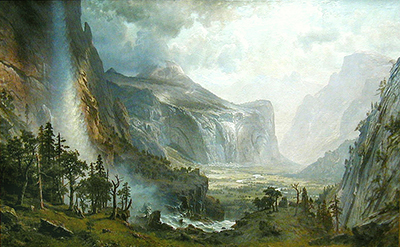
The light depicted inside a landscape is only one part of its appearance. Actual light falling on the surface affects how clearly viewers can see dark passages, colour differences and the whole image. Mayer and Myers show that this was a live concern during Bierstadt’s career. At the 1867 exhibition of The Domes of the Yosemite, lighting was carefully controlled and raised galleries helped determine the spectators’ viewpoint.[1]
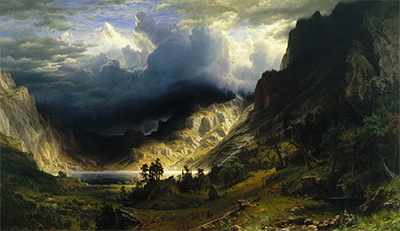
Gaslight enabled evening exhibitions, and photographs of Bierstadt’s Malkasten studio show gas fixtures. He sometimes painted at night. The preferred light could still be a matter of dispute: Mayer and Myers report that a viewer preferred Storm in the Rocky Mountains, Mt. Rosalie under artificial illumination, while Bierstadt himself preferred daylight.[1]
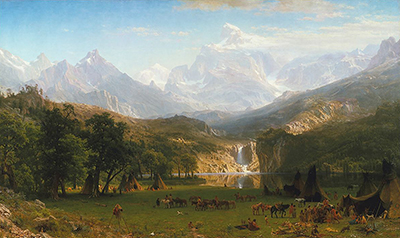
Hanging height and angle mattered because light reflected from a varnished surface could obscure the image. Nineteenth-century paintings were often hung high and tilted forward, partly to manage reflections. Frames also changed the surrounding contrast. The Rocky Mountains, Lander’s Peak appeared in a dark wood frame at the 1864 Sanitary Fair; other Bierstadt paintings had gilt frames. Mayer and Myers suggest that dark wood could intensify the perceived brightness and window-like effect of a landscape, while contemporary opinion differed over which framing best served the pictures.[1]
Preservation adds a further layer to what a viewer encounters. Brooklyn Museum’s May 2017 announcement proposed removing surface dirt and deposits from A Storm in the Rocky Mountains, Mt. Rosalie and its gesso and gilt frame. It scheduled public conservation for 7 June–15 July and recorded the previous extensive treatment in 1976. The announcement documents a planned intervention, rather than confirming its completion.[9]
How treatment changes what we see
The visible surface brings together Bierstadt’s decisions, the aging of materials and the results of later care. A subdued detail may have been painted softly, or it may be obscured by a coating. A raised texture may belong to the original brushwork, while another irregularity may result from damage or an earlier intervention. Conservation records help distinguish these possibilities when a photograph alone cannot.
The museum account in The Nine-Ton Cat gives a vivid example from Lake Lucerne. As a conservator removed discoloured old varnish while preparing the rediscovered painting for exhibition, the tiny clock face on the village church emerged from what a curator remembered as a murky area. This is a published recollection of the cleaning, rather than a laboratory report, but it shows how a small narrative detail can become readable again without being newly painted into the scene.[10]
McKay Lodge Conservation Laboratory describes a different choice for a canvas it calls Oregon Trail and dates to 1869. Its sunset caravan is distinct from the nighttime camp discussed on our Oregon Trail page. The laboratory found yellowed varnish pooled in the paint texture; earlier attachment to a board had affected the canvas weave and paint surface. Examination under ultraviolet light also revealed retouching and an old tear repair. Conservator Stefan Dedecek retained the existing varnish, treating it to reduce yellowing and make the layer more even, before addressing minor losses.[11]
Removal in one case and retention in another reflect decisions about particular objects. Neither account establishes a universal treatment for Bierstadt’s paintings. For the viewer, their value is more immediate: an apparently continuous landscape can carry a complicated material history. Looking closely at the image and reading the record of its care are complementary ways of understanding its present appearance.
In front of an original, allow time for both distances Bierstadt’s painting invites. Step back to follow the larger distribution of shade, water, sky and mountains; then approach to examine the strokes that describe a rock or a branch. If glare obscures a passage, a small change of position can reveal it. Those shifts bring the immense constructed view and the material surface into the same experience.
Watch: Albert Bierstadt
Five perspectives on his paintings and their historical setting.
American Landscape Painting: Albert Bierstadt and the American Land
A Museum of Fine Arts, Boston presentation on American Landscape Painting: Albert Bierstadt and the American Land.
Explore Bierstadt’s artworks
Discussion
Which aspect of Bierstadt’s technique most changes how you understand the apparent light in his landscapes?
Reader Insights
Compare a panorama’s overall effect with its foreground detail. How do composition and paint handling support these different kinds of looking?
Keep the examined Yosemite painting and the two Buffalo versions distinct. Why does the identity of the tested object matter when discussing a painter’s technique?
Compare the effects of framing and gallery lighting with the conservation examples. Which changes affect how a painting is seen, and which alter the material surface itself?
Join the Conversation
Share a specific observation, documented connection or comparison from Albert Bierstadt: Style and Technique.
References
- Lance Mayer and Gay Myers. “Bierstadt and Other 19th-Century American Painters in Context,” Journal of the American Institute for Conservation 38, no. 1 (1999), pp. 55–67, especially sections 2.1–2.3, 3.1–3.3 and 4. Historical exhibition accounts and critical responses are discussed as transmitted by the authors through their cited scholarship, including Anderson and Ferber’s Albert Bierstadt: Art & Enterprise (1990). View source text
- Lisa Strong. “Mount Corcoran,” in Sarah Cash, ed., Corcoran Gallery of Art: American Paintings to 1945 (2011), p. 140, with notes on pp. 267–268; Düsseldorf training and Academy attendance. View source text
- Nancy K. Anderson. Albert Bierstadt biography and “Lake Lucerne,” in American Paintings of the Nineteenth Century, Part I (National Gallery of Art, 1996), pp. 31–39; especially the technical notes on p. 33, field-to-studio method on pp. 33–34, and compositional comparisons on pp. 36–38. View source text
- Alba Campo Rosillo. “Bierstadt’s view of a street in Nassau: a painting about becoming,” Open Windows 11 (2022), pp. 3–25; especially pp. 6–8 on sublime and picturesque compositions and pp. 13–14 on colour rhythm and the Chevreul comparison. English edition. View source text
- Doreen Bolger Burke and Catherine Hoover Voorsanger. “The Hudson River School in Eclipse,” in American Paradise: The World of the Hudson River School (Metropolitan Museum of Art, 1987), pp. 71–98; especially pp. 76–77 on Luminism, unified treatment and the contested category. View source text
- Dare Myers Hartwell and Helen Mar Parkin. “Corcoran and Cody: The Two Versions of The Last of the Buffalo,” Journal of the American Institute for Conservation 38, no. 1 (1999), pp. 45–54, sections 1–4; sampled pigments and grounds, pentimenti and the proposed working sequence, and the Cody reconstruction during the 1984–85 treatment. View source text
- Dare Myers Hartwell. “Bierstadt’s Late Paintings: Methods, Materials, and Madness,” Journal of the American Institute for Conservation 38, no. 1 (1999), pp. 33–44, sections 2–3. Bierstadt’s letter of 27 June 1877 and MacLeod’s diary entry of 22 July 1886 are read through Hartwell’s published transcriptions; the letter’s identification of MacLeod as recipient is uncertain. View source text
- Mary Holland. “Panel-Back Stretchers and Backing Boards,” Art Conservator, Tech Notes, Summer 2016, pp. 19–22; construction, protective functions and the separate Cropsey case study. View source text
- Brooklyn Museum. May 2017 press release announcing public conservation of A Storm in the Rocky Mountains, Mt. Rosalie, p. 1; planned surface cleaning, frame treatment, schedule and prior extensive treatment in 1976. View source text
- Peggy Thomson with Barbara Moore. The Nine-Ton Cat: Behind the Scenes at an Art Museum (Houghton Mifflin and National Gallery of Art, 1997), p. 22; curators’ account of the rediscovery and cleaning of Lake Lucerne. View source text
- McKay Lodge Conservation Laboratory. “Preserving the Oregon Trail: Conservation Treatment of a Bierstadt Painting”; condition examination and Stefan Dedecek’s treatment of the sunset caravan identified in the account as Oregon Trail, 1869. View source text