 by Tom Gurney
Tom Gurney BSc (Hons) is an art history expert with over 20 years experience
Published on June 19, 2020 / Updated on October 12, 2026
Email: tomgurney1@gmail.com / Phone: +44 7429 011000
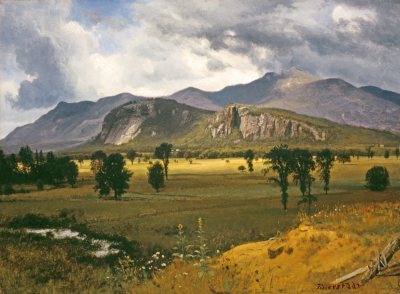
View of Moat Mountain, Intervale, New Hampshire by Albert Bierstadt
A strip of yellow sunlight crosses the fields beneath a rocky ridge. Dark trees stand at intervals across the nearer ground, while heavy clouds fill the sky. Albert Bierstadt's Moat Mountain, Intervale, New Hampshire makes the changing relationship between light and land more conspicuous than any single towering peak.
The Currier Museum of Art's 2010 annual report lists the painting as about 1862, oil on paper mounted on canvas, accession 1947.3.[1] The Smithsonian's art inventory also records the approximate date and Currier collection.[2] The support distinguishes this work from the large canvases often associated with Bierstadt's western landscapes.
At a Glance
Where this painting sits in Bierstadt’s career
Dates refer to the paintings, rather than to the journeys behind them. Approximate dates and ranges retain the qualifications in the collection records.
Lake Lucerne
1858Mountain Brook
1863Street in Nassau
c. 1877–1880The Last of the Buffalo
1888–1889The Golden Gate
1900Contents
Fields, ledges and distant ridges
The nearest ground slopes down from a sandy bank at the right. Pale flowers and taller yellow stems interrupt its warm ochre colour. Broken timber lies along the lower edge, while a narrow, irregular passage of water reflects white sky at the left. These details make the foreground uneven and tangible. Their small scale also establishes how close the viewer stands to this bank, before looking across the broad valley.
Beyond it, the land becomes flatter. Trees appear as separate upright forms across the fields, with dark crowns and short trunks. Some stand close together; others have open space around them. Their repetition gives the middle distance a measured rhythm, different from the dense woodland of Mountain Brook.
The brightest field runs almost horizontally through the centre. Above it, a wooded ridge contains broad exposed faces of rock. Their grey surfaces catch enough light to separate them from the surrounding green. Farther back, successive mountain outlines grow cooler and less sharply defined.
Clouds occupy much of the upper picture. Pale openings and dark grey masses alternate above the ridges, repeating the landscape's divisions between light and shade. A large dark cloud at the left weighs against the brighter sky above the central ledges. The mountains remain substantial beneath these changes: long slopes and exposed rock faces give them a structure distinct from the softer cloud forms.
A valley shaped by human use
The open ground contains signs of human use. A low fence runs across the nearer field, its rails becoming less distinct as they recede. At the far right, small light buildings sit below the wooded slope. They are easy to overlook beside the dramatic sky, but they change the character of the view. Divided fields and buildings place human activity within the mountain landscape.
The fence also contributes to the composition. Its shallow line stretches across the field, while trees rise vertically through the same space. Behind them, the illuminated strip carries the eye towards the base of the ledges. These different directions give the open valley enough internal movement to hold attention before we reach the mountains.
The foreground's flowers, sandy bank and scattered wood retain roughness beside the more ordered fields. The relationship between them makes this an especially varied landscape: close irregular ground, a level occupied valley and distant ridges share the same view. The mountains' height gains force from the extensive low land beneath them.
Bierstadt in the White Mountains
Bierstadt's interest in New Hampshire began well before the western pictures that made him famous. The Museum of the White Mountains records visits in 1852 and 1858, followed by returns with his photographer brothers in 1860 and 1861.[3] The approximate 1862 date of Moat Mountain places it within this sustained engagement with the region, rather than making it an isolated eastern subject.
The White Mountains also belonged to a growing culture of travel and looking. The museum's exhibition describes how rail connections, guidebooks and accommodation expanded tourism during the middle decades of the nineteenth century.[3] That regional context helps explain the audience for mountain scenery. It does not identify a particular visitor, hotel or journey within this painting.
Painting and photographic viewpoints
Bierstadt shared this interest in landscape with his brothers Charles and Edward. Their 1860 book Stereoscopic Views among the White Mountains in New Hampshire combined salted paper photographs with built-in prismatic lenses. The Metropolitan Museum of Art describes Albert's part in composing the pictures and the exchange between his painting and photographic experience. It also records the practical difficulties of the publication: expensive prints and an imperfect lens arrangement.[4] The book brought the appearance of depth into an object that could be viewed away from the mountain landscape.
Another surviving work makes the collaboration more local. The Nelson-Atkins Museum of Art holds the brothers' albumen print The Cathedral, White Mountains, New Hampshire, dated about 1860. Its reverse identifies Cathedral at North Conway. The museum explains that Albert helped choose viewpoints while Charles and Edward handled photographic technique during their New Hampshire work in 1860–1861.[5]
These photographs provide a useful context for looking at Moat Mountain. The painting arranges near ground, separated trees and distant rock into a legible succession of spaces. Selecting a viewpoint matters to both media, though the sources do not connect this painting to a particular photographic exposure. The photograph of Cathedral is a separate work, not a documented preparatory image for the painted valley.
The landscape beneath the painting
The US Geological Survey used this composition on its 1995 report on New Hampshire's stratified-drift aquifers. The cover caption identifies North Conway, a sandy foreground and the Saco River valley's flat outwash deposits.[6] The contrast between bank and field also records recognisable landforms.
The foreword explains how glacial meltwater deposited sand and gravel in valleys, creating important stores of groundwater.[6] This later scientific reading adds a history beneath the painted surface. It is not evidence that Bierstadt intended a geological illustration.
The bank leads into the fields before the eye reaches the rocky slopes. Looking along that route lets us distinguish the landscape's forms as well as their colours.
An eastern landscape within his career
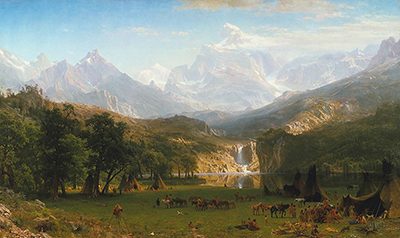
Compared with The Rocky Mountains, Lander's Peak, this view gives less emphasis to a single distant summit. Its drama lies in the illuminated middle ground, the exposed ledges and the weight of the cloud-filled sky. It also keeps a New Hampshire landscape within a career too easily reduced to the American West.
Mountain Brook offers another revealing comparison. There, rocks, trunks and water crowd into a woodland interior. Here, separated trees leave the valley floor open and allow the eye to measure distance across it. Both paintings invite close attention to nearer forms, but that attention leads into very different spaces.
Watch: Albert Bierstadt
Five perspectives on his paintings and their historical setting.
American Landscape Painting: Albert Bierstadt and the American Land
A Museum of Fine Arts, Boston presentation on American Landscape Painting: Albert Bierstadt and the American Land.
Explore Bierstadt’s artworks
Discussion
A sunlit strip crosses fields beneath a rocky ridge. How do the bank, fences and scattered trees lead your eye into the valley?
Reader Insights
How do the fences, scattered trees and small buildings change your reading of the open valley?
What makes the illuminated fields feel different from the sandy foreground and rocky ledges?
How does the later USGS reading of the landscape compare with the depth and light you first notice in the painting?
Join the Conversation
Share a specific observation, documented connection or comparison from View of Moat Mountain, Intervale, New Hampshire.
References
- Currier Museum of Art. 2010 Annual Report, p. 5, “Works on Loan”: Moat Mountain, Intervale, New Hampshire, about 1862, oil on paper mounted on canvas, 1947.3. This is a historical collection and loan record, not a present display notice. View source text
- Smithsonian American Art Museum, Art Inventories Catalog. Moat Mountain, Intervale, New Hampshire, record siris_ari_275644. Object details: approximate date and Currier owner/location. The inventory gives the less specific medium “oil on canvas.” View source text
- Museum of the White Mountains, Plymouth State University. An Enduring Presence: The Old Man of the Mountain, 2023 exhibition, “Becoming a Destination” and the label for Bierstadt's Old Man and Profile Lake. Regional tourism and Bierstadt's visits; the exhibited painting is a separate subject. View source text
- The Metropolitan Museum of Art. Stereoscopic Views among the White Mountains in New Hampshire. New Bedford, MA, 1860, object 2022.145. Collection account of the brothers' collaboration, built-in lenses, salted paper prints and production difficulties. View source text
- The Nelson-Atkins Museum of Art. The Cathedral, White Mountains, New Hampshire, about 1860, object 2005.27.250. Albumen print, reverse inscription and gallery label on viewpoint selection and photographic technique. A separate work; no direct source relationship to this painting established. View source text
- Laura Medalie and Richard Bridge Moore. Ground-Water Resources in New Hampshire: Stratified-Drift Aquifers. US Geological Survey, report 95-4100, 1995, cover, caption and foreword, PDF pp. 1–2 and 5. Reproduction credited to the Currier, 1947.3; landforms and glacial deposits. View source text