by Tom Gurney
Tom Gurney BSc (Hons) is an art history expert with over 20 years experience
Page created on September 3, 2026 / Page updated on September 13, 2026
Email: tomgurney1@gmail.com / Phone: +44 7429 011000
How Mortality Becomes Figure, Encounter and Warning
Death symbolism in art gives mortality a visible form. A skeleton may act like a person, a rider may arrive from scripture, or Death may interrupt a wedding, feast or journey. These images do more than state that life ends. They ask who death addresses, whether anyone can resist it, and how rank, faith or conduct are judged when time runs out.
Context is decisive. A skull in vanitas art belongs to a still-life argument about transient achievement; a skull in memento mori can be a private reminder. This page focuses on Death as figure, actor and collective force.
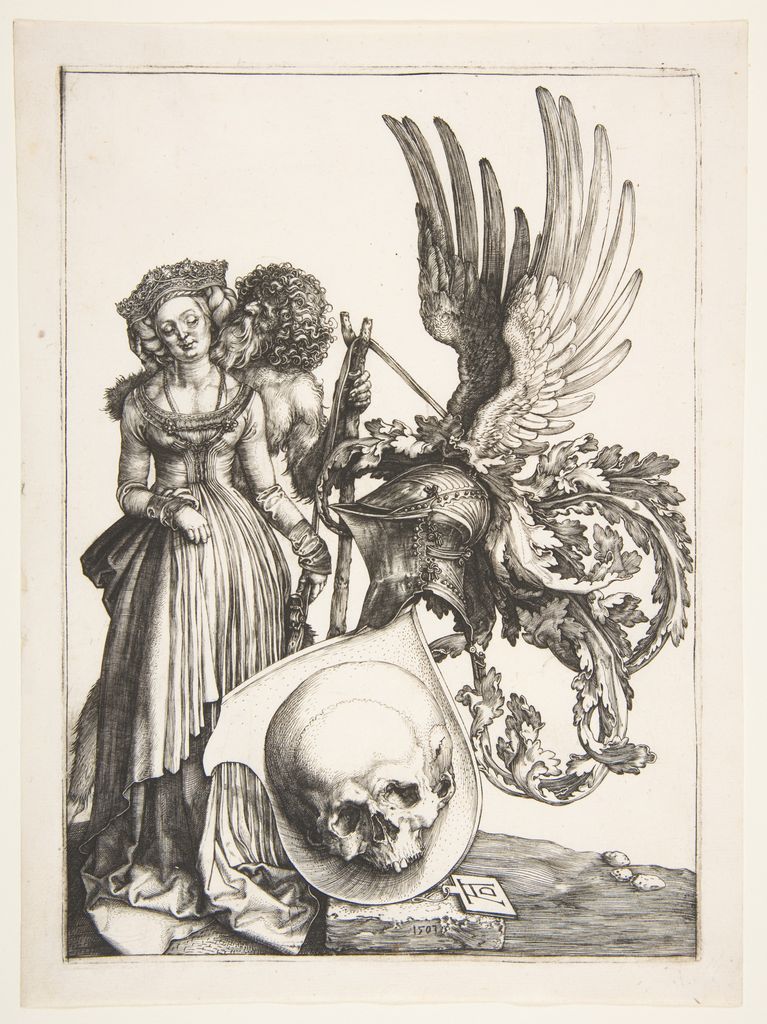
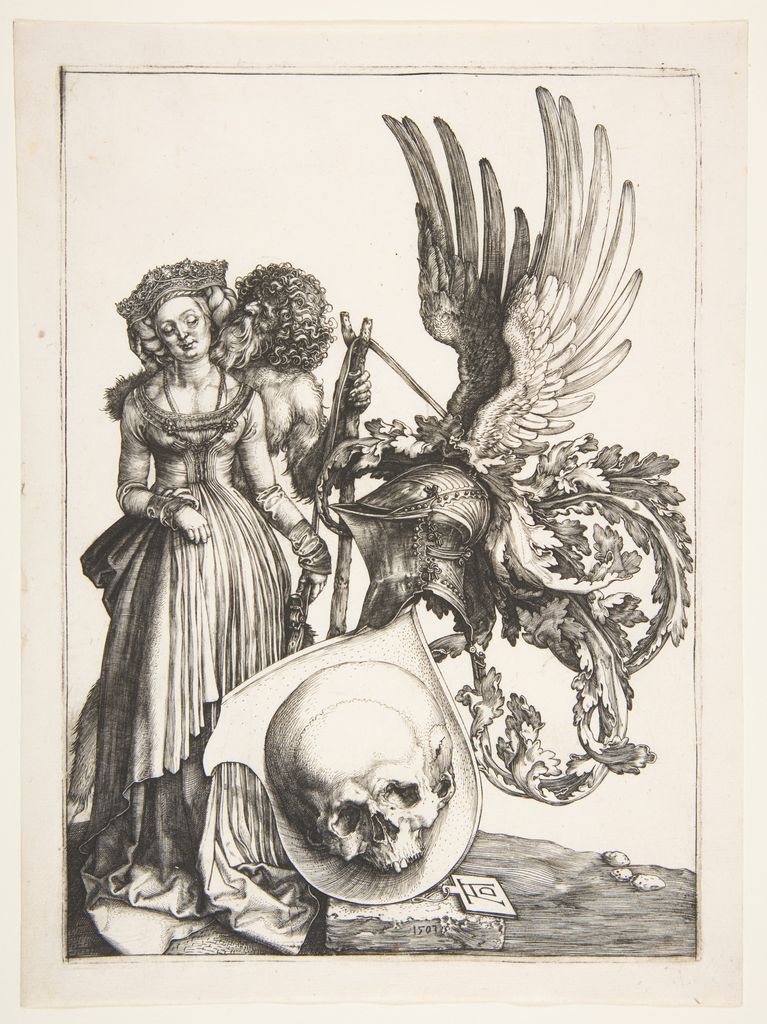
Albrecht Dürer, Coat of Arms with a Skull, 1503. The skull, young woman and heraldic display bring mortality into contact with status, beauty and lineage; the relationship matters more than treating the skull as a context-free token. Image: The Metropolitan Museum of Art, public domain, Open Access CC0.
At a Glance
- Death may appearas a skeleton, corpse, personification, violent event, judgment or modest reminder.
- Function changes meaningdevotion, satire, commemoration, anatomy and moral warning are different contexts.
- Relationships matterage, status, gesture, inscription and setting shape the encounter.
- Distinguish neighboursdeath symbolism, memento mori and vanitas overlap without becoming synonyms.
- Avoid universalsa skull or skeleton does not deliver one timeless message in every culture or work.
Contents
Personifying death
Artists personify death by giving an abstraction agency. Skeletons walk, speak, play music, carry weapons or seize the living. Their bodies are recognisably human yet stripped of individual status. That tension makes them effective: Death resembles everyone and no one.
The Dance of Death developed this equality into a sequence. Death meets pope and ruler, merchant and labourer, adult and child. The tradition does not make every encounter identical; it uses repetition to demonstrate that social distinctions cannot purchase exemption.[1]
Four works: death as an active presence
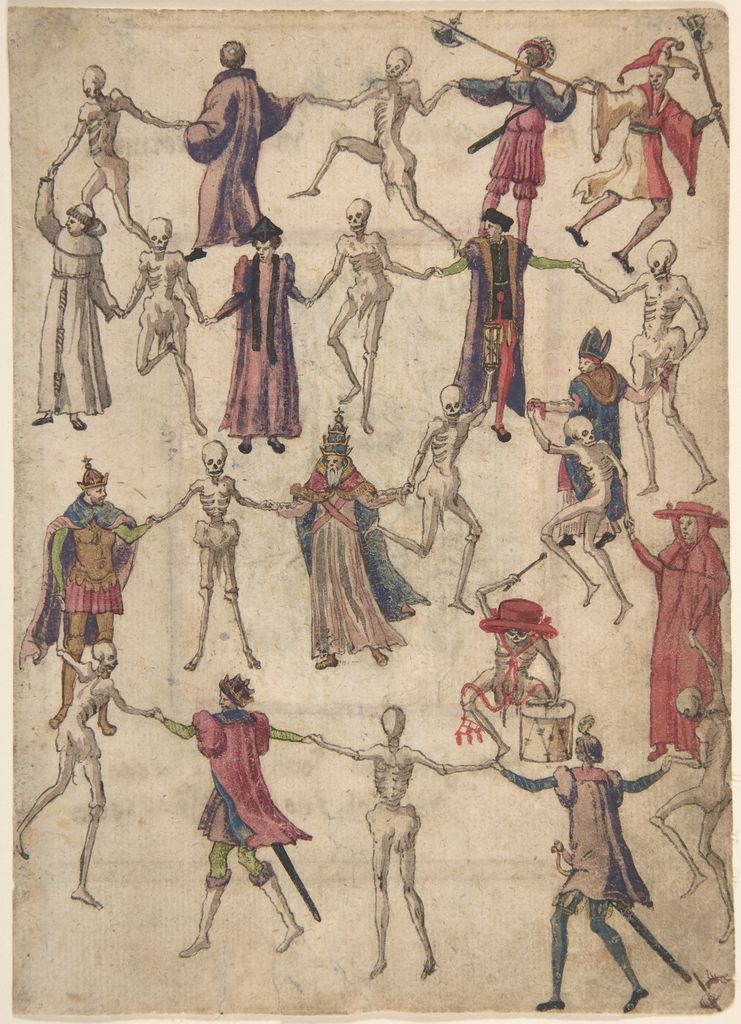
The Dance of Death: equality made rhythmic
An anonymous sixteenth-century German drawing titled The Dance of Death stages mortality as a social encounter.[1] Death is not a static emblem but a participant whose movement gives the scene rhythm. The decorative colour and gold do not soften the warning; they make the encounter compelling enough to revisit.
Series and processions allow the idea to expand. Wenceslaus Hollar's Procession of the Dance of Death (1658), after Holbein, pairs figures led by Death and the pope across a landscape.[2] Rank becomes a temporary costume within a longer human line.
Dürer: the rider who does not turn
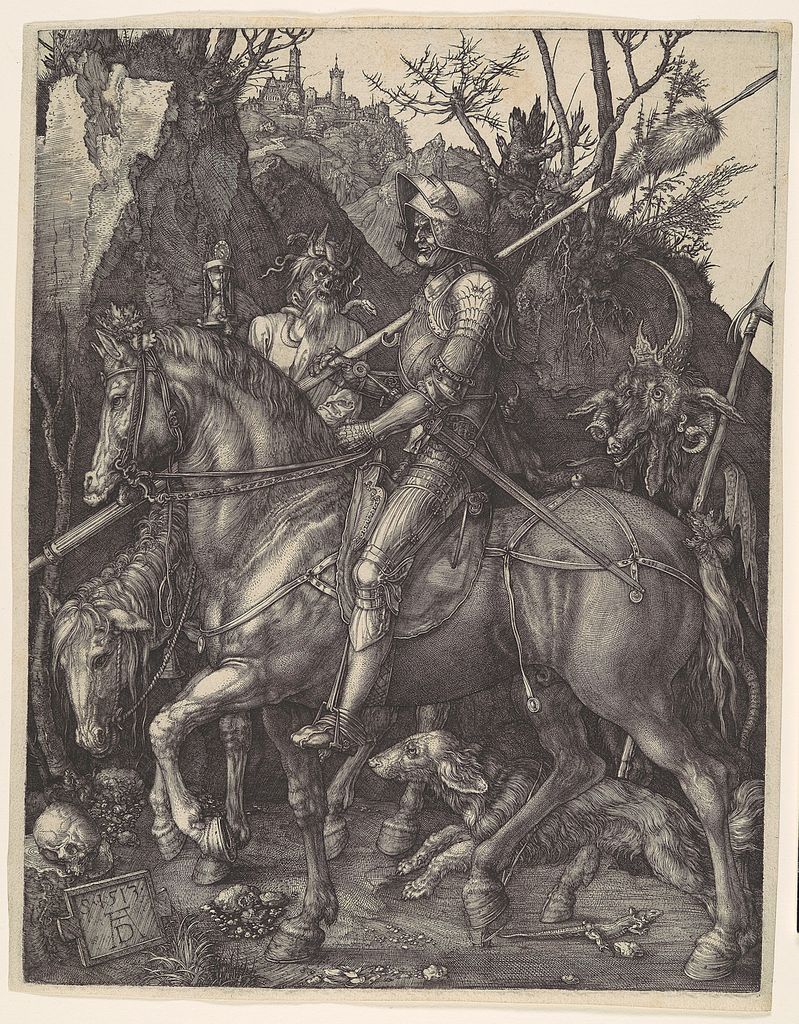
In Albrecht Dürer's Knight, Death, and the Devil (1513), an armoured rider advances through a narrow gorge. Death rides beside him and raises an hourglass; the Devil follows.[3] The Met connects the knight to moral virtue and the Christian soldier who remains undistracted by threatening apparitions.[3]
Death here is neither victor nor distant future. It is a companion testing the rider's direction. The hourglass gives the warning a duration, while the knight's forward gaze turns conduct—not escape—into the central issue.
The Four Horsemen: death within catastrophe
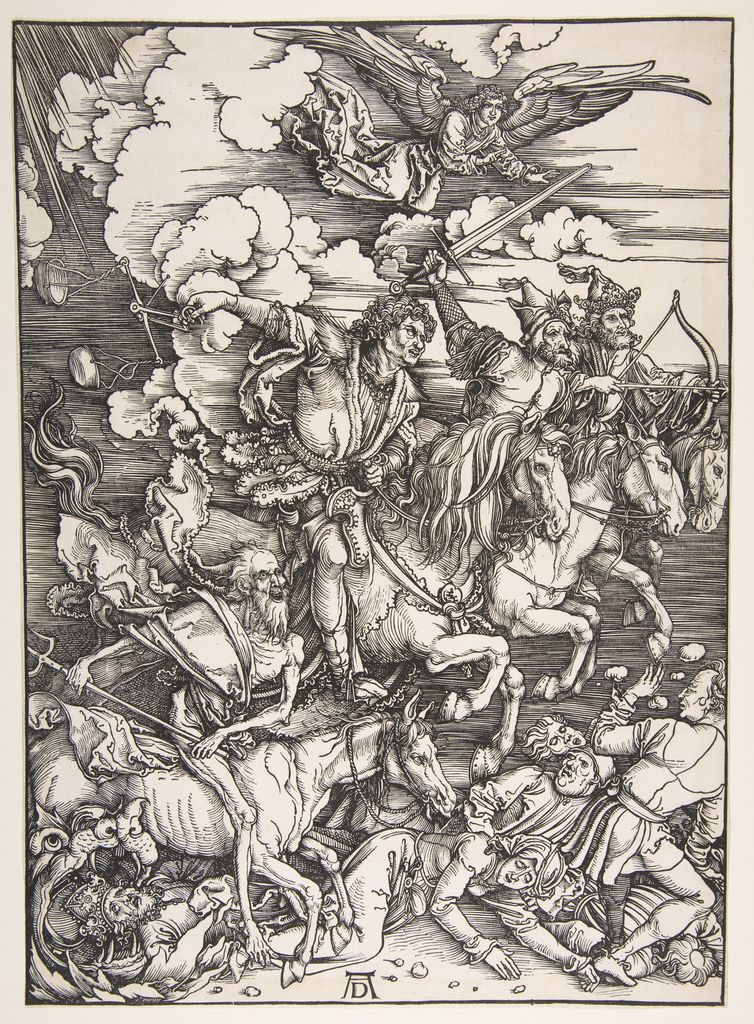
Dürer's The Four Horsemen (1498) translates Revelation 6 into a surge of riders.[4] The Met identifies the forces as Death, Famine, War and Plague or Pestilence. Dense parallel marks and a strong diagonal make catastrophe feel continuous, while people below are overwhelmed without regard to station.[4]
The pale horse and rider called Death belong to a precise Christian text. Treating every mounted skeleton as the same symbol would erase that source. Here meaning depends on apocalyptic sequence and the print's role in Dürer's illustrated Apocalypse.
Della Bella: death enters ordinary life
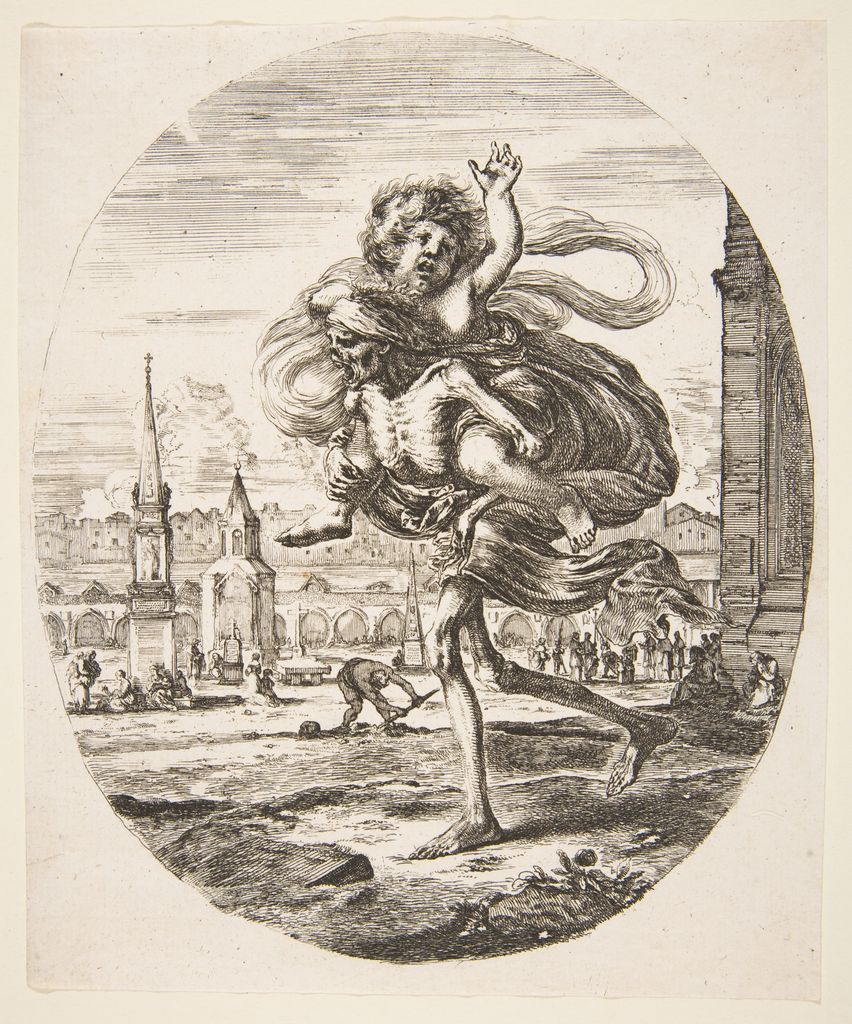
Stefano della Bella's Death carrying a child (c. 1648) belongs to The Five Deaths.[5] The artist updated the northern Dance of Death in oval scenes, placing Death's conquests in cemeteries and on a battlefield. In this print, a rushing skeleton carries a struggling child through the Cemetery of the Innocents in Paris.[5]
The image is deliberately distressing, but its historical point is not spectacle alone. By taking the most vulnerable, Death defeats comforting ideas of fairness or sequence. The familiar urban cemetery grounds the allegory in a place contemporary viewers could recognise.
Recurring forms and changing meanings
The skeleton makes death active; the skull more often makes absence present. The scythe borrows from harvest, imagining lives cut down. The hourglass measures limited time. A pale horse can invoke Revelation, while black clothing, extinguished light or barren landscape may establish mourning or loss without personifying Death.
Artists also adapt these forms through humour and satire. Thomas Rowlandson's The Last Drop (1801) shows a drinker ignoring the skeleton beside him, turning the late-medieval Dance of Death conceit into comic social criticism.[6] Allaert Claesz's Couple and Death with a Drum brings mortality into courtship and music.[7] The figure's interruption, not a dictionary definition, drives each scene.
Modern images can reuse historical forms after their original theology weakens or changes. A skeleton may represent war, epidemic, ecological threat or political violence. Interpretation should identify the source tradition but also ask what the new work changes.
How to read death symbolism responsibly
Begin with the work's subject and source. Is the rider named in Revelation? Does a title identify a Dance of Death? Is a skeleton acting like a character or functioning as an anatomical object? Next examine who meets Death and how: resistance, indifference, terror and calm imply different moral structures.
Then consider audience, medium and tone. A devotional print, satirical caricature and monumental mural do not make the same demand. Avoid assuming that dark imagery expresses the artist's personal despair. Museum records, inscriptions and the represented story provide firmer ground.[8]
Death symbolism is powerful because it turns an invisible limit into an encounter. Its figures can equalise ranks, test virtue, embody catastrophe or expose self-deception. The strongest reading stays specific about which Death appears, in whose world, and to what end.
Watch: Death Symbolism through Formal Analysis
Choose a museum-led whole-work analysis, a close reading, or a foundations overview for considering death symbolism.
Introducing Formal Analysis: Landscape
Follow how recurring shapes, colours and intervals contribute to a larger visual organisation.
Watch on YouTubeFrequently Asked Questions
It is the representation or meaningful evocation of death through figures, bodies, objects, events and settings in a specific historical context.
Its role varies: it may personify Death, animate a dance-of-death encounter, support anatomy, satire or a reminder of mortality.
No. A skull may be anatomical, narrative, devotional, heraldic or part of a vanitas; the work’s function and relationships must be established.
Death symbolism is broad, while vanitas usually describes a historically specific still-life tradition concerned with transience and worldly attachments.
Identify the object, date, place, medium, function and source tradition, then distinguish visible evidence from broader claims about belief or audience response.
Discussion
Which example on this page makes Death feel most like an active participant rather than a static emblem?
Reader Insights
Skeleton, corpse, skull, rider and judgment scene create different evidence.
Ask who sees, resists, ignores or accompanies Death.
Do not collapse devotion, satire, anatomy, vanitas and commemoration.
Join the Conversation
Share one precise observation or a useful museum example below.