by Tom Gurney
Tom Gurney BSc (Hons) is an art history expert with over 20 years experience
Page created on September 3, 2026 / Page updated on September 13, 2026
Email: tomgurney1@gmail.com / Phone: +44 7429 011000
How Art Makes the Awareness of Mortality Present
Memento mori means “remember you must die.” In art, it describes an image, object or detail that brings mortality into present thought. A skull is the best-known sign, but the tradition also uses skeletons, hourglasses, extinguished candles, wilting flowers and damaged or decaying things. Their force does not lie in a secret code. It comes from the encounter between an unmistakable fact—life ends—and a particular viewer, place and purpose.[1]
The phrase is often used loosely for anything macabre. Historically, however, memento mori imagery was frequently ethical or devotional. It could encourage humility, penitence, preparedness, or a more careful valuation of worldly status and pleasure. It might be displayed publicly in a portrait, handled privately as a bead, or embedded in an image whose beauty makes the reminder harder to dismiss.
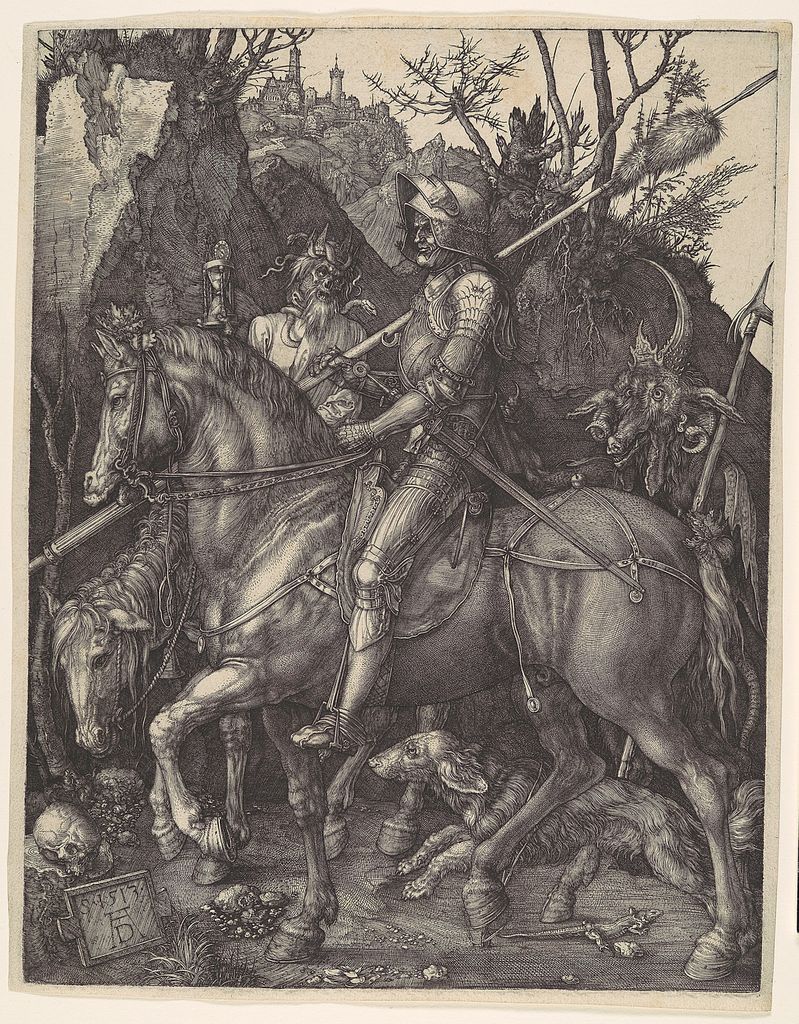
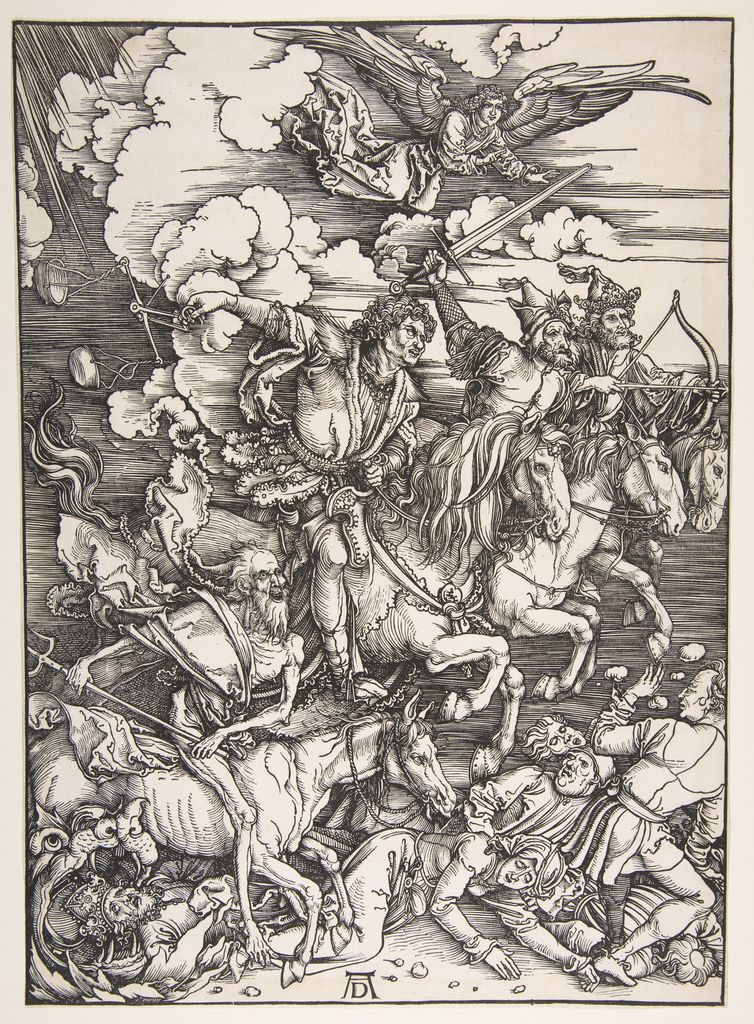
Albrecht Dürer, Knight, Death, and the Devil, 1513. Personified Death holds an hourglass beside the rider, making mortality an encountered presence; the image invites a memento-mori reading without reducing its many figures and debates to one slogan. Image: The Metropolitan Museum of Art, public domain, Open Access CC0.
At a Glance
- Phrasememento mori means “remember that you must die”.
- Form variesskull, skeleton, hourglass, decaying matter, inscription or bodily encounter can prompt remembrance.
- Function mattersdevotion, meditation, portraiture, private object and public warning address viewers differently.
- Not every skullanatomy, heraldry, narrative and decoration require their own evidence.
- Related termvanitas is a more specific still-life tradition concerned with transience and worldly attachments.
Contents
What does memento mori mean?
The Latin imperative is conventionally translated as “remember that you must die.” A memento is literally a reminder: not death itself, but something designed to keep it in mind. The National Gallery notes the use of skulls in sixteenth- and seventeenth-century European portraiture and still life, as well as in images of saints.[1] Those settings matter. The same skull can address social pride in a portrait, spiritual discipline beside a penitent saint, or fleeting sensory pleasure among luxury goods.
Mortality imagery is much older and wider than this one phrase. Classical funerary monuments, medieval tombs and Christian teachings all supplied distinct ways of picturing death. It is therefore safer to use memento mori for a function—an intentional reminder of mortality—than to treat every bone or ruin as part of one unbroken tradition.
The reminder also changes with scale and use. An enormous tomb sculpture confronts a community; a tiny carved bead meets one person at close range. A print may circulate widely, while a painted detail can remain half-concealed until a viewer finds it. Medium is part of meaning.
Four works: mortality made visible
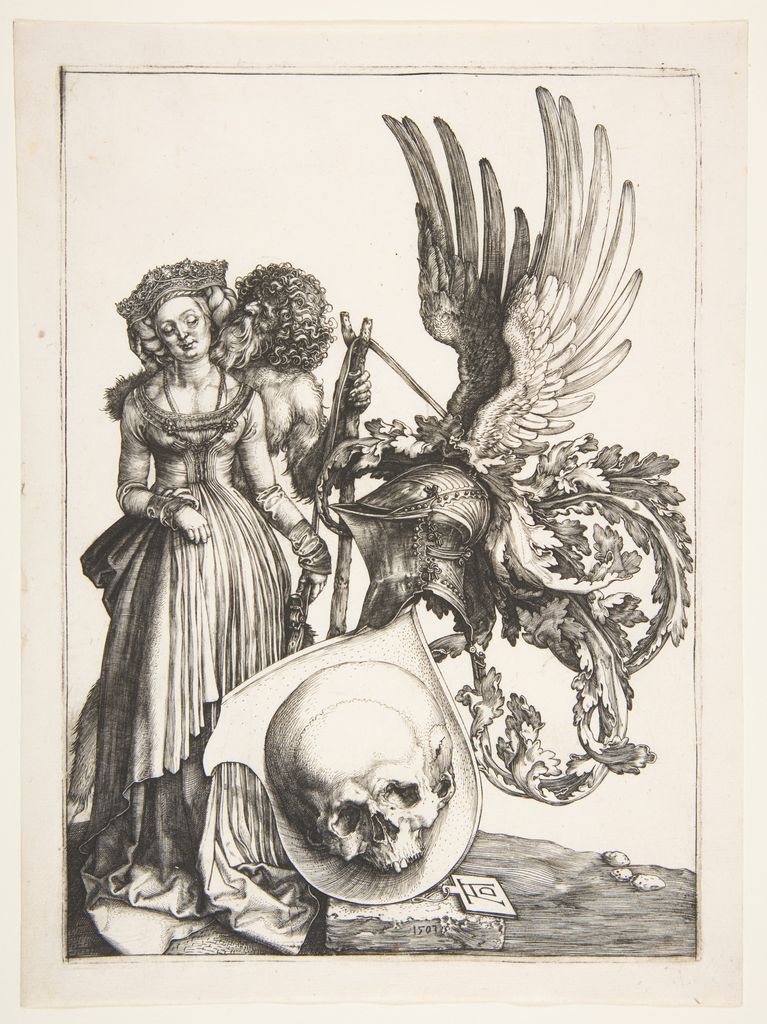
Dürer: rank meets the skull
Albrecht Dürer's Coat of Arms with a Skull (1503) gives an elaborate heraldic display an unsettling companion. A fashionably dressed woman stands beside the shield while a shaggy wild man looks toward her and holds a skull behind her head.[2] Heraldry ordinarily projects family, continuity and rank. The skull does not erase that identity, but places its permanence under pressure.
The print is more complex than a simple slogan against wealth. Its textures, costume and ornamental invention reward sustained looking. That attraction is precisely what lets the reminder work: the viewer can admire worldly display while confronting the limit it cannot overcome. Dürer's exact conjunction of beauty, lineage and death is stronger than a generic claim that “skulls mean mortality.”
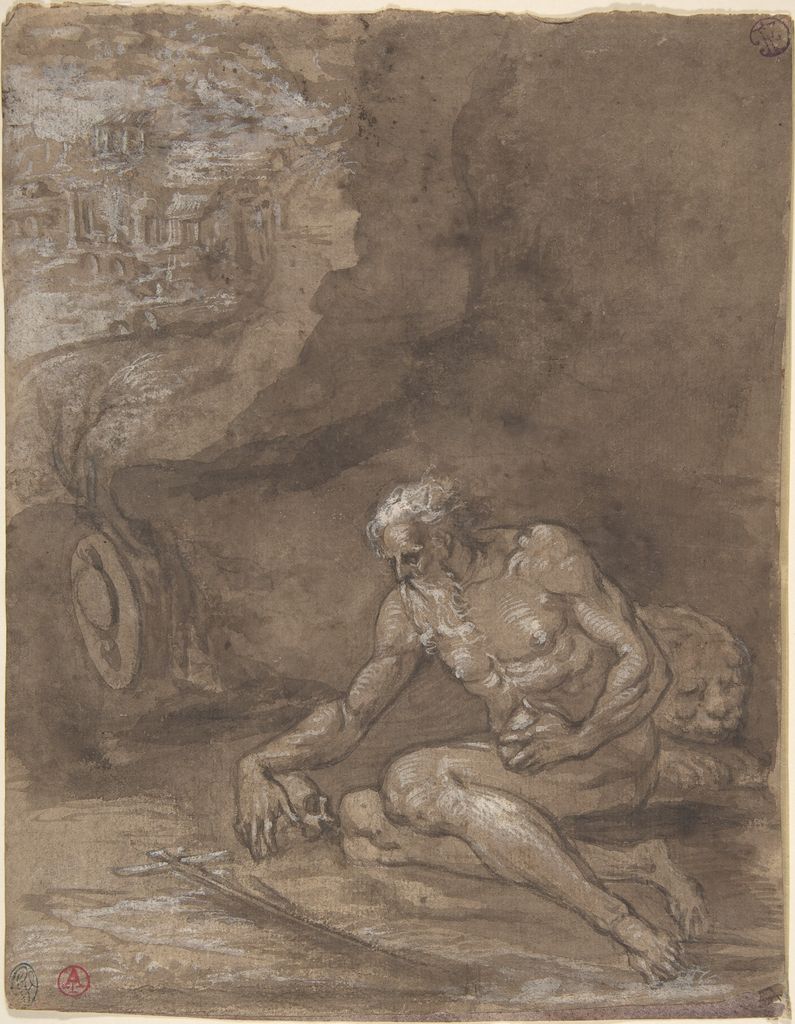
Saint Jerome: death as a discipline of attention
In Saint Jerome Praying in a Landscape (1550–60), attributed to Niccolò dell'Abate, the saint kneels in a rocky wilderness before a crucifix. A skull lies near him.[3] Within this subject, it belongs to a network of established attributes and devotional actions: withdrawal, prayer, penitence and reflection on Christ's death.
The skull therefore does more than announce that Jerome will die. It models a way of directing attention away from distraction and toward spiritual preparation. The landscape, vulnerable body and small crucifix all contribute. A viewer who isolates the skull but ignores the saint's action misses the image's devotional structure. This is also why the broader context of religious art remains essential.
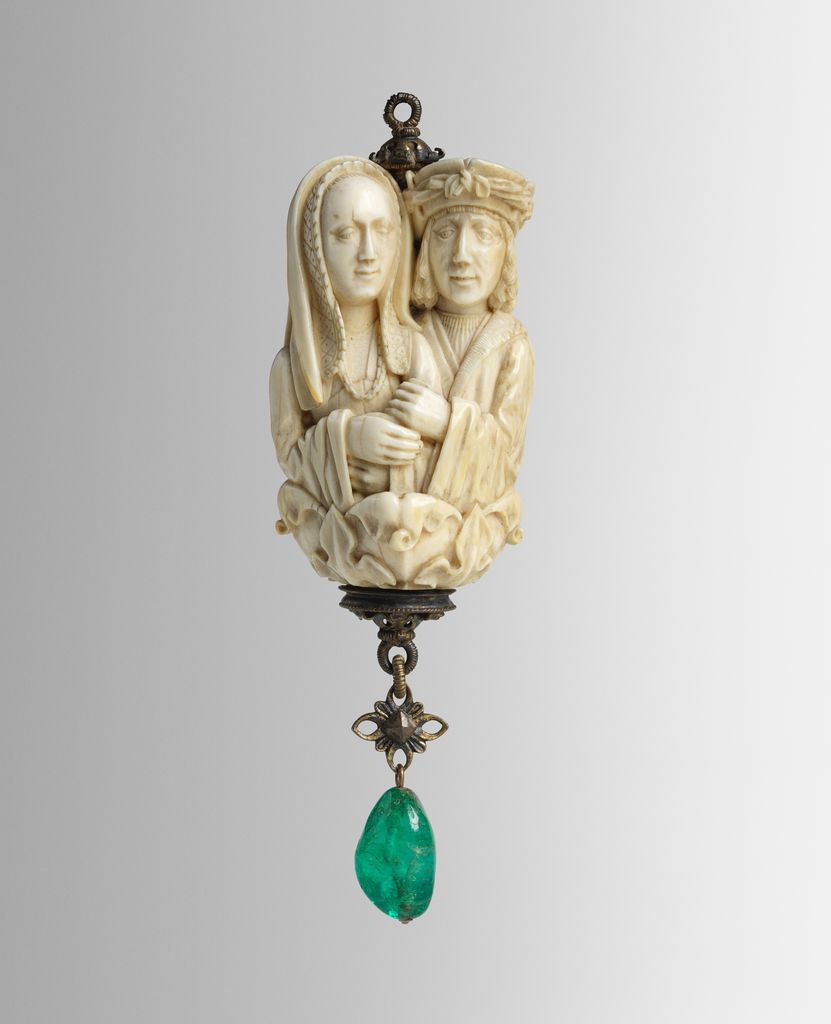
A rosary bead: holding life and death together
A North French or South Netherlandish Terminal Bead with Lovers and Death's Head (c. 1500–1525) compresses a sharp contrast into ivory. One side presents embracing lovers; the other becomes a grinning skull.[4] As a terminal element associated with a rosary, it was not merely seen at a distance. Its small scale invited handling, turning and repeated encounter.
That bodily use changes the reminder. Love, youth and touch are not condemned as illusions so much as placed beside their end. The object asks the holder to rotate between two conditions. Unlike a painted skull hidden in a room, this memento could travel with its owner and return mortality to awareness through habit.
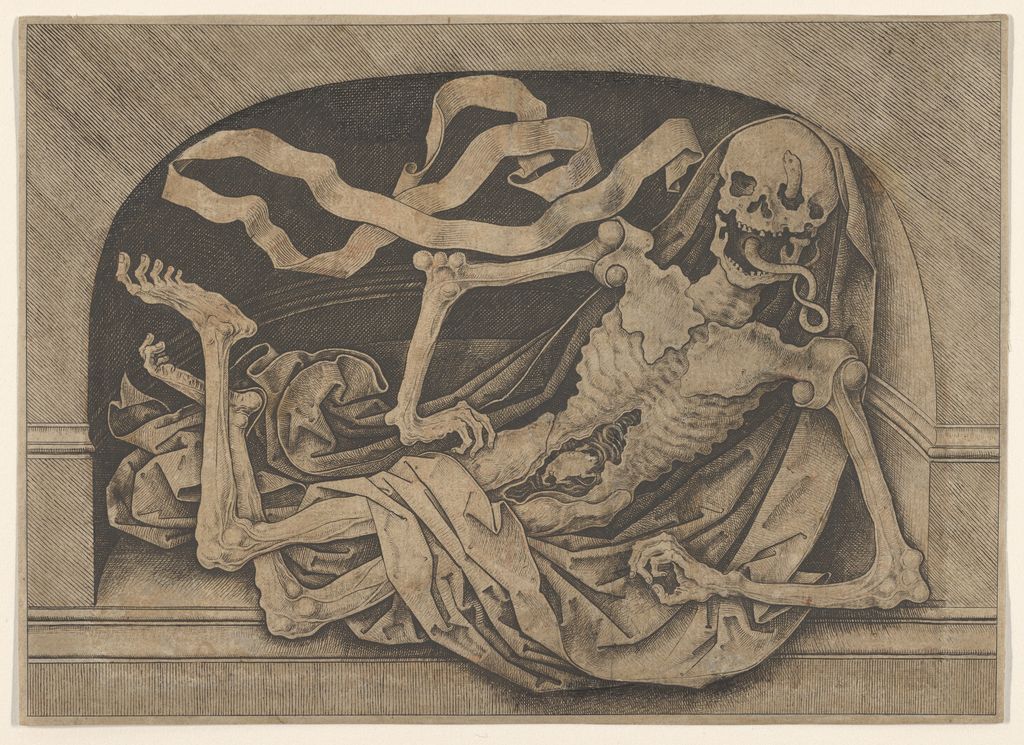
Master IAM: death addresses the viewer
Master IAM of Zwolle's late-fifteenth-century engraving Memento Mori: a skeleton in a niche puts death at the centre rather than at the edge.[5] The skeleton occupies a Gothic architectural frame amid bones, inscriptions and objects associated with worldly stations. It faces outward with the directness of a figure delivering a warning.
The niche resembles a place reserved for a sacred statue or tomb effigy, yet the body has been stripped to what rank cannot preserve. Because prints could circulate beyond a single commission, the warning could meet different viewers in different settings. Its address is broad, but its imagery still belongs to late-medieval European ideas about death, judgment and social order.
Common memento mori symbols—and their limits
A skull is legible because it belongs to every human body. In portraits such as the National Gallery's Young Man holding a Skull (c. 1626–28), the sitter's living face and the bare cranium establish a deliberate contrast.[1][6] Yet a skull can also identify a saint, appear in an anatomical study, or serve another narrative. Its meaning depends on companions and setting.
A skeleton can personify death, show the body's future condition or act as an animated messenger. An hourglass or watch measures finite time; an extinguished candle suggests a life or moment ended; bubbles, smoke and flowers can make fragility visible. Perishable fruit and insects may indicate change and decay. None of these objects carries an identical message every time.
Optical concealment can turn recognition into an event. In Hans Holbein the Younger's The Ambassadors (1533), a distorted form across the foreground resolves into a skull when seen from an oblique angle.[7] The image makes the viewer move from confident possession of the splendid scene to awareness of a disruptive limit. Here, how the skull becomes visible is as important as what it conventionally signifies.
Memento objects could also be deliberately intimate. The Rijksmuseum's seventeenth-century carved Skull with case packages the reminder as something that can be closed, carried and reopened.[8] Such works show why “symbol lists” are insufficient: scale, touch, concealment and repeated use all participate in meaning.
Memento mori and vanitas: what is the difference?
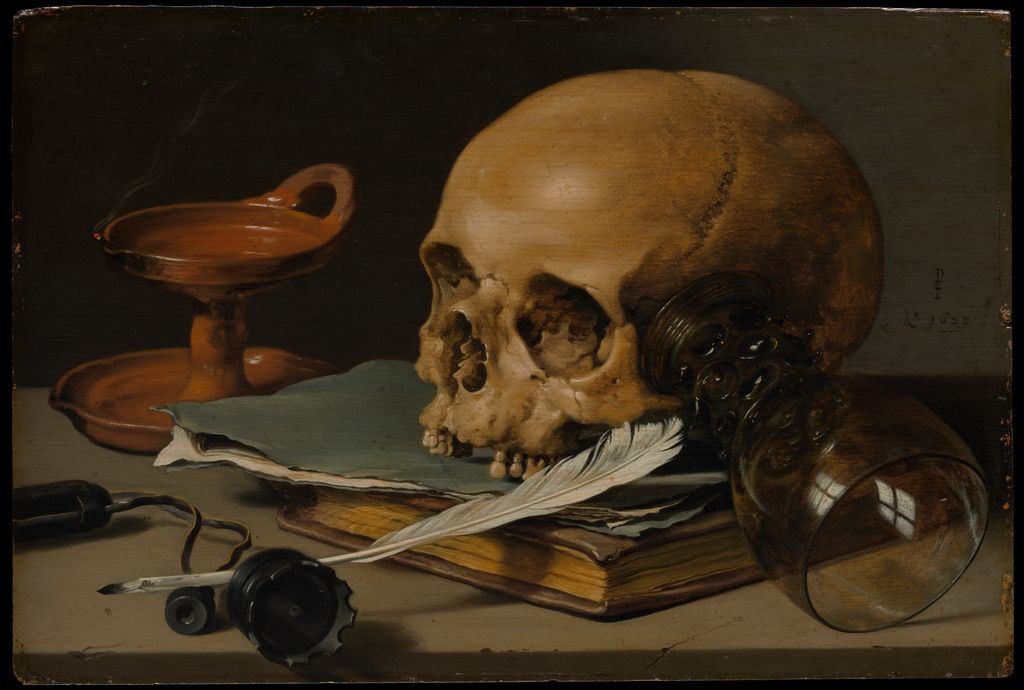
The terms overlap, but they are not interchangeable. Memento mori names the broad reminder of death. It can appear in portraiture, devotional art, prints, sculpture, jewellery and everyday objects. Vanitas usually refers more specifically to an early-modern still-life tradition in which carefully selected goods—books, instruments, flowers, food, coins or luxury vessels—are shown as transient, often alongside skulls, timepieces or signs of decay.[9]
A vanitas painting may contain a memento mori, but a rosary bead or a skull beside Saint Jerome is not thereby a vanitas still life.[3][4] The distinction helps preserve each work's function. The dedicated vanitas guide follows the objects, markets and moral tensions of that genre; this page keeps the wider reminder-of-death tradition in view.
How to interpret a memento mori artwork
Start by describing exactly what is present. Is the reminder a skull, full skeleton, clock, candle, flower or inscription? Is it prominent, hidden, held or reflected? Then identify the work's subject and medium. A skull handled by a portrait sitter behaves differently from one carved into a prayer bead.
Next ask who might have encountered the object and how. Was it displayed in a church, domestic room or collection? Could it be worn or touched? Does the image demand a special viewpoint, as Holbein's does? Look for contrasts between youth and age, abundance and decay, or reputation and bodily equality.
Finally, grade the interpretation. Museum records, inscriptions and established attributes may securely identify a mortality reminder. Claims about the artist's private belief or every viewer's emotional response are harder to prove. The method used throughout Iconography and Symbols in Art is useful here: observe, identify, contextualise, interpret, then test the reading against the whole work.
Memento mori art does not tell us simply to fear death. Across these works, it makes finitude a measure of attention. The reminder can unsettle vanity, deepen prayer, expose the fragility of status or intensify the value of time. Its meanings remain historically specific, but its central question is direct: what changes when mortality is not kept out of sight?
Watch: Memento Mori through Formal Analysis
Choose a museum-led whole-work analysis, a close reading, or a foundations overview for considering memento mori.
Introducing Formal Analysis: Landscape
Follow how recurring shapes, colours and intervals contribute to a larger visual organisation.
Watch on YouTubeFrequently Asked Questions
The Latin phrase means “remember that you must die” and describes reminders intended to keep mortality present to thought.
Skulls, skeletons, hourglasses, extinguished lights and decaying matter can serve this role, but only within supporting context.
No. A skull can belong to anatomy, narrative, heraldry, devotion, portraiture or vanitas, so function and relationships must be established.
Memento mori is the broader reminder of mortality; vanitas usually names a historically specific still-life tradition about transience and worldly attachments.
Identify the object, audience and function, read all accompanying signs, consult reliable records and distinguish secure evidence from moral paraphrase.
Discussion
Which work on this page brings mortality closest to the viewer through scale, touch, address or bodily encounter?
Reader Insights
Name the exact object, figure, inscription or material change.
A bead, print, portrait and monument created different encounters.
Mortality imagery, vanitas, anatomy and death narrative can overlap without collapsing.
Join the Conversation
Share one precise observation or a useful museum example below.
References
- National Gallery — Memento mori
- The Metropolitan Museum of Art — Coat of Arms with a Skull
- The Metropolitan Museum of Art — Saint Jerome Praying in a Landscape
- The Metropolitan Museum of Art — Terminal Bead with Lovers and Death's Head
- The Metropolitan Museum of Art — Memento Mori: a skeleton in a niche
- National Gallery — Young Man holding a Skull
- National Gallery — The Ambassadors
- Rijksmuseum — Skull with case
- Rijksmuseum — Vanitas still life