by Tom Gurney
Tom Gurney BSc (Hons) is an art history expert with over 20 years experience
Page created on September 3, 2026 / Page updated on September 13, 2026
Email: tomgurney1@gmail.com / Phone: +44 7429 011000
Reading Motifs through Season, Poetry and Auspicious Combination
Japanese symbolism in art is not one national dictionary. Images gained meaning through Shinto and Buddhist practice, court poetry, imported Chinese traditions, seasonal festivals, theatre, literature, heraldry and the commercial print market. A crane may be auspicious in one object, part of a poem in another, or simply an observed bird elsewhere.
The most useful question is therefore not “What does this mean in Japan?” but “What did this motif do in this work, medium and moment?” Titles, inscriptions, paired motifs and seasonal setting often provide stronger evidence than the isolated object.
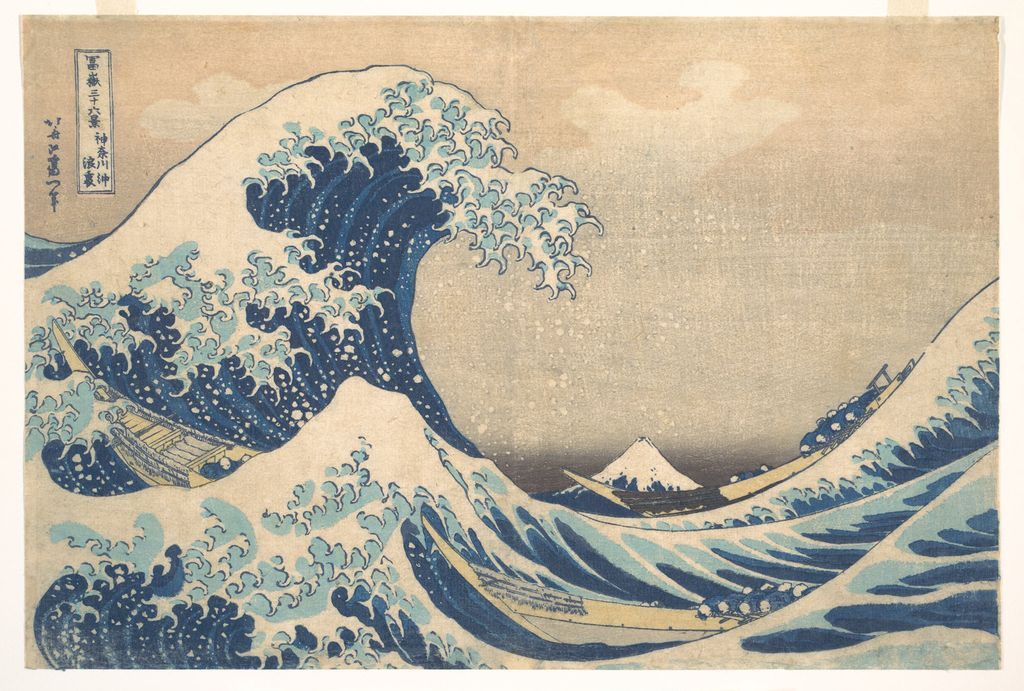
Katsushika Hokusai, Under the Wave off Kanagawa, c. 1830–32. Wave, boats and Fuji belong to a named series and Edo-period print context; later global fame should not be turned into a timeless dictionary of “Japanese” meanings. Image: The Metropolitan Museum of Art, public domain, Open Access CC0.
At a Glance
- Begin with the objectidentify format, maker, date, place and intended use.
- Season is structuralplants, birds, weather and festivals can locate a work within a poetic calendar.
- Combinations matterpine–bamboo–plum or crane–tortoise relationships are more specific than isolated motifs.
- Text may guidetitles, poems, rebuses and characters can constrain visual interpretation.
- Avoid flatteningJapanese art spans many periods, regions, media and audiences; no motif has one national meaning.
Contents
Seasons, poetry and auspicious combinations
Seasonal change occupies a central place in Japanese visual culture. The Met links it to festivals, agricultural cycles, Shinto, Buddhism and poetry, where short-lived blossoms and autumn grasses can evoke beauty through passing time.[1] Artists sometimes represented several seasons within one continuous environment, using blossom, foliage, migrating birds, snow or bare trees as subtle markers.[1]
Motifs also acquire force through combination. Pine, bamboo and plum—the Three Friends of Winter—originated in China and came to signify endurance and renewal in Japanese art. Cranes and turtles often join auspicious designs concerned with longevity. These meanings are historical relationships, not inherent properties of plants and animals.
Four works: symbols in context
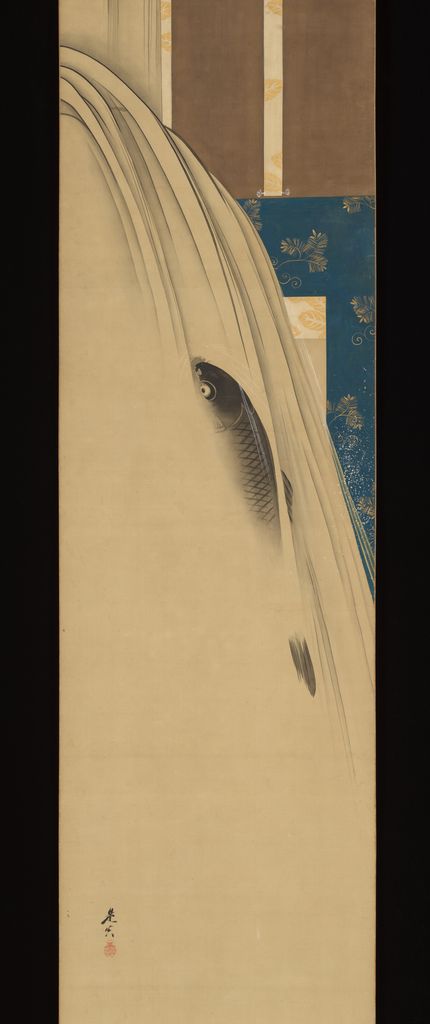
Zeshin: the carp and the waterfall
Shibata Zeshin's nineteenth-century hanging scroll A Carp Ascending a Waterfall isolates a fish against rushing water.[2] The carp climbing rapids invokes an East Asian legend in which perseverance leads to transformation into a dragon. In Japanese contexts the motif could encourage aspiration, strength and success.
Yet the scroll is also a feat of brushwork and vertical design. The upward body is understood through the waterfall's opposing descent. Symbolic association and observed movement reinforce one another; the fish is not merely an emblem pasted onto a background.
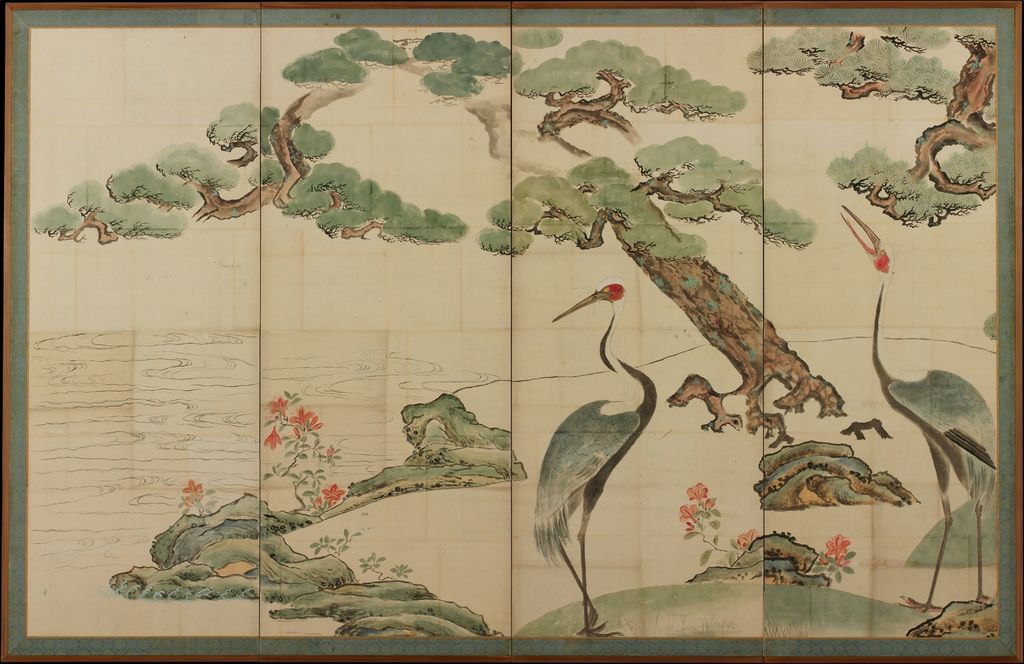
Kōrin: cranes, pines and bamboo
Ogata Kōrin's early-eighteenth-century Cranes, Pines, and Bamboo combines auspicious motifs of longevity beneath a crescent moon.[3] The Met notes that spring and autumn are suggested through azaleas, chrysanthemums, morning glories and eulalias. A stream separates and connects the paired screens.[3]
The work demonstrates how meaning can be distributed across a field. No single motif carries the entire message. Cranes, evergreen growth, seasonal plants and the screen format create an auspicious environment, while Kōrin's formalised design makes nature ornamental without stripping it of association.
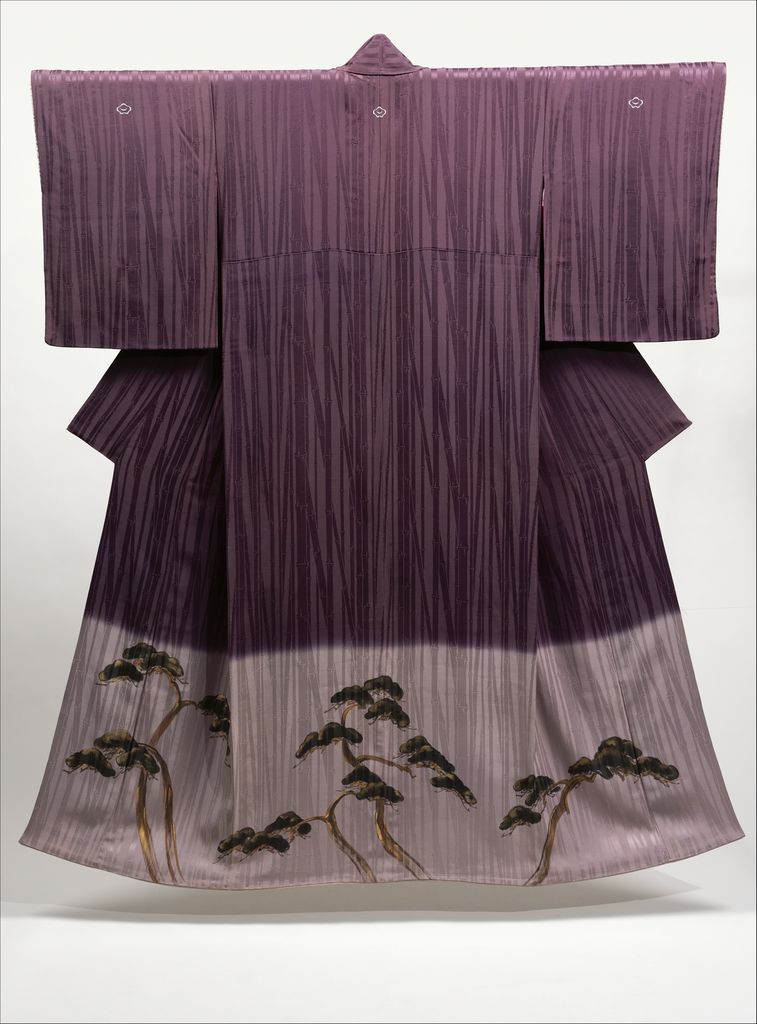
Three Friends of Winter on a kimono
A twentieth-century Kimono with Pines, Bamboo, and Plum adapts a long-standing group to modern textile design.[4] Pine represents longevity and renewal, flexible bamboo endurance, and early-blossoming plum the return of spring. The museum emphasises that the trio originated in China but has a long history in Japanese textiles.[4]
Placement matters: pine is painted near the hem, bamboo woven into the purple fabric and plum embroidered like crests on the shoulders. Meaning is worn and revealed through movement. The playful distribution makes inheritance compatible with modern design.
Mitsunobu: bamboo through four seasons
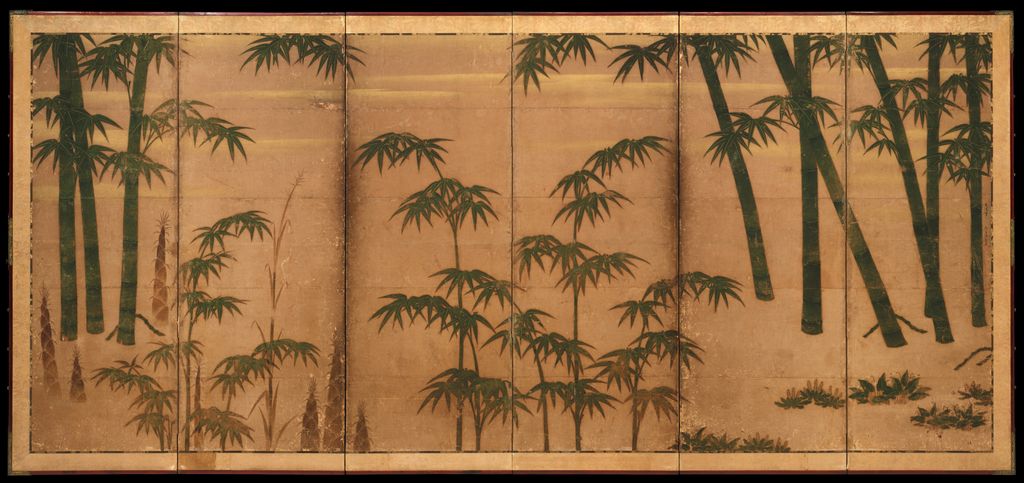
Bamboo in the Four Seasons, attributed to Tosa Mitsunobu and dated to the late fifteenth or early sixteenth century, moves from spring to winter across folding screens.[5] Young shoots, mature stalks and accompanying plants register time while windswept branches unify the composition.[5]
Bamboo had Chinese literary associations, yet the Met describes a distinctly Japanese four-season interpretation. The screen format creates a lived panorama rather than a single emblem. A viewer encounters duration by moving along the panels.
Motifs that need their companions
Cranes often participate in longevity imagery; pine suggests endurance through evergreen growth; plum blossom signals spring's renewal after winter; cherry blossom can bring beauty and brevity together. Chrysanthemum may mark autumn and imperial associations. Bamboo can suggest flexibility and steadfastness. These are useful hypotheses, never substitutes for object research.
A writing box with cranes, pines and plum blossoms may also refer to a poem by Yamabe no Akahito about cranes at Waka Bay.[6] Itō Jakuchū's Crane under a Branch of Plum joins a longevity motif to blossoms, renewal and an inscribed poem.[7] Literary evidence changes the reading from “crane equals long life” to a particular dialogue between image and verse.
Mount Fuji likewise changes across pilgrimage, landscape series, national reception and tourism. Hokusai's Under the Wave off Kanagawa belongs to Thirty-six Views of Mount Fuji; its small mountain, immense wave and endangered boats produce meaning through series and composition.[8] Calling the wave simply “strength” would erase those relationships.
How to interpret Japanese symbols responsibly
Begin with maker, period, medium and title. Translate inscriptions through reliable collection records. Identify whether the motif belongs to a literary quotation, auspicious set, seasonal sequence, Buddhist narrative or Shinto setting. Ask whether the object was hung, folded, worn, handled or commercially circulated.
Then trace origins without treating borrowing as sameness. Motifs moved among China, Korea and Japan and were reworked locally. Avoid projecting later nationalism or contemporary popular meanings backward. The broader Iconography and Symbols in Art method applies: observe first, build the historical evidence chain, and keep uncertainty visible.
Japanese art makes symbols powerful through relationships—between seasons, poems, surfaces, rituals and movement. Reading those relationships produces a richer result than any list of fixed meanings.
Watch: Japanese Symbolism through Formal Analysis
Choose a museum-led whole-work analysis, a close reading, or a foundations overview for considering japanese symbolism.
Introducing Formal Analysis: Landscape
Follow how recurring shapes, colours and intervals contribute to a larger visual organisation.
Watch on YouTubeFrequently Asked Questions
It is the historically grounded use and interpretation of motifs, seasons, texts, auspicious combinations and narratives across Japanese visual culture.
No. Meaning changes with period, medium, region, use, literary reference and the other motifs present.
The grouping known as the Three Friends of Winter can express endurance and auspicious seasonal associations, but the exact object and context still matter.
Cranes can participate in auspicious associations such as longevity, especially in combinations, but they may also be observed birds or seasonal subjects.
Start from the named object and authoritative record, identify season, text, format and motif combinations, and avoid projecting a timeless national code.
Discussion
Which example on this page depends most on a combination of motifs or a seasonal-poetic reference rather than one isolated sign?
Reader Insights
Kimono, screen, print and writing box organise motifs differently.
Companion plants, birds, characters and seasons narrow meaning.
Modern global associations are not automatically original meanings.
Join the Conversation
Share one precise observation or a useful museum example below.
References
- The Met — Seasonal Imagery in Japanese Art
- The Met — A Carp Ascending a Waterfall
- The Met — Cranes, Pines, and Bamboo
- The Met — Kimono with Pines, Bamboo, and Plum
- The Met — Bamboo in the Four Seasons
- The Met — Writing Box with Cranes, Pines, Plum Blossoms, and Characters
- The Met — Crane under a Branch of Plum
- The Met — Under the Wave off Kanagawa