by Tom Gurney
Tom Gurney BSc (Hons) is an art history expert with over 20 years experience
Page created on September 3, 2026 / Page updated on September 13, 2026
Email: tomgurney1@gmail.com / Phone: +44 7429 011000
When Figures, Objects and Actions Give Ideas a Body
Allegory in art makes one visible subject carry another, usually more abstract subject. A crowned woman may embody a nation; a figure with scales may personify Justice; a staged conflict between characters may represent the struggle between Wisdom and Discord. The National Gallery defines allegory as presenting one subject “in the guise of another” and cautions that identifying the figures does not always settle the work's meaning.[1]
Allegory differs from a single symbol. One object can signify within a scene, while an allegory often organises figures, attributes and actions into a sustained second level. It also differs from ordinary narrative: the represented event matters, but it is designed to be read as an idea.
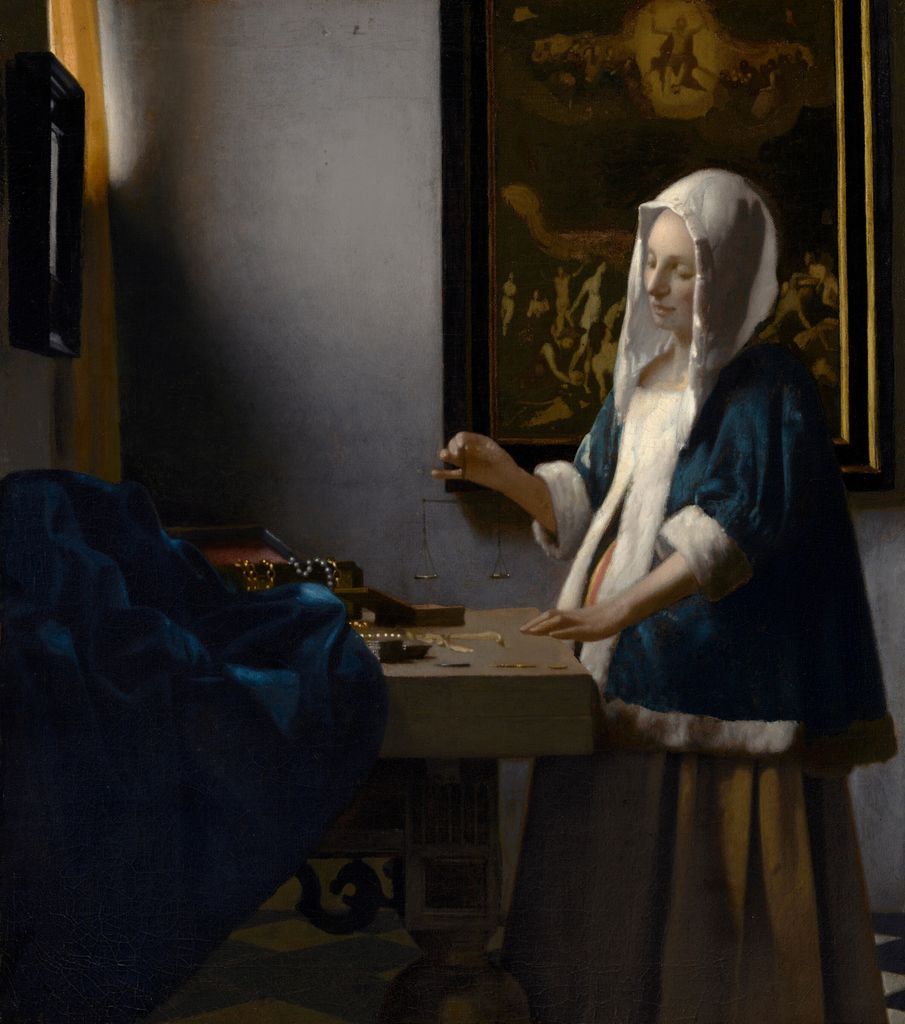
Johannes Vermeer, Woman Holding a Balance, c. 1664. The balance, valuables and Last Judgment create a connected field of moral associations, but identifying these symbols does not automatically make the painting a personified allegory or settle one final meaning. Image: National Gallery of Art, public domain.
At a Glance
- Core methodone visible subject carries another, often more abstract subject.
- Personificationgives human form to an idea, season, institution or community.
- Attributes identifyobjects, inscriptions and gestures help name figures within historical conventions.
- Structure interpretsposition, action and hierarchy show what the embodied ideas are doing.
- Uncertainty remainssecure identification may still support more than one historically plausible interpretation.
Contents
Personification, attributes and visual structure
A personification gives human form to something that has no body: Peace, Autumn, Painting, a university or a political community. Attributes help name that figure. Scales and sword can identify Justice; a cornucopia can point to Abundance; compass or globe may identify Geometry or Astronomy. The Seven Liberal Arts were often presented as female figures carrying such identifying objects.[2]
Recognition depends on historical convention. A winged figure is not automatically Victory, and a woman with fruit is not always Autumn. Titles, inscriptions, original location and comparison with related images make the identification secure. The arrangement then tells us what the abstraction is doing: triumphing, mourning, guiding or yielding.
Four allegories to read closely
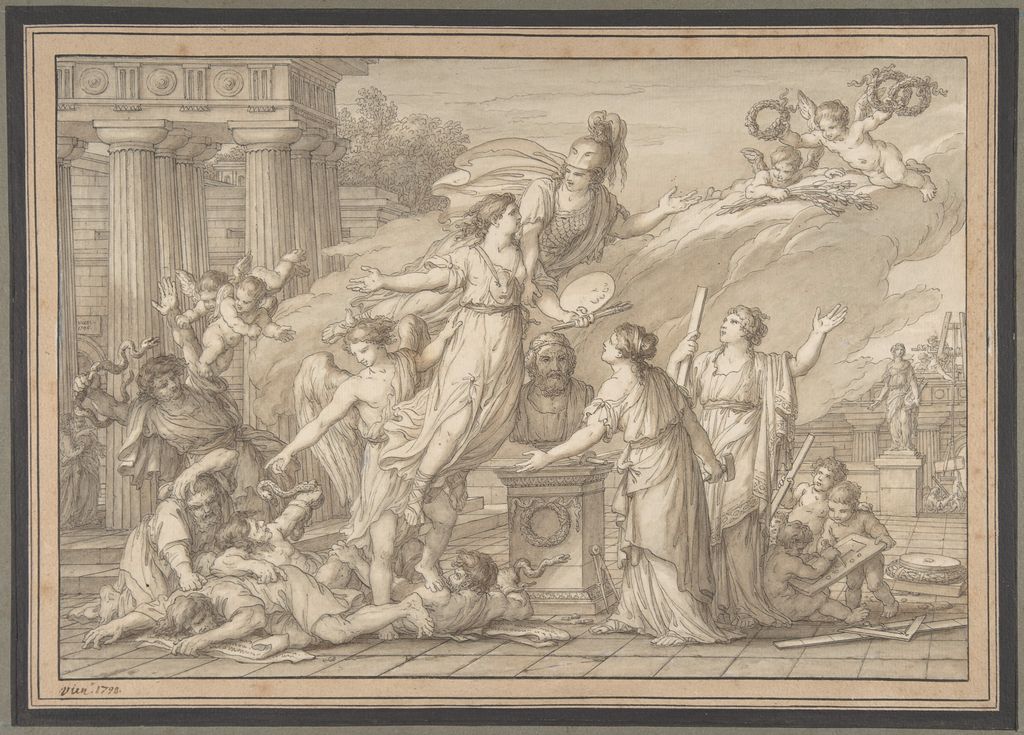
Vien: the arts gather around Homer
Joseph Marie Vien's Allegory of the Arts (1796) groups personifications of the arts around a bust of Homer.[3] The Met explains that the figures are guided by the example of antiquity. Their bodies make distinct disciplines socially present, while Homer provides a shared centre of authority.
The drawing belongs to a post-Revolutionary institutional setting: Vien had recently joined the Institut de France.[3] Allegory turns an administrative claim about cultural continuity into an ideal assembly. It does not document a meeting; it visualises how the arts ought to relate to an inherited past.
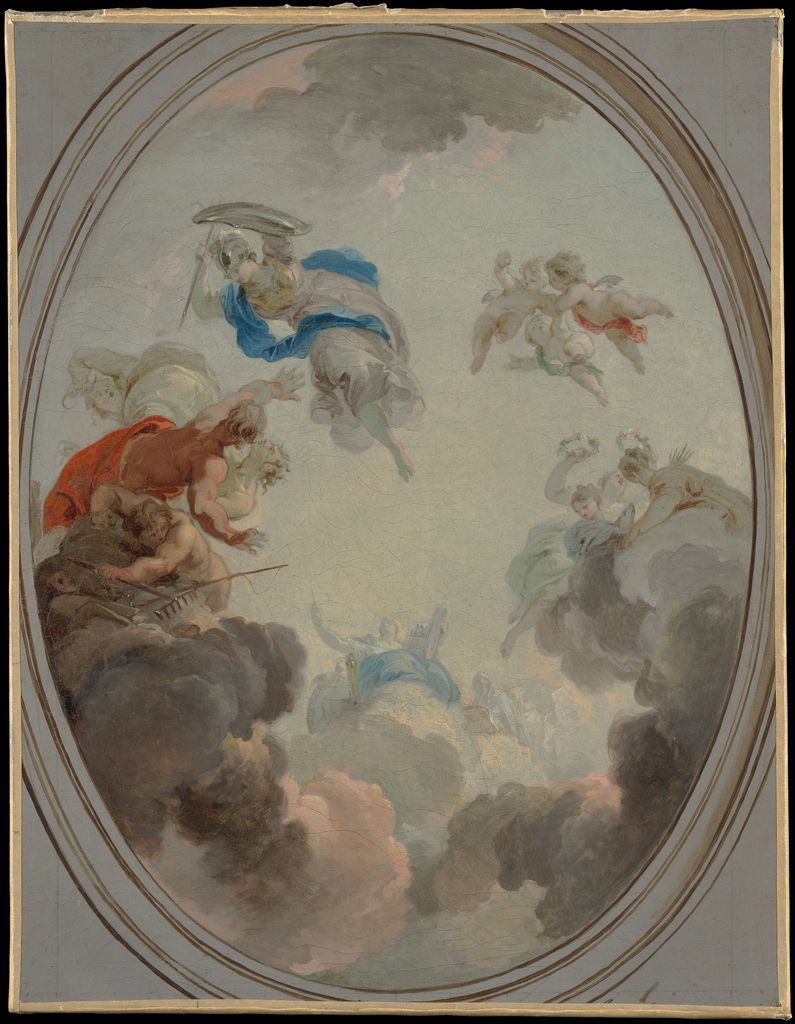
De Wit: government as a moral contest
Jacob de Wit's Allegory of Government: Wisdom Defeating Discord makes its structure unusually clear through the title.[4] Wisdom and Discord are not portraits of particular people. Their gestures and opposition embody qualities, allowing government to appear as victory of order over division.
The painting's persuasive force lies in hierarchy: the desirable principle occupies the commanding position while its opposite is subdued. Such political allegory naturalises a judgement by giving abstractions apparently physical consequences. Asking who commissioned or displayed it is therefore as important as naming the figures.
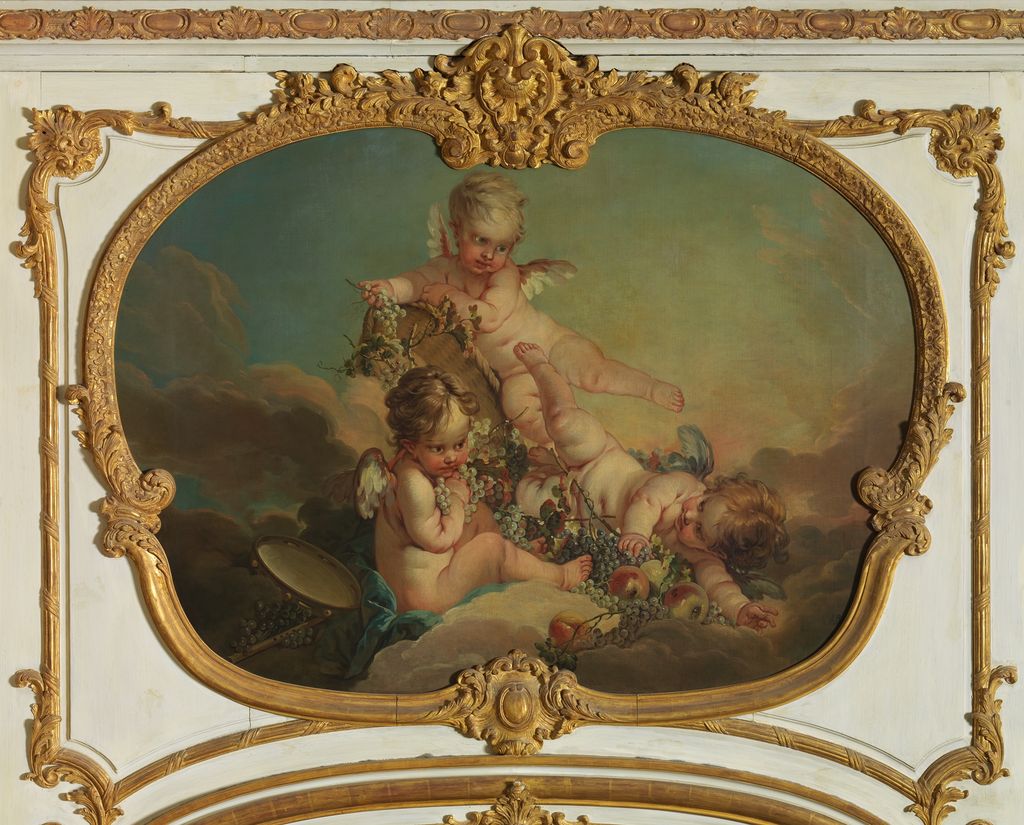
Boucher: a season becomes decoration
François Boucher's Allegory of Autumn (1753) uses airborne putti and seasonal attributes within an irregular decorative canvas.[5] The Met notes that such works were shaped to fit Rococo wall panelling. Autumn is not narrated as an event; it is evoked through bodies, produce and a decorative mood.
Format changes interpretation. This allegory was part of an interior programme, so the surrounding room and companion seasons would have guided recognition. What looks independent in a museum originally participated in architecture.

Puvis: an institution personified
In The Allegory of the Sorbonne (1889), Pierre Puvis de Chavannes places an enthroned woman at the centre to personify the university.[6] Around her, figures represent philosophy, history and sciences. The work is a sketch for a mural in the Sorbonne's new lecture hall, and its grid lines record enlargement into architecture.[6]
Here allegory defines an institution's ideal self-image. Disciplines coexist in calm order under a central figure. The composition is therefore both symbolic and spatially purposeful: it made an educational programme visible to the community that inhabited the building.
Famous allegories and interpretive uncertainty
Bronzino's An Allegory with Venus and Cupid assembles recognisable mythological figures but remains famously difficult to reduce to one message. Titian and workshop's An Allegory of Prudence combines three human heads, three animal heads and a Latin inscription; its meaning and even some identities have generated competing interpretations.[7] These cases prove that allegory is constrained without necessarily being transparent.
Élisabeth Vigée Le Brun's Peace Bringing Back Abundance (1780) is more explicit: Peace leads Abundance with her cornucopia, connecting personification to a timely political hope after war.[8] Delacroix's Liberty Leading the People combines an allegorical Liberty with recognisably contemporary participants. Allegory can therefore mix embodied ideas with historical worlds rather than replacing one with the other.
How to interpret allegorical art
Begin with visible facts: figures, gestures, attributes, inscriptions and relationships. Separate identification from interpretation, following the method in Iconography and Symbols in Art. Confirm names through the title, collection record or established convention. Then ask what the figures do to one another and what hierarchy the composition creates.
Next restore function. Was the work a book frontispiece, medal, ceiling, mural, courtly decoration or gallery painting? Allegories were especially frequent from the Renaissance to around 1800 and appeared often in medals and engraved frontispieces.[1] Placement determined who could read them and what knowledge was expected.
Finally, state uncertainty precisely. A secure personification does not guarantee one complete interpretation. Strong readings explain several details and acknowledge patronage, setting and alternatives. Allegory rewards decoding, but it is more than a puzzle: it gives contested ideas bodies, actions and memorable visual form.
Watch: Allegory through Formal Analysis
Choose a museum-led whole-work analysis, a close reading, or a foundations overview for considering allegory.
Introducing Formal Analysis: Landscape
Follow how recurring shapes, colours and intervals contribute to a larger visual organisation.
Watch on YouTubeFrequently Asked Questions
Allegory presents one visible subject in the guise of another, often embodying abstract ideas through figures, attributes and actions.
Personification gives human form to something without a body, such as Peace, Autumn, Justice or an institution.
A symbol may be one meaningful element, while an allegory usually organises several figures, attributes and actions into a sustained second level.
Yes. Identifications can be secure while the complete relationship among figures, patronage, setting and audience remains debated.
Describe figures and attributes, confirm identities through reliable records, restore the work’s function and setting, then state uncertainty precisely.
Discussion
Which work on this page shows most clearly that identifying its personifications is only the beginning of interpretation?
Reader Insights
Use titles, inscriptions and established attributes rather than resemblance alone.
Ask who guides, triumphs, yields, mourns or occupies the centre.
A mural, ceiling, frontispiece or decorative panel addressed a particular audience and place.
Join the Conversation
Share one precise observation or a useful museum example below.
References
- National Gallery — Allegories
- National Gallery — Seven Liberal Arts
- The Met — Allegory of the Arts
- The Met — Allegory of Government: Wisdom Defeating Discord
- The Met — Allegory of Autumn
- The Met — The Allegory of the Sorbonne
- National Gallery — Reframing Titian's Allegory of Prudence
- The Met — Peace Bringing Back Abundance