



 by Tom Gurney
Tom Gurney BSc (Hons) is an art history expert with over 20 years experience
Published on June 19, 2020 / Updated on October 30, 2026
Email: tomgurney1@gmail.com / Phone: +44 7429 011000
Chez le Père Lathuille by Édouard Manet: Introduction
A young man leans towards a woman across a restaurant table. His face is animated, his arm reaches behind her chair, and his eyes turn up towards hers. She remains upright, her hands on the white cloth. In the garden behind them, a waiter carrying a metal pot looks out towards us.
Édouard Manet painted Chez le Père Lathuille in 1879. The oil painting, now in the Musée des Beaux-Arts in Tournai, measures 92 × 112 cm.[1] It brings the gestures of courtship into a bright, everyday setting, where a table, a chair and a few inches between two hands can carry as much interest as the faces.
At a Glance
- ArtistÉdouard Manet
- TitleChez le Père Lathuille, also known as At Père Lathuille's
- Date1879
- MediumOil on canvas
- Dimensions92 × 112 cm, height × width
- CollectionMusée des Beaux-Arts, Tournai, Belgium
- SettingThe garden of the Père Lathuille restaurant in the Batignolles neighbourhood of Paris.[1]
This work across Édouard Manet’s career
Contents
- A Restaurant Garden in Paris
- Who Posed for the Couple?
- Hands, Gloves and the Edge of the Table
- Light Among the Plants
- The Waiter and Our Place in the Scene
- Huysmans at the 1880 Salon
- Beside In the Conservatory
- Annotated details
A Restaurant Garden in Paris
The garden offers a place to sit among plants without leaving the arrangements of a restaurant. White cloths cover tables, chairs stand ready for customers, and a pale building closes the view at the back. Cultivated greenery surrounds the diners, while service continues along the path behind them.
Writing in 1906, Manet's friend and defender Théodore Duret described Père Lathuille as an old Paris restaurant near the entrance to the avenue de Clichy. He recalled that Manet, who lived nearby, sometimes went there for lunch or dinner. According to Duret, the painter saw an opportunity to use its quiet garden for an outdoor scene in which a young man would court a woman.[2]
That recollection places the subject within Manet's familiar surroundings. The restaurant's name supplies a location, but the painting concentrates on the customers at a particular table. The clipped vessel at the left edge, the foreground cloth and the chair at the right bring their setting close to our own position. We seem to have arrived beside the meal while it is still in progress.
The table also opens a route through the picture. Its broad white surface occupies much of the lower canvas, then narrows towards the two figures. Beyond their shoulders, the restaurant garden becomes busier and less sharply described. Another table and distant customer appear at the left; foliage, lamps and the building draw the eye across the upper half.
Who Posed for the Couple?
The models are generally identified as Louis Gauthier-Lathuille, the restaurant proprietor's son, and Judith French. The local history trail produced by the Déclic17/18 association for the Place de Clichy neighbourhood gives these names and records that Ellen Andrée initially posed for the female figure.[3]
Manet could arrange a glance, a position at the table and an arm along a chair to make an exchange convincing. The ease of the finished scene does not require it to be a record of a private conversation caught by chance.
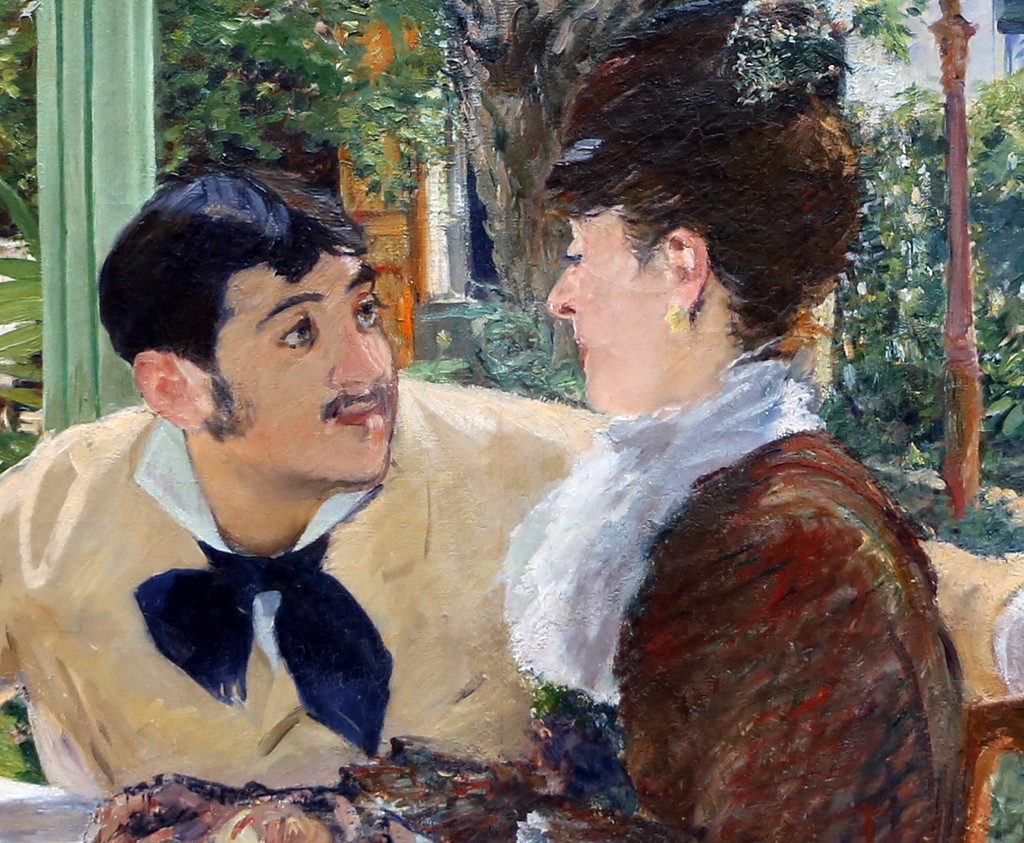
The young man's forward movement is particularly clear. His torso inclines towards his companion, and his head tilts so that his eyes seek her face. The broad dark bow beneath his chin points down into the light jacket, keeping the neck and head distinct from the paler clothes around them. His moustache and raised eyebrows give the face a lively pattern of dark accents.
Her pose answers his movement with a more upright line. We see her face in profile, framed by the dark hat and the pale ruff at her neck. Her shoulders turn enough to give the patterned dress a substantial presence across the right of the canvas. The contrast makes his eagerness easy to read, while leaving her response less settled.
It is tempting to continue the story by deciding what she thinks or what the pair will do next. Duret did so, interpreting her reserve as a calculated response to the young man's passion.[2] That reading belongs to the critic's account. The poses establish different degrees of movement and attention; they do not establish the models' feelings or prove that Louis and Judith had a romantic relationship.
Hands, Gloves and the Edge of the Table
The arm behind the woman's chair makes the man's approach more expansive. It passes beyond her body and ends in a hand resting on the curved wooden back. He occupies space on both sides of her figure, while his other hand stays near the stemmed glass at the left of the table.
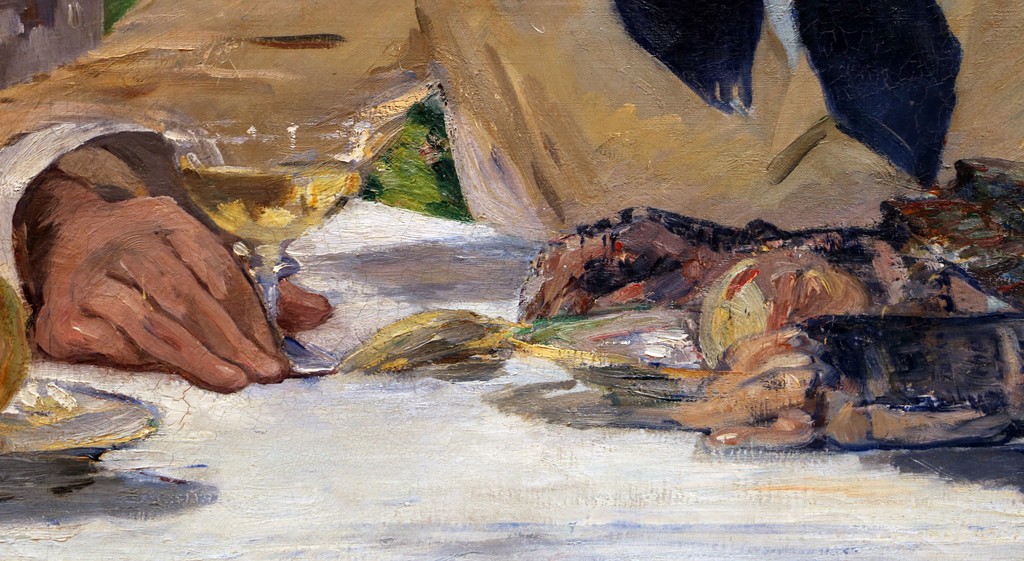
Her hands remain lower and closer together. Dark lace crosses the skin, making a broken pattern against the white cloth. The cutlery and the edge of a plate introduce small, hard lines among the softer painted shapes of fingers, gloves and sleeves.
The two figures' hands do not touch. This matters because the arm behind the chair can initially suggest a closer embrace than the lower part of the painting actually shows. Looking down from the faces reveals another arrangement: his hand near the glass, hers beside the place setting, with objects and pale cloth between them.
Manet makes the difference between their clothes equally visible. Broad passages of cream and warm tan describe the man's jacket. Brown, red and greenish strokes run through the woman's dress, changing direction as the fabric crosses her shoulder and bends towards the waist. Her white neckwear provides a light border between the dress and face; a small yellow earring adds a concentrated warm accent beside her cheek.
The glass supplies a different problem of description. Its bowl is largely transparent, so the white cloth, warm liquid and darker background have to remain visible through or beside it. A few pale marks establish the rim and stem, while yellow and brown passages give weight to the contents. The painted object stays legible through these separate touches rather than through a continuous outline.
Below the glass and hands, the cloth spreads into a broad field of white, blue and lilac. Long strokes and changes of tone suggest its folds and the turn over the table edge. Its brightness brings the small objects forward and gives the dark lace enough contrast to be read. Near the lower left, Manet's signature and the date sit within that pale expanse.
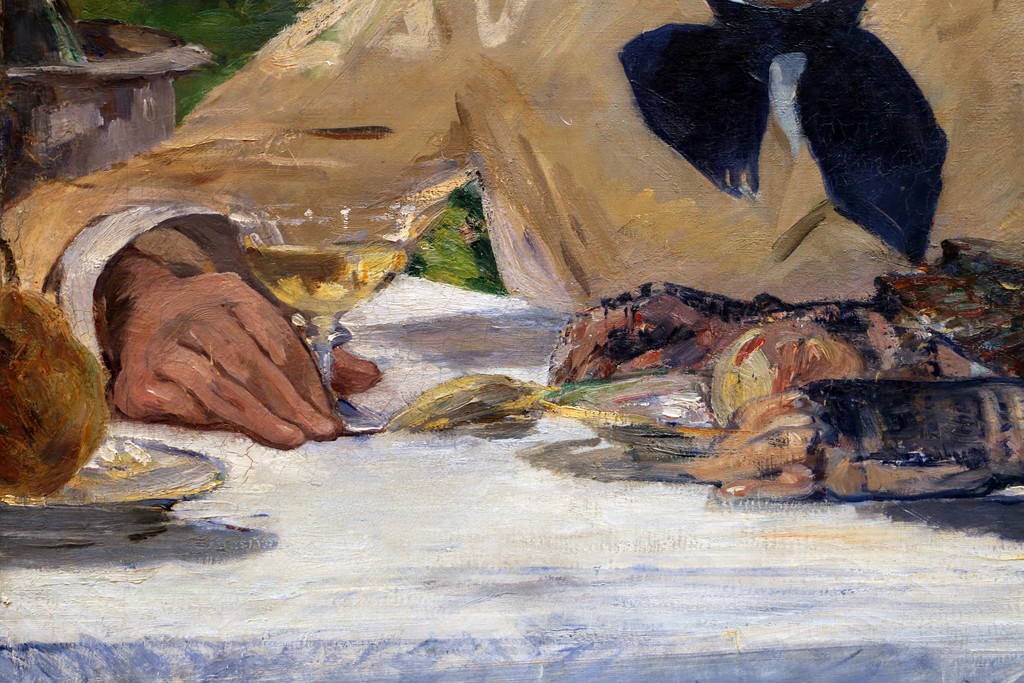
Édouard Manet, Chez le Père Lathuille, 1879, supplied photographic detail of the glass and hands. Musée des Beaux-Arts, Tournai. Photograph: Sailko / Wikimedia Commons. Image source. CC BY 3.0. Supplied detail photograph by Sailko, CC BY 3.0, resized without additional cropping; not a whole-canvas view.
Light Among the Plants
A green upright post rises behind the man's head, separating a small view of the restaurant at the left from the more crowded foliage near the centre. Farther right, a tree trunk and branches interrupt the garden's scattered light. These verticals give the space structure without requiring a deep, clearly measured view.
Manet varies the kind of mark as the eye moves backwards. Faces and hands contain enough detail for a gesture or glance to register. Leaves become clusters of green, yellow and pale touches, and the garden furnishings are held together by a few stronger lines. The near and far parts of the picture remain connected through repeated colours even as their detail changes.
The man's jacket carries the garden's light towards the foreground. Its pale tones sit beside the white cloth and the woman's neckwear, forming a loose chain of bright areas across the group. Against them, her hat, his hair and necktie provide deep accents. The darks remain strong, but they are dispersed among the lighter colours rather than gathered into a single shadowed background.
Duret particularly admired the light in this painting. He argued that even its shaded passages retained enough clarity and colour to approach the brightness of the directly lit areas.[2] His description draws attention to the blue and lilac within the tablecloth, the warm and cool colours in the clothes, and the lively variations of green behind the figures.
The Waiter and Our Place in the Scene
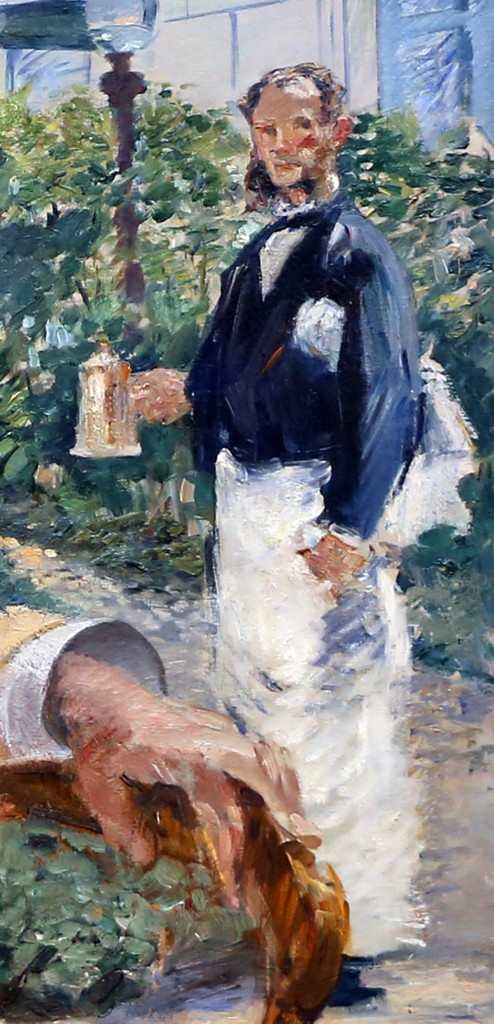
The waiter stands beyond the woman's chair, smaller than the diners but sharply distinguished by his white apron and dark jacket. He holds a metal pot, whose pale highlights catch the light near the greenery. The path remains open around his figure, leading towards the foreground at the right.
His direction of attention changes the encounter. The man at the table looks towards the woman, and her profile keeps our attention within their exchange. The waiter turns outwards, towards the position from which we look at the painting. His face gives the background a connection with the viewer that the couple themselves do not make.
He also gives the restaurant a working presence. The cloth, glass and place setting have been prepared for customers; someone will continue to serve and clear them. With the waiter visible, the diners' apparently private attention remains part of a place where people circulate, carry things and notice one another.
The space beside him is a useful counterweight to the crowded foreground. The couple, their chair and the table overlap closely, while a lighter strip of path runs behind them. His standing figure occupies that more open area, keeping the eye from settling permanently on the two faces.
Huysmans at the 1880 Salon
Manet exhibited Chez le Père Lathuille at the Salon of 1880 alongside his Portrait of Antonin Proust. The critic J.-K. Huysmans preferred the restaurant scene. In his review, later collected in L'Art moderne, he complained that it had been hung high while the portrait received a lower position.[4]
Huysmans's response was enthusiastic about this canvas and distinctly less generous about the Proust portrait. He found the latter empty in places, despite its curious execution. The garden scene, by contrast, struck him as clear and alive, making neighbouring official paintings seem stale. His praise came from a comparison within Manet's own contribution as well as with the wider exhibition.
The critic's central phrase was “Le moderne dont j'ai parlé, le voilà !” — “Here is the modern that I have been talking about!”[4] Modern painting, in this account, appeared through people eating outdoors, speaking to one another and inhabiting a recognisable contemporary world. The liveliness of the figures and the convincing light mattered together.
Huysmans went further, imagining the conversation exchanged over champagne and the waiter's impending announcement of coffee. His prose supplies the sound that the picture cannot give: ordinary talk at the table and service approaching from the garden.[4] The imagined dialogue is part of his critical response, giving a sense of how readily he could turn Manet's gestures into an episode of everyday life.
Beside In the Conservatory
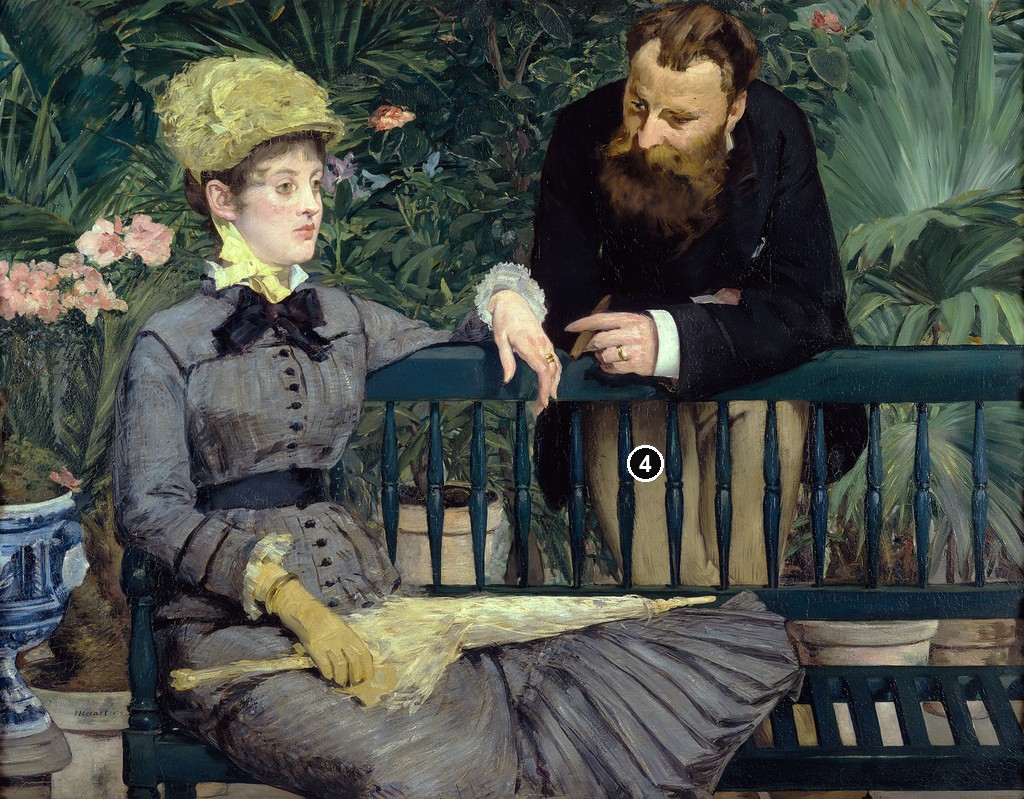
A useful comparison is Manet's In the Conservatory, dated 1878–79 by its owning museum, Berlin's Alte Nationalgalerie. It portrays Monsieur and Madame Guillemet, a married couple who were friends of the artist and ran a fashion business.[5] Here too, cultivated plants surround a woman seated beside a man who leans towards her.
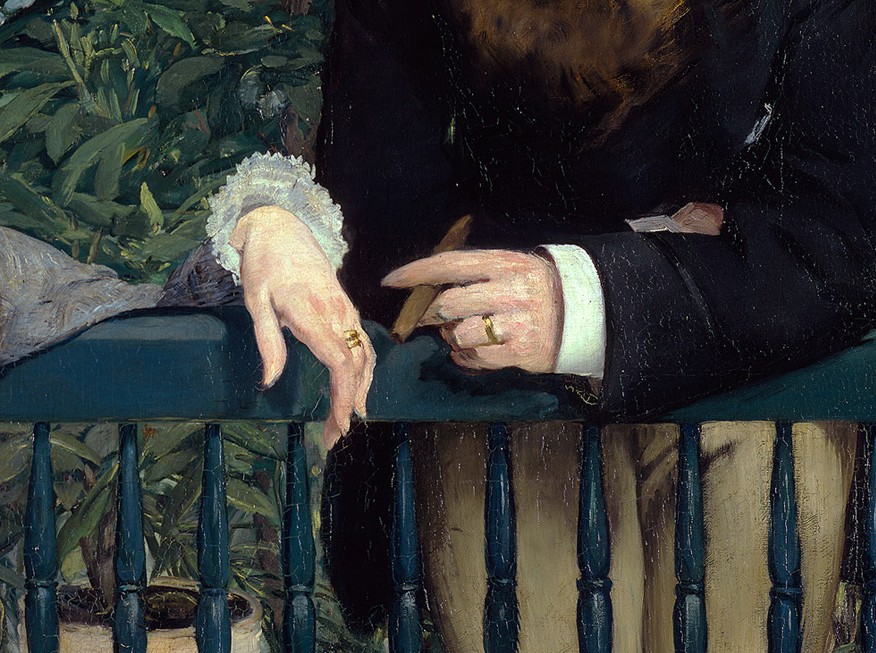
The division of space changes the relationship between the figures. In Berlin, the woman sits on a bench and the man bends over its back. Their bare hands approach one another near the centre, above the line of the bench. In the restaurant, the table opens towards us and the man's extended arm follows the back of the woman's chair. The furniture gives each pair a different way of occupying the same small area.
The women also hold the eye differently. Madame Guillemet faces outward across the conservatory, her yellow hat and gloved hand adding warm accents to the grey dress. The restaurant diner presents a more enclosed profile, concentrating attention on the short distance between her face and the young man's. Both remain upright beside a more inclined male figure.
The Guillemets' marriage is documented by the museum; the restaurant painting presents a courtship scene. Within each, the painted hands stop short of contact, leaving a small interval for the eye to examine.
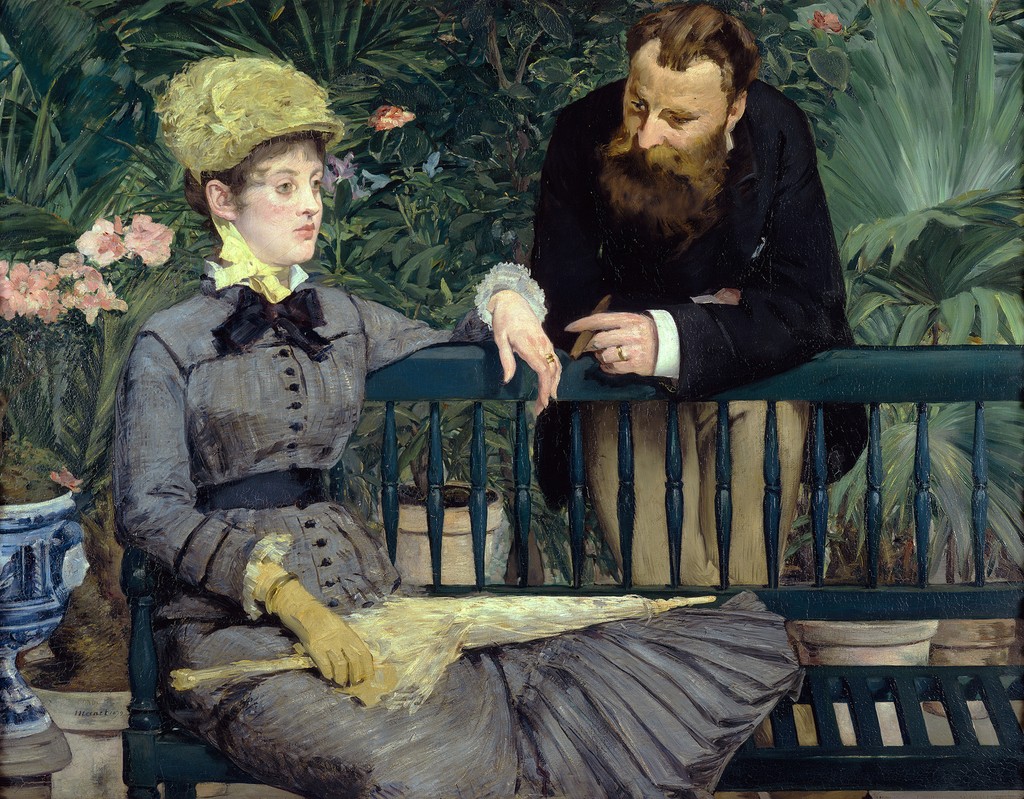
Édouard Manet, In the Conservatory, 1878–79. Alte Nationalgalerie, Staatliche Museen zu Berlin, A I 550. Staatliche Museen zu Berlin, Alte Nationalgalerie / Jörg P. Anders. Image source. Public domain. Whole supplied reproduction resized within native dimensions; no enlargement or retouching.
Annotated Details from Chez le Père Lathuille: Faces, Service and Hands
The numbered points identify visible features discussed in this article. Return from each detail to the whole composition. Each caption identifies the work shown.
Chez le Père Lathuille — Framed Photograph
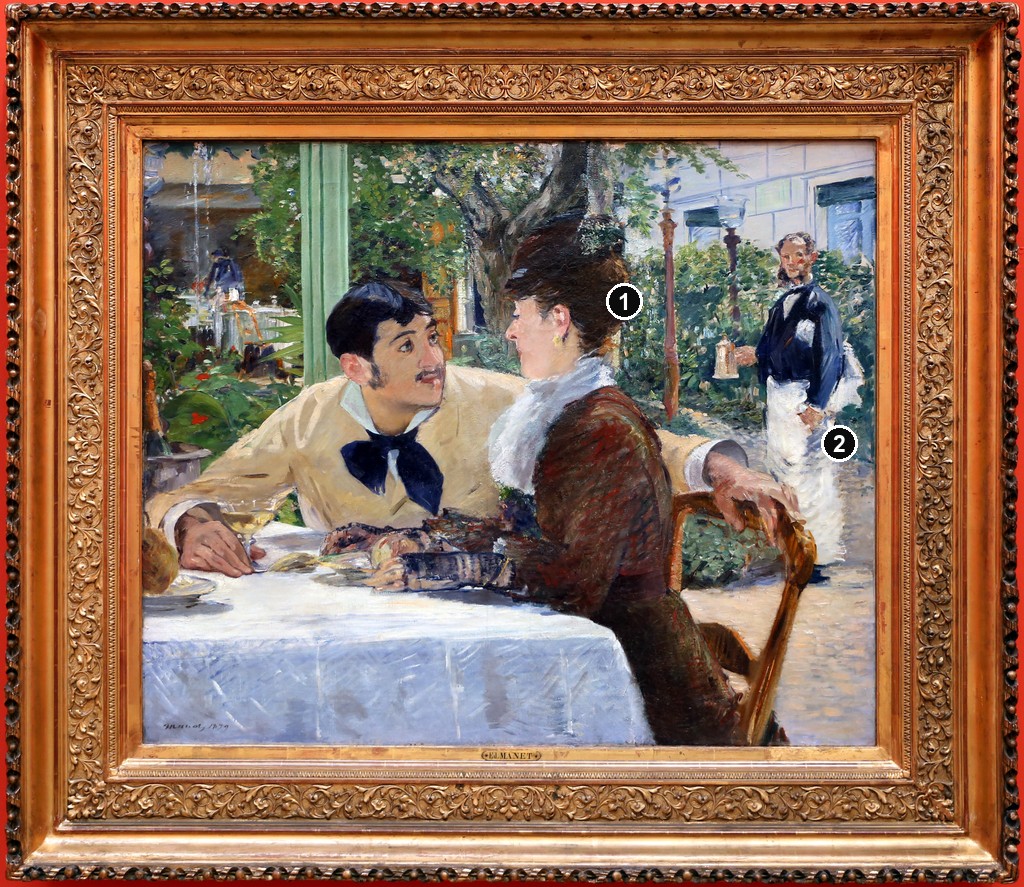
Édouard Manet, Chez le Père Lathuille, 1879. Musée des Beaux-Arts, Tournai. Photograph: Sailko / Wikimedia Commons. Image source. CC BY 3.0. Photograph by Sailko, CC BY 3.0. Numbers added to a separate resized overview retaining the supplied decorative frame. Detail crops from the original photograph; no enlargement, retouching or perspective alteration.
Glass and Hands — Supplied Photographic Detail
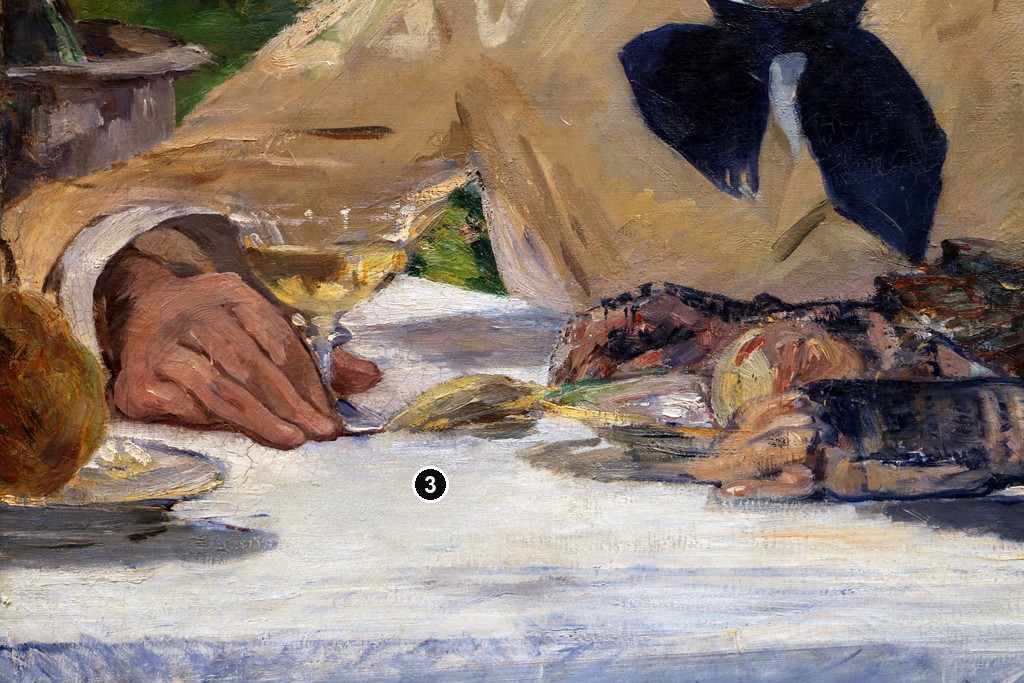
Édouard Manet, Chez le Père Lathuille, 1879, supplied photographic detail of the glass and hands. Musée des Beaux-Arts, Tournai. Photograph: Sailko / Wikimedia Commons. Image source. CC BY 3.0. Supplied detail photograph by Sailko, CC BY 3.0. Number added to a separate resized overview of the provided detail, not a whole painting. One detail crop from that photograph; no enlargement or retouching.
In the Conservatory — Berlin
Édouard Manet, In the Conservatory, 1878–79. Alte Nationalgalerie, Staatliche Museen zu Berlin, A I 550. Staatliche Museen zu Berlin, Alte Nationalgalerie / Jörg P. Anders. Image source. Public domain. Numbers added to a separate resized overview of the complete supplied reproduction, retaining its existing edges. Detail crops from the immutable original; no enlargement or retouching.
Details from CHEZ LE PÈRE LATHUILLE: FACES, SERVICE AND HANDS
Move from the two faces to the waiter’s white apron and held pot. Compare the glass and separate hands in the supplied photographic detail with the hands above the bench in In the Conservatory.
Chez le Père Lathuille — Framed Photograph
Two Faces above the White Ruff
The man tilts his face towards the woman’s upright profile. Her pale neckwear separates her face from the patterned dress.
The Waiter’s Apron and Held Pot
A white apron distinguishes the standing waiter from the greenery. His held pot catches small pale highlights.
Glass and Hands — Supplied Photographic Detail
The Glass and the Separate Hands
The stemmed glass stands near one hand, while the dark lace and the other hands remain separated across the pale cloth.
In the Conservatory — Berlin
The Hands above the Bench Rail
Two bare hands approach across the bench rail without meeting. Dark uprights below contrast with the pale cuff and grey sleeve.
Artworks directory
Explore selected paintings, drawings and prints by Édouard Manet. Search by title or another recorded name.
Frequently Asked Questions
It belongs to the Musée des Beaux-Arts in Tournai, Belgium.[1]
It shows the garden of the Père Lathuille restaurant in the Batignolles neighbourhood of Paris.[1]
Discussion
Look again at the images and ideas explored in Chez le Père Lathuille by Édouard Manet. These editorial prompts invite your observations.
Reader Insights
Follow the man’s arm behind the chair, then compare the separate hands on the tabletop. Notice how the furniture gives each gesture its space.
Look at the glass in the supplied detail. Compare its few bright edges with the broader strokes in the white cloth and the darker lace.
Compare the restaurant scene with In the Conservatory. How do the table, chair and bench change the space between each pair?
Join the Conversation
Share a detail, comparison or question about Chez le Père Lathuille by Édouard Manet below.
References
- Musée des Beaux-Arts de Tournai, Édouard Manet — Chez le Père Lathuille; French owning record, dimensions and commentary (in French). . View English translation. View source 1. View source 2.
- Théodore Duret, Histoire d'Édouard Manet et de son œuvre, 1906, pp.219–222; retrospective account of the restaurant, depicted encounter, light and 1880 Salon (in French). View source.
- Déclic17/18 association / Paris Participatory Budget, Artists’ views of Paris: the Place de Clichy neighbourhood; English local history trail, stop on Chez le Père Lathuille, model identifications. View source.
- J.-K. Huysmans, Salon officiel en 1880, collected in L'Art moderne, 1883; French transcription, passage on Manet's two Salon paintings (in French). View source.
- Staatliche Museen zu Berlin / Angelika Wesenberg, Im Wintergarten, 1878/79, Alte Nationalgalerie, A I 550; German owning record and commentary (in German). View source.
- Splash image, Édouard Manet, Chez le Père Lathuille, 1879. Musée des Beaux-Arts, Tournai. Photograph: Sailko / Wikimedia Commons. Image source. CC BY 3.0. Photograph by Sailko, CC BY 3.0. Cropped to the inner painting and resized.


