



 by Tom Gurney
Tom Gurney BSc (Hons) is an art history expert with over 20 years experience
Published on June 19, 2020 / Updated on October 30, 2026
Email: tomgurney1@gmail.com / Phone: +44 7429 011000
View of the 1867 Exposition Universelle by Édouard Manet: Introduction
A gardener waters a flowerbed, a woman rides across a pale path, and a boy walks a dog at the edge of a wide Paris panorama. Beyond them, exhibition buildings, flags and distant monuments spread beneath a balloon. In View of the 1867 Exposition Universelle, Édouard Manet brings a world event into the background of everyday activity. Painted in 1867, the canvas belongs to Nasjonalmuseet in Oslo.[1]
At a Glance
- ArtistÉdouard Manet
- TitleView of the 1867 Exposition Universelle
- Date1867.[1]
- MediumOil on canvas
- Dimensions108 × 196 cm.[1]
- CollectionNasjonalmuseet, Oslo; NG.M.01293; gift from Nasjonalgalleriets Venner, 1923.[1]
This work across Édouard Manet’s career
Contents
- The Gardener in the Foreground
- The Curving Flowerbed and Pale Path
- The Woman on Horseback
- Léon and the Dog
- Groups on the Lawns
- Buildings beyond the Visitors
- A Balloon above Paris
- The Fair and Manet's Independent Exhibition
- An Unfinished Painting in Oslo
- Annotated details
The Gardener in the Foreground
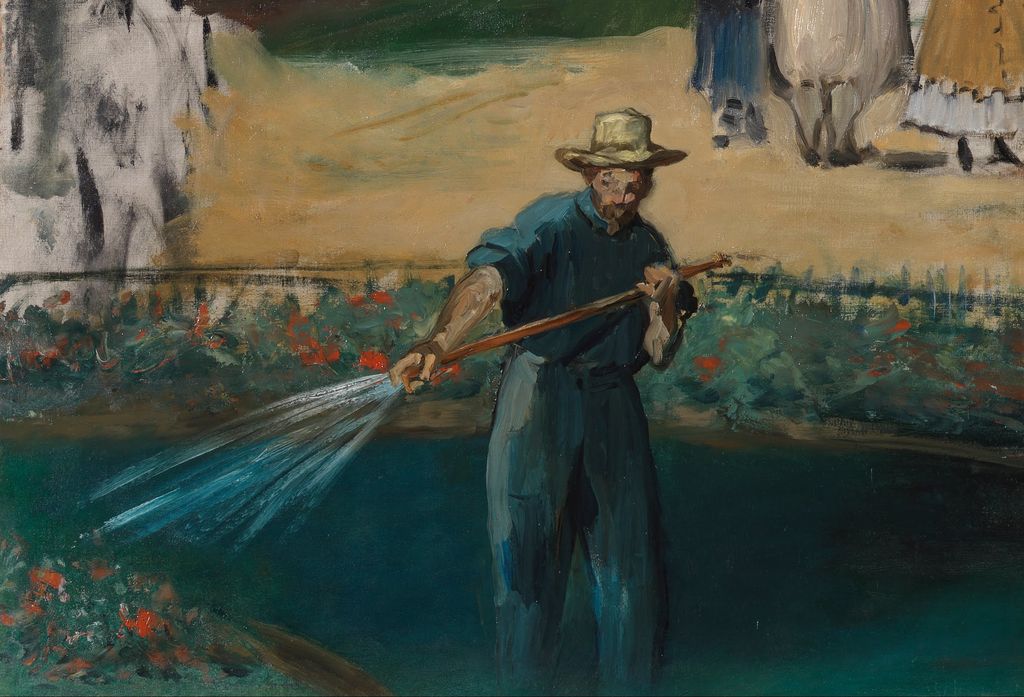
The nearest adult stands at the lower left, wearing blue-green work clothes and a broad-brimmed hat. One arm reaches along a long watering implement while the other hand steadies it closer to his body. Several blue streams spread downwards across the dark flowerbed. Their straight, fanning lines introduce a distinct action into the broad patches of earth and vegetation.
His bent elbows and angled equipment turn him across the foreground rather than towards the distant fair. The hat shades his face, leaving the hands, sleeves and streams more immediately legible. This figure gives the scene a working rhythm alongside the slower movements of the visitors behind him.
The Curving Flowerbed and Pale Path
The flowerbed sweeps across the bottom of the painting in a broad arc. Low green edging marks its boundary, with red touches scattered inside. Its dark surface differs sharply from the pale path beyond. The contrast makes the curve easy to follow even where individual flowers and leaves remain only briefly described.
The path runs behind the gardener, widens around the horse and continues towards the boy at the right. Its open surface separates the nearest figures from the groups on the lawns. Shadows spread across it beneath the horse and near the dog, giving these larger figures a firmer place on the ground. The curve and the path carry the eye sideways through the painting before it moves towards the fairground.
The Woman on Horseback
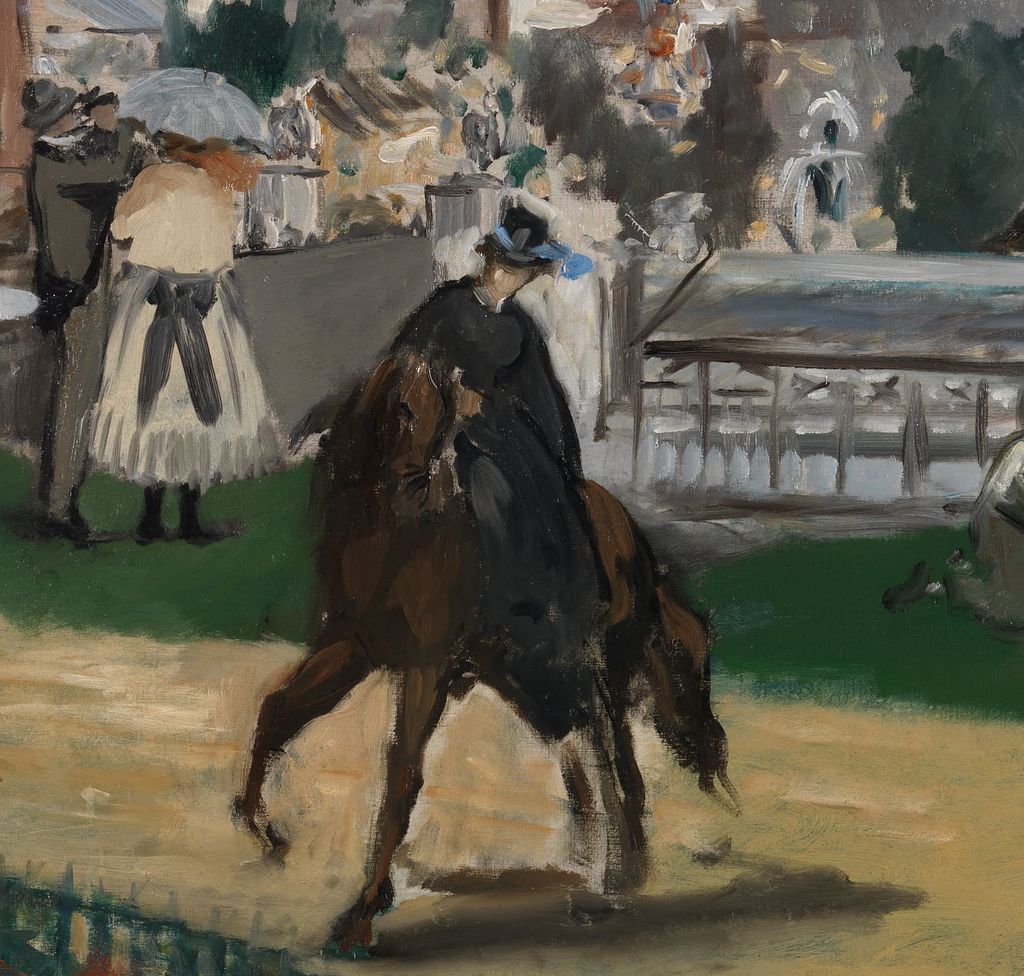
A brown horse occupies the centre, with its body angled towards the foreground. Its legs separate into dark and lighter strokes against the path. The rider wears a small hat and dark clothing that falls along the animal's side. A light area around her face and neck interrupts the larger dark shape above the saddle.
Theodore Reff describes her as an amazone, a woman rider, and observes that the foreground groups align along diagonals meeting around her.[2] Her prominent position helps connect the activity on either side. The horse stands between the left-hand gathering and the boy with his dog, while the rider rises above the low roofs immediately behind her.
Léon and the Dog
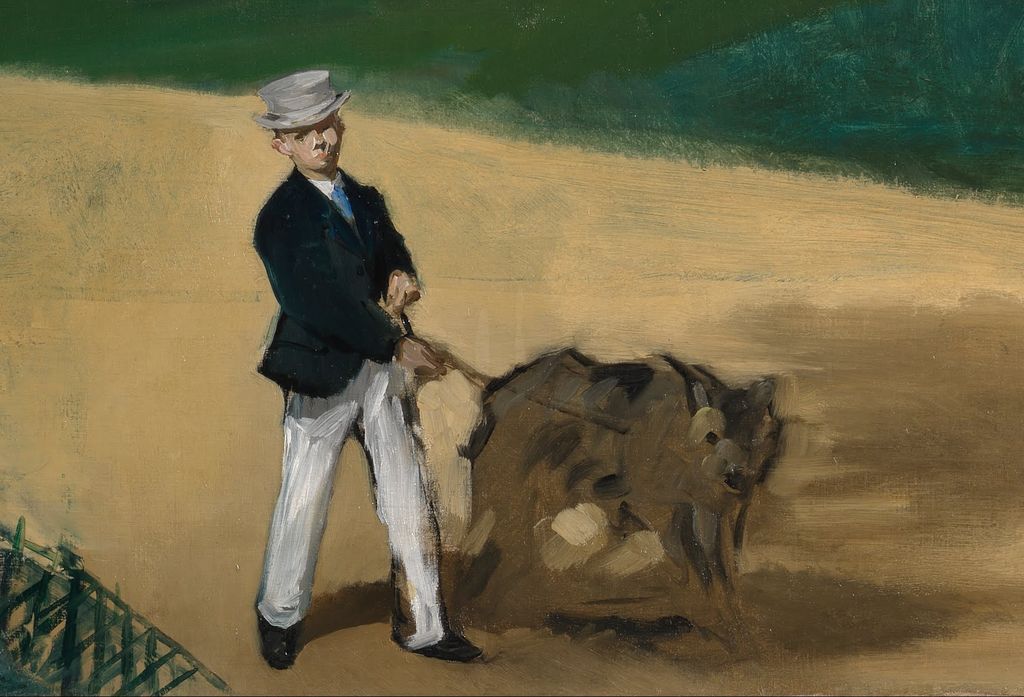
At the lower right, a boy in a dark jacket and pale trousers accompanies a large brown dog. A grey cap sits above his small face, and one arm reaches towards the lead. The dog lowers its head towards the path. Its warm brown body and the boy's pale legs remain distinct against the open ground.
Nasjonalmuseet identifies the boy as Léon Koella Leenhoff, Suzanne Manet's son.[1] The pair brings a personal connection into this crowded public setting. Their place near the lower edge also changes the scene's scale: the boy and dog appear substantial beside the much smaller visitors and structures in the distance, even though they occupy only a small part of the panorama.
Groups on the Lawns
To the left of the horse, women in pale, yellow and green clothing gather beside a darker figure. Their skirts make a series of broad shapes along the path. Farther back, two figures stand near a pale parasol, facing towards the exhibition. The different directions of their bodies prevent the gathering from becoming a single continuous row.
On the right lawn, two men in dark hats stand together with their backs or sides turned towards us. Their upright bodies contrast with the smaller seated figures nearby. Farther right, dark jackets and red trousers distinguish another group. One person sits on the grass while others remain standing. Manet distributes these separate activities across the slope, allowing spaces of green to remain between them.
Buildings beyond the Visitors
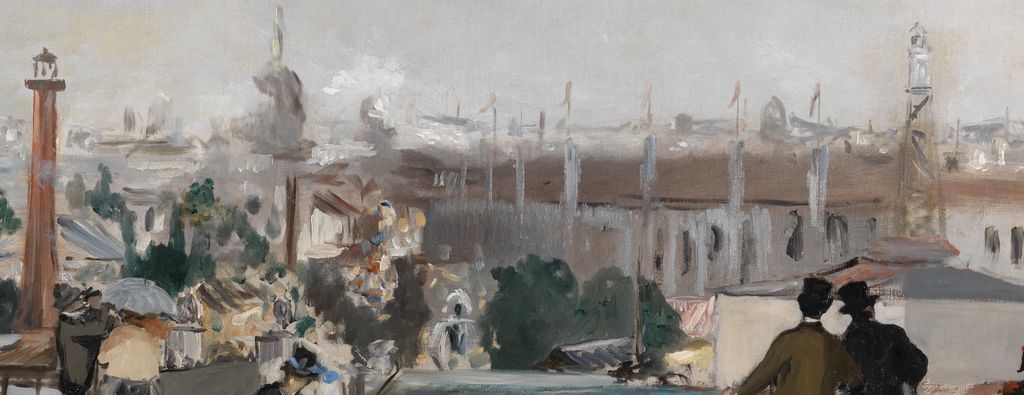
The middle distance contains trees, small roofs, railings and structures packed much more tightly than the foreground people. A long exhibition building stretches across the right, with a broad roof and a line of narrow uprights carrying flags. Its repeated openings and long horizontal edge give the busy background a substantial framework.
Tall structures interrupt that horizontal movement. Reff identifies two of the exhibition's conspicuous towers as lighthouses. He also notes how Manet brings the near gardens and the buildings across the Seine abruptly together, almost eliminating the river and its quays.[2] The painting consequently offers a compressed encounter between visitors and fairground, with many forms overlapping rather than a clear route through every intervening space.
A Balloon above Paris
The distant city becomes paler and less sharply defined towards the horizon. Domes, spires and blocks of buildings emerge among blue-grey marks, while darker trees establish a nearer boundary on the left. Above this intricate band lies a large expanse of light sky, interrupted by patches of blue.
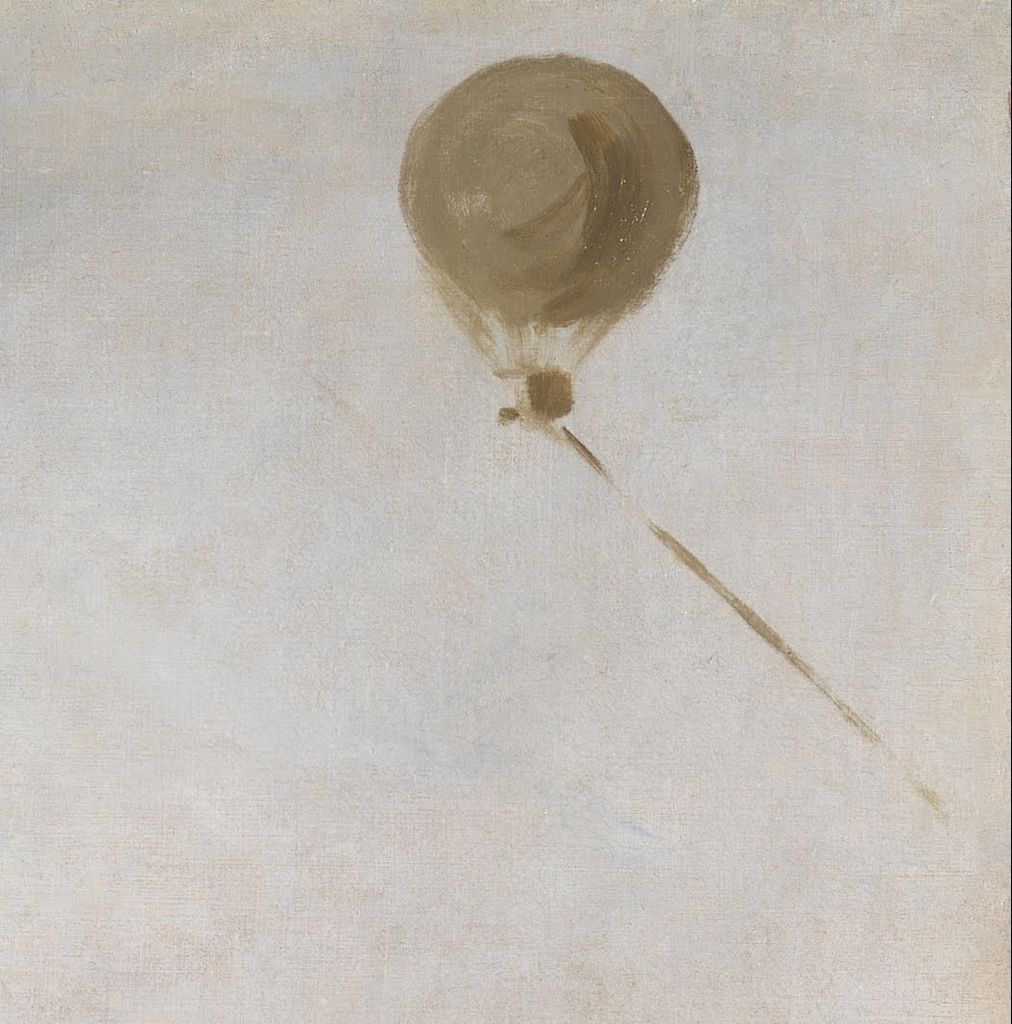
A rounded balloon floats near the upper right corner, with a small basket below and a long diagonal line trailing away. Reff identifies it as Nadar's Le Géant.[2] Its isolated shape contrasts with the crowded architecture below. The balloon carries attention upwards and towards the edge of the canvas, extending the scene's activity beyond the lawns, paths and exhibition buildings.
Annotated Details from View of the 1867 Exposition Universelle
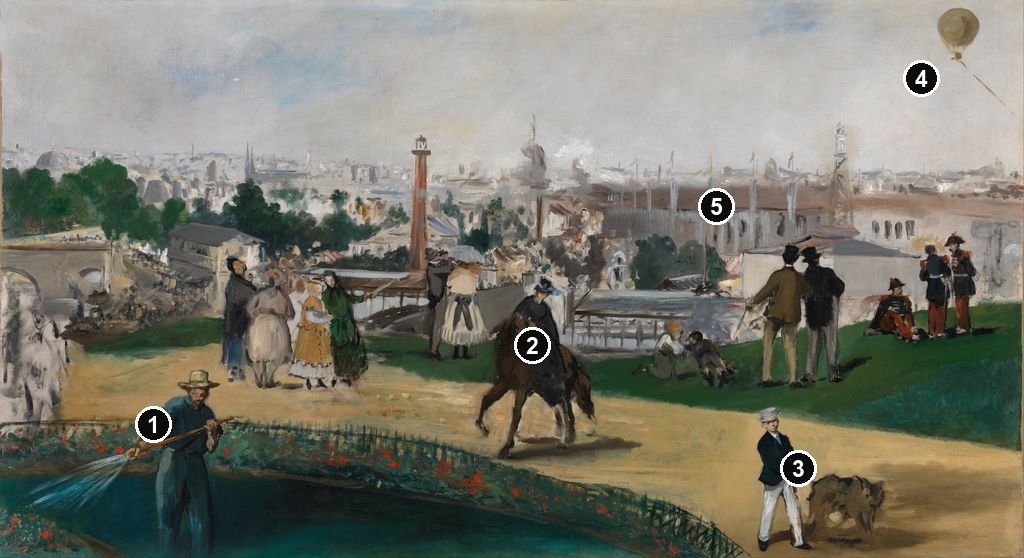
The numbered points identify visible features discussed in this article. Return from each detail to the whole composition. Édouard Manet, View of the 1867 Exposition Universelle, 1867. Oil on canvas, 108 × 196 cm. Nasjonalmuseet, Oslo, NG.M.01293; gift from Nasjonalgalleriets Venner, 1923. Nasjonalmuseet, Oslo; Google Art Project reproduction via Wikimedia Commons. Image source. Public domain. Resized without cropping from the supplied reproduction.
Details from VIEW OF THE 1867 EXPOSITION UNIVERSELLE
Move between the foreground activities, the distant exhibition buildings and the balloon in the open sky.
Watering the flowerbed
The gardener steadies a long watering implement with both hands. Blue streams fan across the dark bed, beside red flowers and low green edging.
The woman on horseback
The rider’s dark clothing rises above the brown horse. Pale strokes around her face and neck interrupt the larger dark shape, while the legs stand against the light path.
Léon and the dog
The boy’s dark jacket and pale trousers stand beside the large brown dog. His reaching arm and the lead connect the two figures near the lower edge.
The balloon above Paris
A rounded balloon, small basket and trailing diagonal line occupy the open sky. Their separate shapes contrast with the many small marks of the city below.
Exhibition buildings and flags
Long roofs and repeated flags spread across the fairground between the tall exhibition structures. Pale distant buildings overlap with darker trees and nearer roofs.
The Fair and Manet's Independent Exhibition
Théodore Duret described the view from the Trocadéro across the Champ de Mars, where the 1867 exhibition was concentrated. He also recorded Manet's separate wooden exhibition pavilion near the Pont de l'Alma. It opened in May 1867 and contained fifty catalogued numbers.[3] The international fair and Manet's own display formed different parts of the same Paris season.
Visitors can take in the exhibition from the slope while remaining occupied with riding, walking or companionship. The fair fills the background, but the people around its edges supply many of the picture's clearest gestures and most varied shapes.
An Unfinished Painting in Oslo
Nasjonalmuseet describes the work as an abandoned sketch and connects Manet's change of attention with Maximilian's execution in June 1867.[1] The broad, lightly described passages remain part of its appearance, especially beside the more substantial foreground figures.
The museum's ownership account includes the collector Auguste Pellerin and Norwegian shipowner Tryggve Sagen. The painting entered the national collection as a gift from Nasjonalgalleriets Venner in 1923.[1]
Artworks directory
Explore selected paintings, drawings and prints by Édouard Manet. Search by title or another recorded name.
Frequently Asked Questions
It belongs to Nasjonalmuseet in Oslo, inventory NG.M.01293.[1]
The museum identifies him as Léon Koella Leenhoff, Suzanne Manet's son.[1]
The panorama looks towards the official fair on the Champ de Mars. Manet's separate pavilion was near the Pont de l'Alma.[3]
Discussion
Look again at the images and ideas explored in View of the 1867 Exposition Universelle by Édouard Manet. These editorial prompts invite your observations.
Reader Insights
Compare the gardener's hands and watering streams with the postures of the standing and seated visitors. Which actions are easiest to follow?
Follow the pale path past the horse and the boy. Where does the open ground give way to overlapping roofs and structures?
Compare the balloon's simple outline with the many small shapes along the horizon. How does each hold your attention?
Join the Conversation
Share a detail, comparison or question about View of the 1867 Exposition Universelle by Édouard Manet below.
References
- Nasjonalmuseet, View of the 1867 Exposition Universelle, current object record and commentary, NG.M.01293. View source.
- Theodore Reff, Manet and Modern Paris, National Gallery of Art, 1982, catalogue no.2, pp.36–37. Museum publication. View source.
- Théodore Duret, Histoire d'Édouard Manet et de son œuvre, 1906, pp.79–80 and162. Digitised French text. French. View source. (in French).
- Splash image, Édouard Manet, View of the 1867 Exposition Universelle, 1867. Oil on canvas, 108 × 196 cm. Nasjonalmuseet, Oslo, NG.M.01293; gift from Nasjonalgalleriets Venner, 1923. Nasjonalmuseet, Oslo; Google Art Project reproduction via Wikimedia Commons. Image source. Public domain. Resized without cropping from the supplied reproduction.


