



 by Tom Gurney
Tom Gurney BSc (Hons) is an art history expert with over 20 years experience
Published on June 19, 2020 / Updated on October 30, 2026
Email: tomgurney1@gmail.com / Phone: +44 7429 011000
Jeanne (Spring) by Édouard Manet: Introduction
A pale parasol rises behind a flower-trimmed bonnet. Beneath it, a young woman looks to the left, her face sharply outlined against a crowded screen of leaves. Her gloved hand holds the parasol's shaft across her shoulder, joining the small gesture in the foreground to the great curve of fabric above.
Manet's Jeanne (Spring), painted in 1881, makes a season visible through a person and her clothes. Flowers appear in the bonnet, the dress and the surrounding foliage, while the face remains a quiet centre within the profusion of coloured marks. The painting belongs to the J. Paul Getty Museum in Los Angeles.[1]
At a Glance
- ArtistÉdouard Manet
- TitleJeanne (Spring), also known as Spring (Jeanne Demarsy)
- Date1881
- MediumOil on canvas
- Dimensions74 × 51.5 cm, height × width
- CollectionJ. Paul Getty Museum, Los Angeles
- Accession number2014.62.[1]
- SitterAnne Darlaud, later known professionally as Jane Demarsy.[2]
- First Salon exhibition1882.[1]
This work across Édouard Manet’s career
Contents
- A Finished Painting for the Salon
- Jeanne, Jane and Anne Darlaud
- The Profile among the Leaves
- A Bonnet Made of Contrasts
- The Parasol and the Gloved Hand
- Flowers Worn and Flowers Painted
- Fashion and the Making of Spring
- Autumn and the Unfinished Seasons Project
- The Salon of 1882
- Related Pictures and Printed Images
A Finished Painting for the Salon
Although sometimes reproduced under the title Spring Study of Jeanne Demarsy, this is the finished painting Manet exhibited at the Paris Salon of 1882. The date of its making and the date of its public appearance are different: the canvas is signed and dated 1881, while its Salon debut followed the next year.[1]
Its measured format gives the figure a substantial presence without showing her whole body. The bonnet nearly reaches the top, the parasol extends beyond the right edge, and the dress continues out of the bottom. The frame contains a carefully selected portion of a larger figure and setting.
The arrangement can suggest a passing encounter in a garden. Yet Manet had the model pose in his studio, selecting her ensemble and working through repeated sittings, as Getty curator Scott Allan explains.[3] The sense of an effortless appearance rests on a deliberately constructed image.
That construction becomes easier to appreciate when we look beyond the initial impression of spring greenery. The face, hat, sleeve, glove and parasol each have a distinct shape and texture. Their edges meet and overlap with unusual care, giving the painting its clarity within an abundance of detail.
Jeanne, Jane and Anne Darlaud
The Salon title was simply Jeanne. The more familiar seasonal title, Le Printemps or Spring, became established later. Getty's research distinguishes that painted “Jeanne” from the sitter's theatrical name, Jane Demarsy, and her birth name, Anne Darlaud.[2]
The familiar “Jeanne Demarsy” combines the picture's title with a later identification. Antonin Proust, recalling Manet in 1897, connected the model with the woman who subsequently used the name Mlle Demarsy. Scott Allan explains how later biographical notices, photographs and other records support the professional spelling Jane.[2]
She was a teenage model when Manet painted her. Her acting career came later; the Getty dates her theatrical debut to 1887.[2] Calling her an already celebrated actress in 1881 would give the portrait a public identity she had yet to acquire.
Knowing the name helps restore an individual to a picture often discussed as an ideal Parisian woman. At the same time, a painted profile offers only a particular presentation of that individual. The costume, pose and seasonal setting belong to the image Manet made with his sitter; they cannot supply a complete account of her private character.
The Profile among the Leaves
The face points towards the left edge, while the shoulder turns enough for us to see a broad expanse of the dress. This slight difference between the head and torso prevents the figure from reading as a single flat silhouette. The rounded sleeve brings the body forward, and the profile carries the gaze sideways.
The line of the forehead moves into a small upturned nose, then through the lips to the rounded chin. Pale paint establishes the cheek, with warmer pink near the ear and mouth. A dark upper eyelid and lashes supply a concentrated accent within the much smoother area of skin.
These small marks can hold attention because the surrounding shapes are so different. Leaves overlap in short, broad strokes, and the bonnet breaks into ruffles and blossoms. Against those interrupted forms, the continuous outline of the face is unusually easy to follow.
The eye looks ahead within the painted scene. We can examine the sitter closely without receiving a returned look. That gives the encounter a certain distance: the figure remains absorbed in the direction established by her profile, while the viewer studies the appearance presented to one side.
Below the jaw, the black bonnet ribbon curves around the neck and descends towards the chest. It makes a dark interval between the pale face and the patterned dress. The ribbon also joins the head to the body, carrying the bonnet's deepest colour down into the centre of the composition.
A Bonnet Made of Contrasts
The bonnet combines a dark mass at the back with a pale, irregular brim. Cream and grey touches suggest ruffled material around the face; a large pink rose-like form rests above the temple. Smaller light and yellow accents interrupt the upper edge.
Some touches describe an ornament clearly, while others remain close to a stroke or dab. Seen together, they make an elaborate piece of dress. Looking closely, we can move between recognising the materials and noticing how little paint is needed to suggest a fold, petal or change of light.
The dark section behind the flowers gives the lighter passages something firm to stand against. The same relationship occurs lower down, where the black ribbon sharpens the face's lower edge. Manet uses darkness inside an otherwise bright ensemble to separate its crowded details.
The bonnet also mediates between clothing and foliage. Its flowers sit close to the leaves behind, but the pale brim draws a boundary around the head. Decoration appears to answer nature while remaining visibly arranged and worn.
The Parasol and the Gloved Hand
The parasol occupies the upper-right corner as a broad, pale curved surface. Much of it is relatively quiet beside the bonnet. Its lace edge, however, breaks into small light marks and openings through which the green and blue surroundings remain visible.
The brown shaft supplies a long diagonal across the shoulder. Following it down leads directly to the gloved hand, whose warm colour is repeated more softly in the canopy above. The line connects distant parts of the picture and makes the hand's small action structurally important.
The glove is described with broader, more continuous passages than the lace. Short changes of tone indicate the fingers gathered around the handle. Folds collect near the wrist and continue down towards the pale ruffled cuff, where strokes of cream, grey and blue loosen into the dress.
The hand supports an object much larger than itself, whose position helps frame the face. Holding the parasol becomes part of the picture's arrangement of lines and colours.
The parasol's scale also changes the space around the sitter. Its canopy seems close behind her head, while the shaft passes across the front of her shoulder. The object wraps part of the figure in an arc, creating a small sheltered area within the dense greenery.
Flowers Worn and Flowers Painted
The dress is light, but it is far from uniformly white. Blue-grey shadows turn the sleeve, warmer passages gather around the cuff, and many tiny green, blue and yellow marks suggest a floral pattern. These touches vary in size and direction instead of forming an evenly repeated design.
From a distance, they read as ornament on fabric. Closer up, individual strokes can become surprisingly independent. A dark blue mark may help describe both a little flower and the turning of the material beneath it. Pattern and modelling share the same painted surface.
The waist draws the dress inward before the lower part spreads towards the frame. Along the near sleeve, curving strokes follow the arm and then gather in a more complicated area of folds. These changes keep the patterned surface attached to a body with volume.
Outside the dress, the greenery is painted in much broader strokes. Leaves turn from deep green to turquoise and lighter yellow-green. A branch cuts through the area at the left, and blue openings near the top introduce a clearer, cooler colour above the crowded foliage.
The similarity between the small floral touches and the surrounding leaves helps bind figure and setting together. Their difference in scale keeps them distinct. Manet can make the woman belong within this abundance while preserving the outline of the face, the curve of the shoulder and the diagonal parasol shaft.
Fashion and the Making of Spring
Spring is suggested through a coordinated appearance: pale fabric, flowers, fresh greens and a parasol. The season does not arrive as a separate emblem added beside the sitter. It is distributed through the things she wears and the setting around her.
This gives the picture an interesting relation to time. The dress and bonnet present a particular fashionable appearance; the seasonal title invites a more recurring meaning. Something belonging to the contemporary world becomes a way of representing the annual return of growth and light.
The Getty connects the profile format and greenery with early Italian Renaissance portrait conventions.[1] That association helps explain the firmness of the silhouette and the carefully ordered presentation. The broad modern brushwork remains visible within this relatively formal arrangement.
The costume also rewards attention as a set of painting problems. Dark ribbon lies beside pale skin; little flowers scatter across curved fabric; lace interrupts the edge of a solid canopy. Each material asks for a different handling of colour and touch. The fashionable ensemble gives Manet a rich variety of surfaces within a single figure.
Autumn and the Unfinished Seasons Project
Spring belonged to a projected series of four seasons represented by fashionable women. Manet produced two paintings for it: this canvas and Autumn, a portrait of Méry Laurent. The larger cycle remained unrealised when he died in 1883.[4]
The painting in Nancy, catalogued as Portrait de Méry Laurent; L'Automne, is dated 1882 in the French national collections record.[5] Laurent appears in dark fur against a blue floral textile. Her profile faces the same general direction as Jeanne's, but the sombre clothing gives the body a much heavier visual presence.
The comparison changes how the flowers operate. In Spring, little floral marks cover the pale dress and merge in colour with the surrounding greenery. In Autumn, the flowers belong to the textile behind the dark figure. The seasonal suggestion shifts from a bright, enclosing abundance to a contrast between the substantial garment and its patterned background.
Scott Allan and Emily Beeny explain that Autumn's background derives from a Japanese robe lent by Antonin Proust. They also distinguish its completion history from that of Spring: Autumn remained unfinished at Manet's death and was retouched by another painter before the studio sale of 1884.[4] The two works therefore survive as parts of an incomplete project with different histories of finish.
Their relationship need not reduce the sitters to fixed statements about age or temperament. Looking at them together brings forward Manet's choices about clothing, background and the balance of light and dark. The seasonal idea gives those differences a shared frame.
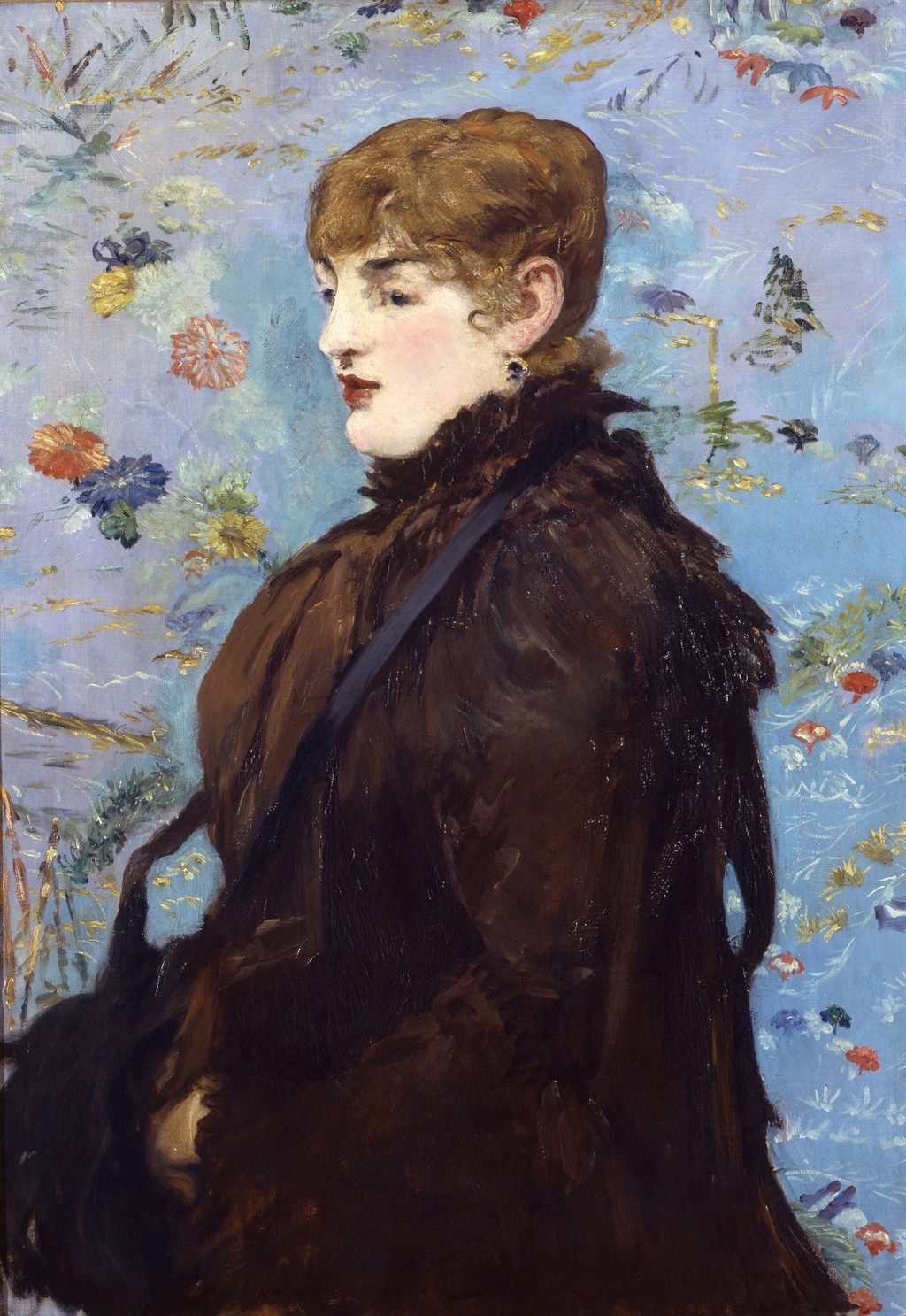
Édouard Manet, Autumn (Portrait of Méry Laurent), 1882. Musée des Beaux-Arts de Nancy, 1071. Musée des Beaux-Arts de Nancy; reproduction via Wikimedia Commons. Image source. Public domain. Whole supplied reproduction resized within native dimensions; no enlargement, retouching or colour alteration.
Annotated Details from Spring: Profile, Bonnet and Glove
The numbered points identify visible features discussed in this article. Return from each detail to the whole composition. Each caption identifies the work shown.
Jeanne (Spring)
Édouard Manet, Jeanne (Spring), 1881. J. Paul Getty Museum, Los Angeles, 2014.62. Image source. CC0 / Public domain. Numbers added to a separate resized whole overview retaining the supplied edges. Detail crops from the immutable original; no enlargement, retouching or colour alteration.
.jpg)
Autumn — Nancy
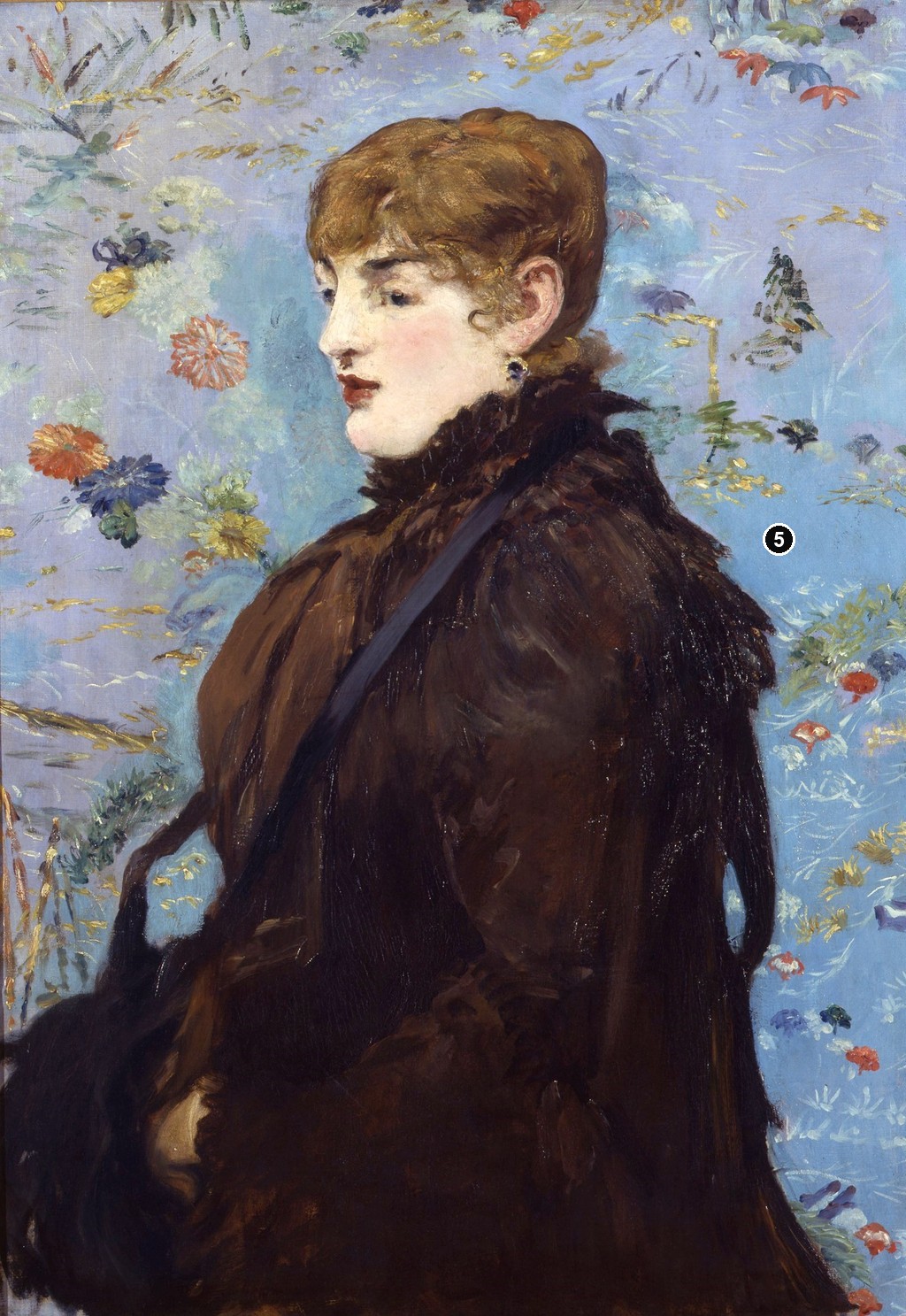
Édouard Manet, Autumn (Portrait of Méry Laurent), 1882. Musée des Beaux-Arts de Nancy, 1071. Musée des Beaux-Arts de Nancy; reproduction via Wikimedia Commons. Image source. Public domain. Numbers added to a separate resized whole overview retaining the supplied edges. Detail crops from the immutable original; no enlargement, retouching or colour alteration.
Details from SPRING: PROFILE, BONNET AND GLOVE
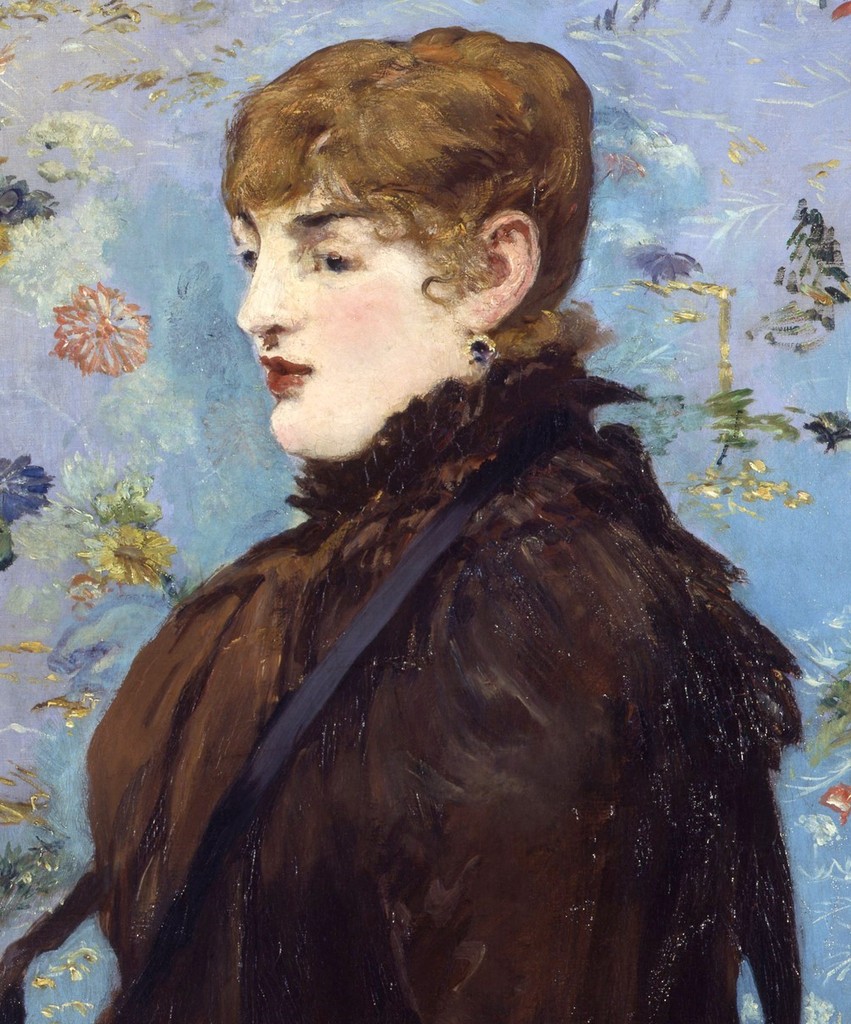
Follow the profile and bonnet flowers, then compare the yellow glove with the flowered sleeve. Autumn places an uncovered head above a much darker wrap.
Jeanne (Spring)
Profile against Green Leaves
The face turns in profile against overlapping green leaves, with a dark ribbon below the chin.
 Detail 01 profile-against-green-leaves.jpg)
Bonnet Flowers and Dark Ribbon
Cream trimming and flowers gather over the broad dark band of the bonnet.
 Detail 02 bonnet-flowers-and-dark-ribbon.jpg)
Yellow Glove and Parasol Handle
The long yellow glove closes around the curved handle, while the shaft runs diagonally upward.
 Detail 03 yellow-glove-and-parasol-handle.jpg)
Flowered Sleeve at the Elbow
Small blue and green marks cross the pale sleeve, bending with the folds around the elbow.
 Detail 04 flowered-sleeve-at-the-elbow.jpg)
Autumn — Nancy
Autumn’s Profile and Dark Fur
The uncovered head and dark fur collar stand against a pale field of scattered flowers.
The Salon of 1882
Manet exhibited Jeanne alongside A Bar at the Folies-Bergère at the Salon of 1882. Allan describes the portrait's exceptionally favourable reception, with critics responding warmly to the fashionable Parisian figure and the handling of her face.[3]
The pairing is striking. Spring gathers its figure into a relatively contained arrangement of profile, dress and foliage. The Bar surrounds its frontal figure with bottles, a counter, reflected people and an uncertain encounter across the mirror. Both paintings give a woman a commanding place within a carefully constructed view of contemporary life.
In Spring, the immediate legibility of the silhouette invites recognition before prolonged examination. The clear face and bright ensemble offer an accessible first impression. Then the eye can move into the looser floral strokes, the complex lace edge and the green marks that almost meet the dress at its boundary.
The portrait's success belongs to this public appearance as a finished exhibition painting. Its varied handling allows different degrees of definition to work together. The face can remain concentrated and clear while the surrounding brushwork carries a much broader energy.
Related Pictures and Printed Images
Manet also represented the sitter in other works. The Getty's 2019 exhibition checklist distinguishes Young Woman in a Capelet (Jeanne Demarsy), about 1881, now in Lyon, from the finished Jeanne (Spring).[6] The existence of related portraits helps explain why titles and reproductions require care: they show the same sitter through different pictures.
The composition also circulated beyond the oil. The checklist records an etching of Jeanne (Spring) dated about 1882 and a photo-gillotage reproduction after a drawing by Manet published with Antonin Proust's Salon article in June 1882.[6] These are different forms of the image, with their own materials and uses.
Jane Demarsy's Later Public Image
A photograph by Emile Auguste Reutlinger, dated about 1890 and held by the Getty, shows Demarsy in the theatrical context of Les Amants Légitimes.[7] She sits more frontally, surrounded by furnishings and flowers, with a small dog beside her. Her elaborate dress and tall hat make a markedly different arrangement from Manet's profile.
The photograph's many decorative elements extend across a larger setting. Bows interrupt the dress, the sleeves swell around the shoulders, and the skirt spreads towards the floor. The sitter looks towards the camera, giving the viewer a more direct encounter than the sideways gaze in Spring.
This later image belongs to the actress's public career. It lets us consider her as someone whose appearance was presented through several media and at different times. It cannot reconstruct the earlier studio sittings, but it widens the view beyond the one famous painting through which she is often remembered.
From Private Collection to the Getty
Antonin Proust bought Spring in 1882.[2] In 1909 it passed through the dealer Paul Durand-Ruel to Colonel Oliver H. Payne, remaining in his family for more than a century before the Getty acquired it in 2014.[3]
Its place in a public collection allows the painting to be studied alongside the wider range of Manet's paintings, with their attention to contemporary clothes, gestures and settings.
Looking back at the gloved hand, we can see how much of the composition depends on its quiet task. It holds the shaft that leads past the shoulder to the parasol above. Around that connection, leaves, flowers, lace and fabric remain animated by different touches of the brush. A poised appearance is sustained by a surface full of movement.
Artworks directory
Explore selected paintings, drawings and prints by Édouard Manet. Search by title or another recorded name.
Frequently Asked Questions
It is the finished painting Manet exhibited at the Salon of 1882. The canvas itself is signed and dated 1881.[1]
Getty’s research identifies her as Anne Darlaud, later known professionally as Jane Demarsy. Jeanne was the painting’s Salon title.[2]
It belongs to the J. Paul Getty Museum in Los Angeles, accession 2014.62.[1]
Discussion
Look again at the images and ideas explored in Jeanne (Spring) by Édouard Manet. These editorial prompts invite your observations.
Reader Insights
Follow the profile up into the bonnet. Compare the smooth pale face with the broken light and dark shapes around the hat’s flowers and lace.
Trace the parasol handle towards the gloved hand. Notice how its firm diagonal crosses the smaller floral marks on the dress.
Compare Spring with the dark-clothed figure in Autumn. How do the flowers change their role when they move from the dress and foliage to a patterned textile?
Join the Conversation
Share a detail, comparison or question about Jeanne (Spring) by Édouard Manet below.
References
- J. Paul Getty Museum, Jeanne (Spring), 2014.62, collection record and commentary. View source.
- Scott Allan, “The Real Woman Behind the Manet Painting”, Getty, 7 October 2019, updated 10 April 2024. View source.
- Scott Allan, “Edouard Manet's Spring Joins the Getty Museum Galleries”, Getty, 25 November 2014. View source.
- Scott Allan and Emily A. Beeny, “The Women behind Manet's Seasons”, Getty Magazine, Fall 2019, pp. 22–25. View source.
- Ministère de la Culture, Portrait de Méry Laurent; L'Automne, Joconde record 05120001048, Musée des Beaux-Arts de Nancy, inventory 1071. View source. (in French).
- J. Paul Getty Museum, Manet and Modern Beauty, exhibition checklist, 2019, entries 2, 4, 11 and 16. View source.
- J. Paul Getty Museum, Emile Auguste Reutlinger, Demarsy (Les Amants Légitimes) 2e Acte, 84.XD.879.167, collection record, about 1890. View source.
- Splash image, Édouard Manet, Jeanne (Spring), 1881. J. Paul Getty Museum, Los Angeles, 2014.62. Image source. CC0 / Public domain. Whole supplied reproduction resized within native dimensions; no enlargement, retouching or colour alteration.


