Pierre-Auguste Renoir.jpg)
 by Tom Gurney
Tom Gurney BSc (Hons) is an art history expert with over 20 years experience
Published on June 19, 2020 / Updated on October 2, 2026
Email: tomgurney1@gmail.com / Phone: +44 7429 011000
Two young performers stand inside a circus ring after their act. One raises her hands; the other holds a cluster of oranges, with more fruit scattered on the ground. Their yellow-trimmed costumes catch the light while the spectators above the low barrier remain mostly cropped or blurred. Renoir's Acrobats at the Cirque Fernando is an oil painting dated 1879 by the Art Institute of Chicago, accession 1922.440. Its subtitle names the sisters Francisca and Angelina Wartenberg, a later identification supported by Angelina's own account. Art Institute scholarly catalogue, cat. 9. [1]
The oranges are not evidence of a juggling routine. In 1938, Angelina wrote to her niece that the public had thrown them to the sisters in appreciation. Her letter identifies her as the figure at the right, gathering most of the fruit; her older sister Francisca stands at the left. The testimony changes the picture from an imagined juggling act into a moment after performance. Renoir still composed it carefully, rather than simply transcribing an instant in the arena. Art Institute, Wartenberg letter and interpretation. [1]
At a glance
- ArtistPierre-Auguste Renoir
- Date1879, current Art Institute dating based on first exhibition
- MediumOil on canvas
- Dimensions131.2 × 99.2 cm
- FiguresFrancisca Wartenberg at left; Angelina Wartenberg at right
- Probable venueCirque Fernando, Montmartre; the venue was not named during Renoir's lifetime
- First recorded displayOffices of La Vie Moderne, Paris, June–July 1879
- CollectionArt Institute of Chicago, 1922.440, Potter Palmer Collection
Watch: Pierre-Auguste Renoir
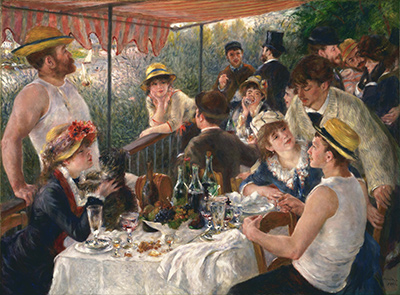
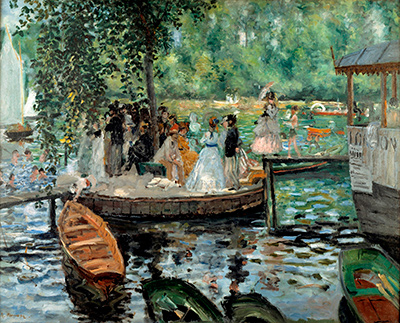
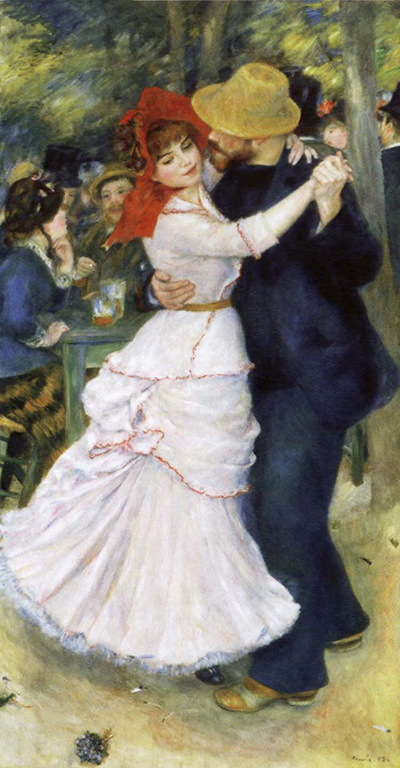
Explore a Montmartre dance, a gathering beside the Seine and the drawings behind Renoir’s paintings.
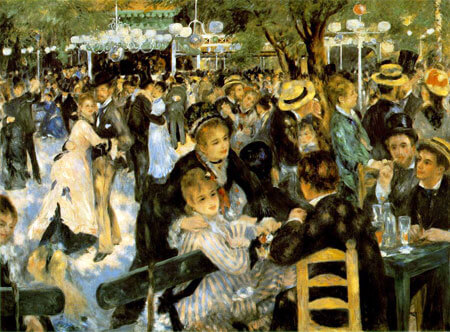
Renoir, Bal du moulin de la Galette
Dr. Beth Harris and Dr. Steven Zucker discuss Renoir’s 1876 Montmartre dance scene, its light and its crowds.
Watch on YouTubeWhat is happening in the ring?
Angelina holds the oranges firmly across her chest. Francisca's hands are raised, but not in the act of catching a ball. The fruit at their feet suggests that the audience's response has just ended, or is ending. The Art Institute traces a custom of rewarding young circus performers with oranges and cites Angelina's letter as direct evidence for this particular picture. Earlier accounts called the girls jugglers; that description is not supported by her memory. Art Institute catalogue essay. [1]
Renoir gives the sisters room to stand almost full length. The arena floor occupies much of the canvas; a barrier holds the background figures high above them. We see parts of seated spectators and adults beyond the wall, but the girls dominate. Their individual expressions also differ. Angelina faces outward with fruit gathered in both arms. Francisca turns towards her sister, leaving a small space between their eyes and gestures. The painting does not show the athletic feat for which they were paid. It offers a quieter interval in a place usually associated with spectacle.
The costumes carry a yellow and orange harmony from hair ribbons and tassels to boots, fruit and floor. White fabric and pink tights keep the bodies distinct from that warm ground. A comparison with Renoir's earlier Dancer reveals a related interest in presenting performers at a portrait scale while withholding the actual performance. The National Gallery's dancer is a single blue-clad figure; the Chicago sisters form a pair in yellows and oranges. Similar scale does not make them versions of the same work. Art Institute comparison with The Dancer. [1]
Francisca and Angelina, beyond the painted image
The Art Institute's research identifies the Wartenbergs as a family of Franco-German gymnasts who travelled and performed. A later promotional photograph shows several children taking part in the family acts. Angelina's 1938 recollection supplied the names that had been lost in the painting's public history. It is unusually direct testimony from someone Renoir painted, though it was written nearly sixty years later. It supports the sisters' identity and the oranges' meaning more strongly than it can reconstruct every moment of the sitting. Art Institute, “The Wartenbergs”. [1]
The museum dates the painting to 1879 because it first appeared publicly that year. On that dating, Francisca would have been about seventeen and Angelina about fourteen. Renoir's figures were often described as little girls, and an earlier gallery title was Two Little Circus Girls. The age estimate and the youthful pictorial treatment should be kept separate. Renoir could present working teenagers as innocent children within a scene of commercial entertainment. Art Institute dating and title history. [1]
The family performed physically demanding acts, including human pyramids. Renoir did not paint the exertion, training or risks of that work. The sisters' apparent ease is a pictorial choice. It should neither erase their labour nor become an unsupported claim that their particular career was unhappy. The Art Institute distinguishes Angelina's positive family memory from the harsher experiences documented for some other child performers. This difference makes the painting's gentle surface worth examining rather than taking literally.
How much of the circus was observed?
The setting is probably the Cirque Fernando, whose permanent Montmartre building opened in 1875. The Art Institute notes that this venue was not specifically identified during Renoir's lifetime. The painting shows a ring and spectators, but it does not give enough architectural evidence to turn “probably” into certainty. Its legacy URL preserves the familiar title while the body keeps the museum's qualification. Art Institute, venue research. [1]
Renoir's brother Edmond wrote about the picture in 1879, praising the movement and life he thought Renoir had captured. Later scholarship asks a different question: could the sisters have been painted in natural light outside the harshly lit arena? Their still poses and softly illuminated costumes make studio work plausible, though the available evidence does not establish a single location for every part of the canvas. The background may draw on observation at the circus, while the bodies are carefully posed. Art Institute, contemporary account and later analysis. [1]
A preliminary chalk study includes a clown near the lower right. Renoir omitted that figure in the finished oil, leaving the sisters less surrounded by the other acts with which circus performers shared a ring. The choice heightens their dignity and isolates their moment of receiving oranges. It is a visible example of selection, not evidence that no clown or other performer was present on the day he observed them. Art Institute, preparatory-study discussion. [1]
Drawn, revised and painted
The Art Institute's technical report finds a deep-blue painted contour beneath the figures, with numerous adjustments before the final positions were settled. Angelina originally faced more forward and bent slightly; Francisca's legs and arms were also altered. Some earlier marks remain visible through thin background paint. Far from recording two children in a single effortless pass, the picture was repeatedly shaped on the canvas. Art Institute technical report. [1]
The background uses thinner, more translucent colour; selected costume details carry thicker final touches. This gives the sisters more presence than the spectators and ring wall. Infrared and X-ray findings support claims about changes in pose and paint handling, but the museum's technical images are research sources here, not cleared supplementary pictures for this page.
Exhibition and ownership
The painting first appeared at the Paris offices of La Vie Moderne in June–July 1879. Its exhibition record also lists the seventh Impressionist exhibition of 1882, another reminder that Renoir returned to the group after his 1877 participation. Durand-Ruel later showed or handled the work under titles such as Au Cirque. These titles refer to the Chicago canvas; they do not identify separate circus paintings. Art Institute exhibition history. [1]
Renoir deposited it with Durand-Ruel in April 1881 and sold it to the dealer in May 1882. Durand-Ruel sold it to the Chicago collector Potter Palmer in May 1892. It passed through Palmer's family and was given to the Art Institute of Chicago in 1922. The accession number 1922.440 fixes the object through its changing titles and exhibitions. Art Institute provenance. [1]
Looking again
Look at the orange held in Angelina's arm, then the scattered ones at the girls' feet. Follow the yellow of their boots into the floor and back up to the crowded edge of the ring. The painting shows real performers whose names can be recovered, but it also transforms their working environment. Renoir gives them a graceful pause and a canvas large enough for portraiture. The gap between the performed labour and the painted interval is the picture's central tension.
Renoir artworks directory
Questions about Acrobats at the Cirque Fernando
They are Francisca Wartenberg at left and her younger sister Angelina Wartenberg at right, identified through Angelina's later account and Art Institute research.
Angelina recalled that spectators threw oranges as a sign of appreciation. The painting shows the sisters collecting them after an act, rather than a documented juggling routine.
The Art Institute considers that venue likely, but notes that Renoir's lifetime records did not explicitly name it. The figures may have been posed in different light from the ring.
It belongs to the Art Institute of Chicago, accession 1922.440. Check the museum's current record for display details.
Discussion
What do you notice when you return to Acrobats at the Cirque Fernando (Francisca and Angelina Wartenberg)?
How do the oranges change your reading of the sisters’ pose?
Reader Insights
How do the oranges change your reading of the sisters’ pose?
Angelina’s 1938 letter identifies the sitters and explains the audience’s gift of fruit.
What does Renoir leave outside the frame of this working circus?
Join the Conversation
Share a close observation or a source-backed question about Renoir’s Acrobats at the Cirque Fernando (Francisca and Angelina Wartenberg).
References
- Art Institute of Chicago, Renoir Paintings and Drawings, cat. 9, sitter identification, 1938 letter, visual and technical analysis, exhibition history and provenance View source.
- Art Institute of Chicago, Acrobats at the Cirque Fernando (Francisca and Angelina Wartenberg), 1922.440, collection identity and public-domain media status View source.
- Whole-work image: Art Institute official IIIF rendition, public domain per the owner's API record; matched to the Art Institute object View source.