by Tom Gurney
Tom Gurney BSc (Hons) is an art history expert with over 20 years experience
Published on June 19, 2020 / Updated on October 2, 2026
Email: tomgurney1@gmail.com / Phone: +44 7429 011000
A woman in a blue bonnet leans forward in a theatre box, a small bunch of flowers in her hand. Another woman sits close behind her, partly hidden. Beyond them, the audience is a blur of faces, hats and warm light. We cannot see the stage. Pierre-Auguste Renoir's At the Theatre, now at the National Gallery in London, makes looking at other spectators part of the event. The museum dates the picture 1876–77 and records it as NG3859. National Gallery object record. [1]
The painting is also called La Première Sortie, usually translated as “The First Outing.” That subtitle sounds like a story about the young woman's first evening out. The National Gallery says it was first used in 1923, nearly fifty years after Renoir made the picture. It is not secure evidence of what he intended. The older neutral title Au Théâtre leaves a more open question: who is watching whom? National Gallery in-depth essay. [1]
At a glance
- ArtistPierre-Auguste Renoir
- Holder titleAt the Theatre (La Première Sortie)
- Date1876–77
- MediumOil on canvas, unlined
- Dimensions65 × 49.5 cm
- CollectionNational Gallery, London, NG3859; bought with the Courtauld Fund in 1923
This work in Renoir’s career
La Grenouillère
1869La Loge
1874At the Theatre
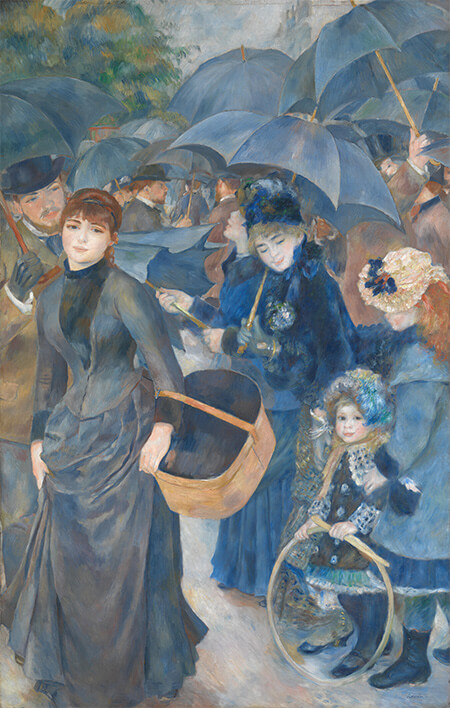
1878The Umbrellas
c. 1881–86The Great Bathers
1884–87The Bathers
1918–19Contents
- Annotated details of the painting
- In a theatre box, without a stage
- Colour and attention across the auditorium
- What the X-ray reveals
- Why the title can mislead
- A companion to La Loge
- Looking again
Annotated Details from At the Theatre
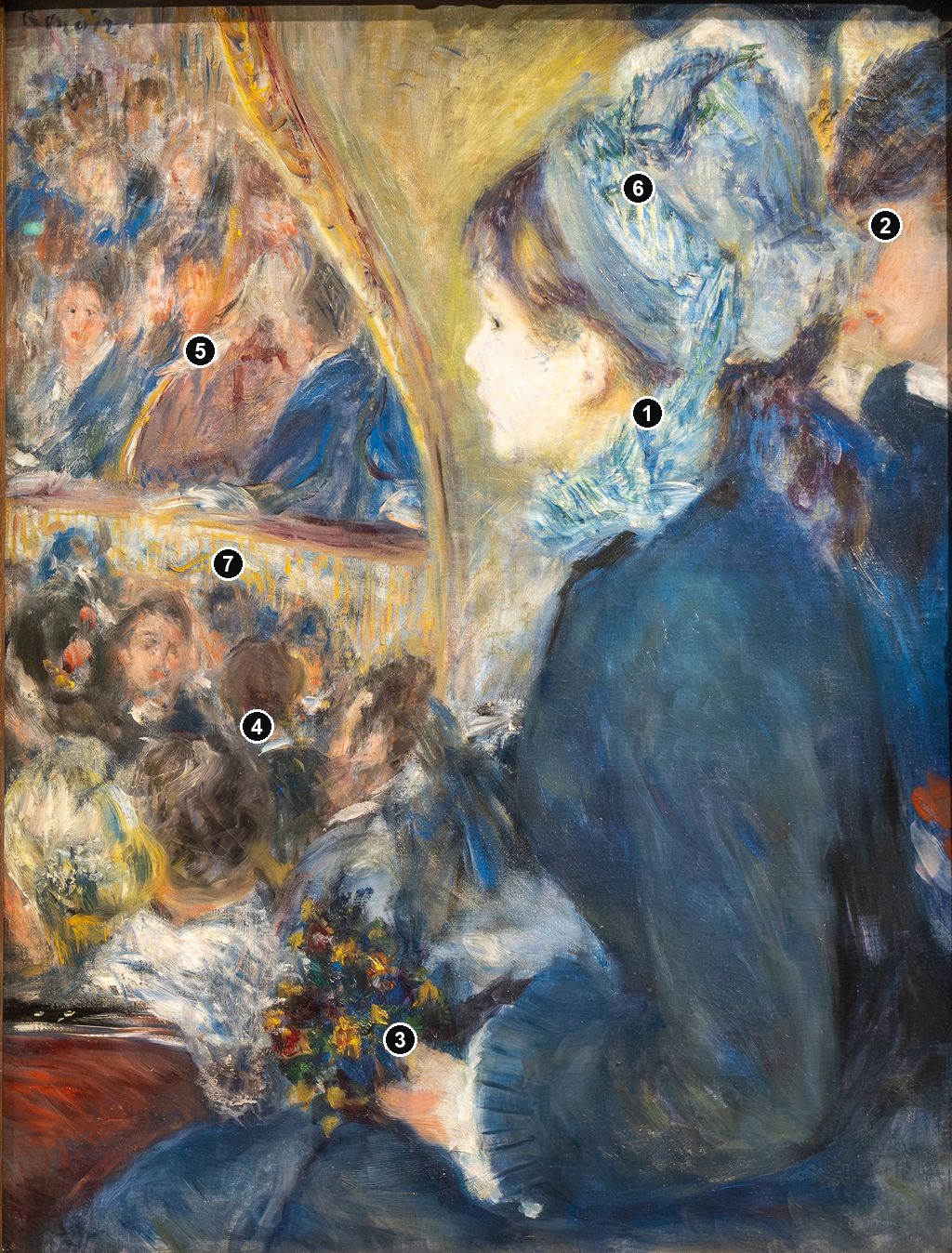
The nearest woman watches from a theatre box while the audience beyond becomes part of the view.
Details from AT THE THEATRE
These details show National Gallery NG3859, distinct from the Courtauld La Loge and another Renoir At the Theatre in Stuttgart.
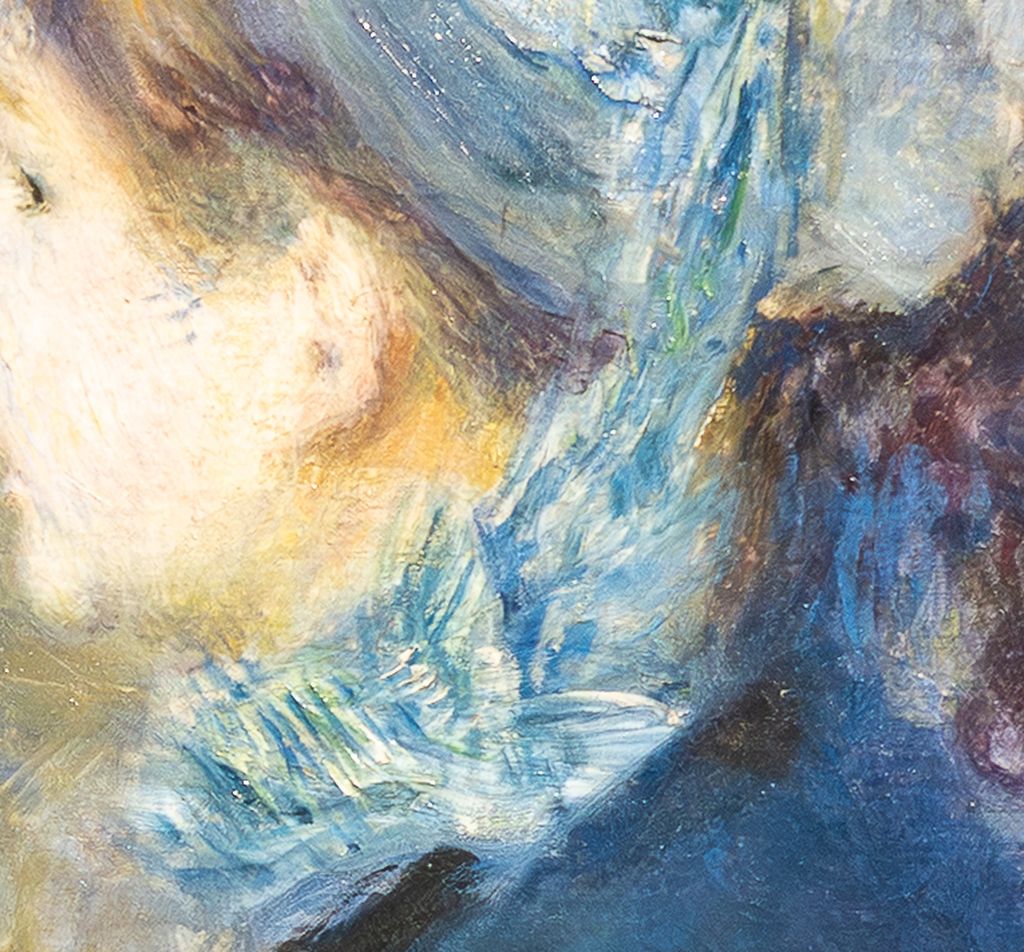
Near spectator
The nearest woman leans forward, her blue bonnet turned away from us.
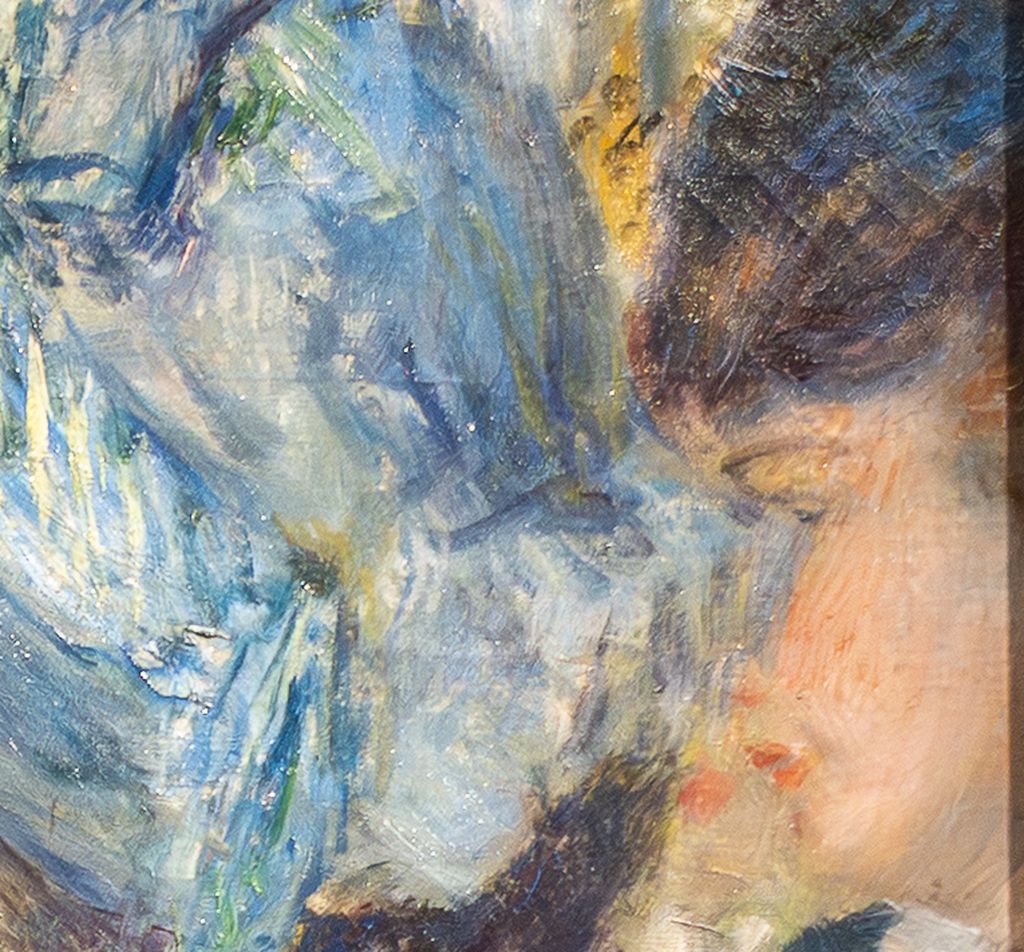
Companion partly hidden
A second woman sits close behind, her face largely obscured.
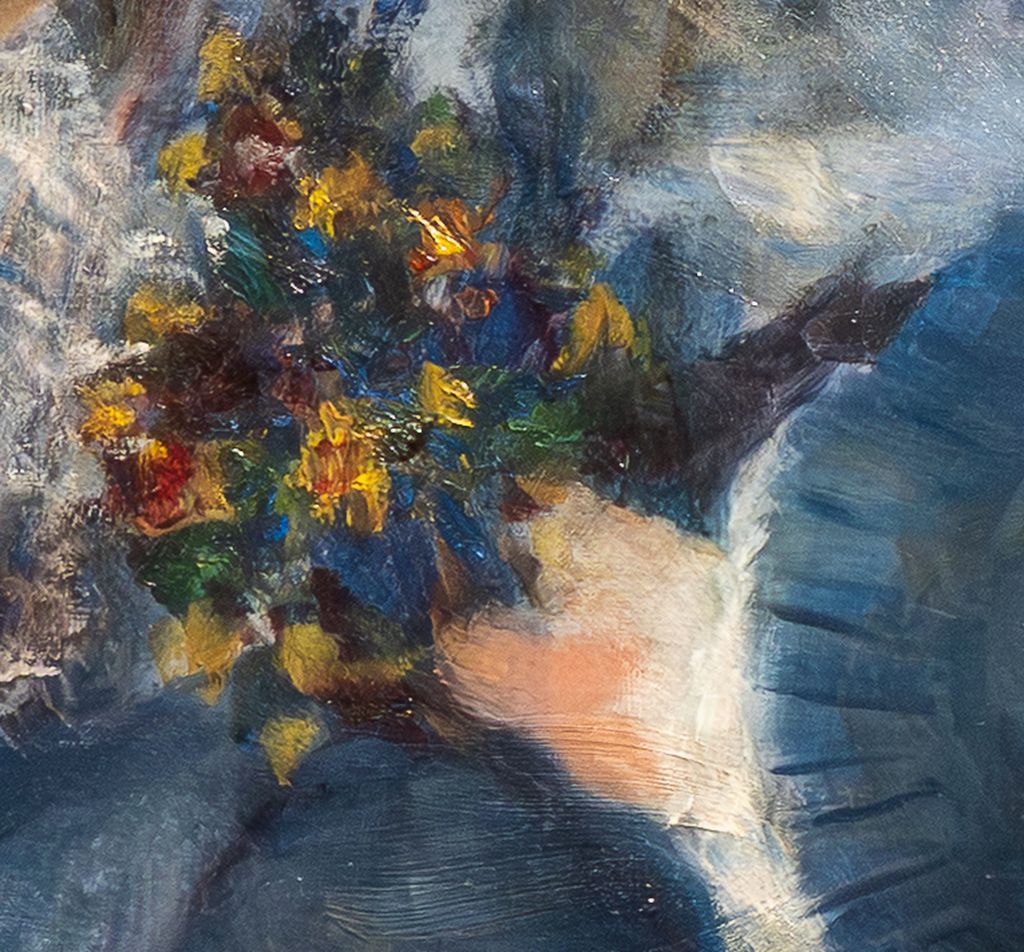
Flowers
A small bouquet adds concentrated colour near the box rail.
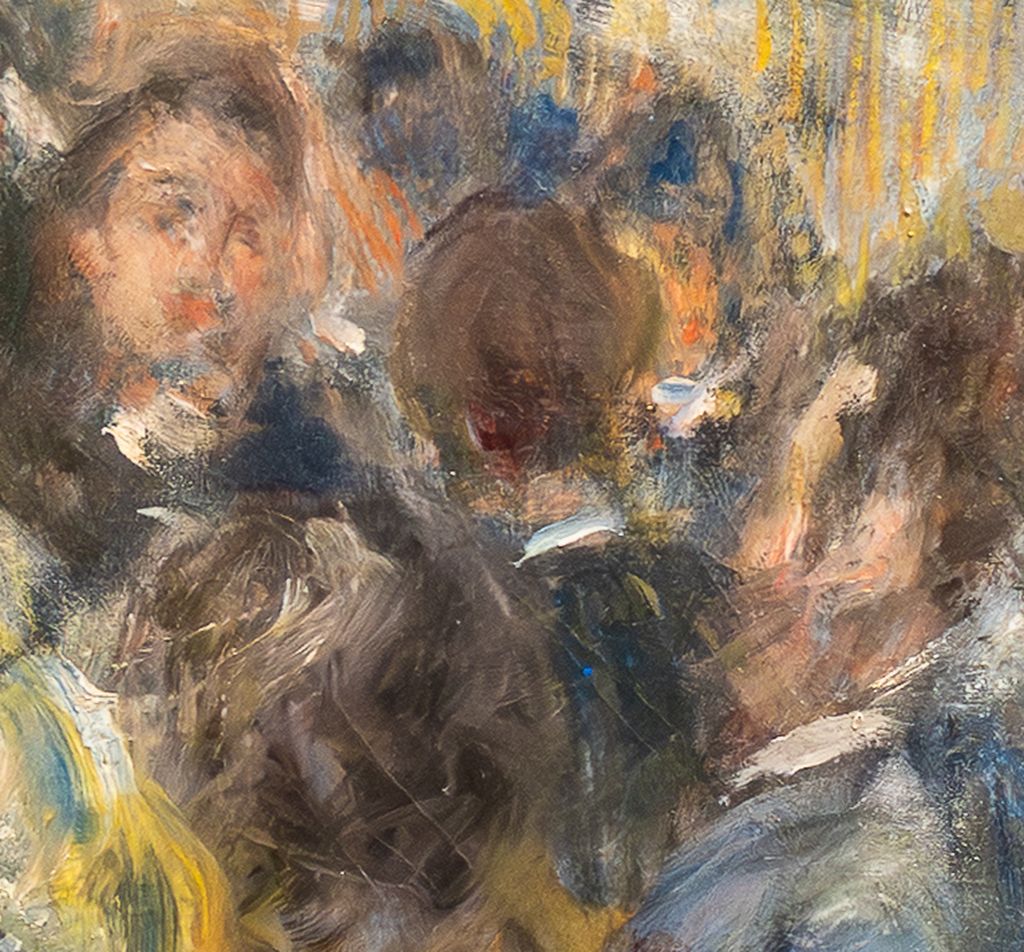
Lower-tier audience
Loosely painted faces in the lower tier look across the theatre.
Upper-tier audience
Figures in the upper tier suggest the social gaze across the auditorium.
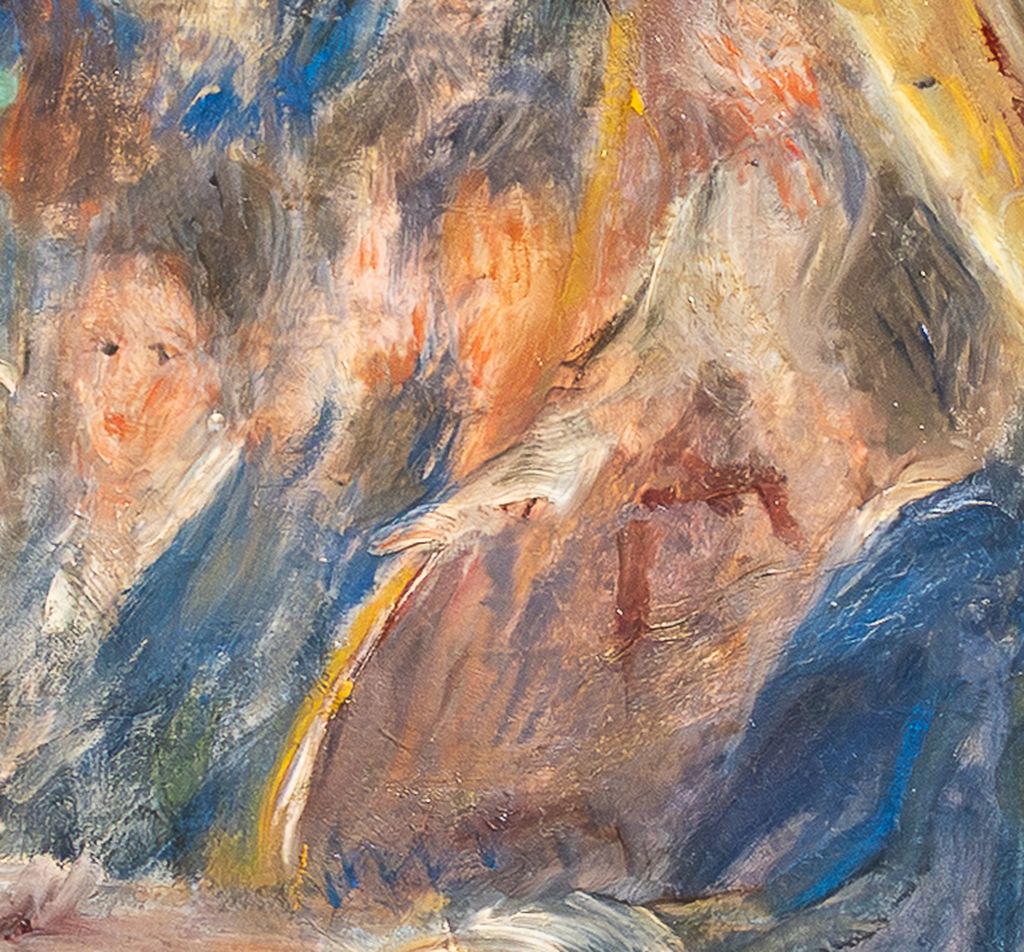
Bonnet and ribbon
Pale blue fabric and ribbons frame the foreground woman’s head.
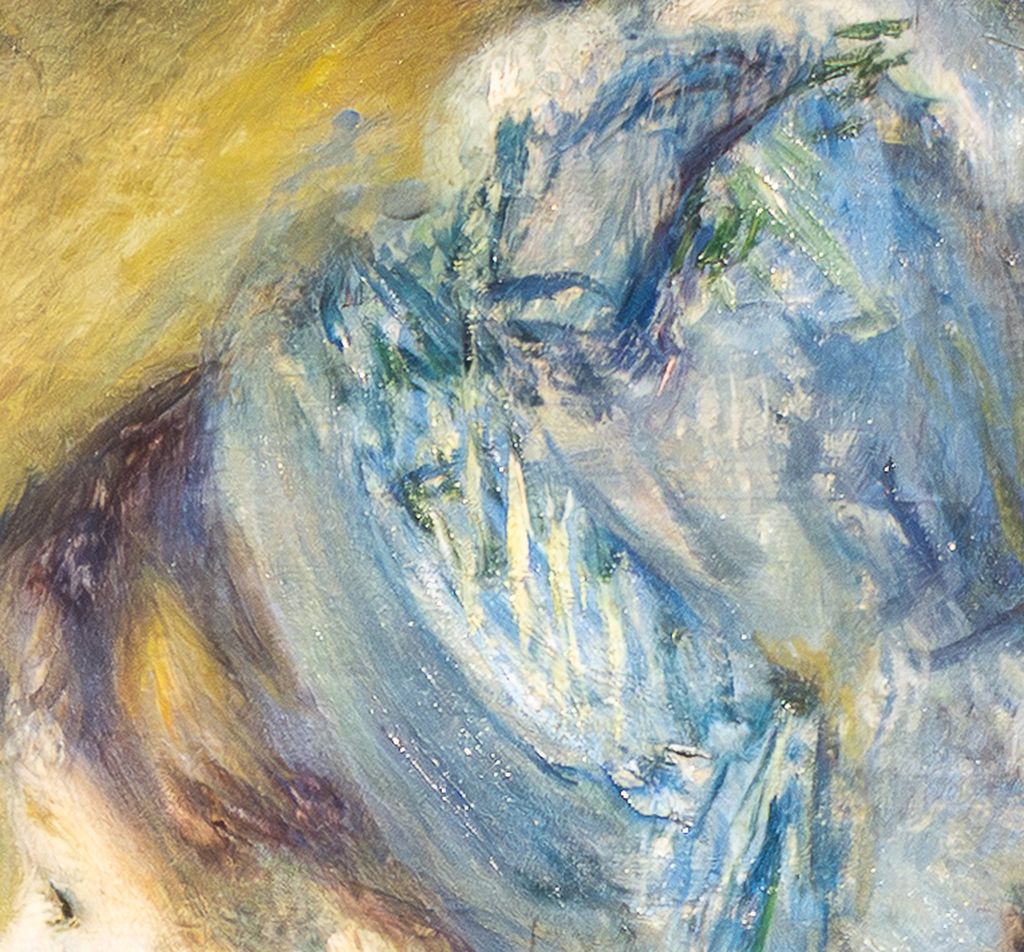
Box rail
The curved rail separates the foreground box from the audience beyond.
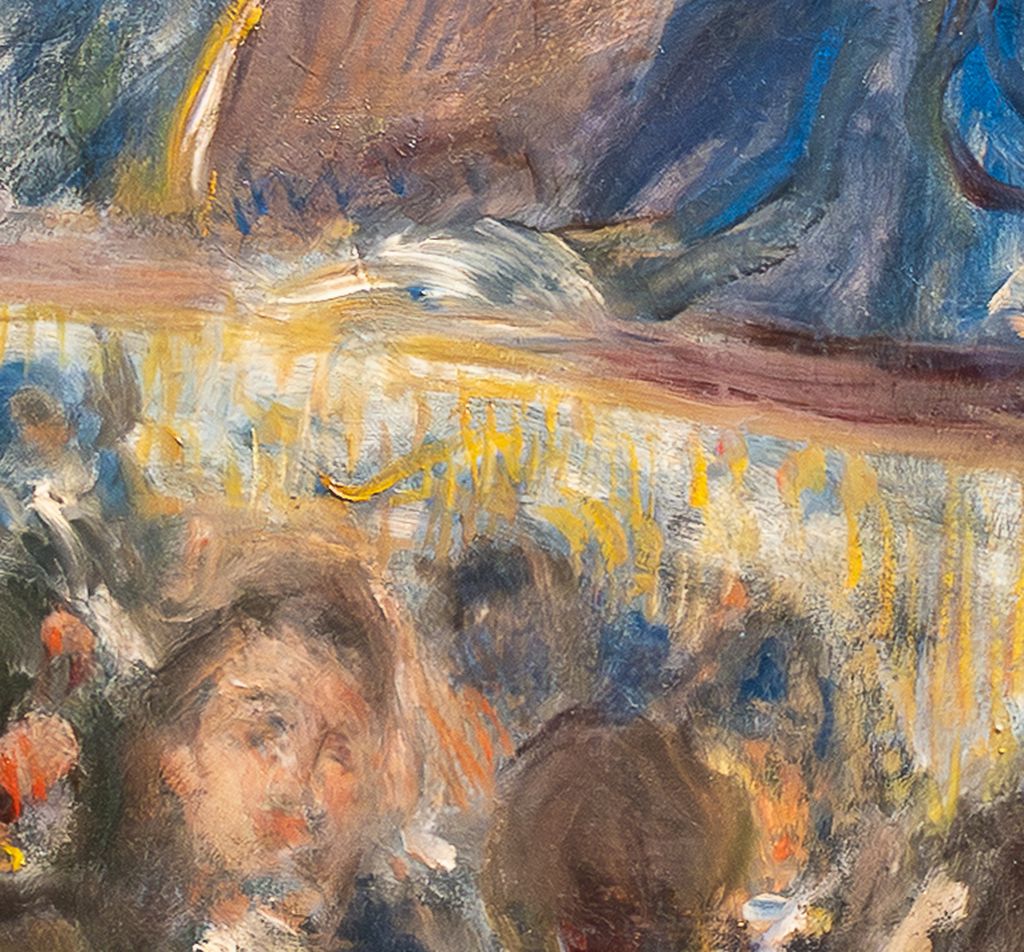
Watch: Pierre-Auguste Renoir
Explore a Montmartre dance, a gathering beside the Seine and the drawings behind Renoir’s paintings.
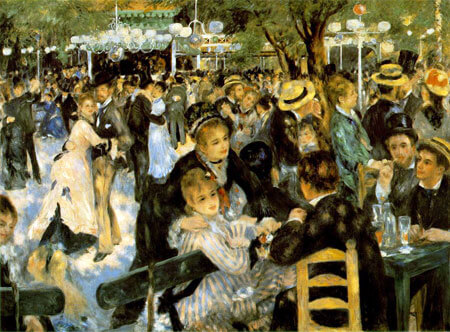
Renoir, Bal du moulin de la Galette
Dr. Beth Harris and Dr. Steven Zucker discuss Renoir’s 1876 Montmartre dance scene, its light and its crowds.
Watch on YouTubeRenoir artworks directory
In a theatre box, without a stage
The nearest spectator faces left, away from us. Her bonnet, collar and dark dress take much of the foreground. The companion at right is even harder to read: her face is mostly concealed by the first woman's hat. A viewer trying to identify their expressions or what exactly has attracted their attention soon meets the painting's limits. The National Gallery explicitly warns against claiming a precise story from those hidden faces. National Gallery object essay. [1]
Renoir gives us more of the audience than the performance. A man in a lower tier and a woman above him stand out from the sketchy crowd. Their glances may seem directed towards the women in the box—or towards us. That uncertainty is part of the scene. In nineteenth-century Paris, a theatre visit involved the social act of seeing other people and being seen by them. The National Gallery points out that some auditorium boxes faced the rest of the audience almost as much as the stage. National Gallery in-depth essay. [1]
The National Gallery places this exchange of glances beside a Parisian example: the Palais Garnier opera house, opened in 1875, had balconies along its grand staircase from which visitors could watch people arriving below. That detail helps explain theatre-going as a public display, but the Gallery does not identify the building in Renoir’s picture as the Palais Garnier. The painted box lets us observe the social pattern without supplying a secure address for the event. National Gallery in-depth essay. [1]
The bouquet near the bottom edge adds a bright, dense group of marks. It does not tell us who gave the flowers or why. The blue bonnet and dark dress hold the foreground against the busy audience; pale ribbons, faces and tier fronts catch the surrounding light. Renoir's quick strokes let the box feel crowded and immediate while keeping the foremost woman visually dominant.
The gilded curve of the auditorium is a useful guide through the picture. It separates the sharpest foreground profile from the looser faces across the box, then draws the eye upward into the lit tiers. The nearest woman's pale cheek stands out against her bonnet and coat, while the people beyond are much less defined. Renoir makes the viewer feel close to one spectator and uncertain about almost everyone else. The framing gives us a place in the box without giving us a complete account of its occupants.
Look closely at the companion on the right. Only part of her cheek and mouth emerges beside the large bonnet. That sliver is enough to establish another person sitting beside the nearer woman, but it gives little basis for an age, identity or relationship. The National Gallery makes precisely this caution in its description. A title that promises a “first outing” can make the pair sound like characters in a familiar story; the painted evidence stays more fragmentary. National Gallery in-depth essay. [1]
Colour and attention across the auditorium
Blue connects the near and distant parts of the scene. It gathers in the leading woman's bonnet, coat and lower skirt, then returns in smaller areas among the audience. Warm yellow and gold lines set the tiers apart. The bouquet combines darker reds and yellow notes near her hands, making a small point of colour where the front of the box meets her lap. These accents guide a viewer around the painting without clarifying the performance off to the left.
The difference in handling is just as important as the colour. The nearest sitter has a readable outline and a carefully lit profile. The background spectators are made from shorter, more broken marks. The painting does not offer a seat-by-seat record of the auditorium, but its scattered faces and bright edges are enough to convey a crowd. The close woman and the indistinct audience belong to the same event, yet we experience them at different levels of certainty.
This is why the unseen stage matters. In a straightforward theatre illustration, the audience could be a frame for the performers. Here the audience is the subject we can actually examine. We look at a woman looking elsewhere, while painted spectators seem to look back. The National Gallery notes that theatre boxes in nineteenth-century Paris could face the auditorium as much as the stage. Renoir uses that social arrangement as a pictorial one: lines of sight cross the canvas, but their destinations remain open. National Gallery object essay. [1]
What the X-ray reveals
The National Gallery's X-radiography shows that Renoir originally painted two more figures at the front of the box and then covered them. Removing them in the final design brought more focus to the nearer woman. This is evidence about changes within this particular canvas, rather than a generic idea that Impressionists worked entirely at speed. The finished picture's spontaneity was shaped by revision. National Gallery in-depth essay. [1]
Knowing about the covered figures changes the way one sees the surviving arrangement. The foremost woman's bonnet and shoulder now have space to stand between us and the audience. She becomes both a person to observe and a barrier to complete knowledge of the companion behind her. Renoir does not have to show every occupant of the box to make its crowded social setting felt.
An X-ray is a record of differences in materials and density under the paint surface. In this case the gallery uses it to identify two figures Renoir painted over. It does not disclose what the final women are watching, their names or the exact occasion. The technical finding is valuable because it ties a visible effect—the strong foreground focus—to a documented revision. It shows deliberate selection within a scene that can look immediate and rapidly painted.
The canvas is listed as unlined in the National Gallery's record. This is an object fact about its support, not a claim that the picture has never received conservation treatment. It is also distinct from the X-ray's finding about overpainting. Keeping those kinds of evidence separate helps a reader understand what the museum has actually established about the work's making. National Gallery key facts and in-depth essay. [1]
Why the title can mislead
The National Gallery traces La Première Sortie to a London auction in 1923. Before that, the picture had been called Au Théâtre and sometimes Le Café-Concert. The latter is a poor fit for the apparently grander setting; none of these titles is documented as Renoir's own. The later “first outing” label may have made the painting easier to market by suggesting youth, flowers and excitement, but it cannot establish a first visit or a particular relationship between the two women. National Gallery in-depth essay. [1]
The uncertainty is more useful than a made-up plot. We can describe the woman's posture, flowers and the eyes across the auditorium. We can ask how a public performance makes spectators into a spectacle. The painting gives many cues for that question and no firm answer to what the women are watching.
The title history also illustrates how a later label can change the way a work is read. Au Théâtre directs attention to a place and an activity; La Première Sortie invites a tale about someone's debut in public. A viewer approaching the latter title may read the flowers as a gift and the woman's lean as excitement. Those are possible impressions, but the picture does not confirm them. The National Gallery traces the “first outing” wording to the sale record, not to a statement by Renoir. Its title should therefore be presented as a later name rather than as an explanation supplied by the artist.
A companion to La Loge
Renoir had painted another theatre-box image, La Loge, in 1874. It is now at the Courtauld Gallery. There a man raises opera glasses towards the audience while a woman faces outward. In At the Theatre, Renoir brings us beside two women and leaves the stage still more elusive. The works share a concern with public looking, but they are distinct canvases with different holders, dates and arrangements. National Gallery in-depth essay [1]; Courtauld, La Loge. [2]
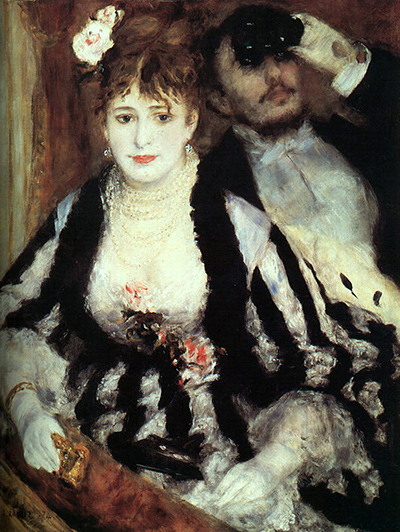
In La Loge, the woman faces the viewer almost directly, and the man behind her makes the act of scanning explicit by raising his opera glasses. At the Theatre reverses much of that arrangement. Its nearer woman turns away, and the glances of the crowd remain ambiguous. The viewer must infer the exchange of attention from fragments of faces rather than from a clearly visible instrument. This comparison explains the shared social theme without treating the paintings as two views of the same people or the same evening.
The Courtauld identifies the models for La Loge as Renoir's brother Edmond and Nini Lopez. The National Gallery does not supply comparable sitter identifications for At the Theatre. The known names belong to the Courtauld picture alone. Courtauld collection record [2]; National Gallery object record. [1]
The Courtauld Fund purchased At the Theatre in 1923. The National Gallery records a later transfer from the Tate Gallery in 1961. That collection path explains why the two famous theatre-box paintings are now both in London yet held by different institutions. National Gallery provenance. [1]
The provenance record goes further back than the gallery purchase. The 1899 Armand Doria sale album listed the painting as no. 203 at 10,000 francs. Pieter van der Velde bought it in 1900 and retained it until 1920. It passed through several dealers before the Courtauld Fund acquired it from Knoedler in 1923. These are documented stages of ownership and trade, not clues to the unnamed women in the scene. Keeping the object's later journey apart from the story one might imagine inside the painted box makes both kinds of history clearer. National Gallery provenance. [1]
Looking again
Start with the bouquet, rise to the nearer woman's bonnet and follow her gaze towards the left edge. Then return through the tiers of spectators behind her. The missing stage is no gap to fill with a story. It puts the social experience of watching at the centre of the picture.
Questions about At the Theatre
There is no evidence that Renoir used it. The National Gallery dates its first known use to 1923, when the painting was sold at auction.
The National Gallery does not securely identify them. One sits in the foreground with flowers; the other's face is largely obscured.
No. La Loge is a 1874 theatre-box painting at the Courtauld Gallery. This 1876–77 painting is NG3859 at the National Gallery.
It belongs to the National Gallery, London. Consult its current page for display information.
Discussion
Look closely at At the Theatre and use the questions below to compare what you see with the documented history.
Reader Insights
How do the two women direct the viewer’s gaze across the box?
National Gallery X-rays record figures painted out of the foreground box.
What can the later subtitle tell us about a story Renoir may not have supplied?
Join the Conversation
Share a close observation or a source-backed question about At the Theatre. The prompts above are starting points for discussion.
References
- National Gallery, At the Theatre (La Première Sortie), NG3859, object facts, in-depth essay, technical finding and provenance View source.
- Courtauld Gallery, La Loge, distinct 1874 painting for comparison View source.
- Whole-work photograph: Wuselig / Wikimedia Commons, CC0 independent exhibition photograph, distinct from National Gallery website media View source.