by Tom Gurney
Tom Gurney BSc (Hons) is an art history expert with over 20 years experience
Published on June 19, 2020 / Updated on October 2, 2026
Email: tomgurney1@gmail.com / Phone: +44 7429 011000
A woman bends forward, one arm reaching out as though to keep her balance. A loose towel is drawn to her chest. Renoir sets her movement near the middle of an otherwise open sheet, leaving the hands and feet less resolved than the sweep of her back and legs. This Bather is a red chalk drawing, made around 1885, in the Art Institute of Chicago as 1937.18. It is not one of his painted bathers, and it is not the large Philadelphia canvas with which the Art Institute discusses his work of the period. Art Institute scholarly catalogue, cat. 21. [1]
The old URL says “1885” without a qualifier. The owner dates the sheet c. 1885, acknowledging that its precise day or year is not established. Its scholarly catalogue provides unusually detailed evidence about the marks, paper, conservation and ownership. Those records make it possible to study an apparently quick drawing without turning every visible line into a certainty about Renoir’s intentions.
At a glance
- ArtistPierre-Auguste Renoir
- Datec. 1885
- MediumRed chalk, with traces of graphite, on cream laid paper
- Sheet42.7 × 31.4 cm
- CollectionArt Institute of Chicago, 1937.18
- DistinctionIndependent figure study; no direct compositional link established to the Philadelphia Large Bathers
Watch: Pierre-Auguste Renoir
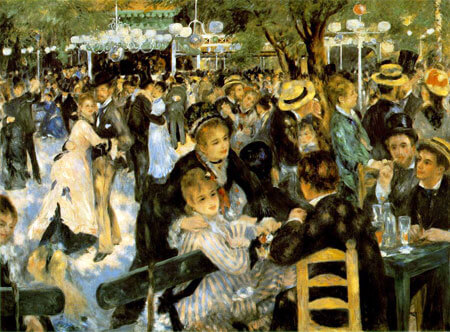
Explore a Montmartre dance, a gathering beside the Seine and the drawings behind Renoir’s paintings.
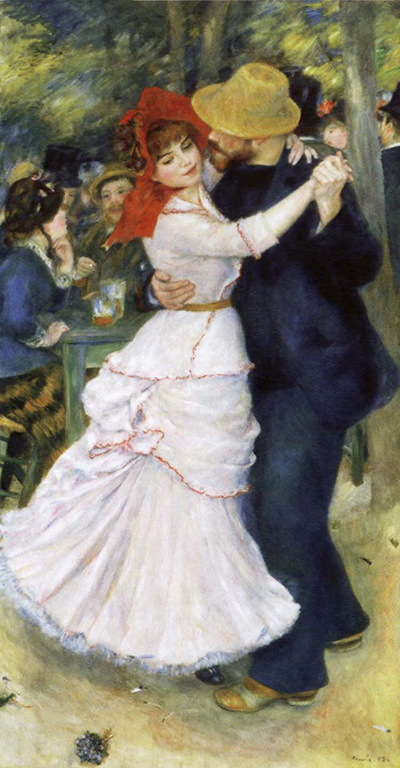
Renoir, Bal du moulin de la Galette
Dr. Beth Harris and Dr. Steven Zucker discuss Renoir’s 1876 Montmartre dance scene, its light and its crowds.
Watch on YouTubeA figure finding her balance
Renoir places the woman within a broad expanse of cream paper. Her head turns down; one arm extends outward; her body folds at the waist and her legs bend beneath it. The Art Institute describes the pose as a study of physical movement and points to uncertain placements of the right leg and reaching arm. These are useful clues to how the drawing was built. They do not require us to decide whether she was actually entering water, stepping away from it or posing in a studio. The title gives the bathing theme; the visible gesture stays open. Art Institute catalogue essay. [1]
The towel at the chest, described by the museum, distinguishes the gesture from a generic reclining nude. The figure seems to protect or steady herself while moving. Renoir gives her torso a continuous curve and makes the projecting arm comparatively light. He does not fill the whole page with setting, furniture or landscape. The blank support becomes part of the image: it leaves room around a pose that is in transition.
Look for places where a line is repeated or reinforced. The museum’s technical report says Renoir sometimes strengthened a contour with a second red-chalk stroke, especially on the limbs. A few short hatches suggest shadow at the neck and shoulder, while a broader angled stroke darkens the left thigh. The figure’s roundness comes largely from the quality and placement of lines; there is no smudged chalk blending to create volume. Art Institute technical report. [1]
What the paper tells us
The surface is cream, moderately textured laid paper. The report describes a Gerhard Loeber watermark and traces of adhesive along a torn left edge. Those traces suggest the sheet may once have belonged to a sketchbook or album, but the museum phrases that as a possibility. The clean right edge and irregular others are part of the object’s physical history. A reproduction of the front cannot prove exactly how or when the sheet was detached. Art Institute material examination. [1]
Infrared examination found small graphite figure sketches near the bottom, faint in normal viewing. The Art Institute says it cannot determine when Renoir put those additions on the sheet or whether they relate directly to the main bather. That caution matters. A research image may reveal marks unseen by most viewers, but visibility alone does not provide a sequence or purpose. Art Institute technical report, graphite findings. [1]
The drawing has also changed since it left Renoir’s hands. The museum documents reduction of peripheral soiling, discoloration, an upper-left liquid stain and old mounting residues during conservation. These treatments help explain why a current image of the paper may look cleaner than an earlier photograph. They should not be confused with Renoir repainting the page or deliberately tinting the entire margin. Art Institute condition history. [1]
Bathers and the larger painting
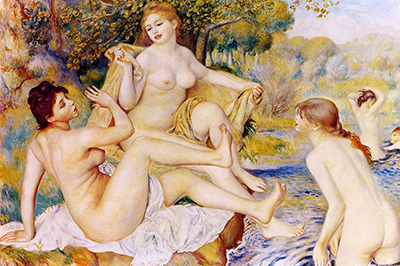
Renoir explored bathers repeatedly in the 1880s while developing The Large Bathers, now in Philadelphia. The Art Institute relates this sheet to that broader search for poses, but says plainly that the present drawing does not connect directly with the Philadelphia composition. It may have helped him refine ideas at an early stage. It would overstate the evidence to label it a confirmed preparatory drawing for a particular figure in the finished canvas. Art Institute catalogue essay. [1]
Red chalk connected Renoir to a longer drawing tradition. The museum notes his admiration for eighteenth-century French artists such as Watteau and Boucher, and it cautiously compares this crouching pose with older representations of Susanna. These are interpretive comparisons, not a claim that the woman in the drawing is Susanna or that Renoir planned a biblical painting. The same bending figure can sit within studies of bathing, movement and long-established poses. Art Institute catalogue interpretation. [1]
From Renoir’s family to Chicago
The catalogue traces the sheet to Pierre Renoir, the artist’s son, in Paris. It was sent by Valentine Gallery, New York, to the Art Institute in January 1937 and sold to the museum on 30 April 1937. The published credit reads “gift of Robert Allerton,” but the scholarly footnote explains the transaction more precisely: the museum appears to have purchased the work with funds donated by Allerton. “Gift” is the catalogue credit, while the purchase paperwork describes the mechanism. Art Institute provenance and note 250. [1]
The Art Institute records the drawing in a Chicago exhibition in 1940, a Renoir exhibition in Los Angeles and San Francisco in 1955, and a figure-drawing exhibition in Iowa in 1964. These entries establish later public display, not the exact moment or audience for Renoir’s first use of the sheet. Art Institute exhibition history. [1]
Looking again
Begin with the reach of the arm and follow it back through the shoulder to the curve of the body. Look where Renoir doubled a contour, then compare the delicate hatching at the neck with the broad mark on the thigh. Finally leave the figure and examine the open paper, torn edge and faint lower marks. The drawing is valuable because it shows a pose under exploration, with decisions visible rather than hidden under a finished painted surface.
Renoir artworks directory
Questions about Bather
No. The Art Institute’s 1937.18 is a red chalk drawing with traces of graphite on paper, about 42.7 × 31.4 cm.
The museum says no direct link to the finished Philadelphia composition has been established. The sheet belongs to Renoir’s wider exploration of bather poses in the 1880s.
The owner dates it around 1885. The year in this page’s address is a convenient legacy label, not a precise date written on the drawing.
Valentine Gallery sent it to Chicago in early 1937. The museum bought it in April with funding supplied by Robert Allerton, whom its public credit names as donor.
Discussion
What do you notice when you return to Bather (c. 1885)?
Where do doubled chalk lines make the bather’s movement easiest to follow?
Reader Insights
Where do doubled chalk lines make the bather’s movement easiest to follow?
The Art Institute says this sheet has no established direct compositional link to the Philadelphia Large Bathers.
What can the paper edges and faint graphite marks tell us, and what remains uncertain?
Join the Conversation
Share a close observation or a source-backed question about Renoir’s Bather (c. 1885).
References
- Art Institute of Chicago, Renoir Paintings and Drawings, cat. 21, Bather, essay by Nancy Ireson and technical report by Kimberly Nichols. Object identity, medium, technique, paper evidence, conservation, provenance and relationship to Philadelphia The Large Bathers View source.
- Whole-work image, Art Institute of Chicago Open Access record 23198 View source.
- Whole-work image, official IIIF image View source.