 by Tom Gurney
Tom Gurney BSc (Hons) is an art history expert with over 20 years experience
Published on June 19, 2020 / Updated on October 2, 2026
Email: tomgurney1@gmail.com / Phone: +44 7429 011000
Pierre-Auguste Renoir's life joined several art worlds that are often told apart. He learned to paint as a decorator of porcelain, copied earlier masters in the Louvre, studied in an academic studio, helped organize independent exhibitions, and later sought buyers and recognition through portraits and the Salon. His pictures changed as those circumstances changed. The friendships that helped form Impressionism remained important even when he turned towards more deliberate drawing and monumental figures.
Renoir was born on 25 February 1841 in Limoges. His family moved to Paris in 1844, and he died at Cagnes-sur-Mer on 3 December 1919. Between those dates, he worked through the political disruptions, commercial pressures and expanding art market of nineteenth-century France. The paintings record parts of that history, but they are neither a diary nor a simple portrait of the man who made them.
At a glance
- Born25 February 1841, Limoges
- Died3 December 1919, Cagnes-sur-Mer
- TrainingPorcelain decoration, Louvre copying and Gleyre’s studio
- Impressionist exhibitions1874, 1876, 1877 and 1882
- Later focusDrawing, portraiture, figure painting and sculpture
Renoir in context
Realism
c. 1848–1880Impressionism
1874–1886 group exhibitionsPost-Impressionism
c. 1886–1905Claude Monet
c. 1860–1920Auguste Renoir
c. 1860–1919Alfred Sisley
c. 1862–1899Berthe Morisot
c. 1864–1895La Grenouillère
1869La Loge
1874The Umbrellas
c. 1881–86The Great Bathers
1884–87The Bathers
1918–19Four stages of Renoir’s career
Craft, study and the Salon
Renoir trained as a porcelain decorator, copied in the Louvre, studied with Charles Gleyre and sought Salon recognition. Follow the early biography.

Shared places and modern life
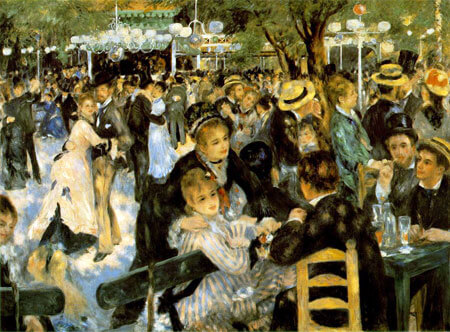
Painting alongside Monet and showing with the independent Impressionists gave Renoir new ways to picture light, leisure and crowds. See the Moulin painting.
Line, studies and large figures
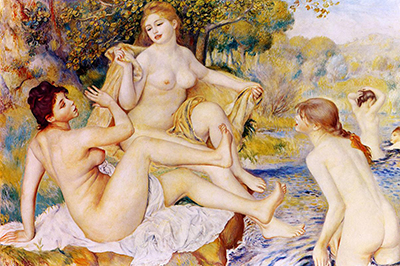
After his Italy journey, Renoir tested firmer drawing and made extensive studies for large figure compositions. Examine the Great Bathers.
Portraits, colour and Cagnes
Renoir kept working across portraiture, landscape and the figure, including the late bathers at Cagnes-sur-Mer. See the late Bathers.
 Pierre-Auguste Renoir.jpg)
Contents
- Childhood, trade and first drawing lessons
- The Salon and the 1860s
- Independent exhibitions and modern life, 1874–77
- Portrait clients and the return to the Salon
- Aline, Italy and new questions about form
- Family pictures, public recognition and late work
- Key dates
Watch: Pierre-Auguste Renoir
Explore a Montmartre dance, a gathering beside the Seine and the drawings behind Renoir’s paintings.
Renoir, Bal du moulin de la Galette
Dr. Beth Harris and Dr. Steven Zucker discuss Renoir’s 1876 Montmartre dance scene, its light and its crowds.
Watch on YouTubeChildhood, trade and first drawing lessons
Renoir's father Léonard was a tailor and his mother Marguerite a seamstress. Their move to Paris placed the family near the museums and art trades in which their son would work. From 1854 to 1860 he was apprenticed as a painter on porcelain. Copying a decorative pattern with controlled colour and a steady hand was useful training, though the job was commercial work rather than an academy education.
Renoir also drew. The Musée d'Orsay traces his early drawing instruction to the porcelain workshop and a free municipal school. In 1860 he received permission to copy at the Louvre. There he could study paintings in their full scale, seeing how earlier artists handled flesh, fabric, colour and groups of people. A later change of style was therefore not his first encounter with older art; looking at it belonged to his education from the outset.
He entered the École des Beaux-Arts and Charles Gleyre's studio in the early 1860s. Gleyre's atelier brought him together with Claude Monet, Frédéric Bazille and Alfred Sisley. The relationships mattered because the young painters could test ideas outside the studio as well as study within it. Working in the forest of Fontainebleau and along the Seine exposed them to changing light, weather and movement. Their pictures share some problems without sharing one answer to each.
The family's Paris addresses were themselves changed by the modern city Renoir would later paint. Research presented at the Musée d'Orsay traces their first home near the Louvre to rue de la Bibliothèque; the street disappeared during works around the Louvre and rue de Rivoli. They moved to rue d'Argenteuil, another street later cut through for the avenue de l'Opéra. These are concrete changes to the surroundings of his childhood, not a reason to claim that every later street painting is a protest against urban renewal. The same research draws on the recollections of Renoir's younger brother Edmond, who shared a cramped room with Auguste and later became a journalist. Their relationship would matter to Renoir's early working life. Musée d'Orsay, Marc Le Cœur, “Renoir frère et frères”. [1]
The Salon and the 1860s
The Paris Salon remained a route to public attention. Renoir first showed a painting there in May 1864: La Esmeralda, a canvas he later destroyed. Other early submissions and acceptances followed. The detail matters because his career did not begin with an outright refusal of every official institution. He sought a place in the Salon even as he and his friends became dissatisfied with its limits.
His painting developed around several subjects during the 1860s. He made landscapes with friends, scenes of sociability and portraits of Lise Tréhot, his companion and a frequent model from about 1865–66. The Musée d'Orsay's 2026 research states that Renoir and Lise did not recognise two children born of their relationship, which ended around 1872. This is a consequential part of the biographical record; it should not be turned into a neat explanation for any painting or repeated as gossip. Her presence in works such as Lise with a Parasol also asks an art-historical question: what can the picture show of the model, and what remains outside it?
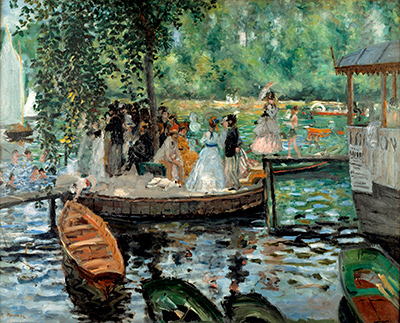
The late 1860s collaboration with Monet provides another route into the work. At La Grenouillère in 1869 they painted the same riverside leisure site. Renoir's surviving canvas and Monet's paintings frame the place differently. Their shared practice helped develop an approach to outdoor light and visible brushwork that became central to Impressionism. It was an exchange among peers, not a one-way lesson from Monet to Renoir.
Friendship also had practical consequences before Renoir could count on a dealer or regular buyers. The Orsay's study of the Renoir brothers finds him living with fellow painter Frédéric Bazille for several years, after earlier hospitality from Jules Le Cœur. The arrangement relieved some immediate costs of a precarious painting career. When the Franco-Prussian War began in 1870, Renoir was called into a cavalry unit and spent months away from Paris. Bazille died in the fighting that November. The biography of Impressionism sometimes moves directly from riverside painting to the first group exhibition, but that sequence passes over military service and the loss of a close collaborator. Musée d'Orsay, “Renoir frère et frères”. [1]
Orsay’s transcript specifies that Auguste was called up to the 10th Chasseurs in August 1870. His younger brother Edmond, exempt from ordinary service, volunteered for the National Guard that September and then a combat battalion in November; the brothers were not serving together. In March 1871, while still away from Paris, Auguste wrote to the architect Charles Le Cœur and asked him to pass news to Edmond if a separate letter failed to reach his brother. The letter is a small but direct trace of family contact during the disruption. It does not by itself tell us where every later painting was planned, or how either brother viewed the political events of the Commune. Musée d’Orsay, Marc Le Cœur’s research on the brothers. [1]
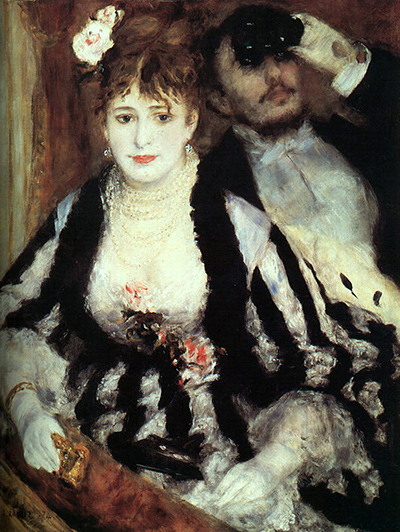
After the war and Commune, Auguste and Edmond shared an apartment. Edmond's later account describes earning money as a journalist and helping with the household while his brother painted; a family memory is evidence of how Edmond understood his role, not a complete ledger of their finances. By 1873 the brothers had moved to rue Saint-Georges, closer to Montmartre's artists, models and theatres. Edmond said he helped find models for Auguste, and he himself posed in La Loge. These details reveal the work behind seemingly informal paintings: finding a room, paying for it, gathering sitters and securing attention in the press. Musée d'Orsay, “Renoir frère et frères”. [1]
Independent exhibitions and modern life, 1874–77
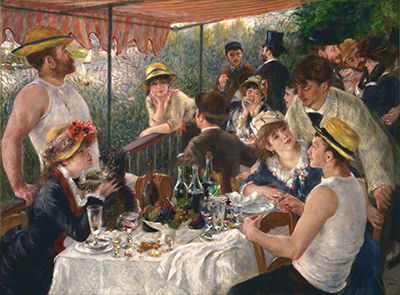
Renoir participated in the first independent Impressionist exhibition in April 1874, and showed with the group again in 1876 and 1877. Such exhibitions allowed artists to show outside the Salon, yet membership did not mean uniform goals. He then pursued Salon exposure and portrait commissions before returning to the seventh Impressionist exhibition in 1882. The return matters: his exhibition history was not a straight departure from the group after 1877. The Musée Fournaise records Luncheon of the Boating Party at that 1882 show, and the Musée d'Orsay records another Renoir work, Champ de bananiers, in its catalogue. Musée Fournaise [2]; Musée d'Orsay. [3]
The 1882 return was negotiated rather than inevitable. The French Ministry of Culture's account traces disagreements among the artists and records Renoir's reluctance. Durand-Ruel, who owned many of their paintings, pressed for the exhibition and supplied works from his stock. This mattered to an artist who still wanted freedom to exhibit at the Salon: group identity, a dealer's investment and individual career needs all shaped the final display. A National Gallery of Australia essay identifies Luncheon among the works shown there. Those sources support his participation without pretending that every painting was selected by Renoir himself. French Ministry of Culture, seventh exhibition [4]; National Gallery of Australia. [5]
In these years he painted people in theatres, gardens, riverside resorts and Montmartre streets and dance venues. La Loge, shown at the first exhibition, explores who looks at whom in a theatre box. Dance at Le Moulin de la Galette, painted in 1876 and exhibited with the group in 1877, turns a Montmartre dance garden into a large, populated picture. Its light appears spontaneous, but its numerous figures and connected spaces required decisions of composition as well as observation. The Moulin article follows the object and its later ownership.
The modern subject should not be mistaken for a full social survey of Paris. Renoir chose whose leisure to represent, which encounters to emphasize, and how to make the crowd hold together. Recent Orsay research sees those paintings within the city's changing social and cultural life, and it gives the relationships between models and pictured figures more attention than the familiar shorthand of “joyful Impressionism.”
The Musée d'Orsay's 2026 exhibition research puts this choice in a sharper social setting. Montmartre was still a working-class district when Renoir rented a house there in 1876, and he used friends and neighbourhood models for the Bal du moulin de la Galette. The museum reads his dance, lunch and theatre scenes as images of public meeting after the violence of the 1870 defeat and the Commune. That is a curatorial interpretation, not proof that the crowds were free of class divisions or hardship. It does, however, help explain why depicting leisure on a large canvas could be an ambitious statement about contemporary life. Musée d'Orsay, Renoir et l'amour. [6]
Portrait clients and the return to the Salon
Portraiture supplied Renoir with buyers as well as difficult artistic problems. The publisher Georges Charpentier and his wife Marguerite were central to an influential literary and artistic circle. Renoir's large Madame Georges Charpentier and Her Children was exhibited at the 1879 Salon, where its reception helped his standing. That date corrects a persistent error in older summaries that place the Salon display in 1878, the year painted.
At the Charpentiers' home Renoir met Paul Bérard, another important patron. He painted Bérard's children and visited the family's house at Wargemont, where he also worked on landscapes and still lifes. These relationships show why a painter associated with independent exhibitions might still seek official display and wealthy clients. A career in modern art still required income, patrons and access to audiences.
The buyers were not a single social type. The Metropolitan Museum of Art places Eugène Murer, a pastry cook with radical politics, beside the wealthy Charpentiers in its account of Renoir's patrons. Their circumstances differed, but both bought into a kind of painting that still provoked resistance. The contrast complicates a tidy story in which Renoir simply exchanged independent painting for upper-class portraiture. Patronage connected working trades, literary circles, collecting and domestic display, and each commissioner brought a different expectation to the portrait. The Met's examples also caution against reading a sitter's politics or wealth straight from Renoir's warm handling of the face. Metropolitan Museum of Art, Renoir essay. [7]
Wargemont was more than a place to make the Bérard family portraits. The Met identifies seascapes and still lifes associated with Renoir's visits. One patron's invitation thus gave him time and access to work beyond the commission that had opened the relationship. The subjects should still be kept separate: a picture of a child answers a family's desire for a likeness, while a seascape or bowl of flowers can test an entirely different arrangement of colour. Treating all three as part of one patronage network explains opportunity without reducing every canvas to a transaction. Metropolitan Museum of Art, Renoir essay. [7]
The dealer Paul Durand-Ruel also became important. His 1883 exhibition of Renoir's work included portraits, still lifes and other genres. It offered a concentrated view of an artist who was already more varied than a series of sunny outdoor pictures would suggest. The Art Institute of Chicago's scholarly catalogue notes that six still lifes appeared among the seventy works in that show. This was a commercial presentation, but its contents are evidence that Renoir considered flowers and objects worth serious attention.
Durand-Ruel promoted Renoir beyond Paris that year. Art Institute research records Renoir paintings in dealer-organised Impressionist exhibitions in London, Boston and Berlin. Exposure was not the same as reliable sales. The same catalogue cites a December 1883 letter from Bérard describing Renoir's lack of new portrait commissions and a crisis of confidence despite the dealer's efforts. These documented, conflicting conditions prevent the retrospective from being treated as an instant commercial triumph. Art Institute of Chicago, Lucie Bérard, “1883: A Watershed Year”. [8]
The exhibition opened on 1 April 1883 in Durand-Ruel's renovated galleries near the place de la Madeleine. Its first gallery was devoted to pictures of children, a subject for which Renoir had already earned critical notice. Théodore Duret's catalogue preface presented him as a figure painter within Impressionism. This was a deliberate public account of the artist's strengths, created by a dealer and an ally at a moment when Renoir was still seeking commissions. It is useful evidence for his reputation, but it should not be mistaken for an impartial description of all his work. Art Institute of Chicago, Lucie Bérard scholarly catalogue. [9]
Renoir's work that year also reached readers through his brother Edmond. In December 1883, he illustrated Edmond's story L’Étiquette for La Vie Moderne, the journal Edmond had come to edit. The brothers also collaborated on Edmond's Paris qui pêche for Le Figaro's Sunday literary supplement. Orsay's research identifies these as their two documented artistic and literary collaborations. They show drawing serving a published story as well as Renoir's preparations for paintings. The same research describes a later, severe break between the brothers but says its timing and cause are difficult to establish. Their joint work in 1883 is evidence of a professional connection then; it does not establish that the relationship stayed close afterward. Musée d’Orsay, “Renoir frère et frères”. [1]
The same year shows the friction between artistic invention and a client's expectations. The commissioned portrait of Madame Léon Clapisson went through a difficult development before its Salon presentation. The Art Institute's study draws on correspondence, ownership history and technical examination to show that the portrait changed substantially as Renoir worked. It resists the easy story of an artist simply abandoning Impressionist colour for academic line. In one picture, outdoor setting, portrait convention, broad colour and controlled figure modelling had to be negotiated together. Art Institute of Chicago, Madame Léon Clapisson scholarly catalogue. [10]
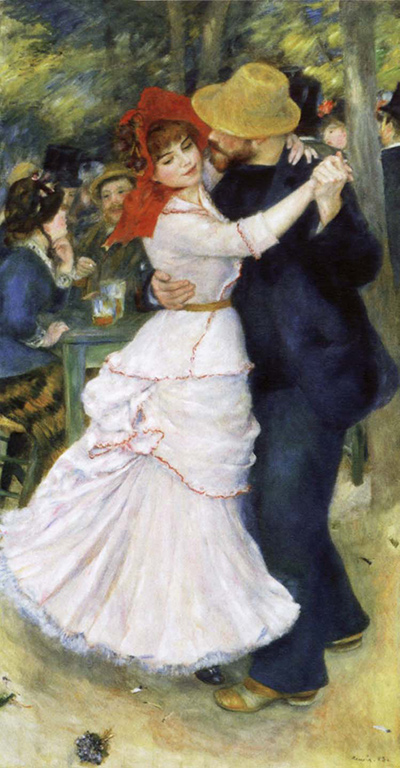
Durand-Ruel's network took Renoir's pictures to a different public in 1886. The Philadelphia Museum of Art records the dealer exhibiting all three large 1883 dances—Dance in the City, Dance in the Country and Dance at Bougival—at New York's National Academy of Design. Their first exhibition paths had differed: the Orsay pair appeared in Durand-Ruel's 1883 Paris show, while Bougival went to London. Bringing them together in New York made the contrast among formal interior, country restaurant and crowded riverside café visible to another audience. Philadelphia describes the larger 1886 exhibition as a turning point in the dealer's American business; he opened a New York gallery the following year. That commercial history concerns opportunities for the paintings to be seen and sold, not evidence that Renoir himself travelled to the show or that each canvas sold there. Philadelphia Museum of Art, Discovering the Impressionists. [11]
Aline, Italy and new questions about form
Renoir met Aline Charigot in 1880. She was a seamstress from Essoyes who became his companion and a model. Their first son, Pierre, was born on 21 March 1885; they married in 1890. Their sons Jean and Claude followed in 1894 and 1901. Aline appears in works of leisure and family life, including a group of 1885 pictures of her nursing Pierre. An Orsay painting titled Maternité connects a specific sitter, child and place: the museum judges that Renoir probably began it during a stay at Essoyes that autumn. “Probably” marks a reasoned museum judgement, not a witnessed fact.
In 1881 Renoir travelled to Italy to study older painting. He became dissatisfied with what he believed outdoor Impressionist technique could do for the human figure. Yet his subsequent changes took years rather than one trip. The three large Dance paintings of 1882–83, the many drawn preparations for The Great Bathers, and later landscapes show experiments running beside one another. Stronger contours, careful figure modelling, freer colour and more varied materials did not arrive or disappear together.
His Italian stay crossed the winter of 1881–82. Orsay's account places him in Venice, Rome, Naples, Calabria, Capri and Palermo, while treating a stop in Florence as uncertain. That route brought very different forms of earlier art into view, so “Italy” should not be used as a single stylistic cause. His responses appeared over time in landscapes, figure paintings and drawings. Musée d'Orsay, Italy journey overview. [12]
The trip also produced still lifes that make the change of method easier to see. The Art Institute of Chicago identifies Fruits of the Midi and Onions as works painted in Naples in 1881 and bought by Durand-Ruel the following May. In the fruit picture, peppers, aubergine, tomatoes and citrus have a more firmly modelled presence than the loosened background and cloth around them. Technical examination found outlines around forms beneath the surface; the museum also documents a revision to the background colours. This is a more precise account than saying Renoir returned from Italy and immediately adopted one uniformly “classical” style. He could use controlled edges and freely brushed surroundings within a single small painting. Art Institute of Chicago, Fruits of the Midi scholarly catalogue. [13]
Letters add another perspective. Renoir wrote to Paul Bérard about the food he was eating and to Madame Charpentier about his desire to see Raphael. The Chicago catalogue reads these alongside his visits to Calabria and to Naples's archaeological museum. Older art was part of his purpose, but ordinary life, local objects and light also held his attention. Reading the pictures with the letters resists a biographical shortcut in which a single encounter with Raphael explains all later canvases. Art Institute of Chicago, Fruits of the Midi scholarly catalogue. [13]
The study of drawing became especially visible in the mid-1880s. Berthe Morisot, who visited Renoir's studio in 1886, remarked on the preparatory work she saw for a large painting. Surviving chalk studies for The Great Bathers now make that process tangible. The finished oil, worked from 1884 to 1887, places sculptural figures against a more flickering landscape. Its difficult making and divided reception help explain why a painter celebrated for apparent ease was willing to revise his methods so thoroughly.
Orsay curator Paul Perrin draws a distinction between Renoir's early training in drawing and the small number of surviving drawings from before he was forty. Perrin says the Impressionist paintings of the 1870s, including The Swing and Bal du moulin de la Galette, generally generated very few separate drawings: Renoir also drew and painted directly on the canvas. The known early Bal sketch is therefore valuable evidence of planning, but it should not be treated as proof of an extensive lost sequence of studies. For The Great Bathers a decade later, Perrin estimates roughly fifteen to twenty large preparatory drawings. That contrast makes the change in working method more precise than the idea of a sudden loss of confidence after Italy. Renoir increasingly used repeated drawing to test contour and figure placement, then spent later years seeking a balance between that discipline and freely handled paint. Musée d'Orsay interview with Paul Perrin. [14]
The public response in 1887 makes the experiment less like a neat stylistic conversion. The Musée d'Orsay describes Bathers: Essay in Decorative Painting as the centrepiece of an international exhibition in Georges Petit's gallery. Viewers recognised Renoir's effort to renew his work, but its dry outlines, pale and acidic colours, and the seeming separation of figures from landscape unsettled them. Renoir had wanted a decorative unity, with lines and bodies carrying movement around the composition. The gap between that ambition and its reception shows why the painting cannot be labelled simply a triumph of stricter drawing. Musée d'Orsay, Renoir dessinateur. [15]
Nor did his interest in line end when the sharpest phase passed. In a November 1888 letter to Durand-Ruel cited by Orsay, Renoir spoke of returning to a softer, lighter manner in continuity with eighteenth-century painting. Orsay nevertheless traces black pencil, red chalk, pastel and printmaking through his later work. Watercolour, especially useful during travel, let him record colour and transparency quickly; about a hundred of these sheets are now known. The paintings' softer edges and his continuing draftsmanship developed together. A biography that calls the 1880s a break and the 1890s a return misses that movement among media. Musée d'Orsay, Renoir dessinateur. [15]
Family pictures, public recognition and late work
Renoir continued to make portraits, pictures of children, still lifes, landscapes and nudes in the 1890s. His position in public collections changed in 1892. The Musée d'Orsay records that admirers, among them Stéphane Mallarmé and the arts administrator Roger Marx, pressed for Impressionist work to enter the national museums at a time when the French state had yet to buy a painting from Renoir. An informal administrative commission led to the purchase of Girls at the Piano from the artist for the Musée du Luxembourg. The purchase order is dated 21 September 1892. This was a specific institutional decision, rather than proof that official opinion had become uniformly favourable. Musée d'Orsay, Jeunes filles au piano, RF 755. [16]
The state-owned canvas was one of several treatments of the subject. Orsay identifies three other finished versions of the composition, an oil sketch and a pastel. The variants make the title alone an unreliable way to identify a reproduction. Orsay also reads the Luxembourg picture as a meeting of clearly defined figures, freely handled colour and an elegant contemporary interior. The transaction thus belongs to Renoir's continuing work on figure painting as well as to the story of public recognition. Later pictures of children include named members of his family, but not every young sitter is identifiable. Musée d'Orsay, Jeunes filles au piano. [16]
In August 1894, Gabrielle Renard, Aline's cousin, came from Essoyes to work in the household and care for the infant Jean. She became a repeated model. She was both a worker in the family and a person represented in paintings; reducing her to the word “muse” hides the practical relationship that made many images possible. She left the household in 1913, according to the Orsay chronology.
By 1900, public and commercial recognition had acquired several forms. The Art Institute of Chicago's catalogue records a 68-work Bernheim-Jeune exhibition in Paris that January and eleven Renoir paintings at the Paris Exposition Universelle in May and June. In August, the French state made him a Chevalier of the Légion d'honneur. These were distinct events: a dealer's display, a world's-fair exhibition and an official honour. Taken with the Luxembourg purchase eight years earlier, they show a widening public presence without implying that every critic or buyer had reached the same judgement. Art Institute of Chicago, Jean Renoir Sewing, cat. 24. [17]
That visibility coexisted with a working household. The Art Institute places Renoir, Aline, Jean, Gabrielle and their cook and model Marie Dupuis at a rented villa near Magagnosc in the winter of 1899–1900; the milder south was also part of Renoir's response to worsening arthritis. Jean later remembered his father painting him sewing there. In January 1900 Renoir gave his birth city of Limoges a different portrait of Jean, signed 1899. The museum describes Limoges as the second French public collection to hold a Renoir. The Chicago Jean Renoir Sewing was another canvas, technically revised despite its domestic subject. Keeping the two portraits apart shows how family painting and public recognition could proceed at the same time. Art Institute of Chicago, Jean Renoir Sewing. [17]
Recognition also changed among a younger collecting public. The Met records that the 1904 Salon d'Automne opened on 15 October with retrospectives of Renoir, Cézanne, Puvis de Chavannes, Redon and Toulouse-Lautrec. It describes how Leo Stein, who had begun to reconsider Renoir while looking at the Musée du Luxembourg's Impressionist room, reacted strongly to that exhibition; Leo and Gertrude Stein soon spent their spare funds on modern art. Their response is one documented example of new audiences forming around these painters, not proof that the show changed every viewer's mind or that Renoir's later art was uniformly embraced. The Luxembourg purchase had made Renoir visible in a public room; the 1904 retrospective put his career alongside several distinct paths in modern painting. Metropolitan Museum of Art, The Steins Collect, Gallery One. [18]
The family bought Les Collettes at Cagnes in 1907 and moved there in autumn 1908, according to the Met's record of a farm landscape. Its farmhouse, olive and orange groves, and views of the hills became recurring subjects in his late landscapes. In The Farm at Les Collettes, Cagnes, painted between 1908 and 1914, Renoir uses trees to frame and partly screen the buildings and distance. That specific work is evidence of the estate's pictorial possibilities; it should not stand in for every painting made there. Metropolitan Museum of Art, The Farm at Les Collettes, Cagnes. [19]
Renoir's mobility was increasingly restricted by rheumatoid arthritis. He nevertheless continued to make paintings and drawings with subjects, materials and artistic choices that deserve attention beyond the physical difficulty of making them. Sculpture brought a more direct collaboration. From 1913, the dealer Ambroise Vollard arranged Richard Guino's work with Renoir; Guino modelled sculptures under the painter's direction. A Paris court recognised Guino as co-author in 1971, and France's Court of Cassation upheld that decision in 1973. The sculptures belong to both makers' histories. Musée d'Orsay, Richard Guino directory. [20]
Aline died in 1915. The collaboration with Guino produced a particularly personal object after Aline's death. The National Gallery of Art catalogues Maternity: Madame Renoir and Son, about 1916, under both Renoir and Richard Guino. Its terracotta group reworks an earlier painting of Aline nursing their first son, Pierre. Renoir considered a memorial for her grave; according to the Gallery, the whole group was not enlarged for that purpose, but its head and bust were cast, while a full replica stood in the family garden. The sequence shows how an earlier family image could become a sculptural design through two makers' work, and why the smaller terracotta should not be confused with the later grave monument. National Gallery of Art, Maternity: Madame Renoir and Son, 1983.1.72. [21]
The First World War also entered the family's life. Jean Renoir was wounded in the leg in April 1915, and the Musée d'Orsay's study of father and son describes a period of illness, Aline's death and the wartime injuries of two sons. It also identifies Andrée Heuschling, who probably met the painter in 1915, as a late model and later Jean's wife. She appears in the account of the large Bathers of 1918–19. These connections anchor the late studio in the lives of particular people; they do not turn the painted bathers into transparent portraits of family history. Musée d'Orsay, Renoir père et fils [22]; late Bathers object record. [23]
The late works also complicate a common account of illness as a simple decline. Renoir's hand and mobility problems were severe, as Orsay's sculpture record explains. At the same time, the museum describes the late Bathers as a large, deliberately composed painting made in the garden at Les Collettes. The question for a viewer is therefore what new scale, colour and figure relationships the painting attempted, alongside the conditions in which it was made. His illness is a part of the record, not a substitute for looking at the work.
Drawing offers another measure of what the late studio attempted. Orsay records monumental red-chalk nudes made after Renoir was sixty and increasingly disabled by rheumatoid arthritis. Vollard first exhibited these late drawings in 1912; Orsay says their combination of light, colour and line attracted a younger generation, including Bonnard, Matisse and Picasso. That account is about the works' artistic reception, not a claim that the artists shared one style. It also gives the drawings an independent public life: they were not merely preliminary notes to be discarded once an oil painting was finished. Musée d'Orsay, Renoir dessinateur. [15]
The family's later role shaped what subsequent viewers could see. Orsay records that Renoir's three sons inherited many works in 1919 and gave the late Bathers to the French state in 1923. Jean sold much of his inheritance to support his early films, then later bought back paintings and sculpture by his father. His memoir Renoir, My Father, published in 1962, helped circulate family memories, but Orsay emphasizes that Jean did not present himself as a historian. Gabrielle Renard's memories also contributed to that long writing project. These accounts are valuable, while dates, sitters and artistic intentions in them still need comparison with objects and contemporary records. Musée d'Orsay, Renoir Father and Son. [24]
Renoir's reception has never been one verdict. The Met describes the late bathers as admired by Picasso, Matisse and Maillol, while also noting Mary Cassatt's sharp criticism of their proportions. These responses show artists arguing with the late work on its own terms. The paintings' scale, fullness and imagined Mediterranean settings influenced some makers and repelled others. That mixed response is more informative than treating the artist as either the cheerful painter of the 1870s or a painter whose final decades matter only because illness made them difficult. Metropolitan Museum of Art, Renoir essay. [7]
Renoir continued to work at Cagnes and died there on 3 December 1919, aged seventy-eight. The career that began with painting on porcelain ended with work admired, sold and debated across Europe and beyond. Its later drawing, figure painting, domestic pictures and collaborative sculpture remain part of his artistic legacy.
Key dates
| Year | Event |
|---|---|
| 1841 | Born in Limoges on 25 February. |
| 1844 | Family moved to Paris. |
| 1854–60 | Apprenticeship as porcelain painter. |
| 1860 | Permission to copy in the Louvre. |
| 1864 | First Salon painting, La Esmeralda. |
| 1874 | First independent Impressionist exhibition. |
| 1877 | Third Impressionist exhibition, including Bal du moulin de la Galette. |
| 1879 | Madame Charpentier and Her Children shown at Salon. |
| 1881 | Travel to Italy begins. |
| 1882 | Returned to the seventh Impressionist exhibition with Luncheon of the Boating Party among his works. |
| 1883 | Durand-Ruel exhibition of Renoir's work. |
| 1885 | Birth of Pierre. |
| 1886 | Durand-Ruel showed the three large dance paintings in New York. |
| 1890 | Marriage to Aline Charigot. |
| 1894 | Birth of Jean; Gabrielle Renard joined household. |
| 1900 | Bernheim-Jeune exhibition, Exposition Universelle display and Chevalier of the Légion d'honneur. |
| 1901 | Birth of Claude. |
| 1904 | Renoir retrospective at the Salon d'Automne. |
| 1907 | Acquisition of Les Collettes at Cagnes. |
| 1908 | Family moved to Les Collettes in autumn. |
| 1915 | Death of Aline. |
| 1919 | Renoir died at Cagnes on 3 December. |
Renoir artworks directory
Discussion
Look closely at Biography and use the questions below to compare what you see with the documented history.
Reader Insights
Which change of place or patron seems most visible in the work?
Consider the Salon alongside Renoir’s participation in independent exhibitions.
Where does the documented biography leave room for a different reading of the pictures?
Join the Conversation
Share a close observation or a source-backed question about Biography. The prompts above are starting points for discussion.
References
- Musée d'Orsay, Marc Le Cœur, “Renoir frère et frères”, 2026 lecture and transcript, on the family, the war and Edmond's part in the early career View source.
- Musée Fournaise View source.
- Musée d'Orsay View source.
- French Ministry of Culture, seventh Impressionist exhibition, 1882 View source.
- French Ministry of Culture, Old Masters – New Visions View source.
- Musée d'Orsay, Renoir et l'amour View source.
- Metropolitan Museum of Art, Renoir essay View source.
- Art Institute of Chicago, Lucie Bérard , “1883: A Watershed Year” View source.
- Art Institute of Chicago, Lucie Bérard View source.
- Art Institute of Chicago, Madame Léon Clapisson View source.
- Philadelphia Museum of Art, Discovering the Impressionists: Paul Durand-Ruel and the New Painting, on the three dances at the 1886 New York exhibition and the dealer's subsequent gallery View source.
- Musée d'Orsay, Italy journey overview View source.
- Art Institute of Chicago, Fruits of the Midi, scholarly catalogue on the Naples still lifes, letters, technique and 1882 sale View source.
- Musée d'Orsay, Paul Perrin interview on Renoir et l'amour and Renoir dessinateur, on the scarcity of early drawings, direct work on canvas and the more intensive Great Bathers preparations View source.
- Musée d'Orsay, Renoir dessinateur detailed presentation View source.
- Musée d'Orsay, Jeunes filles au piano, RF 755: the 1892 state purchase, institutional context and composition variants View source.
- Art Institute of Chicago, Jean Renoir Sewing, cat. 24: 1900 exhibition and honour chronology, Magagnosc household, and the separate Limoges and Chicago portraits of Jean View source.
- Metropolitan Museum of Art, The Steins Collect, Gallery One: 1904 Salon d'Automne retrospective and Leo and Gertrude Stein's documented response View source.
- Metropolitan Museum of Art, The Farm at Les Collettes, Cagnes, 61.190: estate purchase, move and later landscape subjects View source.
- Musée d'Orsay, Richard Guino directory View source.
- National Gallery of Art, Maternity: Madame Renoir and Son, c. 1916, 1983.1.72, for the Renoir–Guino collaboration and Aline memorial View source.
- Musée d'Orsay, Renoir père et fils View source.
- Musée d'Orsay, Les Baigneuses View source.
- Musée d'Orsay, Renoir Father and Son: Jean, Gabrielle, the family holdings and the later circulation of the late work View source.
- Musée d'Orsay, Renoir père et fils chronology, p. 29 View source.
- Musée d'Orsay, Renoir et l'amour detailed presentation View source.
- The Metropolitan Museum of Art, Cindy Kang, “Auguste Renoir (1841–1919)” View source.
- The Metropolitan Museum of Art, Madame Georges Charpentier and Her Children View source.
- Musée d'Orsay, Maternité View source.
- Musée d'Orsay, Aline Renoir directory View source.
- Art Institute of Chicago, Chrysanthemums View source.
- Art Institute of Chicago, Splashing Figure View source.
- Musée d'Orsay, Hymne à la vie View source.
- Musée d'Orsay, Madame Renoir View source.