Pierre-Auguste Renoir.jpg)
 by Tom Gurney
Tom Gurney BSc (Hons) is an art history expert with over 20 years experience
Published on June 19, 2020 / Updated on October 2, 2026
Email: tomgurney1@gmail.com / Phone: +44 7429 011000
A seated woman turns her head toward us while her body faces the coast. She gathers a white cloth across her lap; water and cliffs recede behind her in blue, green and yellow. Pierre-Auguste Renoir painted this Blonde Bather during his 1881 journey in Italy. The canvas belongs to the Clark Art Institute, accession 1955.609, and is distinct from a second version Renoir made in 1882. The Clark’s scholarly catalogue entry [1] documents the work, its revisions and its history.
The sitter was almost certainly Aline Charigot, according to the Clark, which notes that she accompanied Renoir for at least part of the trip. She later became his wife. The identification is persuasive but is expressed by the museum as a conclusion from the available evidence, not as a signed statement on the canvas. Keeping that distinction matters in a painting whose setting and later changes are also more complex than they first appear. Clark catalogue, no. 279. [1]
At a glance
- ArtistPierre-Auguste Renoir
- TitleBlonde Bather (Baigneuse blonde)
- Date1881, during Renoir’s Italian trip
- Medium and sizeOil on canvas, 81.6 × 65.4 cm
- InscriptionUpper-right signatures and dedication to Henri Vever, partly overpainted and renewed
- MuseumClark Art Institute, 1955.609
Watch: Pierre-Auguste Renoir
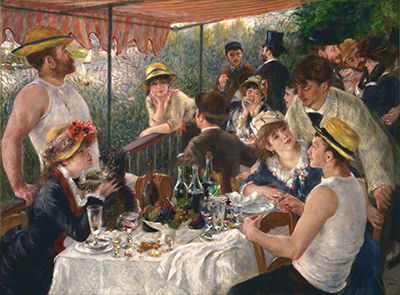
Explore a Montmartre dance, a gathering beside the Seine and the drawings behind Renoir’s paintings.
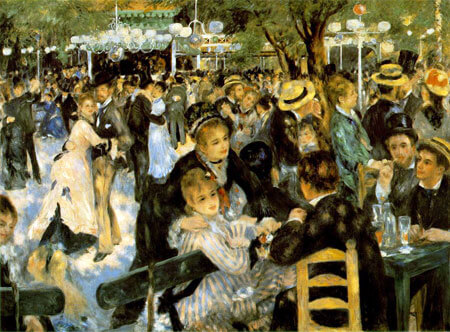
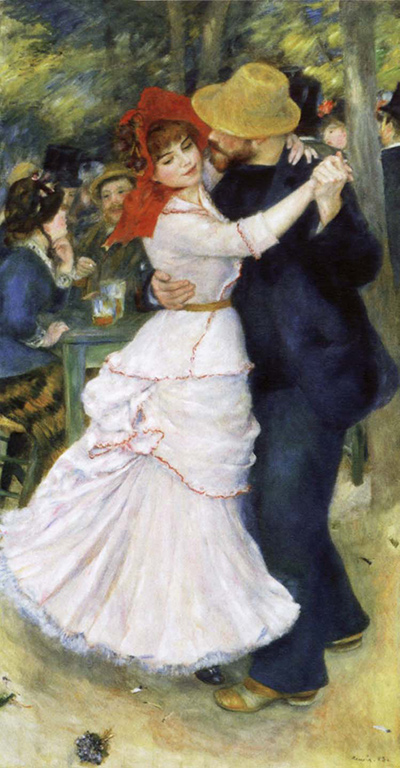
Renoir, Bal du moulin de la Galette
Dr. Beth Harris and Dr. Steven Zucker discuss Renoir’s 1876 Montmartre dance scene, its light and its crowds.
Watch on YouTubeThe 1882 Blonde Bather in the Pinacoteca Gianni e Marella Agnelli, Turin, measures 90 × 63 cm. It is a separate painting, made after this one. The title is shared and the pose is close, but the Clark describes a different background and a stronger separation of figure and landscape in the later version. Clark catalogue and figure 279.1. [1]
A figure against a coastal background
Renoir places the sitter close to the front of the canvas. Her right arm extends diagonally toward the lower left; her other hand rests on the cloth near her thigh. Those arms and the pale fabric form a broad base beneath her upright body. Her head, turned toward the viewer, completes a stable triangular arrangement. The position is relaxed but carefully organised.
Her skin is built from warm pink, cream and delicate cool shadows. The edges remain soft, especially around her hair and shoulder, yet the bright figure is unmistakably set apart from the darker bank on the right and the cooler water on the left. The Clark compares this definition with Renoir’s earlier Study: Sunlight Effect, where broken colour connects the nude more closely with the surrounding foliage. Here the body has greater volume, while the landscape stays freely brushed. Clark catalogue comparison. [1]
Her red-blond hair spreads down the right side of the picture. Muted blues in its shadows answer the blue behind her head. The folds of the cloth are broader and less exact than the modelling of the torso. It is possible to follow the direction of the paint across both, but the marks have different jobs: the cloth gathers and flutters; the body holds its form. The Clark stresses that Renoir retained a loose treatment in the background and fabric even as he strengthened the figure. Clark catalogue visual analysis. [1]
On the left, a small rocky point interrupts the water, and white strokes suggest surf near it. The coast is not surveyed in precise detail. Blue and yellow-green patches create an impression of open air and reflected light. Renoir sets that changing surface against the relative stillness of the sitter’s pose. Her gaze does not lead us to a visible event; it creates a pause within a landscape that otherwise seems to move.
Italy, sunlight and an altered shore
Renoir made the painting during his autumn and winter 1881 visit to Italy. After returning to France, he reportedly told friends that he had painted it on a boat in full sunlight in the Bay of Naples. The Clark cautions that the painting’s present background does not look like a view from a boat: the sitter now appears to be seated by the shore, perhaps on a grassy outcrop. The space between her, the sea and the cliffs is intentionally difficult to fix from the final image. Clark catalogue, location and revision discussion. [1]
Technical examination revealed paint beneath the present cliffs that describes different forms. The museum considers the background substantially reworked, possibly after Renoir returned from Italy. The tale of painting on a boat may reflect an earlier stage, an artist’s recollection, or both. It should not be presented as a literal description of the finished scene. This is one reason the coastal backdrop is best read as part of a composed image rather than as a topographical record. Clark technical and catalogue reports. [1]
The visible wedding ring on the sitter’s hand is another detail that can invite too much certainty. The Clark points out that similar rings appear on earlier Renoir nudes, and Renoir and Aline were not married until 1890. The ring therefore does not establish a marriage or the exact circumstances of the sitting in 1881. It is a painted feature whose meaning remains open. Clark catalogue discussion. [1]
A change in scale and ambition
The Clark presents Blonde Bather as a turning point in Renoir’s figure painting. He was looking closely at Italian art, particularly the frescoes of Raphael at the Villa Farnesina in Rome. Renoir’s letters describe his admiration for their broad harmonies and the handling of sunlight. The Clark relates that experience to the simplified, substantial form of this seated figure. That does not mean the painting abandons everything Renoir had learned outdoors: its water, fabric and hair still carry loose, responsive strokes. Clark catalogue, Italy and Raphael discussion. [1]
The museum also places the pose alongside older European images of bathers and seated women, including works by Rembrandt and Titian. These comparisons help explain Renoir’s interest in a figure that seems both immediate and removed from a specific modern setting. They are art-historical relationships, not evidence that he copied a single work directly onto this canvas. Clark catalogue comparisons. [1]
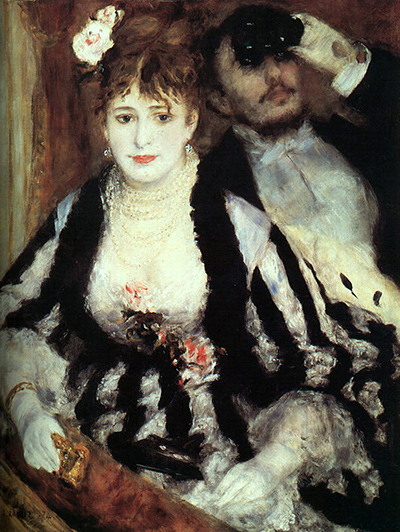
The Clark draws a more immediate comparison with Renoir’s own La Loge of 1874 [2], held by the Courtauld Gallery. Its catalogue describes the bather’s pose as virtually identical to that of the woman in the theatre box, seen from a different angle. The comparison shows how a seated figure associated with Parisian spectatorship could become, through a changed viewpoint and setting, the more monumental and unlocated figure here. It is a comparison of poses, not evidence that one canvas was planned as a study for the other. Clark catalogue. [1]
The result is more complicated than a simple shift from Impressionism to classicism. The coastline is still made of colour and light, with little firm drawing. The figure is more fully rounded, but its edges do not become hard outlines. Renoir tests how much form the body can carry without losing the open atmosphere around it. The painting’s tension between those methods gives it a special place among his early 1880s works.
Two versions and a long journey through collections
On his return from Italy, Renoir gave or sold this canvas to Henri Vever, a jeweller and collector. The Clark says Renoir signed and dedicated it, continued to work on it, then signed and dedicated it again. The partly obscured first inscription is evidence of the work’s evolving surface. In spring 1882, apparently at Paul Durand-Ruel’s request, Renoir painted the second version now in Turin. Its broader bay and distant line of cliffs should not be transferred to this Clark canvas. Clark catalogue, inscriptions and second version. [1]
The Clark’s provenance follows the painting from Vever’s collection to a 1897 sale, where Durand-Ruel acquired it. The dealer held it until Robert Sterling Clark bought it on 2 July 1926. It entered the Clark Art Institute in 1955. The sequence identifies the history of this original 1881 canvas; the Turin version has its own object record and ownership. Clark catalogue provenance. [1]
The museum lists early exhibition appearances, including a 1905 London display under the title Bather at the Seaside. A changed exhibition title need not imply a changed painting. The stable combination of 1881 date, 81.6 × 65.4 cm dimensions and 1955.609 accession distinguishes it amid the two related Blonde Bather canvases. Clark catalogue exhibition history. [1]
Looking again
Begin with the cloth pulled across the lower edge. Follow the sitter’s arm up to her face, then move along her hair into the dark bank behind her. Finally look left to the small cliff and pale surf. The painting keeps the body clear and close while the sea remains restless and distant. It is this balance, together with the evidence of Renoir’s revisions, that makes the canvas more than a straightforward record of a model on a beach.
Renoir artworks directory
Questions about Blonde Bather (1881)
The Clark judges that she was almost certainly Aline Charigot, who accompanied Renoir for at least part of his 1881 Italian trip. The identification is strong but qualified.
Renoir later said he had painted it on a boat in the Bay of Naples. The Clark notes that the finished background suggests a shore setting and shows signs of substantial reworking.
No. The 1881 canvas is at the Clark Art Institute. A second version painted in 1882 is in the Pinacoteca Gianni e Marella Agnelli, Turin.
It belongs to the Clark Art Institute in Williamstown, Massachusetts, as 1955.609.
Discussion
What do you notice when you return to Renoir’s Blonde Bather (1881)?
Where does Renoir separate the sunlit sitter from the cooler coast, and where does the paint remain loose?
Reader Insights
Where does Renoir separate the sunlit sitter from the cooler coast, and where does the paint remain loose?
The Clark identifies this Italian-trip canvas as 1955.609 and documents a separate 1882 version in Turin.
How does the revised seascape change what Renoir’s account of painting on a boat can tell us?
Join the Conversation
Share a close observation or a source-backed question about Renoir’s Blonde Bather (1881).
References
- Clark Art Institute, Blonde Bather, catalogue no. 279: primary object study, sitter assessment, Italy context, technical evidence, inscriptions, second version, provenance and exhibitions View source.
- Courtauld Gallery, Renoir’s La Loge, P.1948.SC.338: the distinct 1874 painting used in the Clark’s pose comparison View source.
- Wikimedia Commons exact-object reproduction: 2068 × 2580 image sourced to a Renoir au XXe siècle exhibition catalogue and marked Public Domain Mark/PD-Art; used for the enlarged local page image. The Clark’s catalogue supplies the object facts View source.