 by Tom Gurney
Tom Gurney BSc (Hons) is an art history expert with over 20 years experience
Published on June 19, 2020 / Updated on October 2, 2026
Email: tomgurney1@gmail.com / Phone: +44 7429 011000
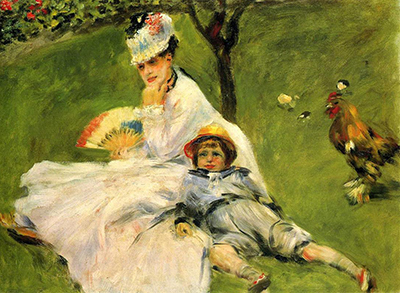
Camille Monet sits on the grass with her son Jean leaning against her dress. She holds an open fan, looks away from us, and rests her chin on one hand. Jean looks outward. At the right, a rooster stands almost as prominently as the two human sitters. In Madame Monet and Her Son, Renoir made a family portrait without a drawing room, a formal pose or a clear boundary between people and garden. The National Gallery of Art, Washington dates the oil painting to 1874 and records it as 1970.17.60. Its current title is shorter than this page’s older descriptive URL, which identifies the same canvas. National Gallery of Art object record. [1]
This was Monet's family and garden at Argenteuil, a place where painters worked together in the 1870s. The picture has a particularly close companion: Édouard Manet painted The Monet Family in Their Garden at Argenteuil in the same summer. The Met says Renoir arrived while Manet was starting, borrowed materials, and positioned himself beside him. Their pictures preserve the same sitters and setting, but offer different answers to how a family could be represented in paint. Met, Manet’s garden painting [2]; National Gallery of Art, The Impressionists at Argenteuil, cat. 21. [3]
At a glance
- ArtistPierre-Auguste Renoir
- Current owner titleMadame Monet and Her Son
- Date1874
- MediumOil on canvas
- Dimensions50.4 × 68 cm
- SittersCamille Monet and her son Jean Monet
- PlaceThe Monet family garden at Argenteuil
- CollectionNational Gallery of Art, Washington, 1970.17.60; Ailsa Mellon Bruce Collection
- Related paintingManet’s The Monet Family in Their Garden at Argenteuil, 1874, Metropolitan Museum of Art, 1976.201.14
Watch: Pierre-Auguste Renoir
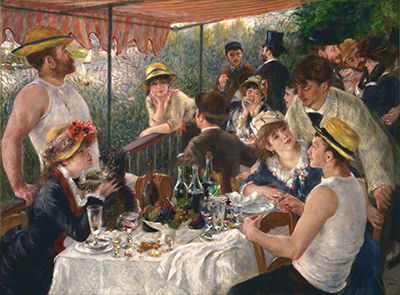
Explore a Montmartre dance, a gathering beside the Seine and the drawings behind Renoir’s paintings.
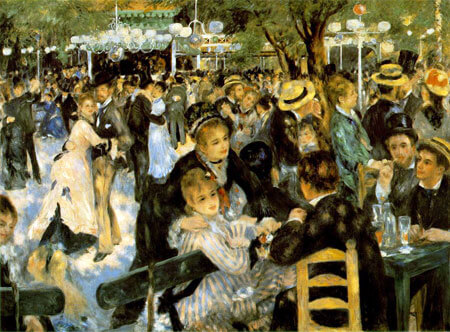
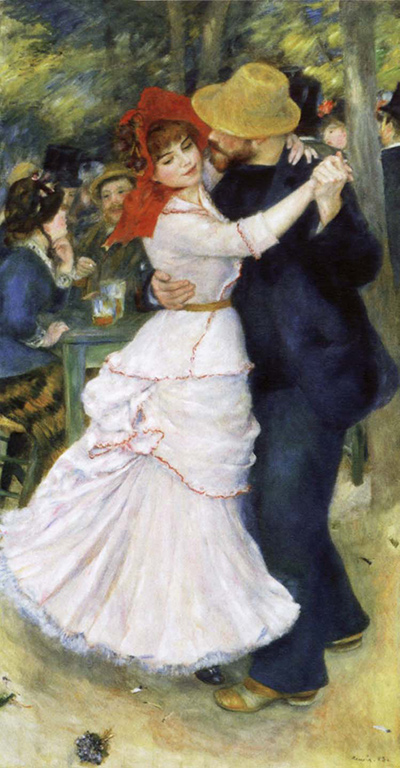
Renoir, Bal du moulin de la Galette
Dr. Beth Harris and Dr. Steven Zucker discuss Renoir’s 1876 Montmartre dance scene, its light and its crowds.
Watch on YouTubeA family portrait on the grass
Camille's white dress spreads across much of the lower canvas. Renoir does not gather it into an elegant portrait silhouette. The skirt runs beyond the bottom edge, while Jean's legs extend diagonally into the foreground. His head presses close to hers, but the two do not make matching expressions. Camille's eyes turn left and down; Jean faces the viewer. Their connection is physical and unposed in appearance, yet their different gazes keep the painting from becoming a single sentimental image of motherhood.
The National Gallery's exhibition catalogue stresses how little traditional portrait decorum remains. Camille's posture is relaxed, the dress is large and untidy in shape, and Jean reclines rather than standing neatly beside her. Such choices matter because Renoir knew who they were. He was painting friends who lived with the garden, rather than presenting unfamiliar clients through possessions or a carefully furnished room. The catalogue reads this informality as a challenge to inherited expectations of portraiture; that is the author's interpretation of the picture, not a recorded reaction from Camille herself. The Impressionists at Argenteuil, cat. 21, pp. 96–97. [3]
The fan, white hat and dark ribbon provide a few precise points amid quickly handled paint. In the child's blue outfit, dark marks suggest folds and fastenings without finishing every seam. Renoir keeps the faces readable, though neither is polished like a Salon portrait. The painting asks the viewer to recognise these individuals inside the loose conditions of a summer afternoon.
The rooster and the tilted garden
The rooster is too assertive to be treated as a tiny decorative detail. It stands upright in profile at the right, its red comb and golden body set against green grass. Three smaller birds appear farther back. Their sizes do not give an easy measure of distance, because the lawn rises steeply until it fills almost the entire background. The National Gallery catalogue notes the oddity of a tree trunk seeming to grow behind Camille and of the flowerbed entering only at the top left. These decisions keep the portrait lively but make the space difficult to map. The Impressionists at Argenteuil, cat. 21. [3]
That is a useful way to look at the painting's speed. Short green strokes run in different directions. They tell us the figures are on grass without constructing a measured, receding lawn. The woman, boy and birds occupy one painted surface even when ordinary depth cues are uncertain. Renoir's picture is observant, but observation does not require every part of a scene to be laid out with architectural precision.
The rooster also interrupts the notion of a private family idyll. It looks like an inhabitant of the garden with its own pose, nearly a second portrait subject. The National Gallery catalogue playfully compares its upright stance to a formal patron. That comparison is an interpretation of visual effect, not evidence that Renoir intended a specific joke. It helps us see why the bird demands attention on the same level as Camille and Jean.
Painting beside Manet
The Met dates Manet's view of the Monet family to the summer of 1874. It records Manet staying across the Seine in Gennevilliers, visiting Monet in Argenteuil, and Renoir joining them. Manet's canvas includes Monet himself tending the garden, while Renoir gives the right side to the rooster and other birds. Both painters saw the same family but selected different relationships within the setting. Met, The Monet Family in Their Garden at Argenteuil. [2]
The National Gallery catalogue compares the paintings directly. Manet presents the garden in more distinct bands and leaves a glimpse of sky; Renoir tips the lawn upwards, bringing figures, vegetation and birds closer to the picture surface. Manet's Camille turns more toward us, while Jean faces away. Renoir's Camille looks aside and Jean meets our gaze. Similar motifs make the different arrangements especially visible. The Impressionists at Argenteuil, cat. 21. [3]
A frequently repeated story has Manet telling Monet that the younger painter had no talent. The National Gallery catalogue itself treats the alleged remark cautiously and suggests that, if said, it may have been a joke. It should not be quoted as a verified verdict on Renoir's picture. The stronger evidence lies in the two surviving canvases and in the museums' records of their shared occasion. Their closeness shows artists competing, borrowing and learning in the same garden without painting identical works.
Monet's own Woman with a Parasol—Madame Monet and Her Son dates from 1875, a separate painting. It shows Camille and Jean standing, with wind moving her dress and veil. A shared pair of sitters does not make it a version of Renoir's reclining garden portrait. Compare the two to see how the same family could become a quiet seated group or a moving outdoor figure. NGA, Monet’s Woman with a Parasol. [4]
A picture that stayed with the Monet family
The National Gallery's provenance traces the painting from Renoir to Claude Monet; it does not specify the transaction. It passed to Monet's son Michel, then was sold in 1952 to Edward H. Molyneux. Molyneux sold it to Ailsa Mellon Bruce in 1955, and her 1970 bequest brought it to the National Gallery. This unusual first part of the chain matters: a painting of a family in its garden remained with that family across generations. The provenance does not tell us how often it was displayed at home, so it should not be made into a detailed domestic story without further evidence. NGA provenance. [1]
Names attached to the canvas have changed with exhibitions. It appeared in a 1913 Renoir exhibition as Dans l'Herbe; later catalogues used Madame Monet and Her Son in Their Garden at Argenteuil or Camille Monet and Her Son Jean in the Garden at Argenteuil. The National Gallery currently chooses Madame Monet and Her Son. These are historical titles for one Washington painting, not evidence of several otherwise identical Renoir canvases. The accession number and provenance keep the identity stable. NGA exhibition history. [1]
Looking again
Follow the curve of the white dress from Camille to Jean, then look at the rooster on the right. The figures share a garden but do not sit in a conventional portrait order. The tilted lawn and quick strokes press the scene close to us. Set the image beside Manet's view of the same family to see how much a painter can change without changing the sitters or the setting. That is the strength of Renoir's 1874 picture: it records recognisable people while making a new kind of informal portrait.
Renoir artworks directory
Questions about Madame Monet and Her Son
They are Camille Monet and her son Jean, painted in the Monet family garden at Argenteuil in 1874.
Manet painted the Monet family in the same garden that summer. His canvas includes Claude Monet and arranges the people and space differently; it is a separate painting in the Met.
The older descriptive title names Camille, Jean and Argenteuil. The National Gallery currently calls the same canvas Madame Monet and Her Son, accession 1970.17.60.
It belongs to the National Gallery of Art, Washington, in the Ailsa Mellon Bruce Collection. Consult the museum's record for current display information.
Discussion
What do you notice when you return to Camille Monet And Jean In The Garden At Argenteuil?
How do Camille, Jean and the rooster share the garden without forming a formal portrait?
Reader Insights
How do Camille, Jean and the rooster share the garden without forming a formal portrait?
The NGA provenance traces the painting through the Monet family and records changing exhibition titles.
Which differences become clearest when compared with Manet’s painting of the same family?
Join the Conversation
Share a close observation or a source-backed question about Renoir’s camille monet and jean in the garden at argenteuil.
References
- National Gallery of Art, Madame Monet and Her Son, 1970.17.60, current object record, visual description, public-domain media, provenance and exhibition history View source.
- Metropolitan Museum of Art, Manet’s The Monet Family in Their Garden at Argenteuil, 1976.201.14, object and shared-sitting context View source.
- Paul Hayes Tucker, The Impressionists at Argenteuil, cat. 21, pp. 96–97, National Gallery of Art exhibition catalogue; visual and comparative interpretation View source.
- National Gallery of Art, Monet’s Woman with a Parasol—Madame Monet and Her Son, distinct 1875 comparison painting View source.
- Whole-work image: NGA open-access IIIF rendition, public domain per owner object page View source.