 by Tom Gurney
Tom Gurney BSc (Hons) is an art history expert with over 20 years experience
Published on June 19, 2020 / Updated on October 2, 2026
Email: tomgurney1@gmail.com / Phone: +44 7429 011000
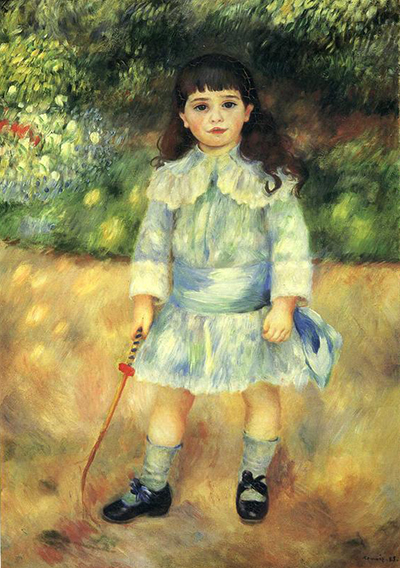
In Child with a Whip, a small child stands on a sunlit garden path and looks straight at us. One hand holds a slender toy whip; the other gathers a fold of the pale blue outfit. Renoir signed and dated the portrait 1885 at the lower right. The painting is in the State Hermitage Museum in Saint Petersburg, under inventory number ГЭ-9006. The Hermitage’s digital collection identifier 28706 [1] and an illustrated collection listing [2] connect the canvas to that inventory number.
The sitter is usually identified as Étienne Goujon, the young son of a French senator. The long hair and ruffled blue smock can prompt a modern viewer to assume the child is a girl. Historical accounts identify the sitter as a boy, while the French title L’Enfant au fouet simply says “child with a whip.” The picture is most rewarding when the sitter’s identity and the actual painting are considered together, without treating present-day clothing expectations as evidence of who posed. Web Gallery of Art entry [3]; Hermitage collection listing. [2]
At a glance
- ArtistPierre-Auguste Renoir
- Common titlesChild with a Whip; Boy with a Whip; L’Enfant au fouet
- Date1885, signed and dated on the canvas
- Medium and sizeOil on canvas, 105 × 75 cm
- CollectionState Hermitage Museum, Saint Petersburg, ГЭ-9006
- SitterUsually identified as young Étienne Goujon
Watch: Pierre-Auguste Renoir
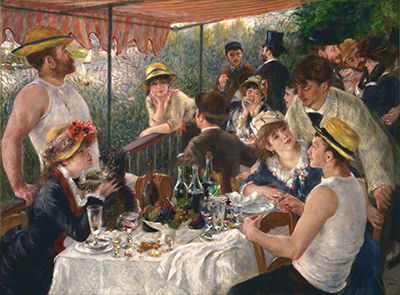
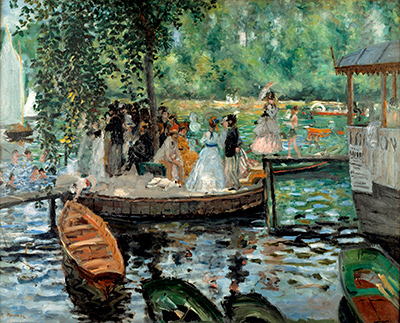
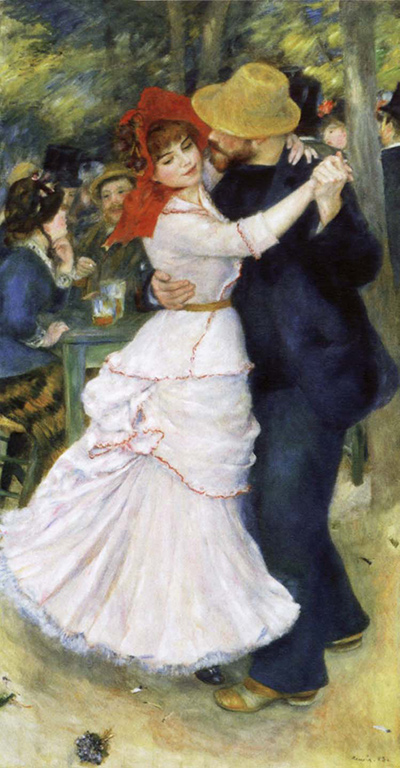
Explore a Montmartre dance, a gathering beside the Seine and the drawings behind Renoir’s paintings.
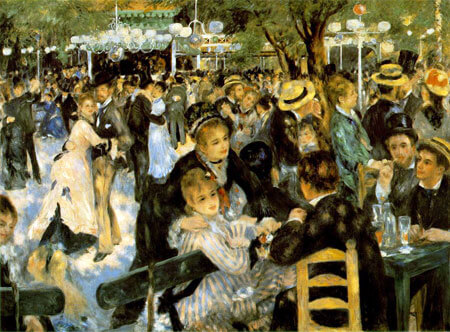
Renoir, Bal du moulin de la Galette
Dr. Beth Harris and Dr. Steven Zucker discuss Renoir’s 1876 Montmartre dance scene, its light and its crowds.
Watch on YouTubeThe English title varies among reproductions. “Child” preserves the neutral wording of the French title; “Boy” reflects the traditional identification of the sitter. The canvas, its 1885 date and its Hermitage inventory number are more reliable ways to recognise this specific work than a translated title alone. The 1973 Federal Register loan checklist for the National Gallery of Art exhibition [4] also lists Child with a Whip as a Hermitage loan.
The child on the garden path
Renoir puts the child close to the picture plane. Dark shoes and blue socks anchor the figure on the broad pale path. The curved line of the whip begins near one hand, passes down beside the knees and almost reaches the bottom edge. Its thin shape introduces motion into an otherwise composed standing portrait. The child’s other hand catches the skirt at one side, making a small, informal counter-gesture.
The face is carefully held together by the dark fringe, level eyes and compact features. The gaze is direct, but the mouth and hands do not act out a dramatic emotion. This restraint gives the sitter a presence distinct from the vigorous painting around them. The blue sash and white collar broaden the body’s middle and shoulders, while the narrow legs and shoes keep the age and scale of the child visible.
Behind the sitter, Renoir lets the garden become a field of short green, yellow, blue and rose marks. A group of light flowers sits to the left, while darker foliage frames the head. The setting suggests a garden and dappled summer light, but the available evidence does not name a particular garden. The child’s head and outfit are more clearly structured than the flowers and path. That difference is part of the portrait’s design: a stable person stands within a shifting atmosphere. Web Gallery of Art interpretation. [3]
A portrait made in 1885
Renoir’s 1885 date matters because the portrait combines two aspects of his work that are sometimes presented too simply as opposites. The visible garden brushwork belongs to his continuing interest in coloured light. The more deliberate drawing of the face points to the firmer treatment of figures he explored during the 1880s. The painting does not require us to choose one label for every part of the canvas: the contrast between figure and surroundings is visible in this one object.
The portrait was a commission, according to the Web Gallery of Art’s object account. [3] Its comparatively large size for an image of a young child, 105 × 75 cm, and the full-length pose give the sitter the formal attention of a family portrait. Yet the toy and outdoor setting keep the child’s age central. Calling the subject a generic “girl in a garden” would lose both the reported Goujon identity and the point of the whip.
Another 1885 child portrait provides a useful comparison. The National Gallery of Art’s Girl with a Hoop [5] depicts a child with a hoop and stick in a similar garden setting. Its ownership record says that Senator Étienne Goujon commissioned it and identifies its sitter through the family provenance. The Hermitage portrait’s sitter is commonly described as a Goujon child too. These paintings can be read as related family commissions, but they are different canvases with different toys, poses, dimensions and later histories. The Washington work is inventory 1963.10.58; the Hermitage work is ГЭ-9006.
From Morozov’s collection to the Hermitage
The documented later history places this portrait in a notable modern-art collection. An illustrated Hermitage collection listing [2] records that Ivan Morozov bought the painting from Ambroise Vollard’s gallery in Paris in 1913. It came to the Hermitage in 1948 from the State Museum of Modern Western Art, after the reorganisation of that museum’s collections. The listing gives the Hermitage number ГЭ-9006. This sequence is specific to the whip portrait and should not be borrowed from Girl with a Hoop, whose National Gallery of Art record follows a different route through the Goujon family and later dealers.
The 1973 federal loan checklist records the Hermitage painting as Child with a Whip, dated 1885, when it was included in an exhibition of works from the Hermitage and Pushkin museums. This helps explain why English-language references may use “Child,” “Boy” or the French Enfant for the same canvas. It also supplies an independently dated public record of the Hermitage attribution. Federal Register loan checklist. [4]
Looking again
Start at the child’s face, then follow the blue sash to the hand and the thin whip. Return through the pale path and the garden flowers to the dark foliage behind the head. Renoir’s picture moves between a composed portrait and the quick play of colour around it. The toy creates an expectation of activity, while the direct gaze holds the moment still.
Renoir artworks directory
Questions about Child with a Whip
The sitter is usually identified as Étienne Goujon, the young son of a French senator. Although the long hair and smock have led to inconsistent English labels, historical accounts describe the sitter as a boy. The French title L’Enfant au fouet is gender-neutral.
Renoir signed and dated it 1885 at the lower right. That year also appears in Hermitage collection and exhibition records.
It belongs to the State Hermitage Museum in Saint Petersburg, inventory ГЭ-9006. A current gallery location should be checked with the museum before visiting.
No. The Washington portrait shows a child holding a hoop. The Hermitage child holds a whip. They are related Goujon family portraits but have separate collection records and histories.
Discussion
What do you notice when you return to Renoir’s portrait of the child on the garden path?
Where do the crisp face and the loosely painted garden meet?
Reader Insights
Where do the crisp face and the loosely painted garden meet?
The Hermitage work is signed 1885, catalogued as ГЭ-9006 and traditionally identified as Étienne Goujon.
How does the whip distinguish this child from the related Girl with a Hoop in Washington?
Join the Conversation
Share a close observation or a source-backed question about the Hermitage portrait.
References
- State Hermitage Museum digital collection, State Hermitage Museum digital collection, object 28706 View source.
- State Hermitage Museum digital collection, illustrated collection listing View source.
- Web Gallery of Art, Child with a Whip: sitter identification, dimensions and interpretive account View source.
- Federal Register, 1973 Hermitage and Pushkin loan checklist: contemporary exhibition evidence for title, date and Hermitage ownership View source.
- National Gallery of Art, Girl with a Hoop: separate Goujon commission, sitter provenance and comparison image View source.
- Wikimedia Commons, exact-object photograph by Hajotthu: 1448 × 2022 independent photograph, marked Public Domain Mark/PD-Art; used for the enlarged local image View source.