by Tom Gurney
Tom Gurney BSc (Hons) is an art history expert with over 20 years experience
Published on June 19, 2020 / Updated on October 2, 2026
Email: tomgurney1@gmail.com / Phone: +44 7429 011000
Three girls share a bright room, but each has a different occupation. One reads on a blue sofa; the smallest faces us with a doll; the eldest sits at the right with sewing in her hands. Renoir painted Children’s Afternoon at Wargemont in 1884 for the family of Paul and Marguerite Bérard, whose Normandy home at Wargemont he often visited. The large oil canvas is now in Berlin’s Alte Nationalgalerie, accession A I 969. Staatliche Museen zu Berlin, object description. [1]
The museum identifies the girls as Marthe (born 1870), Marguerite (born 1874) and Lucie (born 1880). Reading them from the picture’s left to right gives Marguerite with the book, Lucie facing out with the doll, and Marthe sewing. These are not anonymous symbols of childhood; they are members of a family Renoir knew and painted separately over several years. Yet he arranges them with the precision of a composed group portrait, making the room and its patterned objects part of the picture’s meaning. Alte Nationalgalerie catalogue text by Claude Keisch. [1]
At a glance
- ArtistPierre-Auguste Renoir
- Berlin titleDer Nachmittag der Kinder in Wargemont
- English titleChildren’s Afternoon at Wargemont
- Date1884
- MediumOil on canvas
- Size127 × 173 cm
- CollectionAlte Nationalgalerie, Berlin, A I 969
- SittersMarguerite, Lucie and Marthe Bérard, left to right in the painting
Watch: Pierre-Auguste Renoir
Explore a Montmartre dance, a gathering beside the Seine and the drawings behind Renoir’s paintings.
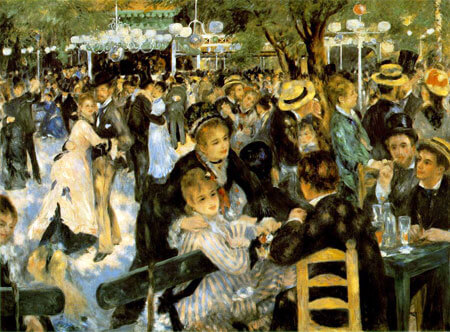
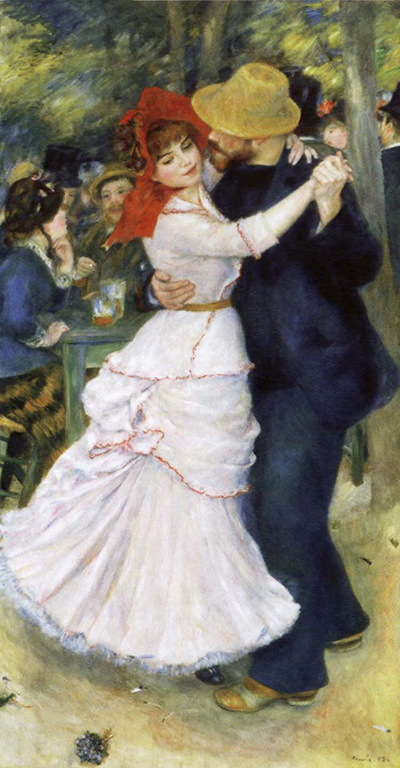
Renoir, Bal du moulin de la Galette
Dr. Beth Harris and Dr. Steven Zucker discuss Renoir’s 1876 Montmartre dance scene, its light and its crowds.
Watch on YouTubeThree activities, one composition
At the left, Marguerite sits deep in a blue sofa and holds open an illustrated book. The museum identifies it as Maurice Boutet de Monvel’s Vieilles Chansons et Rondes pour les Petits Enfants, published in 1883. Renoir has turned its patterned blue cover toward the viewer, so the book is as noticeable as the reader’s lowered gaze. The object tells us what occupies her, while the pose keeps her apart from the other two girls. Berlin object essay. [1]
The youngest, Lucie, holds a doll and looks directly out of the picture. The museum contrasts her conscious pose with the two older girls’ absorption in reading and sewing. She forms a link between us and the household scene. At the right, Marthe bends over needlework, her pale dress speckled with warm marks. Her profile and lowered eyes turn inwards again. Renoir has set profile, frontal view and three-quarter view beside each other rather than leaving the children to an unplanned moment. Berlin catalogue description. [1]
The doll makes a small group of its own with Lucie and Marthe on the right. Across the canvas, the blue sofa and book balance that warmer area. The arrangement is a portrait of particular girls, but it also resembles a genre scene about an afternoon at home. The Berlin text makes precisely this point: portraiture and the conventions of a domestic scene meet in the same painting. This is why the title names an afternoon while the museum’s account names the sitters. Berlin object essay. [1]
What the room contributes
The Bérard children sit among lightweight furniture, curtains, a vase of flowers, textiles and a glimpse of light at the window. Renoir does not need to show the whole house. The carefully chosen objects place the children in a cultivated domestic setting, where reading, sewing and a doll mark different ages and activities. The furniture and patterned surfaces also give him a way to separate the figures without dividing the canvas into three isolated portraits. Alte Nationalgalerie catalogue text. [1]
Colour performs that division. Much of the left is cool blue and green: sofa, book, skirt and wall. The right gathers more red and variegated colour in Marthe’s dress, the drapery and the vase. White accents link the two halves. The Berlin curator describes the many small patterns as a mosaic-like surface and relates their decorative effect to Japanese woodcuts familiar in the period. That comparison is about how the painting is organised; it does not identify a particular print copied into the room. Berlin object essay. [1]
The painting rewards a look at edges. The curve of the sofa carries the eye down Marguerite’s side, while the table and doll pull attention back toward the central figures. The bright window and curtain make a frame within the larger canvas. The children seem quiet, but Renoir has placed colour and contour in a way that keeps the gaze moving across them. None of this requires inventing a conversation between the sisters; the visible book, doll and sewing already give the afternoon enough specificity.
Renoir and the Bérard family
Renoir met Paul and Marguerite Bérard in 1879, according to the Berlin museum. Paul was a banker and diplomat; the family’s inherited Wargemont property stood near Dieppe on the Normandy coast. Renoir visited their Paris house and Wargemont, painting portraits, landscapes and still lifes for them. The girls’ group portrait grew from that sustained relationship, which continued until Marguerite Bérard’s death in 1901. Alte Nationalgalerie catalogue essay. [1]
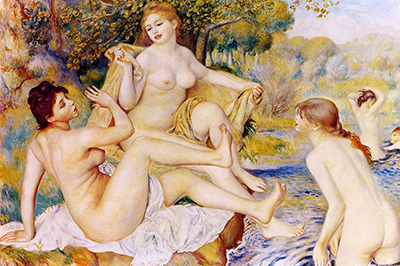
The museum sets this commission within Renoir’s growing access to prosperous portrait patrons after the success of Madame Georges Charpentier and Her Children. It also contrasts the modern domestic setting here with his work toward the large classical Bathers canvas completed in 1887. These were overlapping concerns in the mid-1880s, not a clean switch from one kind of painting to another. Wargemont allowed him to make a carefully organised modern portrait while he also pursued more timeless figure compositions. Berlin object essay. [1]
The route to Berlin
Berlin lists Paul Bérard as the painting’s owner until 1905. It then records Paris dealer entries involving Bernheim-Jeune and Josse Hessel, followed by Paul Cassirer in Berlin and a purchase arranged by Hugo von Tschudi for the Nationalgalerie on 24 June 1905. The museum records the acquisition as a 1906 gift from banker Karl Hagen. The database’s intermediate dealer entries contain compact date codes, so this page uses the clear dated events without pretending to resolve every transaction between them. Alte Nationalgalerie provenance. [1]
Looking again
Begin with the book on the blue sofa, move to Lucie’s face and doll, then follow Marthe’s downward gaze to her sewing. Return through the bright patterned room. Renoir offers three separate activities while giving the sisters one shared place; that balance makes the canvas both a family portrait and a scene of childhood.
Renoir artworks directory
Questions about Children’s Afternoon at Wargemont
They are the Bérard sisters: Marguerite reading at left, Lucie with a doll in the middle, and Marthe sewing at right, as identified by the Berlin museum.
The Alte Nationalgalerie identifies her book as Maurice Boutet de Monvel’s Vieilles Chansons et Rondes pour les Petits Enfants of 1883.
No. Berlin dates A I 969 to 1884. Some reused image metadata gives a different year; the current owner record controls the date here.
The canvas measures 127 × 173 cm, according to the Alte Nationalgalerie.
Discussion
What do you notice when you return to Children's Afternoon at Wargemont?
How do the three sisters’ activities connect across the room?
Reader Insights
How do the three sisters’ activities connect across the room?
Berlin names Marguerite reading, Lucie holding a doll and Marthe sewing in its 1884 canvas.
Which blue and red patterns help hold the group together?
Join the Conversation
Share a close observation or a source-backed question about Renoir’s Children's Afternoon at Wargemont.
References
- Claude Keisch, Staatliche Museen zu Berlin, Der Nachmittag der Kinder in Wargemont, A I 969. Object, sitters, book, composition and provenance View source.
- Whole-work image: Google Art Project reproduction on Wikimedia Commons, Public Domain Mark, resized and recompressed under the established site filename. The museum’s own record also marks its supplied image Public Domain Mark 1.0 View source.