


 by Tom Gurney
Tom Gurney BSc (Hons) is an art history expert with over 20 years experience
Published on June 19, 2020 / Updated on October 2, 2026
Email: tomgurney1@gmail.com / Phone: +44 7429 011000
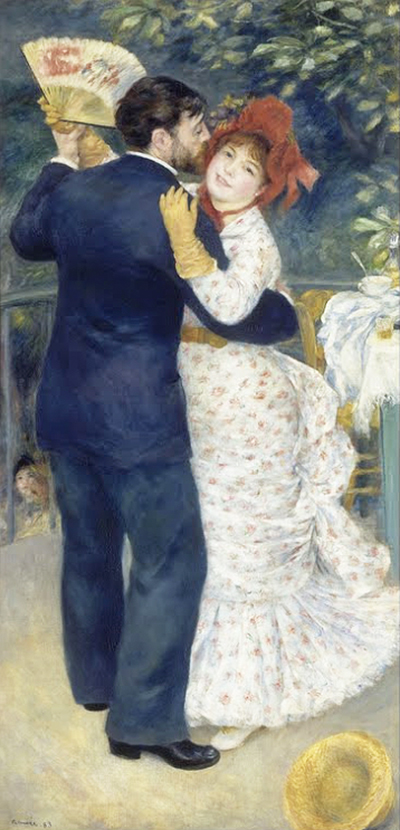
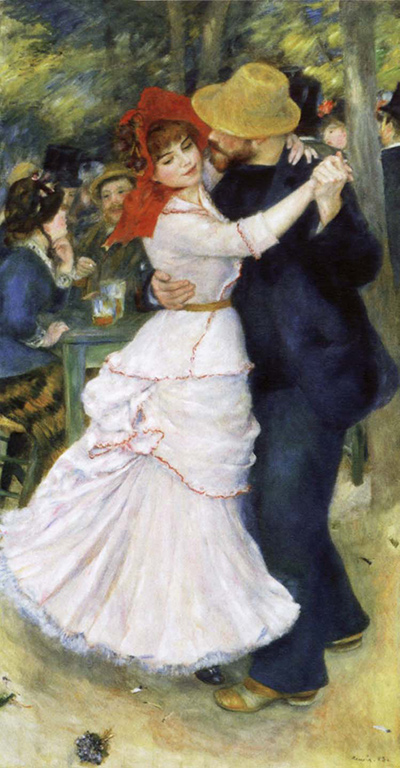
A smiling woman turns toward us as she dances with a man whose back is partly visible. A table has been left in disorder; a hat lies on the ground. Pierre-Auguste Renoir's Dance in the Country (Danse à la campagne) makes an outdoor gathering feel briefly interrupted by a waltz. It is a large 1883 oil painting in the Musée d'Orsay, Paris, accession RF 1979 64. Musée d'Orsay object record. [1]
This is the canvas that belongs at the site's /dance-in-the-country/ route. It is distinct from Renoir's Dance in the City at Orsay, the Boston Dance at Bougival, and later Renoir prints with similar dance titles. The exact object and medium matter when comparing the three paintings. Orsay paired-work essay [2]; MFA Boston trilogy exhibition. [3]
At a glance
- ArtistPierre-Auguste Renoir
- Holder titleDanse à la campagne; English Dance in the Country
- Date1883, signed and dated at lower right
- MediumOil on canvas
- Dimensions180.3 × 90 cm
- CollectionMusée d'Orsay, Paris, RF 1979 64
This work in Renoir’s career
La Grenouillère
1869La Loge
1874The Umbrellas
c. 1881–86The Great Bathers
1884–87The Bathers
1918–19Contents
- Annotated details of the painting
- The couple and the interrupted table
- Fan, flowers and a path through the canvas
- Aline Charigot and Paul Lhote
- Drawings before the large painting
- One of three 1883 dances
- Exhibitions, ownership and the name L'Été
- Looking again
Annotated Details from Dance in the Country
The dancers turn away from a laid table; the fallen hat draws the eye to the ground.
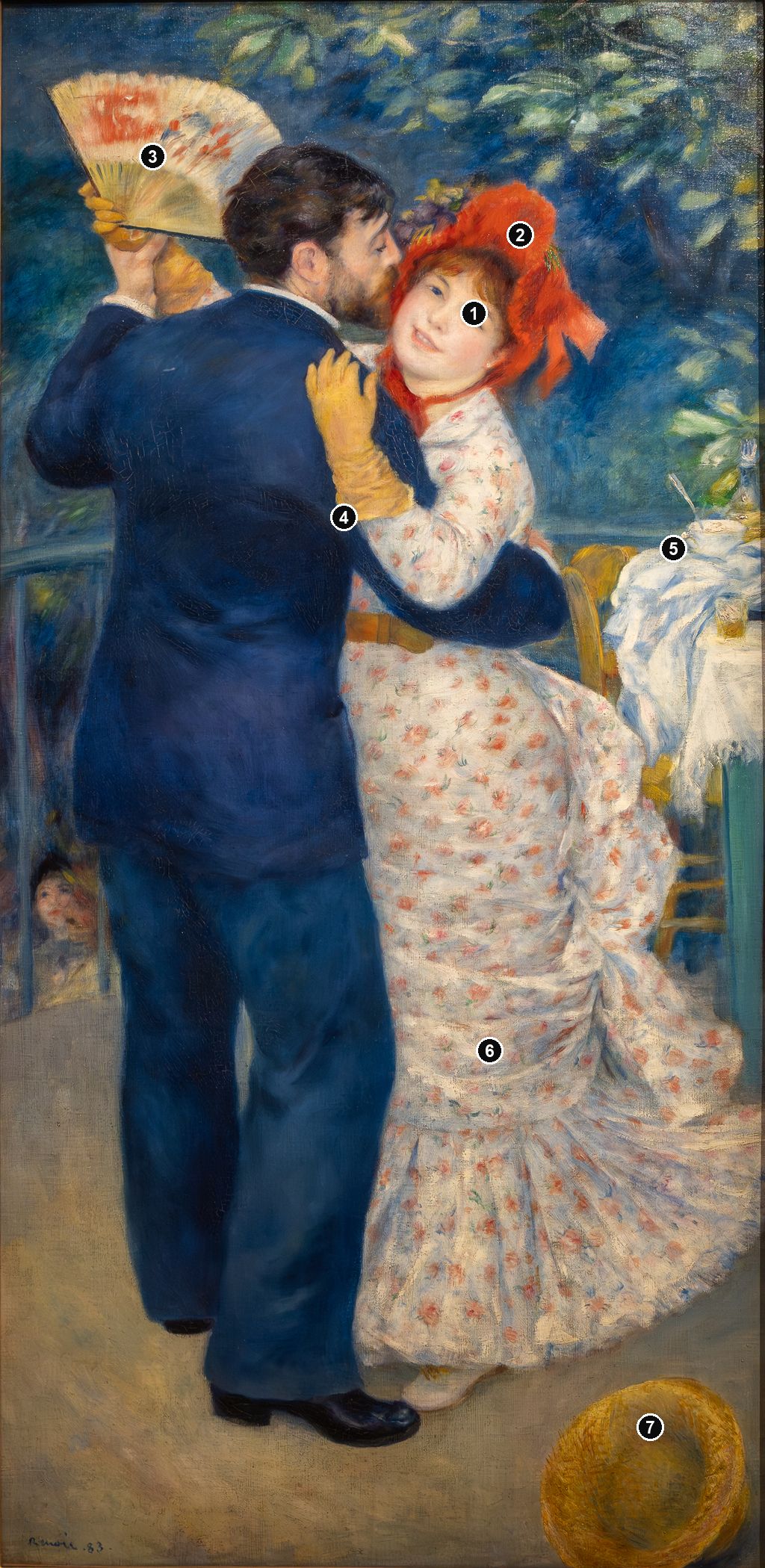
Details from DANCE IN THE COUNTRY
The museum identifies Aline Charigot and Paul Lhote as models; the picture is a composed scene, not a documented moment.
The woman’s face
The smiling face turns toward the viewer as the couple circles.
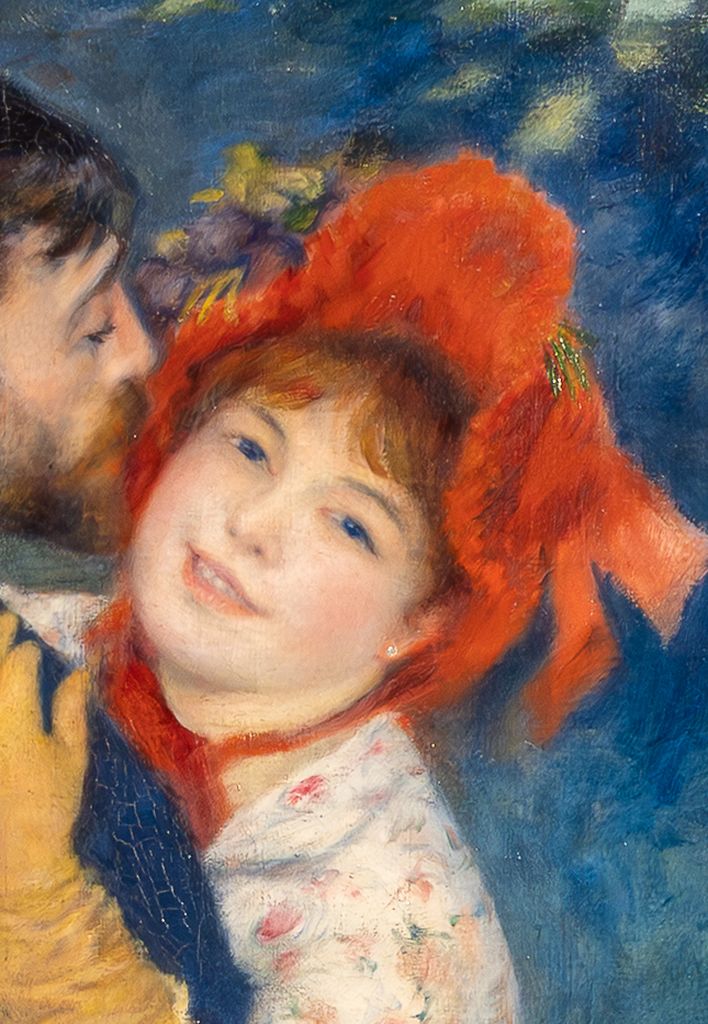
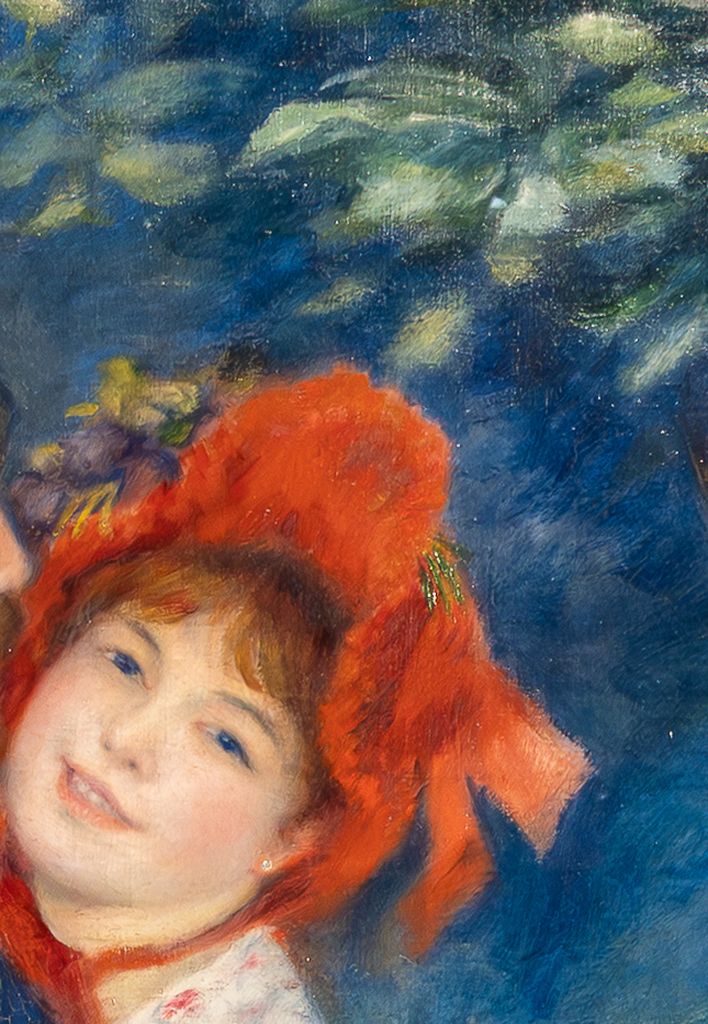
Red hat
A bright red hat marks the woman’s head against blue-green foliage.
Raised fan
A fan rises over the man’s shoulder, adding a second curved shape to the turn.
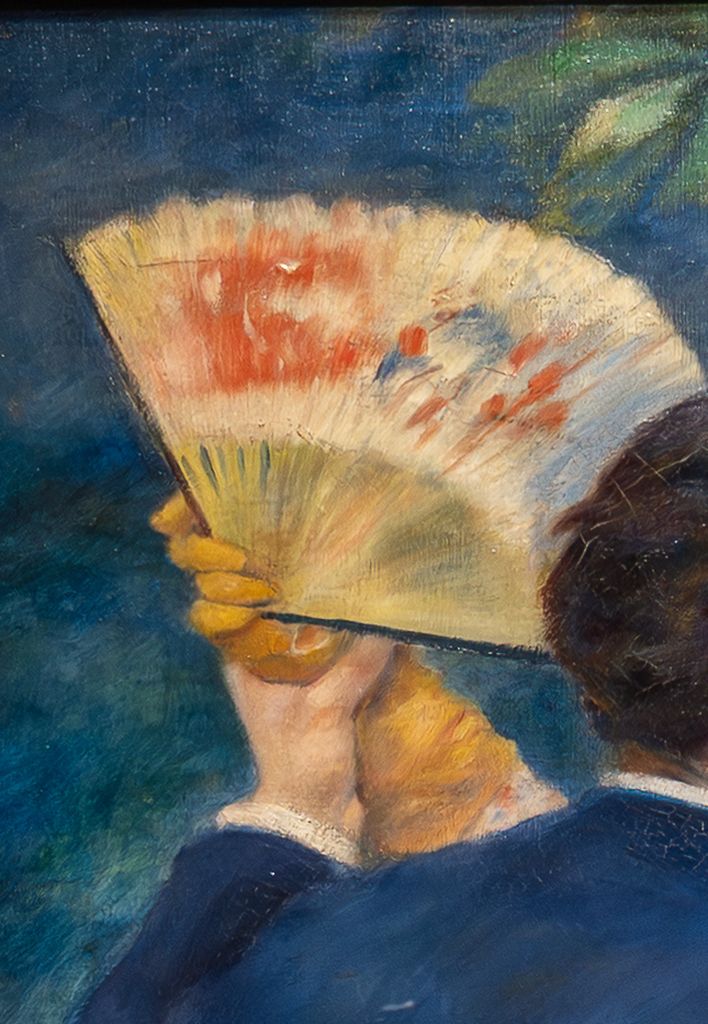
Couple’s embrace
His dark coat and her printed dress interlock at the centre.
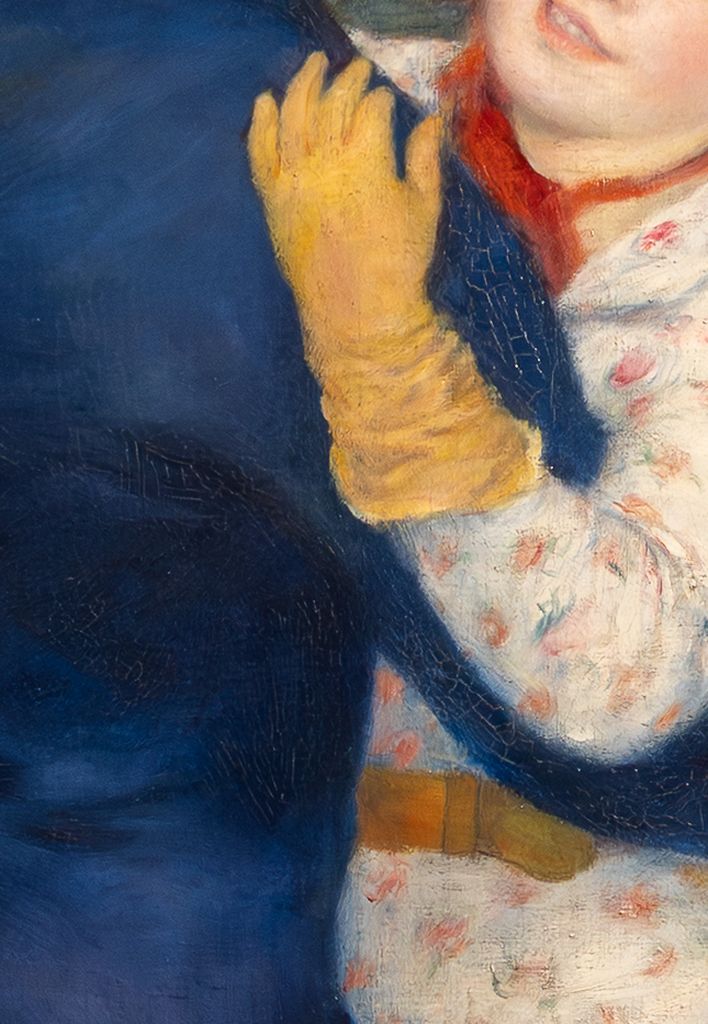
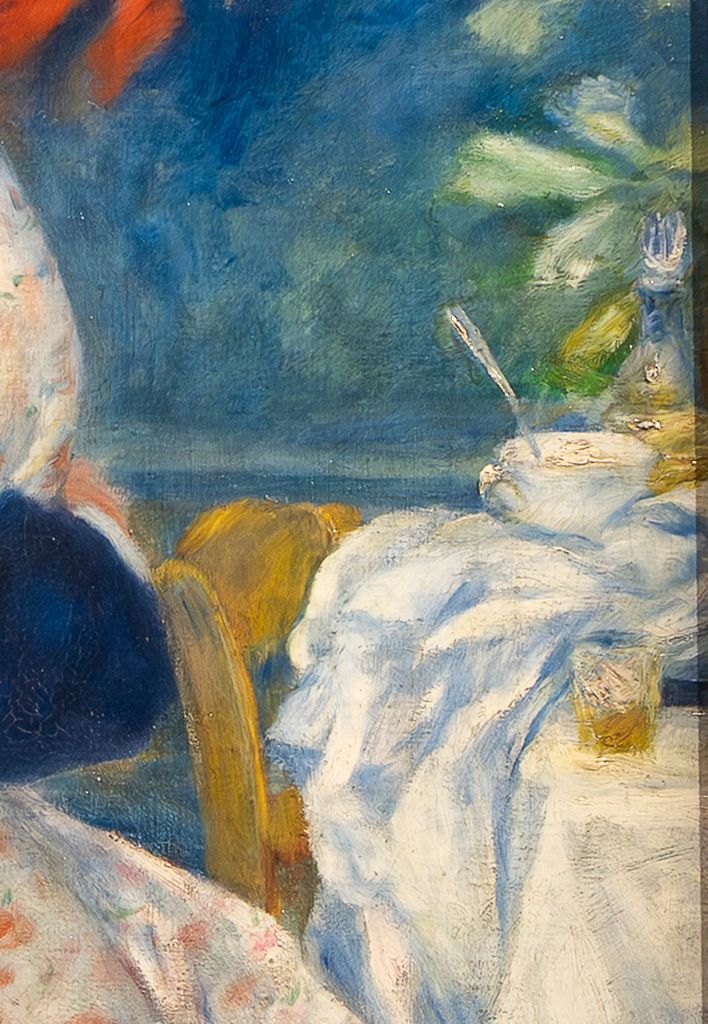
Table left behind
The cloth and tableware suggest an interrupted outdoor meal.
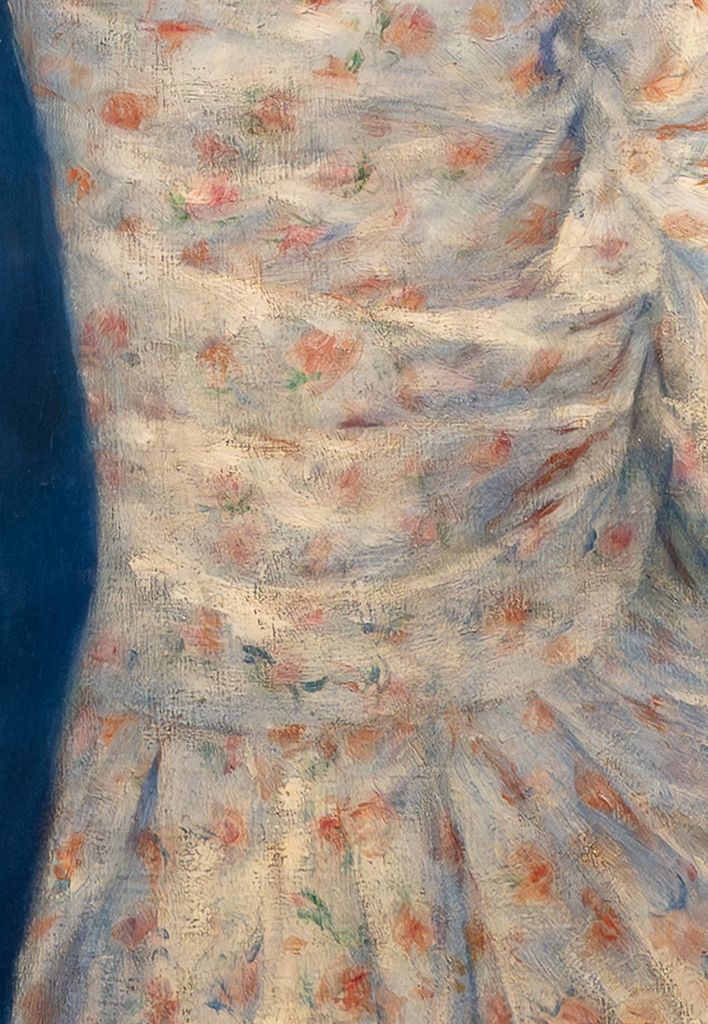
Printed dress
Small warm motifs repeat through the woman’s turning skirt.
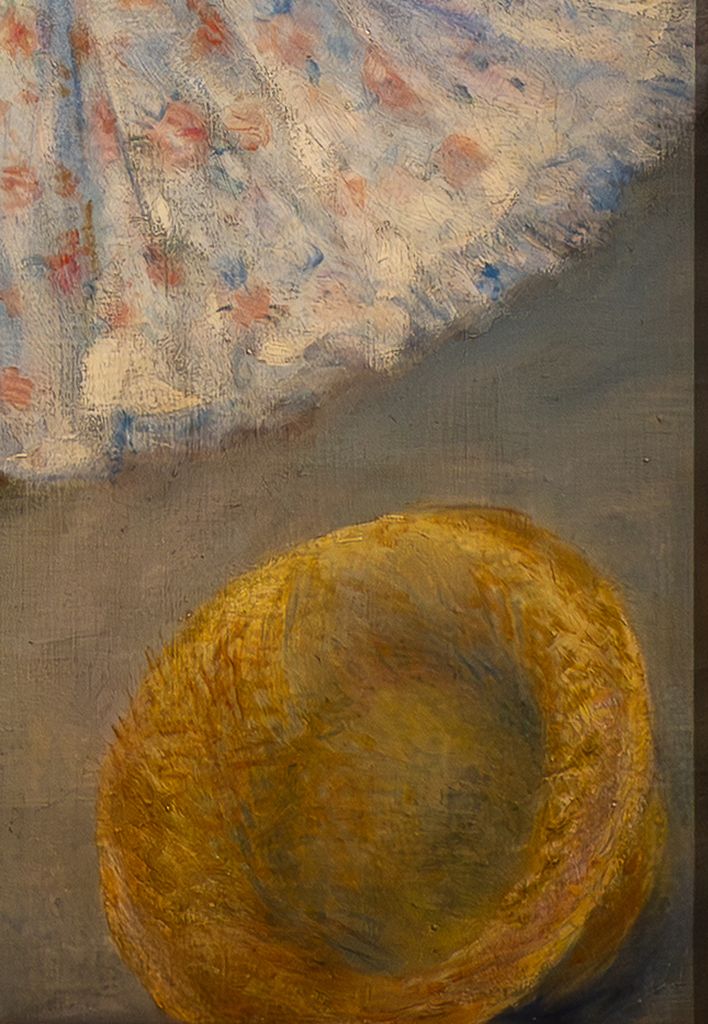
Fallen straw hat
The hat in the foreground makes the dance seem to have begun suddenly.
Watch: Pierre-Auguste Renoir
Explore a Montmartre dance, a gathering beside the Seine and the drawings behind Renoir’s paintings.
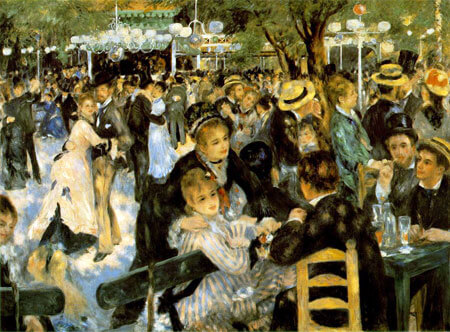
Renoir, Bal du moulin de la Galette
Dr. Beth Harris and Dr. Steven Zucker discuss Renoir’s 1876 Montmartre dance scene, its light and its crowds.
Watch on YouTubeRenoir artworks directory
The couple and the interrupted table
The woman's face is open and visible while the man turns her through the dance. Her printed dress and his dark jacket dominate the upright canvas. Their bodies form a compact knot above her spreading skirt; the surrounding outdoor setting lets that movement feel freer than the formal salon in Dance in the City. Orsay's essay describes the country pair as cheerful and expansive beside the urban dancers' restrained elegance. That contrast is a reading of the two works, grounded in their settings and poses, rather than evidence about the models' private moods. Orsay paired-work essay. [2]
A table stands behind them with a cloth, glassware and small objects. Orsay asks whether the dancers have just left it in a hurry, a suggestion strengthened by the fallen hat in the foreground. These details create a before and after beyond the single turn we see. Yet they do not prove a real event Renoir witnessed. They are staged cues that make the scene easy to imagine. Orsay essay [2]; Frick study. [4]
The hat also keeps the lower part of the picture active. It pulls the eye from faces and hands down to the ground, then back through the woman's skirt. The broad fabric does not simply decorate the figure: it is the visual record of the turning body. In the trees and outdoor background, less definite marks suggest atmosphere around the couple. The central pair has firmer contours, giving an impression of spontaneity through a carefully organised design.
Fan, flowers and a path through the canvas
The woman's bright red hat and face draw the eye first. Her gloved hand rests on the man's shoulder, making a light shape against his dark jacket. Follow his raised arm and an open fan appears above them. The fan is a small object, yet its spread echoes the movement of the dress below. Renoir gives the viewer two arcs, one near the top and one near the bottom, to make a turn feel larger than the dancers' joined bodies.
Their clothing sets up the main colour contrast. The man's blue-black coat is broad and relatively plain. Her pale dress is patterned with small warm flowers. As the skirt opens towards the lower right, those marks repeat across the fabric without becoming a rigid grid. The red hat and orange glove punctuate the field. This distribution of dark mass, pale patterned cloth and bright accents keeps the couple distinct from the cool greens and blues behind them.
The right edge of the picture interrupts this large movement with the table and chair. A white cloth, glass and other small objects suggest a meal or drink nearby. Farther down, the fallen straw hat takes the viewer to the ground. There is also a small figure glimpsed at the far left behind the man's legs. The main pair still command the scene, but these peripheral signs make their dance part of a larger social space rather than an abstract exercise in turning bodies.
Aline Charigot and Paul Lhote
Orsay identifies Aline Charigot as the model for the woman. Charigot was Renoir's partner and later wife. The Frick Collection's 2012 study identifies Paul Lhote, a journalist in Renoir's circle, as the male model, and notes that he also posed for the city dancer. The names describe models used by an artist, not a verified account of Charigot and Lhote actually dancing at an outdoor restaurant. Orsay object essay [2]; Frick study. [4]
The distinction is useful because Renoir revised and re-used human types across the 1883 dance project. A technical study of the Boston Bougival picture even found an earlier female figure under its visible dancer. Recognising posed and revised figures makes the three dances more ambitious than a set of anecdotal snapshots. Frick study. [4]
Drawings before the large painting
Renoir did not arrive at the country composition without preparation. Orsay identifies a black-pencil Study for Dance in the Country [5], RF 31717, made in 1883. The museum's 2026 drawing exhibition says the country dance was the first large painting for which Renoir prepared a substantial body of drawn studies. A related drawing is held by the National Gallery of Art, Washington [6], accession 1995.47.65. Each drawing is a separate object, not a second oil version of the Orsay painting. Orsay drawing exhibition. [7]
This preparation helps explain the canvas's combination of energy and control. A turning pair creates a complex overlap of limbs, dress and table. Drawings let Renoir test the placement before committing it to a work almost as tall as a person. The finished image can feel as if the dancers have just stepped from the table precisely because the painter organised their movement.
The National Gallery of Art holds another distinct work titled Dance in the Country, an 1883 pen-and-brush drawing with grey ink (1995.47.65). It is a full composition, not the Orsay black-pencil sheet. The NGA drawing shows the couple, fan, outdoor table and fallen hat together. Its dark marks make the man's back a strong central shape; the patterned dress and woman's outward-looking face pull against it. The painting carries that contrast into colour and a much larger format. National Gallery of Art object record and open-access image. [6]
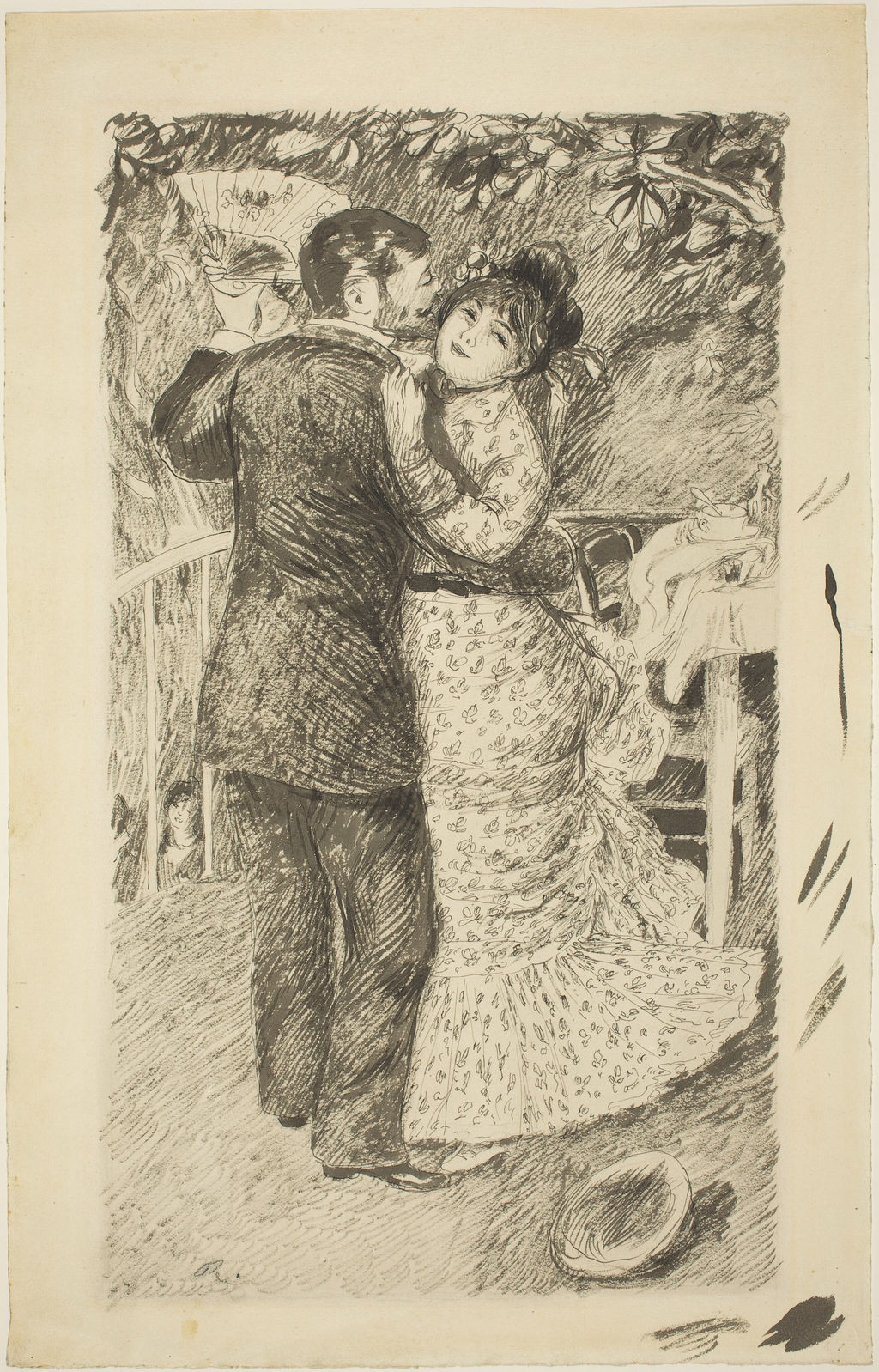
Look particularly at the drawing's fan and table. Renoir has set down their places in rapid dark and pale passages, while the final canvas makes the fan a bright upper accent and lets white tablecloth and coloured dress separate more gently. The drawing does not by itself tell us the exact order of every study or prove that the painting was copied line for line from this sheet. It shows the artist exploring how a posed couple and a few surrounding objects could convey a whole outdoor occasion. The smaller scale also makes the finished canvas's nearly life-size figures more striking.
The two surviving sheets also have different collection histories. Orsay traces its black-pencil study from Renoir to the dealer Auguste Portier and later collectors; it entered the French national collections through a 1966 bequest. The National Gallery of Art traces the larger ink composition through Ambroise Vollard, Norton Simon and the Mellons before their 1995 gift. These records secure the identities of two separate drawings without establishing the exact sequence in which Renoir made them. Orsay, RF 31717 provenance [5]; NGA, 1995.47.65 provenance. [6]
One of three 1883 dances
Orsay calls the country and city canvases pendants: matching formats whose nearly life-size dancers embody distinct social settings. The country scene uses warmer colour and a wider sense of outdoor freedom; the city scene is cooler, more contained. The Musée d'Orsay notes a comparable turning motion across both works, almost as though they capture two phases of a dance. That is an artistic relationship between panels, not a claim that they show one continuous encounter. Orsay paired-work essay. [2]
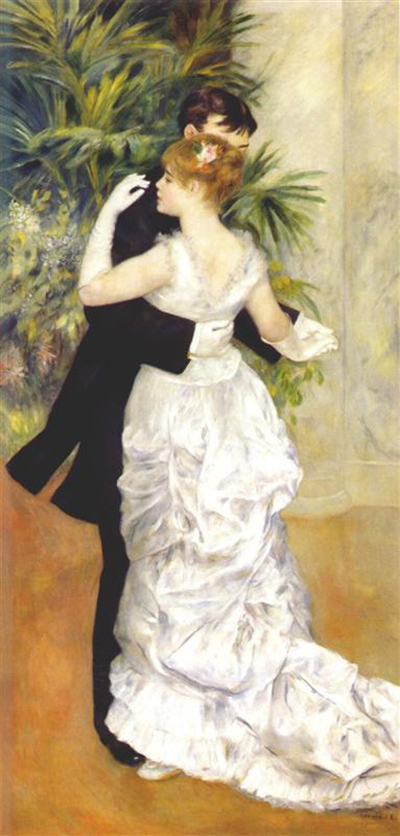
Side by side, the two Orsay paintings make their shared scale and different viewing distance evident. The city dancer's back and pale satin dress face a quiet stone interior; the country dancer meets our gaze while her patterned skirt opens into the terrace space. Both men create dark shapes around which the pale fabric turns. The country canvas adds the fan, table and dropped hat, drawing the eye out from the couple before returning it to their faces. Neither picture documents an actual event; each selects a few details to create a distinct social rhythm.
The Boston Dance at Bougival was also made in 1883. It is another large, dancing pair, placed in a more populated café scene. The three paintings can be compared for setting, fashion and figure modelling, but the Orsay country panel has its own identity, accession and history. It should not be illustrated with a Bougival reproduction simply because both are dancing couples. MFA trilogy exhibition [3]; Frick study. [4]
Exhibitions, ownership and the name L'Été
The Orsay record places the country painting in Renoir's 1883 exhibition at Durand-Ruel, catalogue no. 25. It was with the dealer from that year, and he owned it by 1886. At the Salon des XX in Brussels, 6 February–14 March 1886, it appeared under the seasonal designation L'Été (“Summer”), paired in the records with the city painting as L'Hiver. These names express the contrast between warm outdoor dance and cool interior, but do not establish an additional summer canvas. Orsay exhibitions and provenance. [1]
The Frick dates Renoir’s intensive studio work on the three dance pictures to January–March 1883. It identifies the city and country canvases as the pair included in Durand-Ruel’s Paris retrospective when it opened on 31 March. Boston’s Dance at Bougival was probably completed last and was sent to a separate Durand-Ruel exhibition in London. The three belong to the same ambitious figure-painting campaign, but the first display of the two Orsay pendants should not be mistaken for a Paris display of all three works. Frick 1883 chronology. [8]
They did appear together later. The Philadelphia Museum of Art identifies all three large dances in Durand-Ruel's 1886 exhibition at New York's National Academy of Design. For Dance in the Country, that was a new setting in which the summer-like restaurant scene could be seen beside the cool city interior and the crowded Bougival café. This later grouping belongs to their exhibition history, not to Renoir's first arrangement of the Orsay pair; it also should not be confused with the seasonal L'Été title recorded for the Brussels show that year. Philadelphia Museum of Art, Discovering the Impressionists. [9]
The museum records a later private collection in Paris. The French national museums purchased the work in 1979 for the Jeu de Paume; it was assigned to the Musée d'Orsay in 1986. That is a different state acquisition route from Dance in the City, which entered in 1978 as a dation. The distinction is small but reinforces that the two pendants had separate ownership paths before meeting again at Orsay. Orsay provenance. [1]
Looking again
Begin with the woman's smile, then follow the man's shoulder into their linked movement. Let the skirt guide you downward to the fallen hat. Return along the table edge to the couple. The objects around them imply a social visit interrupted by dancing, while the drawings and matching city panel reveal the planning behind the apparent ease.
Questions about Dance in the Country
Renoir signed and dated the oil canvas 1883. It measures 180.3 × 90 cm according to the Musée d'Orsay.
The woman is modelled on Aline Charigot, according to Orsay. The Frick identifies Paul Lhote as the male model. These are model attributions, not proof of a real dance between them.
No. The Boston Bougival work is a different 1883 canvas. Orsay's Dance in the Country is RF 1979 64.
In the Musée d'Orsay, Paris. Consult the museum's current record before visiting because display status changes.
Discussion
Look closely at Dance in the Country and use the questions below to compare what you see with the documented history.
Reader Insights
Where does the woman’s expression redirect the dance?
The Orsay country pendant has its own models and composition.
How does knowing the three related paintings change the single work?
Join the Conversation
Share a close observation or a source-backed question about Dance in the Country. The prompts above are starting points for discussion.
References
- Musée d'Orsay, Danse à la campagne , RF 1979 64 View source.
- Musée d'Orsay, Danse à la ville essay View source.
- Museum of Fine Arts, Boston, three-dance exhibition account View source.
- The Frick Collection, Renoir, Impressionism, and Full-Length Painting, 2012, pp. 5–6 View source.
- Musée d'Orsay, Study for Dance in the Country View source.
National Gallery of Art, Dance in the Country, 1995.47.65, related 1883 ink drawing and public-domain media.
View source.- Musée d'Orsay, 2026 drawing exhibition View source.
- The Frick Collection, 1883 dance-picture chronology, studio sequence and distinct Paris and London displays View source.
- Philadelphia Museum of Art, Discovering the Impressionists, on the three dances exhibited in New York in 1886 View source.
Whole-work reproduction: Wuselig’s cropped photograph on Wikimedia Commons, CC0; not the Orsay/RMN website image.
View source.
-WUS07474_(cropped).jpg)