 by Tom Gurney
Tom Gurney BSc (Hons) is an art history expert with over 20 years experience
Published on June 19, 2020 / Updated on October 2, 2026
Email: tomgurney1@gmail.com / Phone: +44 7429 011000
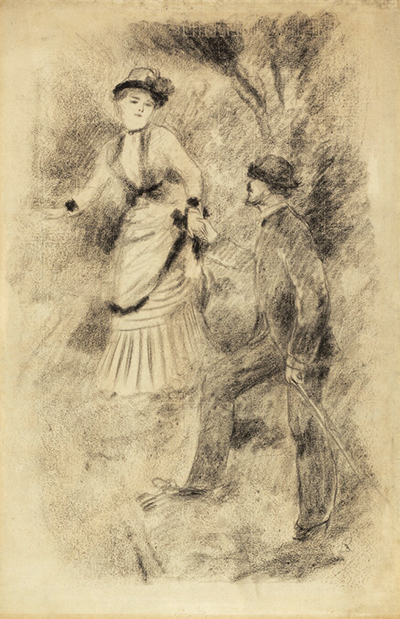
On a steep path, a woman in a long dress and brimmed hat reaches towards a man standing just below her. Their hands meet at the centre of Renoir’s black chalk drawing. Trees and shadowed ground surround them. The scene is not a record of two identifiable tourists: Hélène and Jean Martin are characters in L’étiquette, a short story by Renoir’s brother Edmond. The drawing, The Descent from the Summit: Jean Martin Steadies Hélène, the Banker’s Daughter, is in the Art Institute of Chicago as 1969.870R. Art Institute scholarly catalogue, cats. 12–13 [1]; object and technical record, cat. 13. [2]
The owner dates the front of the sheet to 1881, while the illustrated story appeared in La Vie moderne in December 1883. Other museums have labelled the drawing 1883, matching the publication year. These dates should not be silently flattened into a single event. The drawing and the printed illustration also differ: the Art Institute says a more sharply delineated version in a private collection was ultimately reproduced. Art Institute pair essay [1]; Morgan Library exhibition label. [3]
At a glance
- ArtistPierre-Auguste Renoir
- Art Institute titleThe Descent from the Summit: Jean Martin Steadies Hélène, the Banker’s Daughter
- FunctionIllustration study for Edmond Renoir’s L’étiquette
- Date1881 in the Art Institute catalogue; story printed 1883
- MediumBlack chalk on ivory laid paper, now discoloured to tan
- Size49.2 × 31.9 cm
- CollectionArt Institute of Chicago, 1969.870R; a faint woman’s sketch appears on verso 1969.870V
Watch: Pierre-Auguste Renoir
Explore a Montmartre dance, a gathering beside the Seine and the drawings behind Renoir’s paintings.
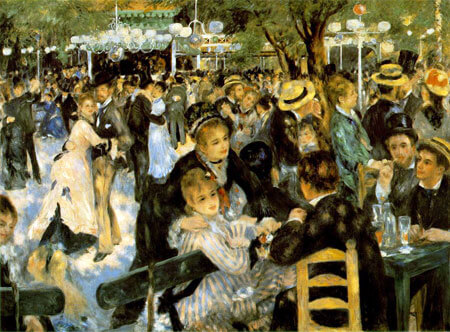
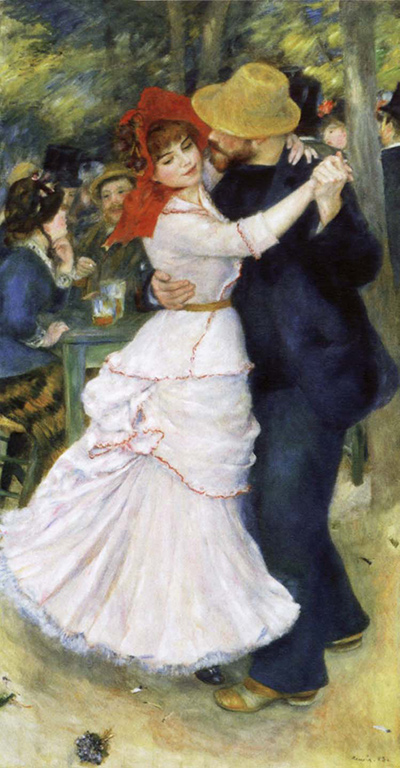
Renoir, Bal du moulin de la Galette
Dr. Beth Harris and Dr. Steven Zucker discuss Renoir’s 1876 Montmartre dance scene, its light and its crowds.
Watch on YouTubeAn illustrated turning point
Edmond Renoir’s story follows the painter Jean Martin, who is mistaken for a prince while travelling on the French Riviera. He falls in love with Hélène, a banker’s daughter whose father values social rank. During an excursion, the party descends from a summit on foot. In the story’s published text, Hélène stumbles when a stone shifts under her foot; Jean catches her, and their hands stay clasped. The episode brings their feelings into a small physical gesture. Musée d’Orsay’s transcription and contextual presentation of L’étiquette. [4]
Renoir makes that meeting legible by placing the hands near the drawing’s centre. The woman occupies most of the left side, with her light dress broken by dark accents at hat, cuffs and waist. Jean, smaller and lower, looks towards her from the right. Their bodies make an angled line that echoes the descent implied by the title. Even without the story, a viewer can read a moment of offered support. With the story, the touch becomes part of a romance complicated by class and mistaken identity. Art Institute catalogue essay. [1]
The Art Institute compares the scene with Renoir’s earlier La Promenade, now at the Getty. It suggests Renoir reversed the placement of the figures, with the woman apparently taking a more active lead here. That is a comparison of visual organisation, not proof that the two works tell the same story. La Promenade is an independent 1870 painting; this sheet was designed to accompany a specific magazine narrative. Art Institute comparison [1]; Getty, La Promenade, 89.PA.41. [5]
Black chalk doing different jobs
The drawing has a broad range of marks. Thick chalk lines establish the figures; finer ones describe their faces and linked hands; denser strokes darken ribbons, cuffs and hatbands. The Art Institute’s technical report identifies these different weights of line and says Renoir left some of the light paper exposed to create highlights. The shaded setting holds the couple without requiring a detailed map of the path. Art Institute technical report. [2]
Under magnification, the museum thinks Renoir probably used chalk of different hardness: harder chalk for delicate features and softer chalk for broader clothing accents. It found no evidence of erasure or smudged blending. These are observations about the material now on the page; they do not establish every order in which Renoir laid down the strokes. The visible changes in line are enough to show how he guides a reader’s eye to the central exchange of hands. Art Institute technical analysis. [2]
The paper itself has a history. The Art Institute describes it as ivory laid paper, darkened to tan by light exposure and possibly an acidic old mount. It records an L. Berville watermark, deckle edges at top, right and bottom, and a torn left side. The verso carries a faint half-length woman’s sketch; the owner catalogues that side separately as 1969.870V and dates it about 1883. A page showing only the front should not imply that the reverse is blank. Art Institute support and verso report. [2]
Two drawings for L’étiquette
The Art Institute owns another illustration for the story, On the Terrace of a Hotel in Bordighera: The Painter Jean Martin Reviews His Bill, accession 1977.491. That sheet introduces Jean as he examines a surprising hotel charge. The descent scene belongs later in the narrative, after he meets Hélène. Reading the two in sequence reveals how Renoir moved from a portrait of the male protagonist to a scene in which the two characters act together. Both Art Institute records use 1881 for the drawings. Art Institute paired catalogue. [1]
The first instalment of L’étiquette appeared in La Vie moderne on 15 December 1883; the next, containing the descent episode, appeared on 29 December 1883. The magazine was backed initially by Georges and Marguerite Charpentier, patrons of Renoir. The illustrated story therefore connects family collaboration, publishing and Renoir’s artistic circle. It does not make every figure in the fiction a literal portrait. Art Institute essay and notes 94, 104 [1]; Musée d’Orsay story presentation. [4]
There is a real chronology question. The Art Institute catalogue dates the studies to Renoir and Edmond’s 1881 southern journey, but the Morgan’s later exhibition label and a 2026 Orsay programme call the descent sheet 1883. Neither label changes the dated 1883 publication. For the object date, this page uses the owner’s current 1881 catalogue while reporting the alternative. A fuller account would need the original paper trail for the sheets and journal commission. Art Institute catalogue [1]; Morgan label [3]; Musée d’Orsay discussion. [6]
Later ownership
The Art Institute lists Ambroise Vollard as a possible early owner, not a proven one. By 1949 the sheet was in the hands of New York dealers and then T. Edward Hanley. It passed through E. V. Thaw and Company to Benjamin E. Bensinger in 1967; Mr and Mrs Bensinger gave it to the Art Institute in 1969. The catalogue cites surviving dealer records for the 1949 transactions and notes the qualification for Vollard. Art Institute provenance. [2]
Looking again
Begin where the two hands meet. Follow Jean’s arm down to his smaller figure, then return through Hélène’s lighter dress to her face. Notice how the chalk grows broader in the trees and clothing, but finer around their contact. The drawing can be enjoyed as a poised encounter; the magazine story makes that encounter a turning point in Edmond’s comedy of class and affection.
Renoir artworks directory
Questions about The Descent from the Summit
It is a black chalk illustration study for Edmond Renoir’s fictional L’étiquette. Jean Martin and Hélène are characters in that story.
The Art Institute says a second, more sharply outlined version, now in a private collection, was ultimately reproduced. This Chicago sheet belongs to the illustration process.
The Art Institute dates the drawing 1881; the story was published in 1883. The Morgan and a later Orsay programme label the sheet 1883. The discrepancy remains documented.
A faint half-length sketch of a woman appears on the reverse, catalogued by the Art Institute as 1969.870V.
Discussion
What do you notice when you return to The Descent from the Summit - Jean Martin Steadies Helene, the Banker's Daughter?
How do the two figures’ joined hands direct your eye across the sloping path?
Reader Insights
How do the two figures’ joined hands direct your eye across the sloping path?
The Art Institute dates the drawing 1881, while the illustrated story was published in 1883.
What does the story reveal about the gesture that the drawing alone cannot tell us?
Join the Conversation
Share a close observation or a source-backed question about Renoir’s The Descent from the Summit - Jean Martin Steadies Helene, the Banker's Daughter.
References
- Nancy Ireson, Art Institute of Chicago, paired catalogue essay on illustrations for L’étiquette. Story context, pair, publication and comparison with La Promenade View source.
- Art Institute of Chicago, cat. 13, object and technical report. Medium, paper, marks, verso and provenance View source.
- Musée d’Orsay, Morgan Library exhibition label View source.
- Musée d’Orsay, Musée d’Orsay, L’étiquette presentation with primary story text View source.
- Getty, La Promenade , 89.PA.41 View source.
- Musée d’Orsay discussion View source.
- Whole-work image, Art Institute Open Access record 113794 View source.
- Whole-work image, official IIIF image View source.