Pierre-Auguste Renoir.jpg)
 by Tom Gurney
Tom Gurney BSc (Hons) is an art history expert with over 20 years experience
Published on June 19, 2020 / Updated on October 2, 2026
Email: tomgurney1@gmail.com / Phone: +44 7429 011000
A seated woman turns her bare shoulders and face towards the viewer. Her body occupies the centre of a blue-grey setting, with pale cloth below and a darker background around her head. Pierre-Auguste Renoir painted this Female Nude in 1876. The Pushkin State Museum of Fine Arts in Moscow records the work as Nude (Обнаженная), inventory Ж-3330, an oil painting on canvas measuring 92 × 73 cm. Pushkin collection record. [1]
The painting has also been associated with the model known as “Belle Anne” and nicknamed The Pearl. These names come from the Pushkin Museum's patron-history project; the short collection record itself uses the neutral title Nude. They are useful historical context, but they should not be made into a detailed biography of the sitter without further documentation. This is the Moscow canvas, distinct from Renoir's sunlit nude at the Musée d'Orsay. Pushkin patron archive, Nude [2]; Pushkin collection record. [1]
At a glance
- ArtistPierre-Auguste Renoir
- Owner titleNude (Обнаженная)
- Date1876
- MediumOil on canvas
- Size92 × 73 cm
- CollectionPushkin State Museum of Fine Arts, Moscow, Ж-3330
- Other namesFemale Nude, “Belle Anne,” The Pearl
Watch: Pierre-Auguste Renoir
Explore a Montmartre dance, a gathering beside the Seine and the drawings behind Renoir’s paintings.
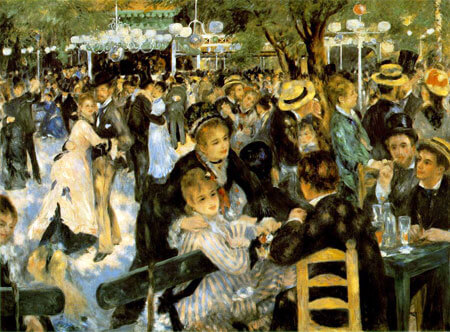
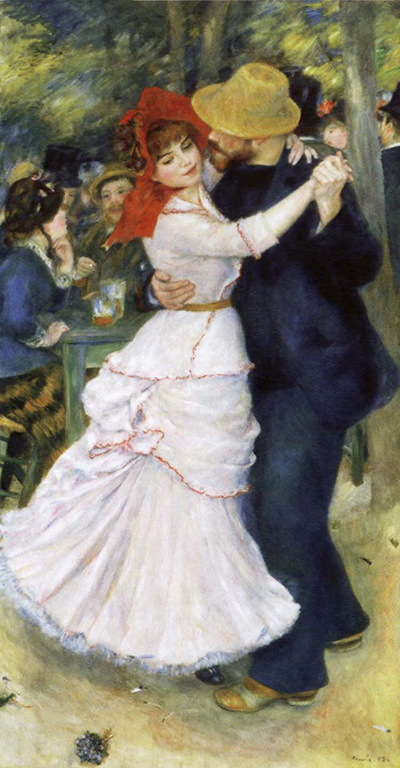
Renoir, Bal du moulin de la Galette
Dr. Beth Harris and Dr. Steven Zucker discuss Renoir’s 1876 Montmartre dance scene, its light and its crowds.
Watch on YouTubeA figure made from warm and cool colour
Renoir brings the model close to the picture plane. Her head turns over one shoulder, while the torso and hips form a gentle curve through the centre. The pose combines a clear bodily structure with edges that soften into the surrounding cloth and shadow. Rather than placing a dark outline around every contour, he lets adjacent areas of colour define the figure. The Pushkin Museum's patron-history text draws attention to the contrast between the warmth of the skin and the cool grey-blue setting. Pushkin patron archive. [2]
The blue and grey tones are especially important on the left and below the figure. They are not a detailed interior description; they give the body a setting and make its warmer colours seem luminous. Small changes in the paint keep the surface from becoming flat. Look at the transition near the shoulder, then at the cloth below the seated form: neither is simply one colour. The visual pleasure of the painting comes in part from these shifts, which the museum account describes as fine glazes and mobile strokes. Pushkin patron archive [2]; collection image. [1]
The model looks back towards the viewer rather than away into the room. That gaze is part of the composition, not evidence for her personal feelings. The nude is arranged as a painting for looking, and its title gives no narrative about a bath, a bedroom or a mythological identity. Historical comparisons with Venus imagery describe a pictorial tradition; they do not make this woman a named mythological character. The Pushkin patron-history text itself compares the modern model to Venus while emphasizing the painted warmth of her skin. Pushkin patron archive. [2]
“Belle Anne” and The Pearl
The Pushkin account identifies the model as a well-known Parisian sitter called “Belle Anne.” It also says that The Pearl became an established second name for the picture, linking that nickname to its delicate colour and finish. These are historically transmitted labels rather than words painted on the canvas. Keeping the museum's own Nude as the object title makes it easier to match the accession and avoid confusing it with another Renoir painting that later acquired an evocative title. Pushkin patron archive. [2]
The date 1876 places this work within Renoir's early Impressionist period, but the painting cannot be reduced to a label about loose brushwork. The pose is carefully legible. The soft edge between the figure and the background allows lively strokes to support a composed figure. This is a question of what can be seen in the painting; it does not establish the duration of the sitting or the exact order in which Renoir worked on its parts. Pushkin collection record [1]; Pushkin patron archive. [2]
It is especially important not to confuse this canvas with the Musée d'Orsay's Nude in the Sun. Both are Renoir nudes from the 1870s, but the Moscow canvas is a seated figure in cool interior-like colour and measures 92 × 73 cm. The Orsay work is a different object with its own collection record, outdoor light and provenance. The matching words “nude” and “1876” are not enough to establish identity; accession and image comparison are. Pushkin collection record [1]; Musée d'Orsay, Nude in the Sun. [3]
How the picture reached Moscow
The Pushkin patron-history project offers a compact provenance. It places the painting with E. Chabrier before an 1896 Hôtel Drouot sale in Paris, then with Durand-Ruel by 1898. It next records P. I. Shchukin from 1898 and S. I. Shchukin from 1912 to 1918. After the nationalisation of the latter collection, the work passed through museums of modern Western art and entered the Pushkin Museum in 1948. These are the dates given by the museum-linked account; the gaps should not be filled with invented owners or transactions. Pushkin patron archive, provenance [2]; Pushkin collection record. [1]
That history helps explain why a painting of a Parisian model is now in Moscow. It also distinguishes P. I. and S. I. Shchukin, whose similar surnames can be compressed into a misleading single ownership line. The Pushkin project lists them in sequence. The collection database confirms 1948 as the year of arrival at the present museum. Pushkin patron archive [2]; collection record. [1]
Looking again
Follow the cool colour behind the model into the warm shoulder and face. Renoir lets the figure hold together without hard borders everywhere. The quiet turn towards the viewer makes the sitter present, while the surrounding paint gives the image its changing light.
Renoir artworks directory
Questions about Female Nude (1876)
It is in the Pushkin State Museum of Fine Arts, Moscow, inventory Ж-3330.
The Pushkin Museum's patron-history project associates this picture with a Parisian model called “Belle Anne.” The public object record uses the simpler title Nude and does not give a fuller sitter biography.
The museum-linked account describes The Pearl as an established second name, connected with the painting's delicate surface and colour. It is a nickname, not the current catalogue title.
No. The Moscow canvas is Ж-3330, a seated figure in a cool setting. The Orsay picture is a separate painting and collection object.
Discussion
What do you notice when you return to Female Nude (1876)?
How do the cool blue-grey surroundings change the warmth of the seated figure?
Reader Insights
How do the cool blue-grey surroundings change the warmth of the seated figure?
The Pushkin Museum identifies Ж-3330 as its 1876 Nude; Belle Anne and The Pearl are historical names.
What separates this Moscow canvas from Orsay’s different 1876 sunlit nude?
Join the Conversation
Share a close observation or a source-backed question about Renoir’s Female Nude (1876).
References
- Pushkin State Museum of Fine Arts, Nude, Ж-3330. Owner identity, date, medium, dimensions and 1948 arrival View source.
- Pushkin Museum patron-history project, Nude. Model nickname, alternative title, visual interpretation and collection history (Russian) View source.
- Musée d'Orsay, Nude in the Sun. Separate object used for identity control View source.
- Whole-work image, Commons reproduction of Pushkin object Ж-3330 View source.
- Creative Commons, Public Domain View source.