by Tom Gurney
Tom Gurney BSc (Hons) is an art history expert with over 20 years experience
Published on June 19, 2020 / Updated on October 2, 2026
Email: tomgurney1@gmail.com / Phone: +44 7429 011000
A broad dirt road cuts into a field of yellow grain. Near its far end, two dark figures stand together; to the right, others work among the stalks. This is Renoir’s The Harvesters, also known by the French title Les Moissonneurs. The Emil Bührle Collection’s illustrated holdings catalogue [1] records this 1873 oil on canvas as 60 × 73 cm, Dauberville 175. It documents Bührle’s 1952 purchase and the painting’s allocation to his heirs in 1960. The composition in the local image matches the illustrated work shown in later Renoir landscape material.
This is an unusual Renoir subject. The painter is most closely associated with leisure scenes, portraits and bathers, but here he gives farm work and a rural road equal weight. The workers are small and not individualized. The land, the cut through it, and the contrast between shaded ruts and sunlit grain carry the picture.
Contents
- The painting at a glance
- Road, grain and figures
- What kind of work is visible?
- Renoir and the first Impressionist exhibition
- Later exhibition and ownership record
- Looking again at the landscape
Watch: Pierre-Auguste Renoir
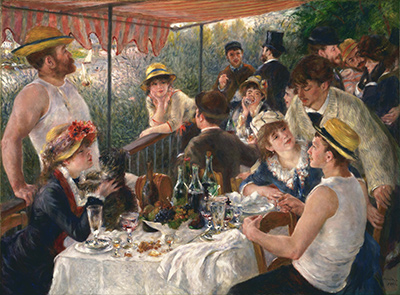
Explore a Montmartre dance, a gathering beside the Seine and the drawings behind Renoir’s paintings.
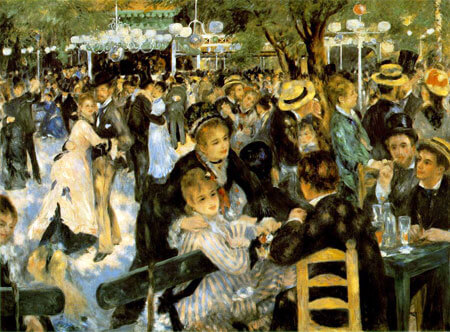
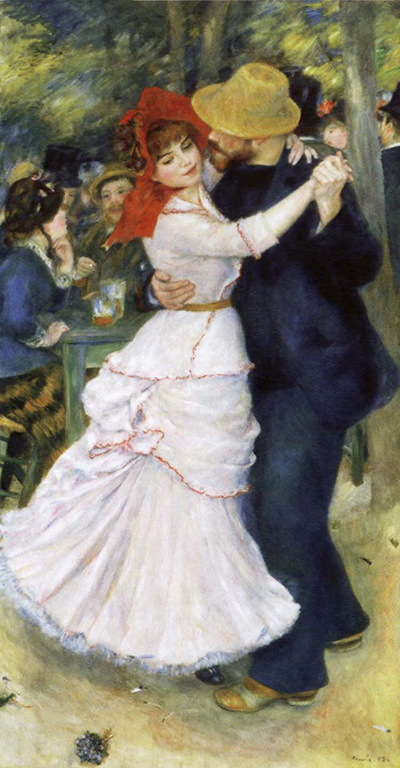
Renoir, Bal du moulin de la Galette
Dr. Beth Harris and Dr. Steven Zucker discuss Renoir’s 1876 Montmartre dance scene, its light and its crowds.
Watch on YouTubeAt a glance
- ArtistPierre-Auguste Renoir (1841–1919)
- TitlesThe Harvesters; Les Moissonneurs
- Date1873, in National Gallery of Art exhibition documentation
- MediumOil on canvas
- Size60 × 73 cm in the Bührle holdings catalogue; the Fondation Pierre Gianadda’s 2014 exhibition list gave approximately 60 × 74 cm
- Signature“Renoir 73” at lower left, visible in the reproduction and listed in historical image records
- Documented statusKept by Bührle’s heirs in 1960; described as privately held in a 2007 National Gallery, London, review; present owner unverified
The Bührle catalogue is a historical ownership record, not a claim that the painting belongs to the Bührle Foundation today. Its 60 × 73 cm measurement differs slightly from the about 60 × 74 cm reported in the Fondation Pierre Gianadda’s 2014 exhibition list. The National Gallery’s 2006–07 review [2] describes The Harvesters as a private-collection work; it does not identify a current owner.
Road, grain and figures
The road begins wide in the lower foreground and narrows sharply towards the centre. Deep browns and ochres mark its wheel ruts and bank. On both sides, wheat or similar grain is painted as a broad band of gold. The route through the field makes the small people readable: one figure in a light shirt stands near the right side of the track, and another bends close to the cut crop. Others gather farther away, their dark marks almost merging with the horizon.
The road is a strong compositional device. It gives the eye a way through the picture without making one worker a formal subject. The person standing upright at the right is large enough to hold attention, yet the track leads past him toward the distant group and the pale sky. Renoir balances an immediate view of farm labour against the open breadth of the field.
A low dark structure sits at the far left near the horizon, with more tiny figures spread across the mid-distance. At the right a thin tree rises beyond the crop. These details give the landscape a lived-in setting, but none defines a precise farm or village. The accessible exhibition records used here do not name the site. Calling the road a particular route or the building a known farm would require evidence beyond the image.
The sky occupies nearly half the canvas. Its pale blue and white marks make the yellow ground look warmer. There is no sharply drawn cloud bank or dramatic sunset. The high horizon allows the human figures to remain small beneath the sky. The painting’s emphasis is on the way work occurs within a landscape, not on a close-up of agricultural tools or faces.
What kind of work is visible?
The figures appear at different stages of moving through the grain. One bends forward close to the harvested strip, while another stands with arms and torso more clearly visible. A pair farther down the road may be pausing or walking. The small scale of the reproduction cannot securely identify every tool, action or person, and the catalogue sources do not supply a list of workers. It is enough to observe that the canvas shows a harvest in progress.
The field’s colour is varied rather than uniformly yellow. Green and brown strokes break through near the track, and brighter touches catch the remaining grain. Along the lower right, cut or flattened material lies across the earth. The paint gives a sense of disturbance and movement without rendering each stalk. Renoir’s quick, broken handling keeps the harvest from looking like a staged group portrait.
This close observation also guards against attaching a broad social story to the image. The painting records labour, but it does not document wages, the workers’ names, or the precise conditions of rural life at that site. Its subject is more concrete than an allegory of the seasons, yet less documentary than a written account of a particular harvest day.
Renoir and the first Impressionist exhibition
The first independent exhibition of the group later called the Impressionists opened in Paris in April 1874. Renoir sent several paintings. The original catalogue included a work numbered 144, titled Moissonneurs. Scholars have linked that entry with this signed 1873 harvest canvas, though title and subject alone cannot make the identification completely certain. The original 1874 exhibition catalogue [3] confirms the title and number, but does not reproduce the work; the exact match remains a research point rather than a claim about an unbroken exhibition record.
The possibility matters because The Harvesters looks different from the image of Impressionism as only city pleasure or garden leisure. It takes a contemporary rural subject and handles it with visible, mobile strokes and broad areas of colour. The National Gallery, London [2] singled it out in its 2007 review as an example of the painterly freedom Renoir had reached in the 1870s. That assessment is about how the painting is made; it does not need a definitive 1874 identification to be useful.
The 1874 title is in French and means “Harvesters.” Some historical notices have used related forms such as “reapers.” We should not assume that every similarly titled rural Renoir is this exact canvas. Here the distinguishing features are its 1873 date, horizontal about 60 × 73 cm size, road dividing the field, and small figures across the harvest landscape.
Later exhibition and ownership record
The Bührle collection’s archive documents Emil Georg Bührle’s purchase on 23 February 1952 from the Zurich dealer Nathan for 171,000 Swiss francs. Its code “1960: PO” means that the painting was kept by Bührle’s heirs when the foundation was established, rather than transferred to the foundation’s permanent holdings. The National Gallery in London later called it a private-collection work in its 2007 Renoir Landscapes 1865–1883 review.
The Bührle archive’s purchase entry gives a documented mid-century point in the chain; it does not tell us who owns the painting now. The National Gallery’s later private-collection label is consistent with the work having remained outside the Bührle Foundation, but does not prove continued ownership by the same heirs. A later sale or current owner record would be needed to settle that question.
Nor does the historical 1874 exhibition catalogue, if the match is accepted, establish every later transfer. The secure information combines the signed 1873 image, the Bührle archive’s 1952–60 ownership record and the National Gallery’s 2007 private-collection description. The intervening and later owners remain unverified.
Looking again at the landscape
The painting is easy to read as a broad yellow field with a few tiny figures. A slower look shows how carefully the road organizes them. Its dark lower edge leads towards the centre, the field opens on either side, and people occupy different distances along the route. The standing worker at right is balanced by the dark pair in the middle distance. A pale sky lifts the horizon and lets the scene breathe.
Renoir makes harvesting visible without isolating a heroic worker. No single figure receives the close attention of a portrait; the brushwork treats bodies, grain, road and sky as parts of one visual event. That does not erase the reality of work, but it explains why the picture can be studied as both a rural subject and a landscape experiment.
For readers familiar with Renoir’s later paintings, the canvas is also a reminder of the range of his early 1870s subjects. He could paint a field in use, not simply a field as empty scenery. The people give scale and purpose to the land, while the land remains the dominant experience of the picture.
Renoir artworks directory
Questions about The Harvesters
The Bührle holdings catalogue dates the oil painting to 1873; the local image also shows “Renoir 73” at lower left.
The Bührle archive lists 60 × 73 cm. The Fondation Pierre Gianadda’s 2014 exhibition list gave approximately 60 × 74 cm.
Renoir exhibited a work titled Moissonneurs in 1874. Scholars have proposed that the surviving 1873 harvest canvas is that work, but the match should be treated as likely rather than conclusively proven by the title alone.
The consulted institutional exhibition records do not give an exact location for the field or road. The visible painting identifies a rural harvest scene, not a named farm.
Bührle’s heirs kept it in 1960, and the National Gallery described it as privately held in 2007. A current owner or public display location has not been verified here.
Discussion
What do you notice when you return to The Harvesters?
How does the road lead you into the harvest scene?
Reader Insights
How does the road lead you into the harvest scene?
The Bührle archive records this 1873 oil as 60 × 73 cm and documents its 1952 purchase; the collector’s heirs kept it in 1960.
Which figures do you notice first, and which appear farther away?
Join the Conversation
Share a close observation or a source-backed question about Renoir’s harvest scene.
References
- Emil Bührle Collection, illustrated holdings catalogue, no. 225: 1873 date, oil medium, 60 × 73 cm size, Dauberville 175, 1952 purchase and the meaning of its 1960 private-ownership code View source.
- National Gallery, London, 2006–07 review: Renoir Landscapes 1865–1883 exhibition context and private-collection description View source.
- Original 1874 exhibition catalogue, no. 144: records Renoir’s Moissonneurs by title, without an illustration to prove that the surviving canvas is the same object View source.
- Fondation Pierre Gianadda, Revoir Renoir 2014 exhibition dossier: exhibited Les Moissonneurs listed as an 1873 oil, 60 × 74 cm, private collection; an alternative size to the Bührle archive’s 60 × 73 cm View source.