by Tom Gurney
Tom Gurney BSc (Hons) is an art history expert with over 20 years experience
Published on June 19, 2020 / Updated on October 2, 2026
Email: tomgurney1@gmail.com / Phone: +44 7429 011000
A young woman sits before a dense screen of green foliage. She wears a white blouse and a wide striped skirt; long dark hair falls over both shoulders, interrupted by small red ribbons. Her folded hands make a quiet centre at the bottom of the picture. Renoir painted In Summer, known in the Berlin collection as Im Sommer, in 1868. It is an oil painting in the Alte Nationalgalerie, accession A I 1014. Staatliche Museen zu Berlin, object record. [1]
The sitter is widely identified as Lise Tréhot, Renoir’s model in a group of early works. A Musée d’Orsay exhibition text [2] identifies Lise in this 1868 summer picture, while Berlin’s short public database record describes the object without naming her. That distinction is useful: the sitter identification comes from related art-historical research, not from an inscription visible on the canvas. The title’s emphasis on summer invites a look at how Renoir uses bright outdoor colour without losing the stillness of a portrait.
At a glance
- ArtistPierre-Auguste Renoir
- Berlin titleIm Sommer (In Summer)
- Date1868
- MediumOil on canvas
- Size85 × 59 cm
- CollectionAlte Nationalgalerie, Berlin, A I 1014
- SitterLise Tréhot, as identified by Musée d’Orsay’s exhibition text
Watch: Pierre-Auguste Renoir
Explore a Montmartre dance, a gathering beside the Seine and the drawings behind Renoir’s paintings.
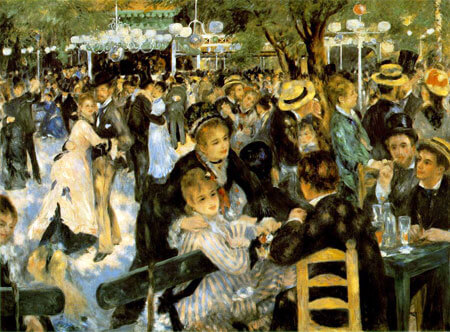
Renoir, Bal du moulin de la Galette
Dr. Beth Harris and Dr. Steven Zucker discuss Renoir’s 1876 Montmartre dance scene, its light and its crowds.
Watch on YouTubeA portrait held between light and shade
The young woman is close to us, occupying most of the narrow canvas. Her face rests against a lively green background, with a particularly bright patch near the right side of her head. The foliage is not described leaf by leaf: Renoir uses broader strokes and tonal contrasts to make a sense of sunlight passing through it. Against that activity, her gaze and joined hands feel unusually steady. The chair remains partly visible at the left, a reminder that this is a seated portrait as much as an image of a season. Berlin object record [1]; Musée d’Orsay, Impressionism and Fashion. [2]
The clothing is central to this balance. White fabric catches light at the neckline and sleeves, while the red stripes below lend pattern and weight. Dark curls pass over both light blouse and coloured skirt, tying the upper and lower halves together. The ribbons are small but vivid; they repeat the skirt’s warm accents near her face. The scene allows a reader to notice specific parts of what she wears without claiming that the portrait is a documentary record of an ordinary afternoon. It is a composed painting of a known model. Musée d’Orsay exhibition discussion. [2]
Some alternative titles use “The Bohemian” or the French La Bohémienne. Those words belong to the painting’s title history, but the Berlin owner currently catalogues it simply as Im Sommer. A viewer should be careful about turning a historical title into a statement about Lise’s identity or background. The visible image gives us a seated woman in summer foliage; it does not supply a biography through costume alone. Berlin collection record [1]; Getty publication on Renoir’s early Salon pictures. [3]
Lise and Renoir’s early portraits
Renoir painted Lise repeatedly in the late 1860s. In Lise with a Parasol, now in Essen, she stands full length in a white dress. In Summer changes the scale to a closer seated figure, so the face, hair and blouse press toward the viewer. The two works share a model but offer different ways to stage her: one emphasises a whole figure in a sunlit setting, the other brings foliage up behind her head and shoulders. The comparison need not make the Berlin picture a sequel to a story. Museum Folkwang, Lise with a Parasol [4]; Musée d’Orsay exhibition text. [2]
The Berlin canvas was shown at the 1869 Paris Salon under the title En été, étude (In Summer: Study). The Barnes Foundation’s Renoir catalogue [5] identifies its seated, three-quarter-length figure of Lise as the Salon picture; Getty scholarship also discusses the work in that setting. Calling it a “study” made room for the broad, informal treatment of the foliage beside the more resolved figure. It appeared five years before the first independent Impressionist exhibition in 1874. Berlin now catalogues it more simply as Im Sommer. Getty, Pierre-Auguste Renoir: La Promenade [3]; Berlin object record. [1]
The canvas predates the first independent Impressionist exhibition and many of the pictures most often used to define Renoir. Yet the looseness of the green brushwork already sits beside careful attention to a person and her clothing. It is more useful to look at that combination than to force the painting into a single movement label. The face is worked to hold the portrait together while the leaves behind it remain mobile and varied. That observation can be checked in the image; it does not require a claim that Renoir made every stroke outdoors.
From Paris to Berlin
Berlin’s provenance places the canvas with the critic and collector Théodore Duret in 1873, then with François Depeaux of Rouen. Its later route goes through a Georges Petit sale in 1906, the firms of Paul Rosenberg and Paul Cassirer, and an acquisition arranged by Hugo von Tschudi for the Nationalgalerie in November 1906. Berlin lists the 1907 gift of Mathilde Kappel as its acquisition. Some details of this chain are given in the museum database as short entries rather than a complete essay, so the page follows the named and dated records without filling gaps. Staatliche Museen zu Berlin, provenance and acquisition. [1]
The role of the Berlin dealer Paul Cassirer in bringing French Impressionist art to German audiences is the subject of an Alte Nationalgalerie exhibition. The museum includes In Summer among the works discussed in that context. That later history is separate from the circumstances in which Renoir painted Lise, but it helps explain why the canvas is now part of Berlin’s collection rather than still in France. Alte Nationalgalerie, Cassirer and the Breakthrough of Impressionism. [6]
Looking again
Follow the white blouse into the bright openings in the foliage, then return to Lise’s face through the dark hair and red ribbons. The green background feels active while the hands remain composed. Renoir is painting both a person and a seasonal effect, and neither disappears into the other.
Renoir artworks directory
Questions about In Summer
It is in the Alte Nationalgalerie, Berlin, inventory A I 1014.
Lise Tréhot is identified in Musée d’Orsay’s exhibition discussion of the painting. Berlin’s short object record itself does not name a sitter.
No. The canvas dates to 1868. The Berlin painting was shown as En été, étude (In Summer: Study) at the 1869 Paris Salon, five years before the first independent Impressionist exhibition.
It is an alternative historical title, not evidence in itself about the sitter’s ethnicity or life. Berlin uses Im Sommer as the current title.
Discussion
What do you notice when you return to In Summer?
How do the bright openings in the foliage frame Lise’s still face?
Reader Insights
How do the bright openings in the foliage frame Lise’s still face?
The Berlin record gives 1868 and A I 1014; Musée d’Orsay identifies the sitter as Lise Tréhot.
What changes when you compare this close seated portrait with Lise under a parasol?
Join the Conversation
Share a close observation or a source-backed question about Renoir’s In Summer.
References
- Staatliche Museen zu Berlin, Im Sommer, A I 1014. Current title, date, material, dimensions and provenance View source.
- Musée d’Orsay, Impressionism and Fashion. Identification of Lise in the 1868 summer portrait View source.
- Getty, Pierre-Auguste Renoir: La Promenade. Early Renoir and the 1869 Salon context View source.
- Museum Folkwang, Lise with a Parasol View source.
- Barnes Foundation, Renoir in the Barnes Foundation, p. 69. Identification of the Lise canvas exhibited at the 1869 Salon. Its figure caption has an inventory-number discrepancy; the Berlin museum record supplies the current number View source.
- Alte Nationalgalerie, Cassirer and the Breakthrough of Impressionism View source.
- Whole-work image, Sailko’s independent museum photograph on Wikimedia Commons View source.
- Creative Commons, CC BY 3.0 View source.