 by Tom Gurney
Tom Gurney BSc (Hons) is an art history expert with over 20 years experience
Published on June 19, 2020 / Updated on October 2, 2026
Email: tomgurney1@gmail.com / Phone: +44 7429 011000
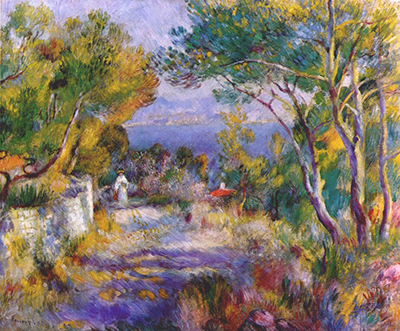
A rough path runs into a grove of trees in Renoir’s L’Estaque. A small pale figure stands near the left side of the track. Behind the foliage, a violet-blue band of sea meets a lighter sky. The picture is one of several landscapes Renoir made around the fishing village west of Marseille in 1882, but its winding path and coastal view distinguish it from his two paintings of rocky slopes. The illustrated work is catalogued as an oil on canvas, 65.8 × 81 cm, in a private collection by Bridgeman Images [1], whose asset number is BAL76849.
The Société Cézanne lists a signed and dated L’Estaque of 66 × 81 cm as Dauberville 869. Its rounded measurements, title, date and private collection agree with the illustrated record. The match is strong, though the published chronology does not reproduce the image beside that particular catalogue line. The identification is therefore based on the combined records and the visible composition, rather than a claim to have examined the canvas itself. Société Cézanne, 1882 chronology [2]; Bridgeman image record. [1]
At a glance
- ArtistPierre-Auguste Renoir
- TitleL’Estaque
- Date1882; listed as signed and dated “Renoir 82” by the Société Cézanne
- Medium and dimensionsOil on canvas, 65.8 × 81 cm in the Bridgeman record; approximately 66 × 81 cm in the Société Cézanne chronology
- Catalogue referenceDauberville 869 in the Société Cézanne chronology
- CollectionPrivate collection; a current owner or public display location is not established
Watch: Pierre-Auguste Renoir
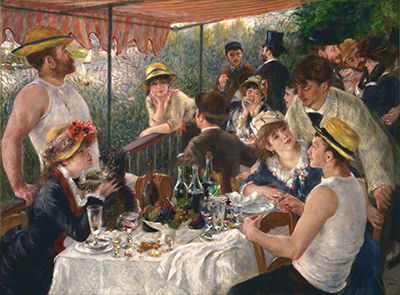
Explore a Montmartre dance, a gathering beside the Seine and the drawings behind Renoir’s paintings.
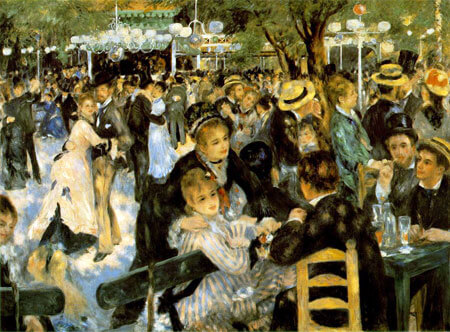
Renoir, Bal du moulin de la Galette
Dr. Beth Harris and Dr. Steven Zucker discuss Renoir’s 1876 Montmartre dance scene, its light and its crowds.
Watch on YouTubeThe two sets of measurements differ only in rounding. The chronology also names three other Renoir canvases of L’Estaque from 1882: a small private painting of rocks, a longer view of olive groves in the Marubeni collection, and the larger Rocky Crags at L’Estaque in Boston. The canvases have different subjects, sizes and catalogue numbers. Société Cézanne chronology. [2]
Following the path
The track enters from the lower edge and bends left, then narrows among the trees. Renoir does not draw it as a clean pale strip. Violet, blue, yellow and ochre marks break its surface into patches of shade and sunlight. A darker foreground bank interrupts a simple straight route into depth. The viewer has to follow the changing colour as much as the path itself.
On the left, an irregular pale wall or bank rises beside the track. Shrubs and trees lean over it. A small light-clothed figure stands beyond its end; farther back, other tiny touches of colour may suggest people, but the reproduction does not support naming or counting them with certainty. The figure gives the path a human scale without turning the landscape into a narrative scene.
The right side is framed by several slender trunks. Their cool blue-violet shadows and warm reddish edges stand against yellow-green foliage. One pine stretches a broad canopy across the upper centre. Its branches make an arch over the route, connecting the trees on both sides. Renoir lets individual strokes stay visible in the needles and leaves, while the trunks provide firmer vertical lines. These changes in handling keep the grove lively without losing its structure.
Between the trees, the sea appears as a comparatively still blue band. A small red roof or patch near the centre sits just below it. The distant coast is less sharply described than the foreground path. That difference in detail gives the picture depth: the eye moves from broken ground and close trees to a cooler, quieter distance. It also explains why the work is a coastal landscape even though the sea occupies only a narrow part of the image. Bridgeman image. [1]
Renoir in L’Estaque in 1882
Renoir arrived in L’Estaque after travelling through Italy. In a letter dated 23 January 1882 to his dealer Paul Durand-Ruel, he described the village by the sea, the mild weather, and his intention to bring back work from the area. He also reported meeting Paul Cézanne and expecting to work with him. The letter is direct evidence for the visit and the proposed collaboration. It does not name this particular path scene or establish the exact day on which Renoir painted it. Société Cézanne transcription and references. [2]
Cézanne had long worked around L’Estaque. For both artists, a familiar place could provide many distinct subjects: rock faces, a ravine, trees, roads and views of the sea. The Allen Memorial Art Museum’s research on Cézanne’s Viaduct at L’Estaque [3] places Renoir’s 1882 visit in relation to the site, while the Museum of Fine Arts, Boston [4] identifies the stony hillside in its own Renoir canvas. Neither source turns the leafy path in this private painting into Cézanne’s viaduct or Boston’s ravine. The shared geography is a basis for comparison, not proof that the paintings depict the same viewpoint.
The colour here also resists a simple account of one painter copying another. The open touches across the path, the warm greens and the glimpsed figure are characteristic of Renoir’s interest in the experience of walking through a sunlit place. A comparison with Cézanne can draw attention to the tree trunks and the ordered depth, but a visible resemblance cannot tell us which artist suggested a particular decision. Renoir’s letter confirms contact; the painting invites a separate visual reading.
Four pictures, one place
The four-work list in the Société Cézanne chronology is useful because titles can be deceptive. The small privately owned Rocks at L’Estaque is 32.3 × 40.3 cm and presses close to a rocky rise and dark tree. Boston’s 66.4 × 81 cm Rocky Crags at L’Estaque opens a ravine between pale cliffs. The Marubeni Olive Groves of L’Estaque is a much longer composition. This L’Estaque, at about 66 × 81 cm, centres a path, trees and a sliver of sea. Société Cézanne inventory [2]; Christie’s catalogue for the smaller rock painting [5]; Marubeni Gallery exhibition. [6]
All four are dated 1882 in that inventory, yet the evidence available here does not give their order of execution. Renoir could frame a rock formation closely, step back for a wider ravine, or turn toward a tree-lined route. Their variety matters more than an invented sequence. This page’s title is deliberately the simple L’Estaque, while the other route titles identify different works.
Private ownership and the image
Bridgeman’s record identifies the painting as privately held and credits its photograph to Bridgeman Images. No public museum location or later ownership history can be inferred from the phrase “private collection.” Bridgeman asset details. [1]
Looking again
Start with the cool violet shadows in the foreground path. Trace its turn past the pale wall and the small figure. Then look upward along the right-hand trunks to the pine canopy, and through the gap beneath it to the blue sea. Renoir sets the near ground in motion while letting the distance settle. The painting holds the sensation of a place to walk through and a horizon to pause over.
Renoir artworks directory
Questions about L’Estaque
Both the Bridgeman record and the Société Cézanne chronology date the work to 1882. The chronology records a signature and date reading “Renoir 82.”
It is listed in a private collection. The consulted records do not establish a current owner or a place where the painting can be seen.
No. This picture shows a tree-lined path and distant sea. The Boston canvas shows a rocky ravine and is catalogued separately as Dauberville 774; this work is listed as 869.
Renoir’s January 1882 letter says that he met Cézanne and that they intended to work together. It does not document Cézanne’s presence during the making of this exact canvas.
Discussion
What do you notice when you return to Renoir’s L’Estaque?
How does the shaded path lead your eye between the foreground trees and the distant sea?
Reader Insights
How does the shaded path lead your eye between the foreground trees and the distant sea?
An illustrated private-collection record identifies the 1882 canvas at 65.8 × 81 cm; the Société Cézanne lists L’Estaque as Dauberville 869.
What can Renoir’s January letter establish about his meeting with Cézanne, and what remains uncertain about this canvas?
Join the Conversation
Share a close observation or a source-backed question about Renoir’s L’Estaque.
References
- Bridgeman Images, L’Estaque (BAL76849): illustrated exact-object record, dimensions, medium, date, private-collection listing and image credit View source.
- Société Cézanne, 1882 chronology: Renoir’s January letter and four-work L’Estaque list, including L’Estaque, Dauberville 869 View source.
- Allen Memorial Art Museum, Allen Memorial Art Museum, Cézanne’s Viaduct at L’Estaque View source.
- Allen Memorial Art Museum, MFA Boston’s Rocky Crags at L’Estaque View source.
- Christie’s catalogue for the smaller rock painting View source.
- Marubeni Gallery exhibition View source.
- Image: existing local reproduction of the exact painting; Bridgeman Images documents the work as asset BAL76849.