 by Tom Gurney
Tom Gurney BSc (Hons) is an art history expert with over 20 years experience
Published on June 19, 2020 / Updated on October 2, 2026
Email: tomgurney1@gmail.com / Phone: +44 7429 011000
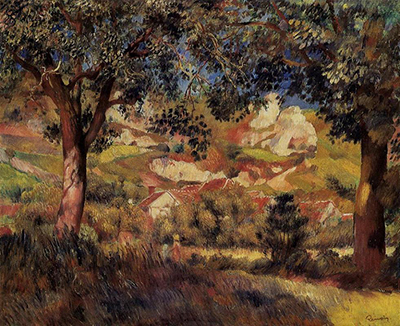
Two dark trees frame a cluster of pale roofs and low buildings. Their foliage forms a canopy across the top of the canvas, while a band of shaded grasses fills the foreground. Renoir's Landscape in La Roche-Guyon is a view built from layers: close trunks, a sunlit settlement, and rising ground beyond. The local image matches the reproduced Paysage à La Roche-Guyon catalogued by Christie's [1] as an 1887 oil on canvas, 45.7 × 55.9 cm.
The match matters because Renoir painted more than one landscape at La Roche-Guyon. Aberdeen Art Gallery [2] holds another, dated 1885–86, with its own collection history. The Christie’s picture is the tree-framed view reproduced here. The two works share a place name, not an object record.
Contents
- The painting at a glance
- A view held in the trees
- Brushwork and depth
- Which La Roche-Guyon landscape?
- Documented ownership and exhibitions
- Looking again
Watch: Pierre-Auguste Renoir
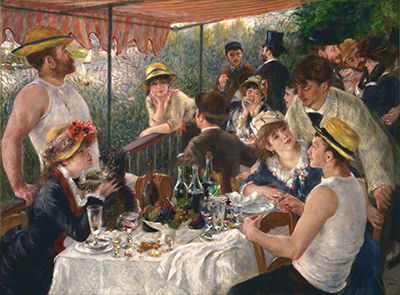
Explore a Montmartre dance, a gathering beside the Seine and the drawings behind Renoir’s paintings.
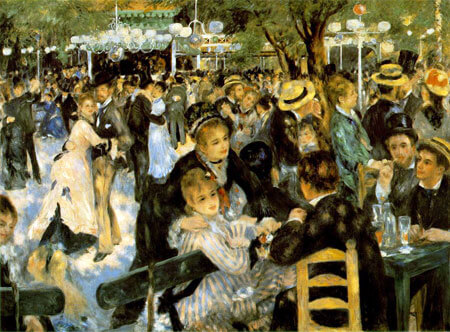
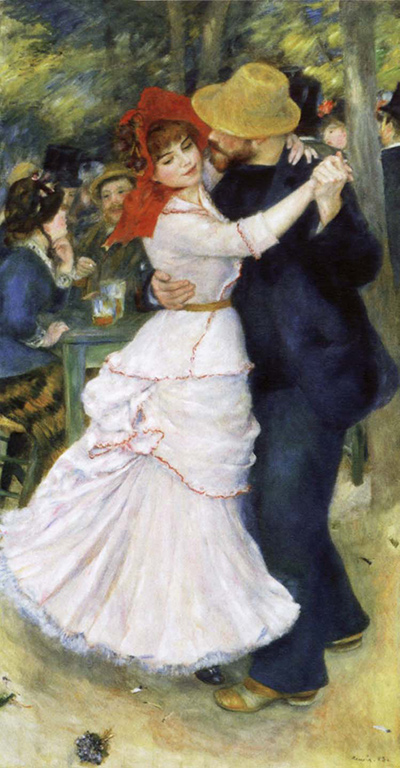
Renoir, Bal du moulin de la Galette
Dr. Beth Harris and Dr. Steven Zucker discuss Renoir’s 1876 Montmartre dance scene, its light and its crowds.
Watch on YouTubeAt a glance
- ArtistPierre-Auguste Renoir (1841–1919)
- French titlePaysage à La Roche-Guyon
- Local titleLandscape in La Roche-Guyon
- Date1887, in the Christie’s catalogue and a later museum loan list
- MediumOil on canvas
- Size45.7 × 55.9 cm (18 × 22 in.)
- MarkStamped signature “Renoir” at lower right, according to Christie’s
- Documented collectionPérez Simón Collection, Mexico City, in a 2016 Museo Thyssen-Bornemisza loan document
- Present ownershipNot independently reconfirmed after that dated loan record
The Museo Thyssen-Bornemisza's 2016 transport and loan list [3] names the Pérez Simón Collection as lender for a Renoir Paysage à la Roche-Guyon of 1887 with exactly the Christie’s dimensions, 45.7 × 55.9 cm. It gives inventory 10742. The matching title, date and measurements make this a strong later record for the same painting, but the document describes a loan at that time rather than a permanent public display location today.
A view held in the trees
The left foreground tree is thick and forked. Its reddish-brown trunk rises into foliage painted with short strokes of green, ochre, blue and near-black. A second trunk stands close to the right edge. The two work like the sides of an opening, guiding the eye into the middle of the canvas. The dense crown above them lowers the apparent ceiling of the scene, even where blue sky shows through its leaves.
Below this canopy, a strip of dark grass and earth lies across the front. This is not a smooth green lawn. Upright strokes make it coarse and uneven, and warm red-brown marks appear among the darker greens. The shaded foreground makes the bright pale buildings in the middle distance seem farther away. Renoir gives the viewer a place to look from without painting a clearly marked road or a named viewpoint.
The village buildings are small and irregular. Red roofs and warm cream walls show between patches of vegetation. Some shapes are barely separated from the hills behind them. The eye cannot map every structure from the image, and the catalogues consulted do not identify individual houses. What is visible is their relationship to the landscape: a settlement tucked into sloping, planted ground rather than an isolated architectural monument.
The far hillside is painted in light yellow, peach and muted green. Its contours remain legible through shifts of colour rather than hard outlines. The strongest contrast is between the shadowed trees near us and the warm ground and buildings beyond. This contrast gives depth to a scene with only a little unobstructed sky.
Brushwork and depth
Christie’s lot essay [1] pays particular attention to the different handling of trees, middle ground and distance. It describes Renoir's use of varied strokes to create a gradual recession into the hills. The picture rewards that kind of close look. The foliage is dense with short, separate touches; the village is made from flatter, lighter passages; and the foreground grass returns to dark, vigorous marks. One kind of paint handling does not cover the entire canvas.
The catalogue also relates the painting to Renoir's work with Paul Cézanne at La Roche-Guyon and to the more measured, parallel strokes associated with Cézanne. That is useful stylistic context, but it does not tell us that Cézanne stood beside Renoir while this specific 1887 canvas was painted. The Morgan Library & Museum [4] records Renoir's stay in the village with his young family in the summer of 1885. The later 1887 date of this work should be kept distinct from that documented visit unless more precise evidence for its making is found.
The painting's structure has a quiet firmness. The paired trunks mark the vertical edges, the canopy closes the top, and the shadowed grasses anchor the base. Inside that frame, pale buildings and sloping land are more loosely joined. Renoir can therefore keep individual brushstrokes visible without making the whole view feel scattered.
Which La Roche-Guyon landscape?
The place name alone is not a sufficient identifier. Aberdeen's La Roche Guyon is an oil canvas dated 1885–86, measuring 46.5 × 56.1 cm. Its museum record says it was presented to the gallery in 1974. Christie’s explicitly compares its 1887 lot with this earlier Aberdeen work, treating the two as separate pictures. The local image in this route corresponds to the Christie’s 1887 composition, with one large tree at left, another at right, and village buildings between them.
That distinction prevents an easy but serious error: Aberdeen's accession, display status, and 1974 gift should not be copied onto this page. The canvases happen to have similar horizontal dimensions and a shared subject, which makes the confusion more likely. Their visual compositions and ownership trails have to be checked separately.
La Roche-Guyon itself is a village on the Seine northwest of Paris. Renoir painted there during a period when he was reconsidering how to give landscape both light and structure. The Morgan's account [4] of his family stay in 1885 establishes the connection with the place. It does not fix the exact year, season or viewpoint of every painting bearing the village's name.
Documented ownership and exhibitions
Christie's lists the artist's studio, Kojiro Matsukata in Tokyo, Wildenstein & Co. in New York, and Benjamin and Minna Reeves, who acquired the painting from Wildenstein on 9 April 1954, in its provenance. The lot page also records a 1969 Wildenstein exhibition in New York, loaned by the Reeveses. These details are a documented path through several collections, not a complete statement of every transfer afterward.
The 2016 Thyssen museum document supplies a later point: the Pérez Simón Collection in Mexico City was listed as lender for this 1887, 45.7 × 55.9 cm landscape. The document gives a practical loan record, including the collection and object number. It does not say whether the painting was normally on public view. A current display claim would need a present collection or exhibition notice.
The existence of a large online reproduction is useful for comparing the image with the local 400px copy. Its colour balance is different: the larger file shows more distinct blue and olive strokes in the canopy and richer detail in the village. The inherited image remains on this page; the larger reproduction serves only as a comparison.
Looking again
Start with the two trunks and notice how much of the view they conceal. Then move through the gap to the small red roofs. The buildings occupy little area, yet their lighter paint pulls the eye past the dark grasses. Finally return to the foliage overhead, where separated strokes allow bits of sky and distant warmth to show through. The scene is built around what can be glimpsed as much as what is fully described.
Renoir does not offer a panoramic survey of La Roche-Guyon. He makes a nearby stand of trees the active foreground of a village view. The result is both a record of a place and a study of how close, middle and distant forms can be held together with changing colour and brushwork.
Renoir artworks directory
Questions about Landscape in La Roche-Guyon
Christie's catalogues the tree-framed oil as 1887. A later Museo Thyssen-Bornemisza loan list uses the same date and measurements.
It measures 45.7 × 55.9 cm (18 × 22 inches) in the Christie’s catalogue.
No. Aberdeen Art Gallery holds a distinct La Roche Guyon dated 1885–86. Christie’s compares its 1887 painting with that earlier work.
Christie’s records several past owners, including Kojiro Matsukata and Benjamin and Minna Reeves. A 2016 Thyssen museum loan document lists the Pérez Simón Collection as lender. Ownership after that document has not been independently verified here.
The 2016 record places the work in the Pérez Simón Collection's loan programme, but it does not establish a current public display location. Check a current collection or exhibition notice before planning a visit.
Discussion
What do you notice when you return to this Renoir landscape?
How do the two foreground trees frame the village?
Reader Insights
How do the two foreground trees frame the village?
Christie’s catalogues this 1887 oil at 45.7 × 55.9 cm; a 2016 museum loan list records the Pérez Simón Collection.
Which roofs remain visible between the trunks and foliage?
Join the Conversation
Share a close observation or a source-backed question about Renoir’s La Roche-Guyon view.
References
- Christie's, Paysage à La Roche-Guyon lot record: exact object, image comparison, 1887 date, medium, dimensions, stamped signature, provenance, 1969 exhibition and discussion of the composition View source.
- Aberdeen Art Gallery, La Roche Guyon: distinct 1885–86 canvas and its collection record View source.
- Museo Thyssen-Bornemisza, 2016 Renoir exhibition loan list: 1887 title, exact dimensions, Pérez Simón Collection lender and inventory 10742 at that date View source.
- Morgan Library & Museum, Renoir in La Roche-Guyon: context for Renoir's family stay in the village in 1885, separate from this painting's 1887 catalogue date View source.
- Wikimedia Commons, high-resolution reproduction: Public Domain Mark; used only for visual comparison with the owner-supplied legacy page image View source.