 by Tom Gurney
Tom Gurney BSc (Hons) is an art history expert with over 20 years experience
Published on June 19, 2020 / Updated on October 2, 2026
Email: tomgurney1@gmail.com / Phone: +44 7429 011000
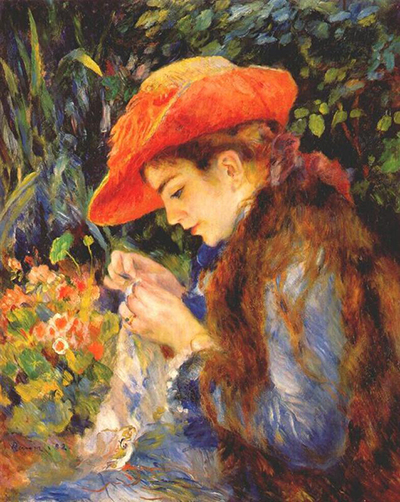
Marie-Thérèse bends over her needlework, absorbed in the small task between her hands. A broad orange-red hat lights up her dark hair and blue dress, while foliage and flowers crowd the space behind her. Pierre-Auguste Renoir painted Marie-Thérèse Durand-Ruel Sewing in 1882 as part of a commission from her father, the dealer Paul Durand-Ruel. The painting is held by the Clark Art Institute in Williamstown, Massachusetts, as 1955.613. The Clark’s scholarly catalogue entry [1] identifies the sitter, records the canvas and follows its history.
The portrait feels intimate because Renoir brings us close to Marie-Thérèse’s face and hands. He does not show the whole garden or a formal family setting. Her downward gaze keeps the sewing central, while the hat and foliage make the outdoor light a part of the portrait. The Clark dates the signed canvas to 1882, when Marie-Thérèse was about fourteen. Clark catalogue, no. 283. [1]
At a glance
- ArtistPierre-Auguste Renoir
- TitleMarie-Thérèse Durand-Ruel Sewing (Marie-Thérèse Durand-Ruel cousant)
- Date and inscription1882; signed and dated “Renoir. 82.” at lower left
- Medium and sizeOil on canvas, 64.9 × 54 cm
- MuseumClark Art Institute, 1955.613
- SitterMarie-Thérèse Durand-Ruel (1868–1937), elder daughter of Paul Durand-Ruel
Watch: Pierre-Auguste Renoir
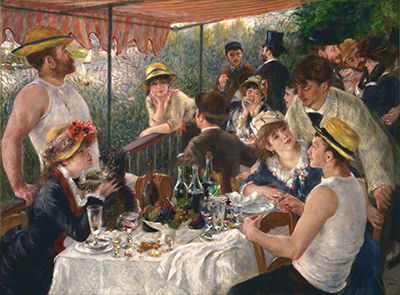
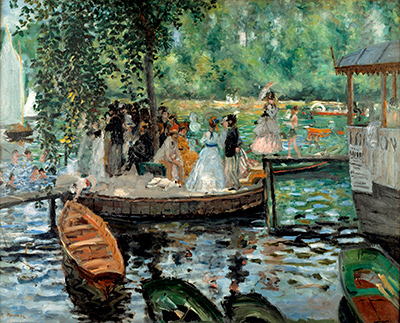
Explore a Montmartre dance, a gathering beside the Seine and the drawings behind Renoir’s paintings.
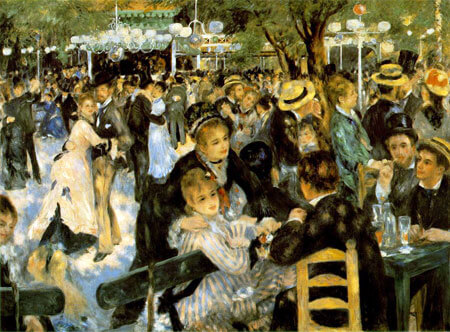
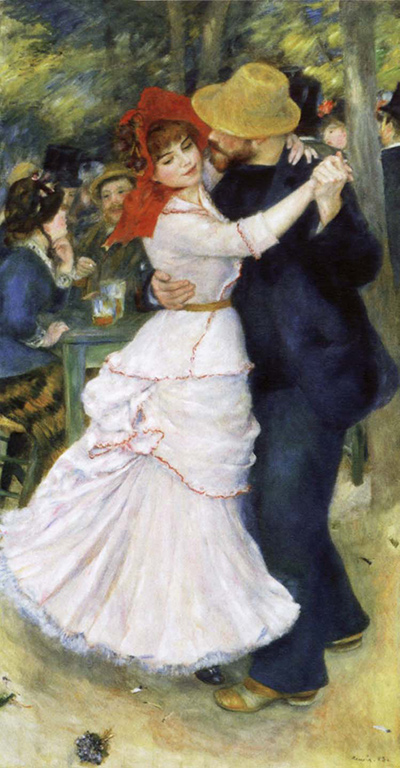
Renoir, Bal du moulin de la Galette
Dr. Beth Harris and Dr. Steven Zucker discuss Renoir’s 1876 Montmartre dance scene, its light and its crowds.
Watch on YouTubeThese details come from the Clark’s object catalogue. Its accession number matters because Renoir painted more than one member of this family. The museum owns this single portrait of Marie-Thérèse sewing; the paired portrait of Marie-Thérèse and Jeanne is a different painting and should not inherit this canvas’s size or collection history. Clark catalogue. [1]
A sitter at work
Marie-Thérèse’s hands meet just below her face. A pale length of fabric or thread drops toward her lap, where its loose strokes mingle with the blue of her clothing. The task is recognizable as sewing even though the exact work she is making cannot be identified from the painting. Renoir gives the hands enough shape to anchor our attention, then lets the material spread into lighter, less definite marks.
Her hat is the strongest area of warm colour. It arcs across the upper-left part of the figure and makes her profile stand out against dark leaves. The face is more smoothly modelled than the garden. Her lowered eyelid, nose and cheek are clearly drawn, yet their shadows contain several colours. The Clark’s catalogue notes this contrast between the precise profile and the freer treatment of her hair, dress, sewing and flowers. Clark catalogue interpretation. [1]
Long brown hair runs down her right shoulder, with blue and violet marks cutting through it. The dress is blue, but not a single unbroken field: pale strokes describe the sleeve, and warmer touches appear along its edges. At lower left, red, orange and cream flowers bring the hat’s colour back into the garden. The eye moves between these lively patches and the focused face rather than settling on one flat background.
The foliage closes around Marie-Thérèse. Its dark greens and blues make the daylight on her skin and hat more vivid. The portrait does not show the horizon or a distant view; its garden is an immediate setting for one person. That closeness makes the painting feel private, while the outdoor light keeps it different from a studio portrait.
The Durand-Ruel commission
Paul Durand-Ruel became Renoir’s principal dealer. The Clark explains that in 1882 he commissioned portraits of all five of his children. Renoir wrote to his friend Paul Bérard in June that Durand-Ruel had engaged him for August. The museum concludes that the portraits appear to have been made at a house the family rented in Dieppe that month. This is stronger evidence for the setting than a general claim that Marie-Thérèse sat at the family’s own Normandy home. Clark catalogue, commission and location. [1]
The Clark says this portrait and two others in the commission were painted in the garden. It cites the painter Jacques-Émile Blanche, who remembered the Durand-Ruel children posing beneath moving chestnut leaves in a garden on the coast near Rouen. His account connects the dappled light with the practical difficulty of painting faces outdoors. It is an evocative witness to the working conditions, though his recollection should not be treated as a minute-by-minute record of this exact sitting. Clark catalogue and cited Blanche recollection. [1]
Marie-Thérèse was born in 1868. At roughly fourteen, she appears neither as a small child nor as a formally presented adult. The sewing, her concentration and the open-air setting make this a portrait of an individual activity. It is tempting to read her expression as a definite feeling, but the evidence is limited to what Renoir painted: a lowered gaze, a quiet pose and hands at work. Clark catalogue biography and dating. [1]
The commission did not simply yield portraits approved by the dealer. The Clark cites a later 1882 letter in which Renoir suggested that Durand-Ruel was unhappy with the sunlit portraits. Renoir joked about returning to a studio and a dark background. The remark shows an artist aware of the risks of painting a patron’s children in shifting outdoor light. It does not prove that this individual canvas was rejected or changed at Durand-Ruel’s request. Clark catalogue and letter references. [1]
Renoir’s handling after Italy
The portrait belongs to a period when Renoir was reassessing his approach after travelling in Italy in 1881–82. The Clark describes a combination of broad Impressionist handling and firmer definition: the hair, clothes, sewing and flowers remain open and varied, while Marie-Thérèse’s profile separates more clearly from the foliage. The contrast between her orange hat and dark leaves is sharper than in many of Renoir’s earlier outdoor figures. Clark catalogue discussion. [1]
These shifts are visible without turning the painting into a complete break from his earlier work. The Clark compares its close composition with Renoir’s Lise Sewing of about 1866, now at the Dallas Museum of Art. Both concentrate on a woman absorbed in needlework. The museum treats the resemblance as a deliberate return to an earlier motif. That comparison gives the 1882 portrait a history within Renoir’s own work, alongside the new colour contrasts he was exploring. Clark catalogue comparison and figure 283.1. [1]
Technical research also complicates any claim that the image we see is an untouched 1882 surface. The Clark’s technical report records a 1962 relining by conservator William Suhr, following an earlier lining that had flattened impasto. Researchers found an off-white commercial ground, no detectable underdrawing and signs that the background was painted after the figure. The report also notes crack patterns and retouching. Those details help explain why a close view of the paint is useful, while reminding us that colour and texture in a reproduction are only an imperfect guide to the physical canvas. Clark technical report. [1]
From the family to the Clark
The Clark traces the painting first to Paul Durand-Ruel, then to Marie-Thérèse herself by 1925, when she was Mrs. Félix André Aude. The dealer Knoedler sold it to Robert Sterling Clark on 23 July 1935. It entered the Clark Art Institute in 1955. The museum’s provenance gives the key transfers, while qualifying how long Paul Durand-Ruel retained it. Clark catalogue provenance. [1]
The painting was shown early in its history. The Clark lists a Paris exhibition in 1883 and a New York exhibition in 1886, followed by many later appearances. This public record sits beside the portrait’s intimate subject. The picture was made for the family of Renoir’s dealer, but soon entered a wider story of how his work was displayed and collected. Clark exhibition history. [1]
Looking again
Follow Marie-Thérèse’s gaze down to the point where her hands work. From there, let the pale fabric lead toward the flowers, then return along the blue sleeve and brown hair to the orange hat. Renoir holds a sitter’s concentration steady while the garden around her remains restless with colour. The tension between those two kinds of attention is what gives this portrait its life.
Renoir artworks directory
Questions about Marie-Thérèse Durand-Ruel Sewing
She was the elder daughter of art dealer Paul Durand-Ruel. Renoir painted her around her fourteenth birthday as part of her father’s 1882 family portrait commission.
The Clark places the Durand-Ruel portraits at the family’s rented house in Dieppe during August 1882 and identifies this as one of the garden portraits.
The canvas measures 64.9 × 54 cm. It is a vertical, close-up portrait, not the separate double portrait of Marie-Thérèse and her sister Jeanne.
It belongs to the Clark Art Institute in Williamstown, Massachusetts. Its accession number is 1955.613.
Discussion
What do you notice when you return to Renoir’s Marie-Thérèse Durand-Ruel Sewing?
How do the orange hat and dark foliage frame Marie-Thérèse’s face and hands?
Reader Insights
How do the orange hat and dark foliage frame Marie-Thérèse’s face and hands?
The Clark identifies this signed 1882 garden portrait as 1955.613, one of Renoir’s Durand-Ruel family commissions.
Where does Renoir keep a clear edge, and where do the sewing and garden dissolve into looser strokes?
Join the Conversation
Share a close observation or a source-backed question about Renoir’s Marie-Thérèse Durand-Ruel Sewing.
References
- Clark Art Institute, Marie-Thérèse Durand-Ruel Sewing, catalogue no. 283: primary object study, biography, commission, setting, provenance, exhibitions and technical report View source.
- Clark Art Institute, collection concentration PDF: confirms 1882 date, ownership and accession 1955.613 View source.
- Wikimedia Commons exact-object reproduction: 2057 × 2491 image sourced there to a Renoir exhibition catalogue and marked Public Domain Mark; used for the enlarged local page image. The Clark’s catalogue remains the authority for object facts View source.