 by Tom Gurney
Tom Gurney BSc (Hons) is an art history expert with over 20 years experience
Published on June 19, 2020 / Updated on October 2, 2026
Email: tomgurney1@gmail.com / Phone: +44 7429 011000
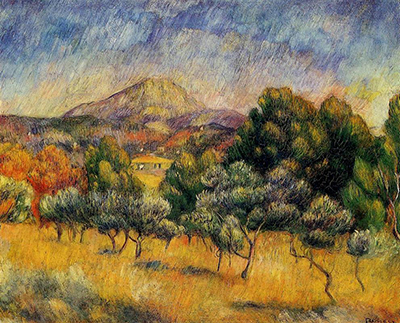
A diagonal row of olive trees crosses the golden foreground of this painting. Behind them are deeper green trees, a low pale building, and the distant ridge of Mont Sainte-Victoire under a streaked blue-grey sky. The local image matches the work catalogued by the Yale University Art Gallery [1] as Renoir’s Mont Sainte-Victoire, accession 1980.12.14. A Yale collection publication [2] describes the same receding line of olive trees and gives the object’s date, size and ownership history.
The mountain is closely associated with Paul Cézanne, Renoir’s friend and fellow painter. Renoir’s version is worth viewing on its own terms: it does not merely copy a Cézanne composition. The tree trunks bend across the field, silvery foliage catches light, and warm colour gathers in the grass. The mountain is visible beyond those near and middle distances rather than pressed forward as a single monumental form.
Contents
- The Yale painting at a glance
- How the composition leads the eye
- Colour and brushwork
- Renoir and Cézanne near Aix
- The painting’s recorded history
- Renoir’s view beside Cézanne’s
- Why this landscape holds together
Watch: Pierre-Auguste Renoir
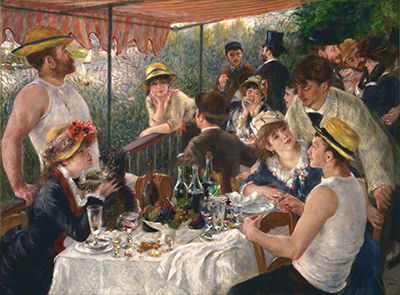
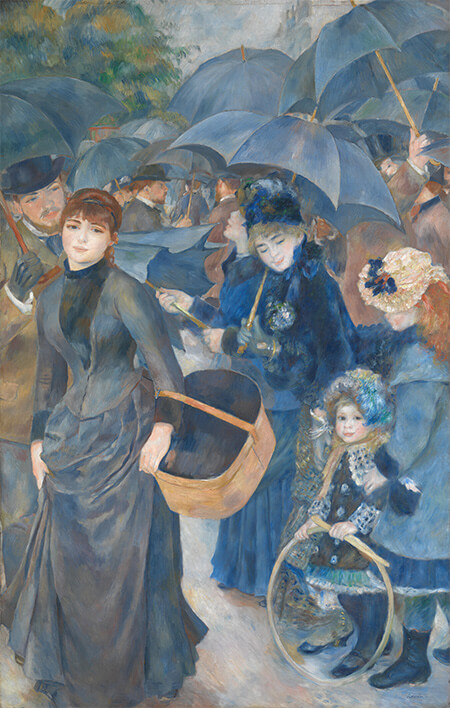
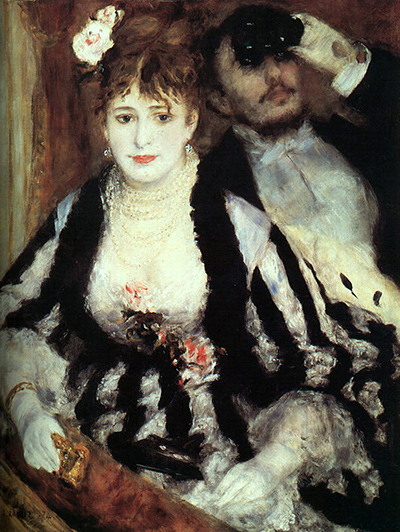
Explore a Montmartre dance, a gathering beside the Seine and the drawings behind Renoir’s paintings.
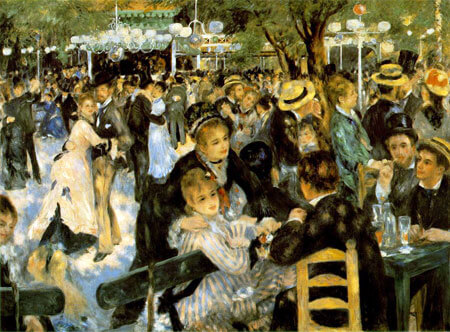
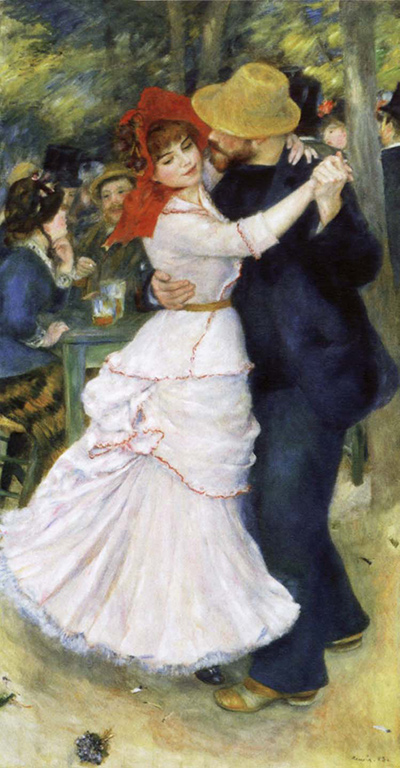
Renoir, Bal du moulin de la Galette
Dr. Beth Harris and Dr. Steven Zucker discuss Renoir’s 1876 Montmartre dance scene, its light and its crowds.
Watch on YouTubeAt a glance
- ArtistPierre-Auguste Renoir (1841–1919)
- Museum titleMont Sainte-Victoire
- Datec. 1888–1889, in Yale’s publication
- MediumOil on canvas
- Size53 × 64.1 cm (20⅞ × 25¼ in.)
- Signature“Renoir,” lower right, as recorded by Yale
- CollectionYale University Art Gallery, New Haven
- Accession1980.12.14, Katharine Ordway Collection
These facts belong to the Yale object [1] and its published catalogue entry. The approximately two-year date range should remain a range: Yale notes visits in both 1888 and about 1889, and the available source does not establish the precise day or trip on which Renoir painted this canvas. “Mount Sainte Victoire” in the retained URL omits the hyphen used in the French place name; it does not denote a second mountain.
How the composition leads the eye
The line of olive trees begins towards the left foreground and moves diagonally to the right. Their slim trunks and pale foliage set a rhythm across the broad warm field. The trees do not form an opaque screen. Spaces between their branches give glimpses of the valley, the light building and the darker shapes behind them. This broken screen is what allows the mountain to remain distant but recognisable.
At the right, a denser mass of green trees holds the middle ground. It balances the mountain’s lower, paler shape at the left. The peak sits below a substantial sky rather than filling the horizon. The painting’s visual weight is therefore shared: yellow grasses occupy much of the lower half, cool cloud and blue light the upper part, with the olive trees joining the two. Their trunks rise out of the bright land while their grey-green crowns echo the cooler tones above.
Yale’s publication calls attention to the line of olive trees, their curved trunks and the way their leaves seem to shimmer. It also notes purple shadows in the foreground. Those observations fit the reproduced view, where strokes of violet and blue interrupt the yellow field. A small image cannot show the paint surface as the original does, so claims about individual pigments or exact working sequence would need technical evidence. The visible arrangement itself is clear: Renoir leads the eye through vegetation before it reaches the famous mountain.
Colour and brushwork
The foreground is not a flat patch of gold. Yellow, orange, green and cool violet marks pass across it, creating depth without sharply drawing every blade of grass. The olive crowns mix muted green and pale grey. Darker trees near the centre and right make those lighter forms stand out. Beyond them, the mountain is a soft mass of ochre and violet, with its contour still legible against the luminous sky.
Yale’s catalogue compares Renoir’s marks with Cézanne’s repeated parallel strokes but describes Renoir’s handling as more fluid and more densely applied. That is a comparison of two painters’ approaches to a shared landscape, not a claim that every mark in the Yale canvas was borrowed from Cézanne. The view is recognisably Renoir’s in its animated foliage and its emphasis on soft transitions of light across the field.
The sky gives the colour a different register. Broad, slanting strokes of grey-blue and pale yellow suggest shifting cloud, but the painting does not provide a documented time of day or weather forecast. The warmer ground could reflect sunlight, seasonal vegetation or Renoir’s pictorial choices. It is more useful to observe the relationship of warm foreground to cool upper sky than to assign an exact season without evidence.
Renoir and Cézanne near Aix
Yale’s publication records that Renoir visited Aix-en-Provence in early 1888 and returned around 1889. During the later visit he rented a house at Bellevue from Cézanne’s sister and brother-in-law. The surrounding views of Mont Sainte-Victoire had already engaged Cézanne, and Renoir could look towards the same landmark while constructing a different foreground and rhythm. The date range in Yale’s record reflects that context.
The Cézanne online catalogue raisonné [3] cites Renoir’s Yale canvas while discussing Cézanne’s own Mont Sainte-Victoire compositions. Christie’s catalogue of a Cézanne view [4] likewise notes that Renoir painted from a comparable viewpoint. These comparisons establish a documented artistic conversation around the site. They do not make the two paintings identical in date, ownership or surface.
The mountain itself rises east of Aix. It became a recurrent subject for Cézanne, but Renoir’s canvas makes the viewer pass through an olive grove before reaching it. The place is therefore both a geographical landmark and a reason to compare two artists’ decisions: what to place in the foreground, how to handle the sky, and how much visual emphasis to give the distant ridge.
The painting’s recorded history
Yale’s current object record traces the canvas to David William Traill Cargill in Lanark, Scotland, by 1937. It places the painting with the Bignou Gallery in New York by 1940, records the gallery’s 1941 sale to Katharine Ordway, and dates her gift to Yale to 1980. The gallery’s accession is 1980.12.14. This is a documented sequence from the 1930s onward, not an unbroken chain from Renoir’s studio. Yale object provenance. [1]
The museum’s object number is particularly important because Renoir painted more than one work under a Mont Sainte-Victoire title. The Barnes Foundation [5] holds a distinct Montagne Sainte-Victoire (Paysage), BF288. The Barnes catalogue [6] traces that work through Durand-Ruel and Albert C. Barnes. Its purchase history, object number and technical findings belong to the Barnes canvas, not to Yale’s 1980.12.14.
This distinction matters even if both pictures arose from Renoir’s visits near Aix. Their shared mountain and closely related dates can make a quick search result look conclusive. An exact match needs the image, dimensions, collection number and owner record together. The local route’s olive-tree composition and Yale’s description provide that match here, while the Barnes title is retained only as a comparison.
Renoir’s view beside Cézanne’s
Cézanne’s many treatments of Sainte-Victoire often invite discussion of geometric structure and the relationship of plane to plane. Renoir’s Yale painting also has structure: the line of trees, the block of darker foliage, the field and the distant peak are deliberately placed. Yet its effects come through shifting colour, curved trunks and a softer passage between zones. The mountain remains present without taking over the scene.
Yale’s catalogue contrasts Cézanne’s cooler, more strongly built forms with Renoir’s warmer and more decorative handling. That assessment gives readers a starting point, but the works should be compared as specific pictures, not turned into fixed definitions of the artists. Renoir’s foreground is particularly active. The eye can follow a sequence of olive crowns, notice a shadow crossing the gold, and only then arrive at the pale summit. It is a mountain view that gives much of its attention to the living landscape between viewer and peak.
The comparison also helps correct the older page’s broad suggestion that Renoir merely emulated Cézanne. They shared a motif and visited the same region. Yale’s source describes Renoir’s own colour and paint handling, while the documented record does not identify a single Cézanne canvas that this picture directly copies. Friendship and artistic exchange are grounded context; a one-way account of imitation is too simple for this object.
Why this landscape holds together
The far mountain names the picture, but the olive trees make the journey through it. Their staggered line supplies depth; their light foliage connects warm earth to cool sky; their curved trunks keep the lower half from becoming a static band. The darker trees provide a pause before the pale ridge. Renoir can give the landmark a modest amount of space because every part of the foreground prepares us to see it.
The painting is also a useful reminder that a famous subject can be shared without losing individual character. Cézanne made Sainte-Victoire a central motif of his practice. Renoir’s Yale canvas records his own encounter with the same country, made during his visits to Aix in the late 1880s and preserved in a museum under a precise accession number. That specificity lets us enjoy the image as an arrangement of trees, colour and distance rather than as an anonymous illustration of “Cézanne’s mountain.”
Renoir artworks directory
Questions about Mount Sainte-Victoire
It is Pierre-Auguste Renoir’s Yale University Art Gallery canvas 1980.12.14, not one of Cézanne’s many views of the mountain.
Yale dates the oil on canvas to about 1888–1889. The record does not pin it to one of Renoir’s two visits near Aix with certainty.
The Yale publication gives 53 × 64.1 cm (20⅞ × 25¼ in.).
No. The Barnes holds a separate Renoir canvas, BF288, with its own ownership and technical history.
The work discussed here belongs to the Yale University Art Gallery, New Haven. Check the museum’s current display information before planning a visit.
Discussion
What do you notice when you return to Mount Sainte-Victoire?
How do the olive trees lead your eye towards the mountain?
Reader Insights
How do the olive trees lead your eye towards the mountain?
Yale records this exact canvas as an oil of c. 1888–1889, 53 × 64.1 cm.
What do you see in Renoir’s foreground before you find the peak?
Join the Conversation
Share a close observation or a source-backed question about Renoir’s mountain view.
References
- Yale University Art Gallery, Mont Sainte-Victoire, object 24298: owner record for accession 1980.12.14 View source.
- Yale University Art Gallery, collection publication, entry 15: image description, size, date, signature, Katharine Ordway provenance and Aix context View source.
- The Paintings, Watercolors and Drawings of Paul Cézanne: An Online Catalogue Raisonné, FWN 258: documented comparison with Renoir’s Yale painting View source.
- catalogue of a Cézanne view View source.
- Barnes Foundation, Montagne Sainte-Victoire (Paysage): separate Renoir canvas BF288, cited to distinguish the two objects View source.
- Barnes catalogue View source.
- Yale University Art Gallery image on Wikimedia Commons, Yale University Art Gallery image on Wikimedia Commons View source.
- Creative Commons, Public Domain View source.
- Lead image credit. Image: Yale University Art Gallery via Wikimedia Commons, marked Public Domain; resized JPEG.