 by Tom Gurney
Tom Gurney BSc (Hons) is an art history expert with over 20 years experience
Published on June 19, 2020 / Updated on October 2, 2026
Email: tomgurney1@gmail.com / Phone: +44 7429 011000
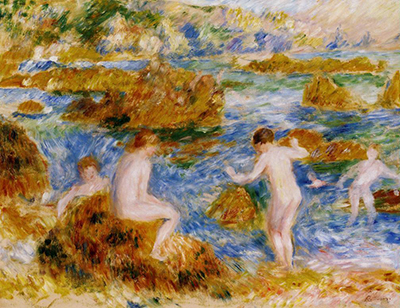
Four boys occupy a rocky shore. One sits with his back to us at the lower left, another leans towards the water, a third stands farther out, and the smallest figure appears near the right edge. Blue water moves between ochre and brown rocks. This is the composition reproduced on this page as Pierre-Auguste Renoir’s Nude Boys on the Rocks at Guernsey, catalogued in French as Garçons nus dans les rochers à Guernsey. The exact work was listed by Christie’s in 2002 [1] and Sotheby’s in 2011. [2]
The painting belongs to Renoir’s Guernsey subjects of 1883. Its recent catalogue history gives a firmer starting point than the English title alone: an oil on canvas measuring 47 × 55.9 cm, with a stamped Renoir signature at lower right. The catalogues record earlier owners and exhibitions, but neither establishes a public collection or current place to see the original.
Contents
- The painting at a glance
- Four figures across the shore
- Sea, rock and painted light
- Renoir on Guernsey in 1883
- A different Moulin Huet painting
- A recorded route through collections
- Looking again
Watch: Pierre-Auguste Renoir
Explore a Montmartre dance, a gathering beside the Seine and the drawings behind Renoir’s paintings.
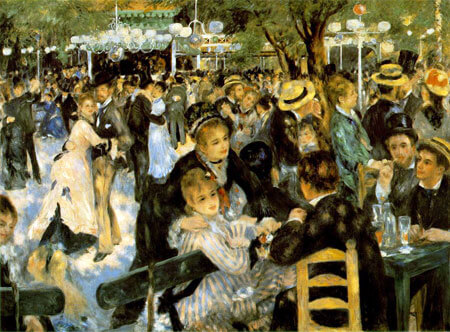
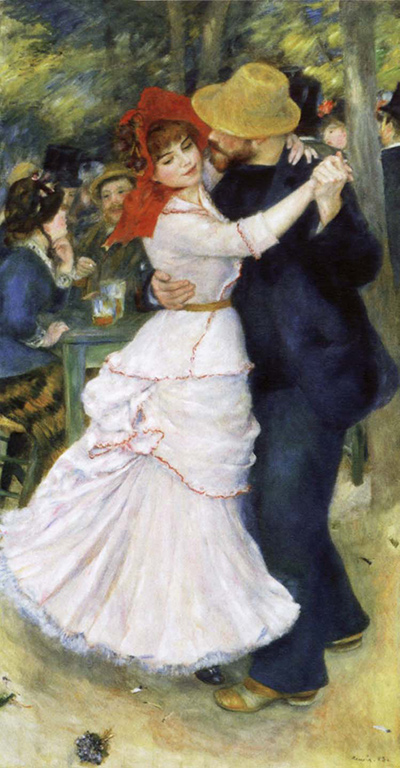
Renoir, Bal du moulin de la Galette
Dr. Beth Harris and Dr. Steven Zucker discuss Renoir’s 1876 Montmartre dance scene, its light and its crowds.
Watch on YouTubeAt a glance
- ArtistPierre-Auguste Renoir (1841–1919)
- French catalogue titleGarçons nus dans les rochers à Guernsey
- English route titleNude Boys on the Rocks at Guernsey
- Date1883, according to Christie’s
- MediumOil on canvas
- Size47 × 55.9 cm (18⅜ × 22¼ in.)
- MarkStamped “Renoir” at lower right, according to both auction catalogues
- Documented saleSotheby’s, New York, 4 May 2011, lot 170
- Current owner or displayNot independently established by the sources consulted
The two auction records agree on the title, medium, dimensions and signature description. Christie’s [1] explicitly dates the painting 1883. Sotheby’s [2] places it in the group made during Renoir’s late-summer stay on Guernsey. Their catalogued image matches the four-figure shoreline scene shown locally. The title describes the subject; it should not be used to identify every Renoir canvas of bathers on Guernsey’s rocks.
Four figures across the shore
The boys are not arranged in a straight row. The seated figure at left anchors the foreground, turning his back to the viewer and looking toward the water. Near the centre, a second boy bends forward from a rock, his hand reaching down. Behind and to the right, another figure stands on the edge of the water. A smaller figure at far right is partly absorbed into the broken line of shore and sea. Their different scales and distances make the scene feel discovered across a stretch of beach rather than posed as a single group.
The largest seated boy is painted in pale peach, cream and blue-gray against a darker, warm rock. His outline is readable, but it is continually interrupted by nearby colour. The central leaning body is lighter and more active. Its angled back and extended arm link the dry rock to the water. At the right, bodies become smaller and less distinct. Renoir lets the eye move from a comparatively clear foreground figure into a busy surface of waves, stone and people.
There is no broad strip of level sand. The rocks create ledges, channels and small places to perch. They also hide parts of the bodies and break the water into patches. The picture’s activity comes from this meeting of uneven ground and shifting sea, as much as from any individual boy’s gesture.
Sea, rock and painted light
Blue runs across much of the canvas, but it does not form an even field. Turquoise, deep blue and near-white strokes suggest water turning around the rocks. Warm ochre, rust and yellow mark the exposed stone. In several places the same short, broken brushwork crosses the boundary between a rock’s edge and the water beside it. The shore stays legible without being drawn with hard contours.
The far band of coast and sky occupies little space. It gives a horizon, then yields attention to the foreground rocks and the spaces between them. The figures’ pale skin catches the eye among the stronger blue and orange-brown passages. Renoir uses this colour contrast to hold the boys in the scene even where their forms are abbreviated.
A small reproduction can make these marks look like a general shimmer. Looking closely reveals different directions: horizontal touches in the distant water, abrupt diagonals along rocks, and curved strokes around shoulders and backs. The picture’s surface connects the bodies to the beach while still allowing the four figures to be counted.
Renoir on Guernsey in 1883
The National Gallery in London [3] records Renoir’s visit to Guernsey in September and October 1883 and explains that his paintings there return to Moulin Huet Bay from different viewpoints. The gallery describes a working method in which oil sketches made on site could become the basis for more finished paintings later. This context does not prove precisely where or in how many sessions the present canvas was made; its individual auction record supplies the date, and the wider museum account explains the group to which it belongs.
In a letter to his dealer Paul Durand-Ruel, quoted in the Sotheby’s catalogue note [2], Renoir described bathers using the rocks as improvised changing places. He was interested in the cluster of people and stone as a source of painting motifs. The boys in this canvas make that relationship visible: they sit, lean and stand where the rocks meet the water. The letter is evidence for Renoir’s response to the Guernsey shore, not a statement naming this particular painting.
Sotheby’s estimates that Renoir made about fifteen paintings on the island and describes varied approaches, from wider views of the bay to groups of figures among rocks. The present work concentrates on bathers. Its figures are prominent enough to give the painting its title, yet they share the picture with an animated seascape. That balance is a distinctive reason to look at it beside the more open coastal studies.
A different Moulin Huet painting
The National Gallery’s Moulin Huet Bay, Guernsey [3] is another Renoir oil of about 1883. Its museum record gives a much wider format, 29.2 × 54 cm, and its own inventory number, NG6204. The gallery purchased that work in 1954. Those details belong to the National Gallery picture, not to this four-boy canvas.
The gallery study is useful for understanding the setting and Renoir’s quick notation of figures, sea and rock. It also shows why the words “Guernsey” and “Moulin Huet” cannot by themselves settle object identity. Dimensions, composition and collection records must travel with the correct image. This page’s four-figure work is the 47 × 55.9 cm painting in the Christie’s and Sotheby’s catalogues.
A recorded route through collections
Sotheby’s 2011 provenance [2] traces the painting through Galerie Renou et Colle in Paris, then Thos. Agnew & Sons in London, which acquired it in 1935. Sir Hugh Walpole acquired it from Agnew that year. The later sequence names Lord Ivor Churchill, Sam Salz in New York by 1956, and William Appleton Coolidge in Boston from 1957. The canvas subsequently passed by descent before sales in 2000 and 2002. Sotheby’s records that it was acquired at the 2002 Christie’s sale and offered again as lot 170 in 2011.
This is a dated auction provenance, not a live ownership register. It should not be turned into a claim that one of those owners still holds the canvas. The original has also travelled for exhibitions: Sotheby’s lists the Tate Gallery in 1947, Guernsey Museum and Art Gallery’s Renoir show in 1988, and the Museum of Fine Arts, Boston, in 1995, among others. An exhibition in a museum does not mean the museum acquired the work.
The inherited local image visually matches the illustrated Christie’s and Sotheby’s lot records. It is retained under the owner-declared public-domain legacy-image policy. A larger exact-work reproduction on Wikimedia Commons [4] names Sotheby’s as its source and is marked Public Domain Mark/PD-Art; no replacement is needed.
Looking again
Begin at the seated boy, whose pale back stands against a warm rock. Follow the line through the central figure’s reaching arm into the blue water. Then search for the smaller bodies to the right. Their positions make the eye cross the same channels between rocks that the bathers occupy. Return to the distant shore and notice how little detail Renoir needs to establish a larger bay beyond this close view.
The painting is a scene of children at the water, but it is also a study of connected surfaces: skin, wet stone, moving sea and light. Renoir gives the figures enough presence to animate the coast without allowing them to detach from it.
Renoir artworks directory
Questions about Nude Boys on the Rocks at Guernsey
Christie’s catalogues the exact four-boy painting as 1883, the year of Renoir’s Guernsey visit.
The Christie’s and Sotheby’s catalogues give 47 × 55.9 cm (18⅜ × 22¼ inches), oil on canvas.
No. The National Gallery work is a separate, wider 29.2 × 54 cm oil with inventory number NG6204. This page shows the 47 × 55.9 cm painting of four boys on the rocks.
Yes. Sotheby’s records exhibitions at the Tate Gallery in 1947, Guernsey Museum and Art Gallery in 1988, and the Museum of Fine Arts, Boston, in 1995. Those were exhibitions, not evidence of permanent museum ownership.
The 2011 Sotheby’s listing is the latest exact-work record verified here. It does not establish a current public display location. Consult a current collection or exhibition notice before planning a visit.
Discussion
What do you notice when you return to this Renoir beach scene?
How do the rocks shape where the four figures sit and stand?
Reader Insights
How do the rocks shape where the four figures sit and stand?
Christie’s dates this exact 47 × 55.9 cm canvas to 1883; Sotheby’s records its later sale and exhibitions.
Where does your eye travel between the figures and water?
Join the Conversation
Share a close observation or a source-backed question about Renoir’s Guernsey bathers.
References
- Christie’s, Garçons nus dans les rochers à Guernsey, 2002 lot: exact title, image, 1883 date, medium, dimensions, signature description and provenance View source.
- Sotheby’s, Garçons nus dans les rochers à Guernsey, 2011 lot 170: exact image and dimensions, later provenance, exhibition history and Guernsey context View source.
- National Gallery, Moulin Huet Bay, Guernsey: Renoir’s 1883 visit, working methods and the record for a distinct Guernsey painting View source.
- Wikimedia Commons, exact-work reproduction: image comparison and digital-image credit; marked Public Domain Mark/PD-Art View source.