by Tom Gurney
Tom Gurney BSc (Hons) is an art history expert with over 20 years experience
Published on June 19, 2020 / Updated on October 2, 2026
Email: tomgurney1@gmail.com / Phone: +44 7429 011000
A woman reclines on a shadowed bank, her pale body set against a dark stream and thick vegetation. Her left arm bends back, its hand resting against her thigh, while her right elbow and hand meet the stream. The figure is recognizable as Lise Tréhot, Renoir's frequent model in the late 1860s, yet the title presents her as a nymph from classical myth. A Nymph by a Stream, dated 1869–70, belongs to the National Gallery, London, inventory NG5982. Its surface blurs the border between body, flowers, grass and water without erasing the contrast between the figure and her setting. National Gallery object record. [1]
This is one of Renoir's first painted nudes. It combines a traditional subject with the particular features of a woman he knew. Looking carefully at that combination is more revealing than treating the picture as either a straightforward portrait or a timeless mythological scene. The National Gallery's description asks readers to notice that the bank and brook may not even separate cleanly: water seems to pass between Lise's fingers while her outline dissolves into the landscape. National Gallery, “About the work”. [1]
At a glance
- ArtistPierre-Auguste Renoir
- Date1869–70
- MediumOil on canvas, unlined
- Dimensions66.7 × 122.9 cm
- ModelLise Tréhot, identified by the National Gallery
- CollectionNational Gallery, London
- InventoryNG5982; purchased 1951
Watch: Pierre-Auguste Renoir
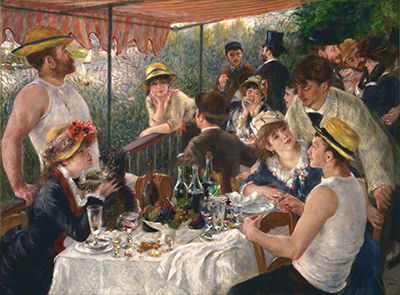
Explore a Montmartre dance, a gathering beside the Seine and the drawings behind Renoir’s paintings.
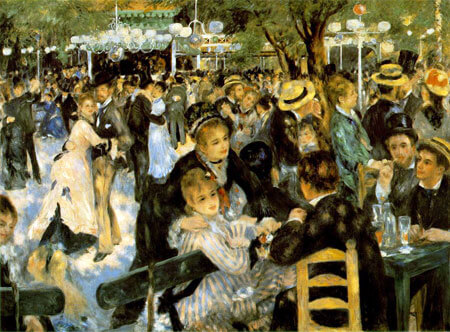
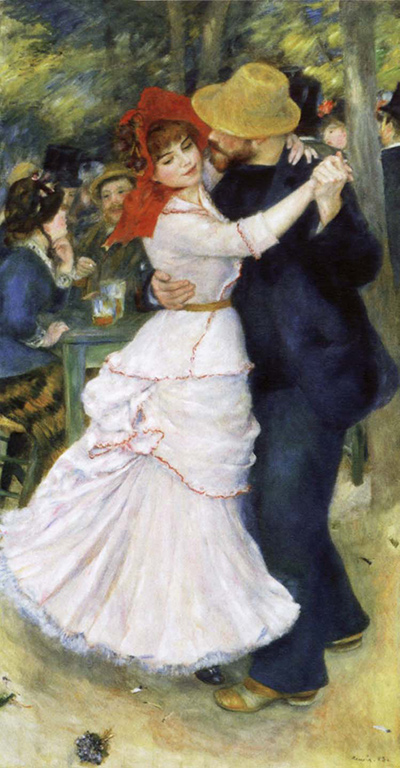
Renoir, Bal du moulin de la Galette
Dr. Beth Harris and Dr. Steven Zucker discuss Renoir’s 1876 Montmartre dance scene, its light and its crowds.
Watch on YouTubeReading the figure and the stream
The picture is unusually wide for a single reclining figure. Its horizontal shape allows plants, water and shadow to surround the body. The pose runs along the bank rather than rising into an upright portrait. Lise looks outward, yet her hair, flower garland and pale limbs are immersed in the landscape's colour. The National Gallery notes that the looseness of the brushwork makes it hard to decide where the bank ends and the stream begins. That uncertainty helps turn a real sitter into a figure associated with water. National Gallery visual analysis. [1]
Look first at the right hand in the water, then move back along that arm to her shoulder and face. The stream's flow gives the hand a gentle action rather than a rigid studio pose. Small white marks among the greenery might read as flowers beside the brook or plants in it. Dark green and brown passages frame the light flesh, whose pink and grey modelling is more varied than a simple white highlight. The clear tonal contrast lets Renoir keep the figure legible even as her edges soften.
The title may have been attached early, but the National Gallery treats its originality as uncertain. It can also be translated as Nymph at the Spring. Neither wording makes the exact place identifiable. A spring or stream is a familiar mythological setting: nymphs are figures linked with natural forces and water. Renoir uses that convention while allowing the sitter's individual face to remain visible. National Gallery title and subject discussion. [1]
Lise Tréhot: model, likeness and limits
The National Gallery identifies the woman as Lise Tréhot, Renoir's companion and a model in more than twenty paintings during the early part of his career. This identification matters because a named person can be lost behind a mythological title. Lise's features are not idealized into an anonymous classical type. At the same time, the picture does not tell us what she thought about the sitting or how she wished to be represented. Those are different questions from whether her likeness is recognizable. National Gallery record. [1]
Lise posed for Lise with a Parasol, where clothing, sunlight and the scale of a standing figure produce another kind of presence. In A Nymph by a Stream, the natural setting has a more explicit symbolic role. Comparing the two works shows Renoir using the same model for very different pictorial ideas, rather than documenting two everyday moments in Lise's life.
The National Gallery suggests that Renoir's Woman of Algiers in Washington may have been conceived as a companion painting. The pictures are close in size, and the figure is reversed; Lise appears clothed in the Washington canvas. “Presumed companion” remains a qualified relationship, not proof of an original hanging arrangement. Both images show how a real model could be transformed through established artistic themes. National Gallery comparison. [1]
A traditional subject, painted differently
Nudes beside water were familiar in European art well before Renoir. The National Gallery points to Ingres and Courbet as artists who had recently treated related themes. Renoir could therefore work within an accepted artistic subject while testing his own handling of colour and surface. The theme provided permission for a nude in a landscape; the brushwork kept the figure from looking like a polished, isolated statue. National Gallery interpretation. [1]
There is no need to call this an Impressionist outdoor sketch. The museum dates it 1869–70, before the first independent Impressionist exhibition in 1874. Renoir was already exploring lively paint and light, but the controlled, horizontal figure composition belongs as much to a long history of mythological painting as to his later modern-life scenes. The relation between a known sitter and an inherited subject is part of the experiment.
The picture also raises a useful question about naturalism. Lise is recognizable, and water appears to move through her hand. Yet the garland, title and possible companion painting place her in an invented setting. Renoir asks the viewer to accept both a particular human face and a generalized nymph. The painting's interest lies in the friction between those readings.
Ownership and evidence gaps
The National Gallery records that Prosper Gamy acquired the canvas from Renoir and sold it to Paul Rosenberg in 1917. It later passed through the Freund-Deschamps Collection and a 1927 Paris sale before appearing with Sir Victor Schuster in London in 1942. The gallery purchased it from Lefevre Gallery in 1951. These are recorded milestones, not a continuous account of every hand and location. National Gallery provenance. [1]
The museum marks the picture as having incomplete provenance for 1933–45. That flag should be visible rather than smoothed over by the surrounding chronology; it does not, by itself, establish a specific loss or restitution event. Readers tracing its history should consult the gallery's current provenance notice and ask what documentation fills the intervals between the recorded transactions. National Gallery provenance notice. [1]
The page uses an independently photographed, cropped image of the National Gallery canvas by Rainer Halama (Wuselig). The Commons file page [2] gives a CC0 dedication and identifies the image as the photographer’s own work. The museum’s object record remains the source for the painting’s title, date, dimensions and history.
Looking again
Return to the bent left arm and the hand resting against her thigh. Follow the right hand into the stream. The woman is both distinct from and visually entangled with the foliage. Renoir's early nude uses a recognizable sitter, a traditional nymph title and uncertain boundaries between figure and place. Those choices make the painting more complex than a simple exercise in attractive surface.
Renoir artworks directory
Questions about A Nymph by a Stream
The National Gallery identifies her as Lise Tréhot, Renoir's companion and a frequent early model. The painting presents her through a mythological nymph subject.
The National Gallery dates it 1869–70. It is an oil on canvas measuring 66.7 × 122.9 cm.
The title evokes a nymph and a spring or stream. The museum does not identify a specific site, and Renoir's fluid handling leaves the border of bank and water ambiguous.
It belongs to the National Gallery, London, inventory NG5982, purchased in 1951. Check the museum's current record for display information.
Discussion
What do you notice when you return to A Nymph by a Stream?
Where can you still see the border between Lise’s body and the stream?
Reader Insights
Where can you still see the border between Lise’s body and the stream?
The National Gallery identifies Lise Tréhot while keeping the title’s origin qualified.
How does a recognizable model change your reading of a mythological nymph?
Join the Conversation
Share a close observation or a source-backed question about Renoir’s A Nymph by a Stream.
References
- National Gallery, A Nymph by a Stream, NG5982, object data, model and title discussion, visual analysis, provenance and incomplete-history notice View source.
- Whole-work web photograph: Rainer Halama (Wuselig), cropped A Nymph by a Stream photograph on Wikimedia Commons, CC0 on the file page. Matched to National Gallery NG5982 View source.