by Tom Gurney
Tom Gurney BSc (Hons) is an art history expert with over 20 years experience
Published on June 19, 2020 / Updated on October 2, 2026
Email: tomgurney1@gmail.com / Phone: +44 7429 011000
Four people pause beside the Seine. Three stand in long grass on the near bank; a fourth looks back from a slender boat whose bow runs out of the frame. Across the river, a sail, other small craft and low buildings make the water feel like a place of regular activity. Pierre-Auguste Renoir painted Oarsmen at Chatou in 1879. The canvas belongs to the National Gallery of Art, Washington, accession 1951.5.2. Its own collection record fixes the title, date, medium and dimensions, while the gallery's educational study gives further context for rowing at Chatou. NGA object record [1]; NGA, Picturing France, p. 62. [2]
This is a painting about a threshold. The boatman is in the water but still close enough to speak to people ashore. The standing figures face different ways, and the far bank is open to view. Renoir made a leisure scene without pinning it to one documented outing or a named group portrait. The painting's broad surface, 81.2 × 100.2 cm, gives the boat and water as much space as the people. NGA object record. [1]
At a glance
- ArtistPierre-Auguste Renoir
- Date1879
- MediumOil on canvas
- Size81.2 × 100.2 cm
- SettingSeine at Chatou, west of Paris
- CollectionNational Gallery of Art, Washington
- Accession1951.5.2
- Exhibition notePossibly the seventh Impressionist exhibition of 1882, as Canotiers
Watch: Pierre-Auguste Renoir
Explore a Montmartre dance, a gathering beside the Seine and the drawings behind Renoir’s paintings.
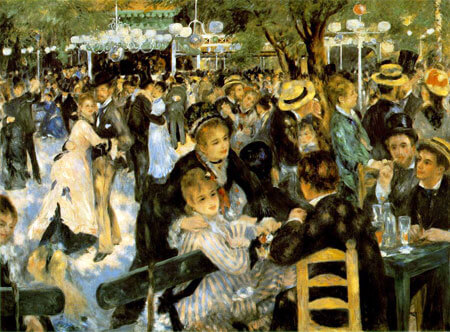
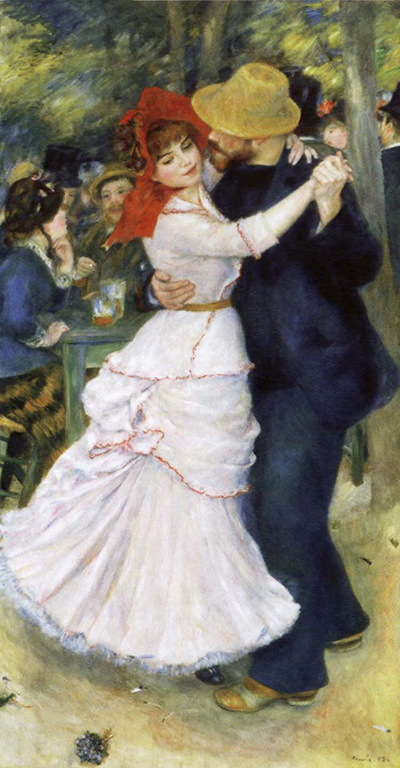
Renoir, Bal du moulin de la Galette
Dr. Beth Harris and Dr. Steven Zucker discuss Renoir’s 1876 Montmartre dance scene, its light and its crowds.
Watch on YouTubeLooking from bank to river
Begin with the diagonal boat. It enters near the figures and points to the right edge, drawing the eye out across the broad horizontal river. The person inside turns back rather than rowing away. On land, the man in the pale jacket looks across the water; the woman in pink and blue is angled towards the viewer; another man at the left is partly enclosed by foliage. The four bodies make a loose group, but there is no single shared gaze or action. The NGA's visual description identifies the same arrangement of three standing figures and one seated rower. NGA visual description. [1]
The tilted hull supplies a clear, solid line through an otherwise shifting picture. Water, grasses and sky are built with smaller broken marks. White and blue touches make the river flicker. Warmer red and orange passages in the boat and the woman's clothes answer the cooler water. The NGA teaching guide uses this painting to discuss complementary colour and asks readers to compare the strokes in grass, ripples and clouds. Those questions point to a visible difference in handling; they do not require a claim that Renoir followed one strict colour system. NGA, Picturing France, pp. 61–62. [2]
The far bank is more than a blue horizon. It has a sail, barges or other boats and buildings among trees. Those details locate the foreground party within a worked and visited river landscape. Renoir gives the viewer a high enough position to look over the boat and into the water. The cropping at the right makes the craft feel larger than the visible canvas; it does not prove that this was a spontaneous, unplanned snapshot. The placement of figures and hull is a composition Renoir chose.
Why Chatou mattered
Chatou, on the Seine west of Paris, was associated with rowing and other suburban leisure. The NGA guide explains that a gig like the one pictured could take two people: a rower faced a companion who could steer with rudder ropes. It describes restaurants on the opposite bank as places for boaters to finish an afternoon. These contextual details help explain the social world Renoir evokes, though they do not establish that a particular restaurant or boating trip is represented here. NGA, Picturing France, p. 62. [2]
Rail access and river recreation made places such as Chatou familiar subjects for artists painting modern life. Leisure required equipment, transport, businesses and labour; the picture shows the pleasurable surface of that system. The foreground group is dressed for an outing, not for rowing as paid work. On the far bank, buildings and passing vessels keep the river from becoming untouched countryside. Renoir joins social figures to landscape instead of choosing one genre alone.
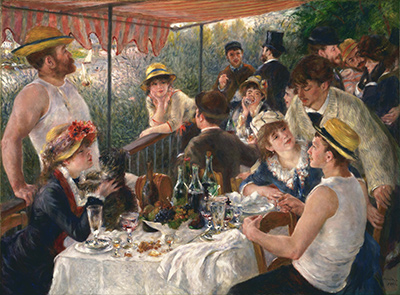
Another useful comparison is Renoir's Luncheon of the Boating Party, painted later around the restaurant of the Maison Fournaise at Chatou. Both pictures concern river leisure, but the later composition crowds the viewer with a named social circle at a meal. Oarsmen at Chatou opens out across the river and leaves the group's moment unresolved. The two paintings should be read as different works, rather than as a preliminary and final version of the same scene.
Can the figures be named?
The NGA's educational guide suggests that the rower may be Renoir's brother Edmond and identifies two people on the bank as Gustave Caillebotte and Aline Charigot. The rower's identification is expressly tentative there. The NGA's current collection page describes the figures by appearance and position, without recording those names as secure object data. This page therefore treats the guide's proposal as an interpretation, not as a proven roll call. Even if one likeness were accepted, the canvas would not become a record of a precisely dated meeting. NGA object record [1]; NGA, Picturing France, p. 62. [2]
The naming question can distract from what the canvas does show: the boatman is ready to communicate with the people ashore, and the people are not posed as one formal portrait. Renoir places different forms of attention across the foreground. Looking at their direction and distance offers a firmer reading than inventing a conversation between them.
Exhibition and ownership
The National Gallery lists a possible appearance at the seventh Impressionist exhibition in 1882, under the title Canotiers, catalogue number 151. That record is explicitly qualified. It would be too strong to state that the Washington canvas is conclusively the work in the 1882 catalogue. The uncertainty is especially useful here because generic rowing titles can refer to more than one painting. NGA exhibition history. [1]
The documented later ownership is clearer. Renoir sold the canvas to the dealer Paul Durand-Ruel in 1911. Durand-Ruel sold it to Arthur B. Emmons in 1912. After Emmons's 1920 sale, the work passed through Durand-Ruel and M. Knoedler & Co.; it was sold in 1922 to Adolph Lewisohn. His son Sam A. Lewisohn inherited it, and the work came to the National Gallery as a 1951 bequest. This chain is drawn from the NGA's provenance record and should not be stretched backwards into an undocumented account of the painting's first three decades. NGA provenance. [1]
The Washington accession number is a practical way to keep this canvas distinct from Renoir's other river and boating pictures. The NGA's record also marks the object image public domain, allowing the same painting shown in its collection entry to be used here. Current display status should be checked at the museum rather than inferred from its ownership. NGA object and media record. [1]
Looking again
Trace the boat from the bank to the right edge, then return through the blue water to the distant sail. Notice how the pale jacket stands out against the river, while the leftmost figure dissolves more into bank and foliage. Renoir lets people, light and place share attention. The scene has the appearance of a passing summer encounter, but its balance of strong boat diagonal and soft river texture is deliberate.
Renoir artworks directory
Questions about Oarsmen at Chatou
The National Gallery of Art dates its canvas to 1879. It is an oil painting measuring 81.2 × 100.2 cm.
Three figures stand on the bank and a fourth sits in the boat. An NGA educational guide proposes names for some of them, but its rower identification is tentative and the current object record does not establish a secure full identification.
The NGA lists the match with an exhibited work called Canotiers as possible, not certain.
It belongs to the National Gallery of Art, Washington, accession 1951.5.2. The museum's current record is the best source for display information.
Discussion
What do you notice when you return to Oarsmen at Chatou?
How does the diagonal boat pull your eye from the bank across the river?
Reader Insights
How does the diagonal boat pull your eye from the bank across the river?
The NGA lists a match with the 1882 exhibition work Canotiers as possible, not certain.
What can you see in the figures before trying to give them names?
Join the Conversation
Share a close observation or a source-backed question about Renoir’s Oarsmen at Chatou.
References
- National Gallery of Art, Oarsmen at Chatou, 1951.5.2, object identity, description, provenance, exhibition qualification and public-domain status View source.
- National Gallery of Art, Picturing France 1830–1900, pp. 61–62, rowing context, suggested sitter identities and close-looking discussion View source.
- Whole-work image: NGA official IIIF rendition, public domain per the owning institution; visually matched to accession 1951.5.2 and exported under the existing local filename View source.