by Tom Gurney
Tom Gurney BSc (Hons) is an art history expert with over 20 years experience
Published on June 19, 2020 / Updated on October 2, 2026
Email: tomgurney1@gmail.com / Phone: +44 7429 011000
A seated man studies a sheet of paper beneath a large parasol. His cap rests on his leg, and his shoes extend into the garden foreground. This is Jean Martin, a fictional painter in L’étiquette, a story written by Pierre-Auguste Renoir’s brother Edmond. Renoir’s drawing, On the Terrace of a Hotel in Bordighera: The Painter Jean Martin Reviews His Bill, belongs to the Art Institute of Chicago, accession 1977.491. It introduces a character whose ordinary hotel bill becomes an opening clue to a story about manners and mistaken social rank. Art Institute of Chicago, cat. 12 [1]; paired catalogue essay. [2]
The museum dates the drawing 1881. The first instalment of the illustrated story appeared in La Vie moderne on 15 December 1883. The dates name two different events: making a drawing and publishing an illustration. The story calls its hotel setting Bordighera, in Italy, while the Art Institute says Edmond posed for Renoir in the garden of a hotel in Menton, across the French border. The title therefore identifies the fictional scene, not a documented site of execution. Art Institute paired essay. [2]
At a glance
- ArtistPierre-Auguste Renoir
- Art Institute titleOn the Terrace of a Hotel in Bordighera: The Painter Jean Martin Reviews His Bill
- FunctionIllustration for Edmond Renoir’s L’étiquette
- Date1881, according to the Art Institute; story printed 1883
- MediumConté crayon over pen and brush and black ink on ivory laid paper, now cream-coloured
- Size45.2 × 35.4 cm
- CollectionArt Institute of Chicago, Helen Regenstein Collection, 1977.491
Watch: Pierre-Auguste Renoir
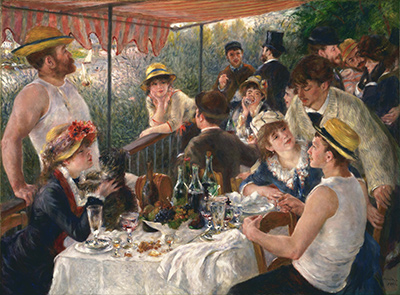
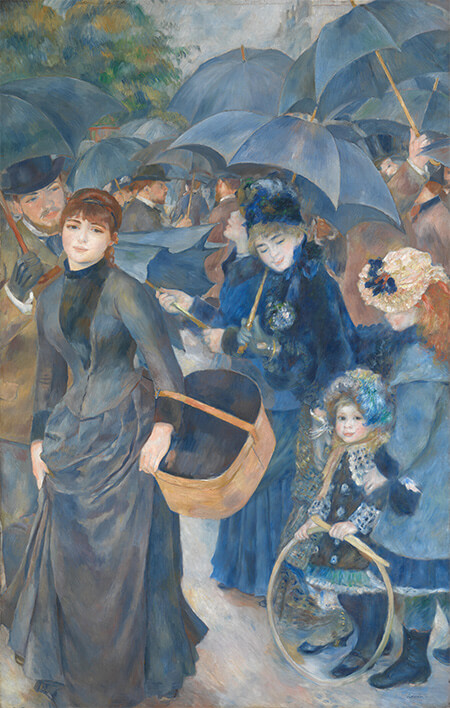
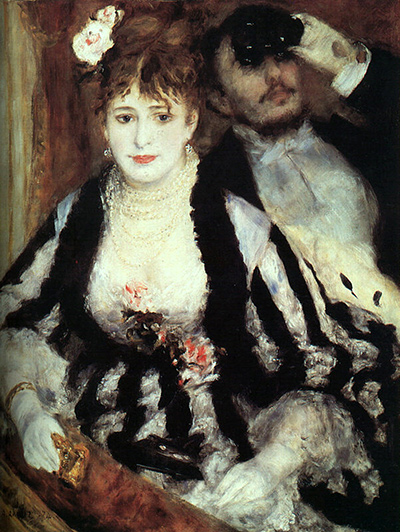
Explore a Montmartre dance, a gathering beside the Seine and the drawings behind Renoir’s paintings.
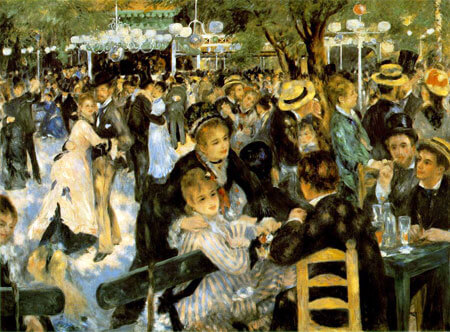
Renoir, Bal du moulin de la Galette
Dr. Beth Harris and Dr. Steven Zucker discuss Renoir’s 1876 Montmartre dance scene, its light and its crowds.
Watch on YouTubeWhat is Jean Martin reading?
The drawing accompanies the opening of Edmond’s story. Jean studies an itemized hotel bill and pauses over a charge for paper: 3.75 francs. Once he understands that the charge is for writing paper, the unexpected item makes him smile. Renoir shows a moment of concentration rather than an argument with hotel staff. Jean’s open posture, carefully placed cap and relaxed seat keep his puzzlement within the story’s theme of polished behaviour. Art Institute essay, with quotation from the story [2]; Musée d’Orsay’s presentation of L’étiquette. [3]
The narrative’s central confusion is larger than the bill. Other guests take Jean for a prince travelling incognito, though he is actually a painter. His composure helps make the mistake plausible. Later, he falls for Hélène, a banker’s daughter, and her father welcomes the supposed prince before learning his profession. The first drawing gives the reader time to look at Jean before the social comedy unfolds. Its companion, The Descent from the Summit, places Jean beside Hélène later in the story. Art Institute paired essay. [2]
Edmond as model and storyteller
The Art Institute identifies Edmond Renoir as the sitter for the Jean Martin drawing. That does not turn the fictional painter into a portrait of Edmond in every respect. Edmond supplied the words and posed while the brothers travelled together in southern France; Renoir translated his appearance into a character on the page. Earlier writers sometimes identified the figure as Renoir’s friend Paul Lhote, but the museum explains the history of that identification and favours Edmond. Art Institute catalogue essay. [2]
The stated destination in the title is another place where fiction and the brothers’ travel can blur. Bordighera is where the narrative places the terrace. The catalogue says the model sat in Menton. The drawing may use things Renoir saw on that journey, but a viewer cannot treat every building or plant as a topographical record of Bordighera. The parasol, chair and terrace do enough to establish a warm coastal hotel setting for a magazine reader. Art Institute catalogue essay. [2]
How the drawing works on paper
This is a combination of ink and Conté crayon, rather than a painting. The Art Institute’s technical report says Renoir worked out the composition mainly in pen and black ink. Fine lines shape Jean’s face and his grip on the bill. Closely spaced lines and hatching build middle tones; brush and ink supply stronger darks in his shoes, hair and hat, as well as elsewhere in the garden. Conté crayon adds softer tone to his clothes and the shaded underside of the parasol. Art Institute technical report. [1]
Renoir also leaves the paper visible in parts of the building, parasol and foreground, so the blank support can read as sunlight. The Art Institute describes the sheet as moderately textured ivory laid paper, now discoloured to cream. Crayon catches on that texture, making the shading grainy. The left margin appears to have been folded back early in the drawing’s life; the museum notes media along the fold. These material details make it possible to see the sheet as a working object, designed for illustration and later kept as an artwork. Art Institute object and conservation record. [1]
The catalogue calls attention to the controlled contrasts needed for reproduction in print. It also notices loose marks near the bottom of the sheet, where Renoir seems to have worked excess ink from his nib and brush. Those marks are not scenery to decipher. They show the practical side of preparing a drawing for a magazine. The museum reports no visible compositional revisions under its examination conditions and no drawing on the reverse. Art Institute essay and technical report [2]; cat. 12. [1]
From La Vie moderne to Chicago
Edmond’s illustrated story appeared in La Vie moderne in December 1883. The Art Institute dates the first instalment to 15 December and records this drawing as illustrated there. The magazine had been initially backed by Renoir’s patrons Georges and Marguerite Charpentier. A collaboration between Renoir and his brother thus reached readers through a journal linked to the artist’s own circle. The drawing has a clear job in that setting: it introduces Jean and his social poise before the plot turns on a mistaken identity. Art Institute catalogue essay [2]; cat. 12 references. [1]
The object’s later history is unusually well documented and includes a forced seizure. The Art Institute traces it to Charlotte Labille by 1925 and Paul Rosenberg by September 1940. Nazi agents confiscated it from Rosenberg in Bordeaux that month; it passed into Hermann Göring’s collection and through an exchange in 1942. A Swiss court ordered its return to Rosenberg in June 1948. The museum records its later passage through the Rosenberg family and E. V. Thaw and Company, from which Chicago bought it in 1977. This provenance belongs to the drawing’s history and should not be omitted when presenting its path to the present collection. Art Institute provenance and notes. [1]
Looking again
Start with the small bill in Jean’s hand. Follow his glance to it, then notice how the chair, cap and parasol hold his figure within the larger garden scene. The dark accents make his seated outline clear even at magazine scale. Knowing the story changes the sheet from a pleasant travel scene into the introduction to Edmond’s wry tale: an ordinary painter will be treated like a prince.
Renoir artworks directory
Questions about On the Terrace of a Hotel in Bordighera
Jean Martin is fictional. The Art Institute identifies Edmond Renoir as the man who posed for the drawing, while Edmond also wrote the story.
Bordighera is the story’s setting. The Art Institute says Edmond posed for this drawing at a hotel garden in Menton. The title should not be read as a verified production address.
The Art Institute dates the drawing to 1881. The illustrated story appeared in 1883. They are object and publication dates respectively.
It was confiscated from Paul Rosenberg in 1940, moved through Hermann Göring’s collection, and returned to Rosenberg in 1948, according to the Art Institute’s provenance record.
Discussion
What do you notice when you return to On the Terrace of a Hotel in Bordighera - The Painter Jean Martin Reviews his Bill?
How does the small bill in Jean Martin’s hand hold your attention beneath the broad parasol?
Reader Insights
How does the small bill in Jean Martin’s hand hold your attention beneath the broad parasol?
The fictional setting is Bordighera; the Art Institute says Edmond posed for Renoir in Menton.
Which parts of the sheet show Renoir working with ink, and which with Conté crayon?
Join the Conversation
Share a close observation or a source-backed question about Renoir’s On the Terrace of a Hotel in Bordighera - The Painter Jean Martin Reviews his Bill.
References
- Art Institute of Chicago, cat. 12, object, technical and provenance record. Accession, medium, measurements, technical observations and ownership history View source.
- Nancy Ireson, Art Institute of Chicago, paired essay on the L’étiquette illustrations. Story, Edmond’s role, travel context and magazine use View source.
- Musée d’Orsay, presentation of Edmond Renoir’s L’étiquette. Primary story context View source.
- Whole-work image, Art Institute Open Access record 94131 View source.
- Whole-work image, official IIIF image View source.