 by Tom Gurney
Tom Gurney BSc (Hons) is an art history expert with over 20 years experience
Published on June 19, 2020 / Updated on October 2, 2026
Email: tomgurney1@gmail.com / Phone: +44 7429 011000
Renoir's name is attached to many polished sayings. His surviving letters sound less like a book of maxims: they discuss paintings under way, other artists, patrons, travel, money and illness. The quotations below come from short extracts of catalogued autograph letters published in the Louvre's collection records. They are given in French, the language in which Renoir wrote, with brief English translations made for this page. The museum identifies each original letter by inventory number; its short published excerpts are more traceable than unattributed quote graphics. Louvre collections, Renoir's letters to Théodore Duret [1]; Louvre collections, Renoir's letters to the Charpentiers. [2]
Contents
- On seeing the whole painting
- On fellow artists
- On patrons and changing taste
- On money and work
- On illness in 1886
- How to read a Renoir quotation
- Sources
Watch: Pierre-Auguste Renoir
Explore a Montmartre dance, a gathering beside the Seine and the drawings behind Renoir’s paintings.
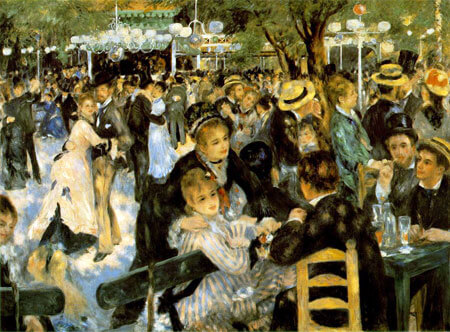
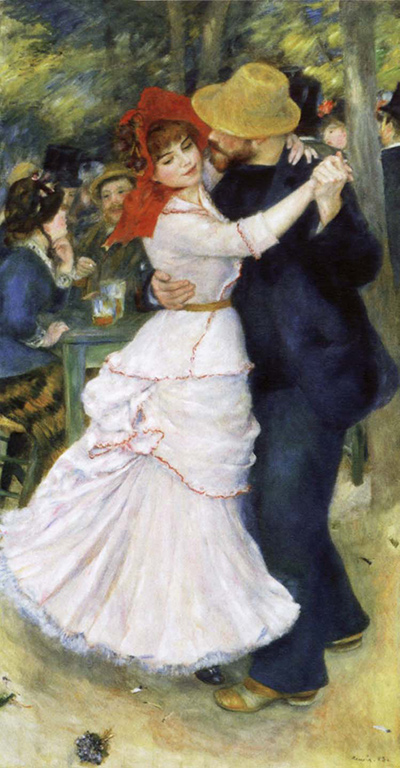
Renoir, Bal du moulin de la Galette
Dr. Beth Harris and Dr. Steven Zucker discuss Renoir’s 1876 Montmartre dance scene, its light and its crowds.
Watch on YouTubeOn seeing the whole painting
“J'ai fini par ne plus voir que les grandes harmonies”
Translation: “I came to see only the great harmonies.” In an undated letter from L’Estaque to Madame Charpentier, Renoir discusses his Italian journey, Raphael and his own progress. The longer passage contrasts broad harmonies with small details that, in his image, extinguish rather than kindle the sun. The Louvre catalogues the letter as A 3607. The date is not supplied in the record, so the quote should not be placed in a precisely dated “1882 manifesto” without further evidence. Louvre, letter A 3607. [2]
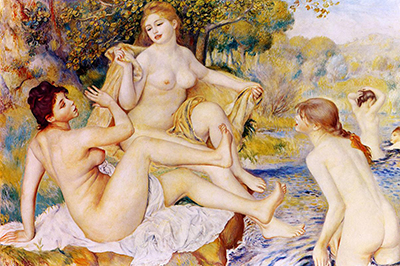
It is tempting to treat a single sentence as a complete theory of Renoir's style. Its immediate context is more specific: a painter reporting his way of looking after travel in Italy. It helps explain why the early 1880s were a period of reconsideration, yet it does not mean Renoir stopped attending to surfaces or details. In The Large Bathers, for example, a more deliberate figure structure coexists with a lively surface; the letter opens a useful question about that balance rather than resolving it on its own.
On fellow artists
“ce grand artiste”
Translation: “this great artist.” Renoir used the phrase for James McNeill Whistler in a letter to Théodore Duret dated Easter Monday 1881. The Louvre's summary says Renoir was pleased to have spent time with Whistler. In the same letter he mentioned work on flowering trees with women and children, a postponed London trip, and the Salon presentation of Portrait des petites Cahen. This makes the phrase evidence of a particular meeting and opinion, not a timeless claim that the painters worked in one school. Louvre, letter A 3581. [1]
“le lutteur joyeux”
Translation: “the joyful fighter.” Renoir addressed Édouard Manet this way in a letter from Capri, 28 December 1881. The Louvre's extract presents affection for Manet's good humour amid unfairness. It is a warm contemporary assessment from one painter to another, written during Renoir's Italian travels. It should not be mistaken for Manet's own words or for a retrospective art historian's verdict. Louvre, letter A 3642. [3]
Those two letters are useful together. Renoir did not write only about his own pictures. His correspondence also places him in a network of artists whose work and reputations mattered to him. The Duret letter is especially concrete: professional admiration appears beside news of his own current paintings and exhibition plans.
On patrons and changing taste
“Ma peinture vous déplaît maintenant.”
Translation: “My painting displeases you now.” Renoir wrote this to Madame Charpentier in November 1894, according to the Louvre's catalogue of letter A 3640. He says the apparent change in her response to his painting is the difficulty he wishes to discuss. The sentence is personal and practical; it should not be recast as proof that all collectors rejected his later work. Louvre, letter A 3640. [4]
The Charpentier family had been important to Renoir's career. His monumental portrait of Madame Georges Charpentier and her children had found public attention at the 1879 Salon. A letter fifteen years later shows that the relationship between an artist and a patron could involve friction as well as support. It also reminds us that “Renoir's style” was not received as one unchanging thing over his long career. Metropolitan Museum of Art, Madame Georges Charpentier and Her Children [5]; Louvre, 1894 letter. [4]
On money and work
“je ne puis arriver à trouver de l'argent nulle part”
Translation: “I cannot manage to find money anywhere.” The Louvre prints this extract from an undated letter to Théodore Duret, inventory A 3577, in which Renoir asks for financial help. Because the letter is undated in the catalogue, it should not be used to claim that a particular painting sold badly or that a specific year was his poorest. It does, however, document that the economics of making a living could be an immediate concern. Louvre, letter A 3577. [6]
The line is less picturesque than the familiar image of a painter absorbed solely in colour and pleasure. It shows why letters matter: they can record a temporary difficulty that a later career summary smooths away. The distinction between a dated professional event and an undated request is part of responsible quotation. The words are genuine as excerpted in the museum notice, but their exact place in a career chronology remains unresolved here.
On illness in 1886
“Je suis pris par des névralgies atroces.”
Translation: “I am seized by terrible neuralgic pains.” Renoir wrote the sentence to Georges Charpentier from Essoyes on 29 December 1886, while sending wishes to the family. The Louvre catalogues the letter as A 3639. It is an immediate report of pain, not a diagnosis supplied by the museum. In particular, it should not be silently turned into evidence for the much later history of the disability associated with Renoir's final decades. Louvre, letter A 3639. [7]
Placing the letter in its dated setting makes the passage more useful. A reader can see both its human force and its limit. Renoir continued to work for decades after 1886; the sentence tells us how he felt at that moment, not how every painting of the period must be explained.
How to read a Renoir quotation
These six excerpts have different kinds of context. The Louvre identifies recipients and dates for four; two remain undated. Its catalogue often summarises a letter and then quotes only a phrase. This page quotes the phrase, not the whole summary as if Renoir had written it verbatim. The English below each phrase is a new translation; differences from other English versions do not by themselves imply a different French original.
There are also levels of confidence. A catalogued autograph letter with an inventory number is an identifiable original object. A short museum excerpt accurately tells a reader what its printed notice reports. The short catalogue extract does not show every sentence in the manuscript, so spelling, punctuation and broader context deserve care. A later memoir or reported conversation could be valuable too, but it would need the witness, publication and date beside it. A sentence reproduced only on quote sites has none of those anchors.
These are physical documents, not a set of maxims Renoir assembled for publication. The Louvre describes the letters as signed autograph manuscripts held in its graphic-arts collection. Its records trace the four letters cited here to the Charpentiers and Manet through Étienne Moreau-Nélaton's 1927 bequest. The two Duret letters were instead bought at a Paris Hôtel Drouot sale on 22 February 1935. Those different acquisition paths help identify the surviving objects; neither an inventory number nor a museum's short extract supplies a complete transcript or a date for an undated letter. Louvre, A 3607 [2]; A 3577 [6]; A 3581. [1]
Renoir artworks directory
Questions about Renoir's words
No. The sourced letter extracts here are in French. The English renderings are translations for readers of this page.
No. The letters to Duret about money and to Madame Charpentier from L’Estaque are undated in their Louvre records. Their place in a timeline needs separate evidence.
Check for a traceable letter, interview or named witness, and then check the exact wording and translation. A memorable line without a source should be described as attributed to Renoir, not quoted as established fact.
The museum records publish selected extracts rather than full critical editions of every letter. Short excerpts let the surrounding date, recipient and topic do more work than an isolated aphorism.
Discussion
Look closely at Quotes and use the questions below to compare what you see with the documented history.
Reader Insights
Which letter extract changes your picture of Renoir as a working artist?
Notice which Louvre letters are dated and which are not.
How might a full manuscript alter the context of one short museum excerpt?
Join the Conversation
Share a close observation or a source-backed question about Quotes. The prompts above are starting points for discussion.
Sources
- National Gallery of Art, Renoir Seated [8], 1949.5.472, Desboutin portrait and public-domain image.
- Louvre, letter to Madame Charpentier from L’Estaque, A 3607. [2]
- Louvre, letter to Théodore Duret, Easter Monday 1881, A 3581. [1]
- Louvre, letter to Édouard Manet, 28 December 1881, A 3642. [3]
- Louvre, undated letter to Théodore Duret, A 3577. [6]
- Louvre, letter to Madame Charpentier, November 1894, A 3640. [4]
- Louvre, letter to Georges Charpentier, 29 December 1886, A 3639. [7]
References
- Louvre collections, Renoir's letters to Théodore Duret View source.
- Louvre collections, Renoir's letters to the Charpentiers View source.
- Louvre, letter A 3642 View source.
- Louvre, letter A 3640 View source.
- Metropolitan Museum of Art, Madame Georges Charpentier and Her Children View source.
- Louvre, letter A 3577 View source.
- Louvre, letter A 3639 View source.
- Renoir Seated View source.
- Lead image credit. Image: Marcellin-Gilbert Desboutin, Renoir Seated, 1877, drypoint portrait of Renoir. National Gallery of Art, 1949.5.472; public-domain image.