Pierre-Auguste Renoir.jpg)
 by Tom Gurney
Tom Gurney BSc (Hons) is an art history expert with over 20 years experience
Published on June 19, 2020 / Updated on October 2, 2026
Email: tomgurney1@gmail.com / Phone: +44 7429 011000
A young woman lowers her eyes to an open book. Her bright hair, pale face and the white pages gather light from an otherwise dark interior. Renoir does not show us the words she is reading. He holds our attention instead on the act: one hand supports the book, the other grips its edge, and the reader appears absorbed. This is La Liseuse, usually translated The Reader, an oil painting made between 1874 and 1876. It belongs to the Musée d’Orsay, Paris, as RF 3757. Musée d’Orsay object record. [1]
The old English page title adds “Young Woman Reading a Book,” a useful description but not a separate museum title. The Orsay record controls the work’s identity and dates. It records no name for the model. A plausible story about who she might be cannot become her identity merely because the image is intimate. Musée d’Orsay, La Liseuse. [1]
At a glance
- ArtistPierre-Auguste Renoir
- Museum titleLa Liseuse
- Date1874–76
- MediumOil on canvas
- Dimensions46.5 × 38.5 cm, without frame
- CollectionMusée d’Orsay, Paris, RF 3757
- Provenance landmarkBequeathed by Gustave Caillebotte; accepted by the French state in 1896
Watch: Pierre-Auguste Renoir
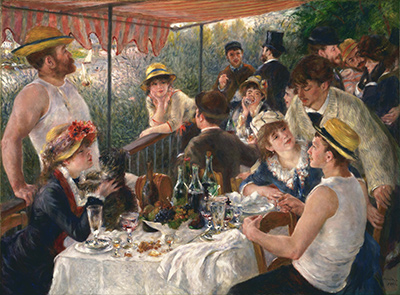
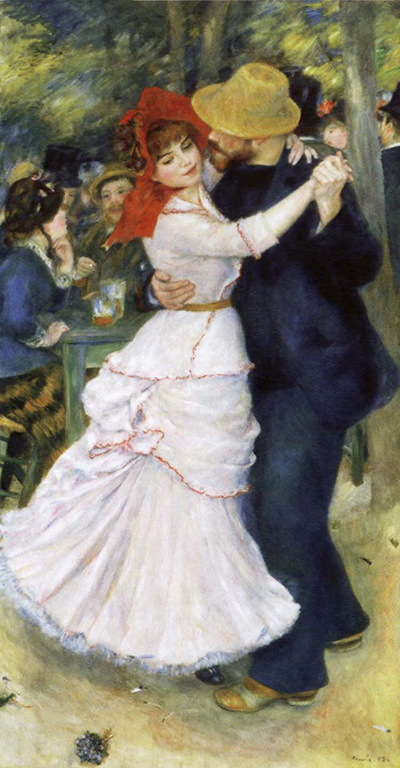
Explore a Montmartre dance, a gathering beside the Seine and the drawings behind Renoir’s paintings.
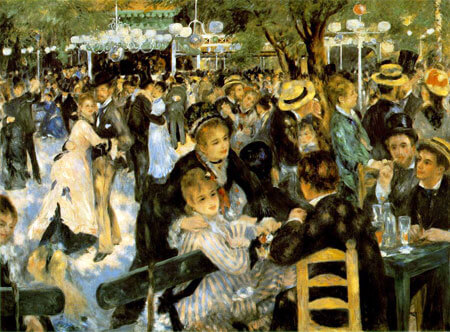
Renoir, Bal du moulin de la Galette
Dr. Beth Harris and Dr. Steven Zucker discuss Renoir’s 1876 Montmartre dance scene, its light and its crowds.
Watch on YouTubeA portrait of attention
The woman’s face turns down and slightly to her right, following the book. Renoir presents her close to the picture plane, from about the waist or chest upward. The book tilts towards us, but its print is too indistinct to read. That choice keeps her reading private while making the viewer aware of it. We cannot identify a particular novel or author from painted pages. The Orsay catalogue records the subject as a half-length figure engaged in reading, rather than a named portrait. Musée d’Orsay object details. [1]
The contrast of light and dark is carefully placed. The pale face and red-gold hair stand against a dark ground; the open pages make a second luminous area below. The woman’s clothing is much darker, so the eye moves between expression and book before exploring the rest of the canvas. The warm hair and cool shadows do not act as a simple outline. Renoir uses short, visible strokes to let colour turn the head and soften its boundary with the surroundings. This is a close reading of the image, not a claim about the sitter’s inner thoughts.
Look especially at the open edge of the book. Its upper page curves and catches light. The dark mass beneath makes that lit paper easier to see, while the reader’s hand anchors it on the right. The sequence of face, page and hand is a small but strong visual circuit. The painting is only 46.5 centimetres high without its frame, so this is an intimate composition in physical scale as well as subject. Musée d’Orsay dimensions. [1]
Date and title
The Musée d’Orsay gives the date as between 1874 and 1876. Older reproductions sometimes use a single year such as 1876; the museum’s range is the safer statement for this particular canvas. Renoir was working in the years of the first Impressionist exhibitions, but the painting’s current record does not tie it to the first group show in 1874. The Orsay exhibition list starts with a Durand-Ruel Renoir show in Paris in 1883, where it appears as catalogue number 23. It also lists an 1891 Brussels exhibition and a further Durand-Ruel show in 1892. Musée d’Orsay date and exhibition register. [1]
The French word liseuse means a woman who reads, or a female reader. It is the museum’s principal title. “The Reader” communicates the subject without identifying the book or the model. The added phrase in this URL, “Young Woman Reading a Book,” describes what viewers can see, but it should not be treated as proof of an artist-given title. The work is signed “Renoir” according to the Orsay object entry. Musée d’Orsay title and inscription. [1]
From Caillebotte’s collection to Orsay
The painting was in Gustave Caillebotte’s collection by 1894, the year of his death. The Orsay provenance explicitly says the date when Caillebotte acquired it is unknown. This is a useful limit: his ownership is documented, but a precise purchase event or direct transaction with Renoir is not. Caillebotte’s bequest was accepted by the French state in 1896 for the Musée du Luxembourg. Musée d’Orsay provenance. [1]
From 1896 to 1933, the canvas was assigned to the Luxembourg museum in Paris. It then passed to the Louvre, including the Jeu de Paume gallery after 1947, before its assignment to the Musée d’Orsay in 1986. Those changes are institutional custody, not a succession of private sales. The museum retains both RF 3757 and the earlier inventory reference LUX 377 in its record. Musée d’Orsay history and identifiers. [1]
The 1883 and 1892 Durand-Ruel exhibitions show that the work circulated publicly before Caillebotte’s bequest. Its later appearances include a 1933 Renoir exhibition at the Orangerie and international loans in the twenty-first century. An exhibition list records that a picture was shown; it does not itself reveal the response of each viewer. For this canvas, the ownership and display sequence is clearer than a detailed story of its earliest reception. Musée d’Orsay exhibition history. [1]
Looking again
Start with the lit hair and follow the reader’s downward gaze to the pages. Then look at the hand on the right edge and at how little of the printed text Renoir supplies. Finally move back into the dark background and notice how it makes the face and book seem close. The painting makes an everyday, quiet activity visible through relationships of scale, light and touch. It does not need a named sitter or a known book to hold that attention.
Renoir artworks directory
Questions about The Reader
The original is in the Musée d’Orsay, Paris, inventory number RF 3757. The museum calls it La Liseuse.
The Musée d’Orsay dates the painting between 1874 and 1876. A single year sometimes found on older reproductions is less precise than that current catalogue range.
No sitter is named in the museum object record, and the book’s text cannot be identified from the painting. Both details should remain unknown.
It was in Gustave Caillebotte’s collection by 1894 and entered the state through his bequest, accepted in 1896. The date on which he had bought it is unknown.
Discussion
What do you notice when you return to The Reader (Young Woman Reading a Book)?
How do the light on the face and the open pages direct your attention?
Reader Insights
How do the light on the face and the open pages direct your attention?
The Musée d’Orsay records Caillebotte’s ownership by 1894 but not his acquisition date.
What can you learn from the woman’s pose without identifying her or her book?
Join the Conversation
Share a close observation or a source-backed question about Renoir’s The Reader (Young Woman Reading a Book).
References
- Musée d’Orsay, La Liseuse, RF 3757. Current object identity, date, size, title, inscription, provenance and exhibition history. The owner’s webpage photographs carry separate RMN photographer credits and are used only for object comparison View source.
- Whole-work image, Sailko’s independent photograph on Wikimedia Commons View source.
- Creative Commons, CC BY 3.0 View source.