by Tom Gurney
Tom Gurney BSc (Hons) is an art history expert with over 20 years experience
Published on June 19, 2020 / Updated on October 2, 2026
Email: tomgurney1@gmail.com / Phone: +44 7429 011000
A woman lies across a cushioned bed with her back towards us. A patterned pillow supports her upper body; a white cloth lies beneath her legs. Renoir lets the line of her back run across almost the full width of the canvas, while the room around her is painted in warm greens, ochres and pinks. The work is Nu couché, vu de dos, also titled Le repos après le bain, in the Musée d’Orsay as RF 1951 16. The museum currently dates it about 1916–17. Musée d’Orsay object record. [1]
The English URL joins the two museum titles: “Reclining Nude from the Back” translates the principal French title, and “Rest after the Bath” translates the alternative. They refer to one painting, not to two objects. An older public collection record and the title of an independent photograph give a date around 1909, so the date disagreement needs to be made visible rather than silently resolved. This page follows the current Orsay record while documenting the older attribution below. Musée d’Orsay [1]; French Ministry of Culture, Joconde record 000PE004093. [2]
At a glance
- ArtistPierre-Auguste Renoir
- Museum titleNu couché, vu de dos; alternative Le repos après le bain
- Datec. 1916–17 in the current Musée d’Orsay record; an older state record gives c. 1909
- MediumOil on canvas
- Size40.5 × 50.3 cm, without frame, per Orsay
- CollectionMusée d’Orsay, Paris, RF 1951 16
- GiftDr and Mme Albert Charpentier, accepted by the French state in 1951
Watch: Pierre-Auguste Renoir
Explore a Montmartre dance, a gathering beside the Seine and the drawings behind Renoir’s paintings.
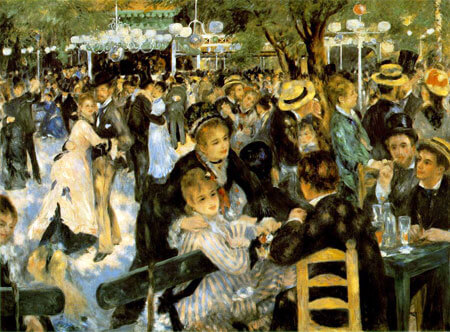
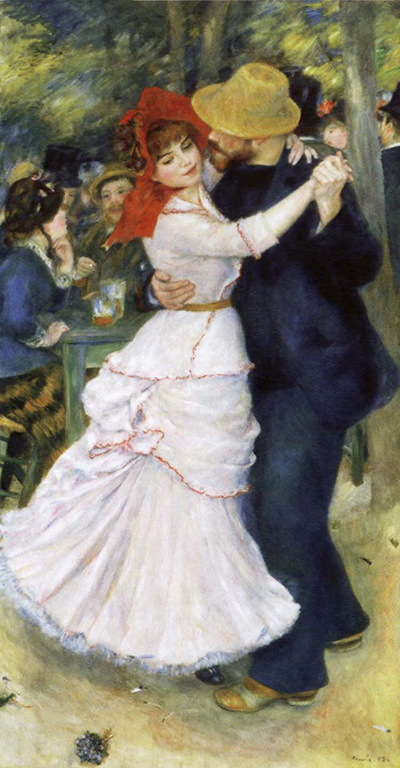
Renoir, Bal du moulin de la Galette
Dr. Beth Harris and Dr. Steven Zucker discuss Renoir’s 1876 Montmartre dance scene, its light and its crowds.
Watch on YouTubeA figure seen from behind
The model reclines diagonally from the lower left towards the upper right. Her legs extend over the edge of a pale cloth, while one arm appears to rest beyond the patterned cushion. Renoir offers little of her face. The viewer therefore reads the pose primarily through the long sweep of her back and the way the torso meets the pillow. That is a visual choice, but the canvas does not disclose a named sitter or the actual circumstances of a bath. The alternative title suggests a moment of rest; it does not turn the picture into a record of a particular day. Musée d’Orsay title and subject data. [1]
The cloth catches light at the lower centre, creating a pale shape beneath the warmer body. The patterned pillow at the right is more detailed in colour than the broad surrounding bedcover. Look at how Renoir repeats pink and orange from the body in nearby fabric, while green and yellow surround it. The figure is distinct from its setting, yet the same soft brushwork moves through both. This is an observation of the image, not a claim that the model and furnishings carried a symbolic code.
The composition is only about half a metre wide. The small scale can make the broad pose feel intimate, particularly because Renoir cuts the scene close to the bed. There is no distant view or architectural setting to lead our eye away. The Orsay record classifies the scene as a woman reclining from behind on a bed with cushion and household linen. The description supports a domestic reading while leaving the room, model and date of any sitting undocumented. Musée d’Orsay dimensions and categories. [1]
Why the date needs a qualifier
The current Musée d’Orsay record assigns the work to around 1916–17. Its page identifies the same accession, title, medium and dimensions that appear in the older French state Joconde record. Joconde gives around 1909 and slightly different rounded dimensions, 41 × 52 cm. The difference is not evidence of two paintings: both records use RF 1951 16, identify the same subject and describe the same 1951 state gift. It is a cataloguing discrepancy for one object. Orsay current record [1]; Joconde historical record. [2]
The independent Commons photograph used on this page also has “1909 ca.” in its old file title. Its photographer documented a museum visit, not a separate dating study. The current owner’s object record is the controlling date for this page; the older label remains useful evidence of why readers encounter conflicting dates elsewhere. A precise year should not be inferred from the subject’s style alone. Orsay [1]; Sailko photograph record. [3]
The later date places the picture near the end of Renoir’s life, when he continued to paint reclining nudes. That general context can help orient a reader, but this canvas’s documented object history remains more secure than any invented account of the model or a studio session. Renoir painted many bathers and reclining women. Similar subject matter is not a license to transfer another painting’s sitter, provenance or technical findings to RF 1951 16.
Ownership and the 1951 gift
The Orsay provenance places the painting in Pierre Decourcelles’s collection until 1926. It was sold at the Hôtel Drouot, Paris, on 16 June 1926, as lot 577, and the dealer Durand-Ruel held it that year. It later belonged to Dr and Mme Albert Charpentier. The French state accepted their gift in 1951 for the Jeu de Paume and assigned the work to the Louvre collection. It moved to the Musée d’Orsay in 1986. Musée d’Orsay provenance. [1]
The Orsay list includes a 1937 Paris exhibition and a 1952 Limoges exhibition devoted to Berthe Morisot and Renoir, followed by international displays in Mexico, Asia and Europe. These entries show the painting’s circulation after Renoir’s death. They do not tell us what the model thought, how the 1926 buyers interpreted it or whether the alternative title was coined by the artist. Musée d’Orsay exhibition history. [1]
The canvas bears a Renoir signature at lower left, according to the museum record. The institutional provenance is a better guide than file names on later reproductions. In particular, the appearance of “1909” in an image title should not overwrite the owner’s updated chronology or lead to an unqualified date in a page heading. Musée d’Orsay object details. [1]
Looking again
Follow the long diagonal of the model’s back, then compare its warm colour with the cooler patches around the pillow. Move down to the bright cloth and the less-defined edge of the bedcover. The picture’s quietness comes from that close, horizontal arrangement and from the figure’s turned-away face. The museum’s two titles point to what we can see: a reclining nude from behind, resting on a bed. The precise experience behind that rest remains outside the painting’s documented record.
Renoir artworks directory
Questions about Reclining Nude from the Back
No. The Musée d’Orsay records both titles for the same canvas, accession RF 1951 16.
The current Orsay record says around 1916–17. An older French state record and an old photograph title say around 1909; the discrepancy is documented rather than silently combined.
It belongs to the Musée d’Orsay in Paris. Dr and Mme Albert Charpentier gave it to the French state in 1951.
The Orsay object record does not identify a sitter. The painting’s subject and alternative title do not establish a name.
Discussion
What do you notice when you return to Reclining Nude from the Back, Rest after the Bath?
How do the warm body, patterned pillow and pale cloth divide the small canvas?
Reader Insights
How do the warm body, patterned pillow and pale cloth divide the small canvas?
The current Orsay record dates RF 1951 16 c. 1916–17, while an older state record says c. 1909.
Which details can you see in the picture without inventing a sitter or a particular bath?
Join the Conversation
Share a close observation or a source-backed question about Renoir’s Reclining Nude from the Back, Rest after the Bath.
References
- Musée d’Orsay, Nu couché, vu de dos, RF 1951 16. Current title, date, dimensions, gift, provenance and exhibition history View source.
- French Ministry of Culture, Joconde record 000PE004093. Same accession and earlier c. 1909 dating; its credited RMN photograph is not reproduced here View source.
- Whole-work image, Sailko’s independent photograph on Wikimedia Commons View source.
- Creative Commons, CC BY 3.0 View source.