 by Tom Gurney
Tom Gurney BSc (Hons) is an art history expert with over 20 years experience
Published on June 19, 2020 / Updated on October 2, 2026
Email: tomgurney1@gmail.com / Phone: +44 7429 011000
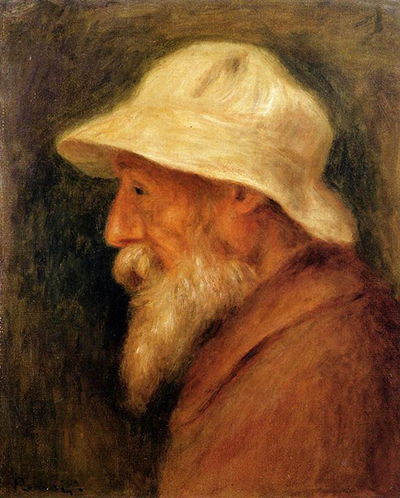
In this portrait, Pierre-Auguste Renoir turns almost entirely to the left. A soft, pale hat caps his head; the nose, moustache and long beard form a profile against a deep green background. The painting is Self-Portrait with a White Hat, or Autoportrait au chapeau blanc, dated 1910 and held in a private collection. A checklist for the Fondation Pierre Gianadda's Renoir exhibition identifies it as an oil on canvas, 42 × 33 cm. Those details anchor the exact image on this route. Fondation Pierre Gianadda exhibition press dossier [1]; Bridgeman Images record. [2]
At a glance
- ArtistPierre-Auguste Renoir
- Exhibition titleAutoportrait au chapeau blanc (Self-Portrait with a White Hat)
- Date1910
- Medium and sizeOil on canvas, 42 × 33 cm
- CollectionPrivate collection in the 2014 exhibition checklist
- Distinguishing viewLeft-facing profile before a dark green background
Watch: Pierre-Auguste Renoir
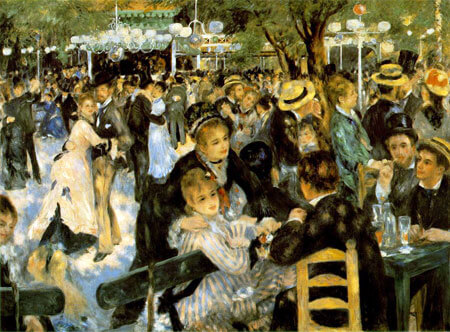
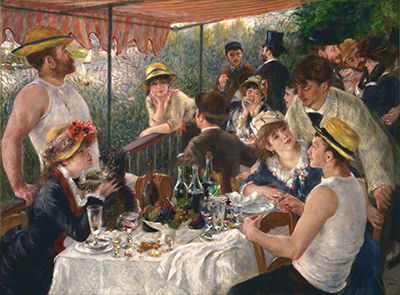
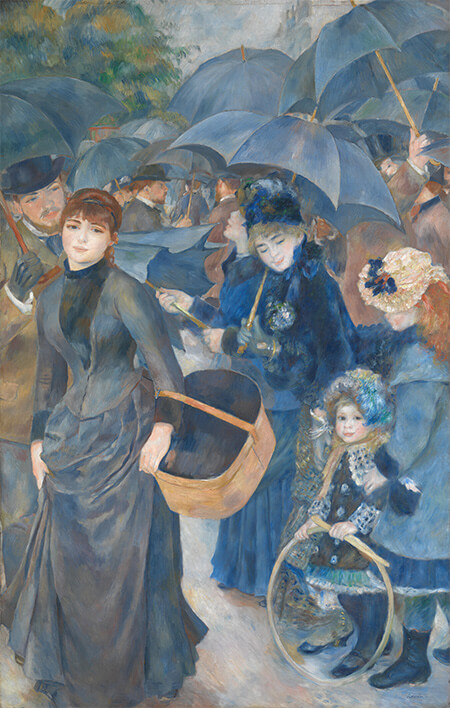
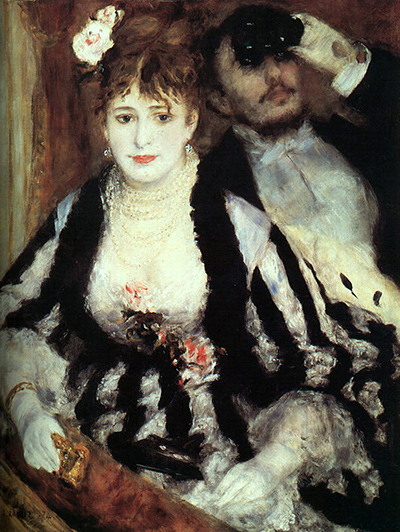
Explore a Montmartre dance, a gathering beside the Seine and the drawings behind Renoir’s paintings.
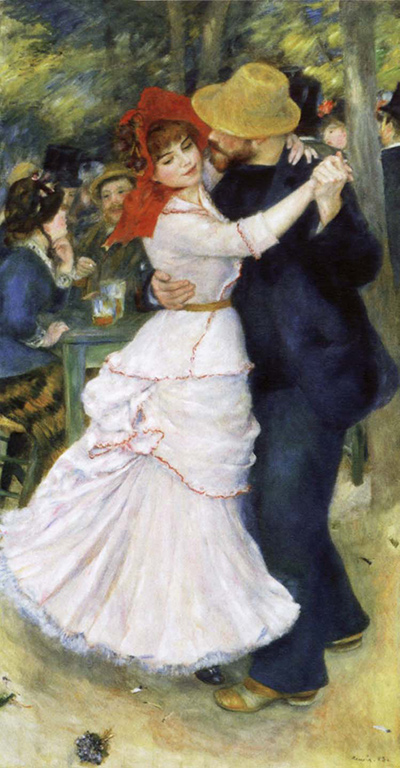
Renoir, Bal du moulin de la Galette
Dr. Beth Harris and Dr. Steven Zucker discuss Renoir’s 1876 Montmartre dance scene, its light and its crowds.
Watch on YouTubeThe white hat is more than a convenient title cue. Its broad, pale surface fills much of the upper canvas and sets the first edge we notice against the dark setting. Renoir places the brighter brim near the brow; below it, the eye is a small dark mark. The downward line of the nose meets the moustache, and the beard hangs past the collar. Few other objects compete with that sequence. This is a portrait built from head, hat, beard and coat rather than the setting of a working studio.
A profile rather than a meeting of eyes
Renoir's 1899 self-portrait at the Clark Art Institute looks outward toward us from beneath a grey hat. Here he shows himself almost from the side. The eye is visible, yet it does not meet the viewer. That choice makes the outline of the face unusually important: hat brim, nose, moustache and beard carry the likeness. We can compare those visible arrangements without claiming the two pictures were conceived as a pair. They belong to different dates and collections. Clark catalogue, 1955.611 [3]; Fondation Pierre Gianadda exhibition dossier. [1]
The pale hat is softly modelled rather than left as a blank white shape. Its crown rises in a rounded mound, while the brim turns down at the sides. Subtle warm and grey strokes make its fabric appear pliable. The beard, too, varies: its light mass has brown and grey passages near the jaw and yellowed cream towards the point. The darker green ground lets these pale forms stand forward. A reddish-brown coat occupies the lower right, linking the warm face to the dark edge of the picture.
The visible canvas texture and soft transitions call for caution. A digital copy records the broad relationships, but it cannot establish every pigment or the exact sequence of Renoir's brushstrokes. Even within this reproduction, the face changes from stronger marks near the nose to less sharply divided cheek and ear. That variation, together with the spare setting, keeps the figure legible without a firm drawn outline around every part.
A documented 1910 canvas
The painting appeared in the Fondation Pierre Gianadda Renoir exhibition materials as Autoportrait au chapeau blanc, dated 1910. The checklist supplies its 42 × 33 cm dimensions and calls the owner a private collection. It also credits Jean-Louis Losi, Paris, for its published photograph. This is evidence for the object and for an exhibition reproduction; it is not a public provenance from Renoir's studio to today's owner. A detailed ownership chain should wait for a catalogue that supplies one. Fondation Pierre Gianadda exhibition dossier, object checklist. [1]
Bridgeman Images [2] also has a matching image record using the English title. The two records support the subject, title and date, while the exhibition document provides the measurements. Neither identifies the exact room where Renoir posed or describes a documented sitting. The profile should not be turned into an invented account of mirrors, a model assisting the artist, or a final declaration about his state of mind.
The image on this page is especially easy to confuse with another 1910 Renoir self-portrait. That other work, shown on this site as Self Portrait III, faces more toward the viewer against a vivid red ground. Its light hat and white beard make the title overlap, but the viewpoint, background and recorded dimensions distinguish the canvases. The white-hat profile here has a dark green setting and measures 42 × 33 cm in the exhibition checklist. Fondation Pierre Gianadda dossier [1]; Commons file for the separate red-background portrait. [4]
Renoir's changing self-image
This picture belongs to a long span of Renoir painting himself. The Clark's circa 1875 portrait is a direct encounter with a dark-haired young man, with lively blue and yellow touches across his face. Its 1899 portrait presents an older Renoir in a grey hat, dark jacket and a room with patterned wallpaper. The 1910 white-hat canvas removes the outward gaze and compresses the setting to a dark field. The changes are visible even without treating the paintings as a planned series. Clark catalogue, 1955.584 [5]; Clark catalogue, 1955.611. [3]
It is tempting to call any late self-portrait Renoir's last. The available exhibition checklist does not establish that this was the final one he painted. There is also the separate red-background portrait dated 1910, and an exact chronology of their execution is not supplied here. The secure statement is narrower and more useful: this is a privately held 1910 oil self-portrait, identified by its white hat, profile and 42 × 33 cm format.
Looking again
Start where the hat's light brim crosses the darker forehead. Follow the nose left to the moustache, then trace the beard down into the coat. Only after reading that outline, look at the green ground. It offers no place or story, but its cool darkness gives the pale hair room to stand out. The picture asks us to recognize a face mostly from its edge, while Renoir keeps the paint soft enough for that edge to change as we look.
Renoir artworks directory
Questions about Self-Portrait with a White Hat
The Fondation Pierre Gianadda exhibition checklist and Bridgeman image record date this private-collection canvas to 1910.
The exhibition checklist records an oil on canvas measuring 42 × 33 cm.
No. This painting shows Renoir in left-facing profile against a dark green background. The separate 1910 self-portrait on this site's “III” route turns more toward the viewer before a red background.
The 2014 exhibition checklist calls it a private-collection work. It does not name the present owner or provide a full ownership chain.
Discussion
What do you notice when you return to Renoir’s Self-Portrait with a White Hat (1910)?
How does a profile view change your encounter with Renoir’s face?
Reader Insights
How does a profile view change your encounter with Renoir’s face?
A Fondation Pierre Gianadda exhibition checklist records this 1910 private-collection painting at 42 × 33 cm.
Which edges stand clear against the dark green background, and which become softer?
Join the Conversation
Share a close observation or a source-backed question about Renoir’s Self-Portrait with a White Hat (1910).
References
- Fondation Pierre Gianadda, Renoir exhibition dossier: checklist title, date, medium, dimensions, private collection and photograph credit View source.
- Bridgeman Images, Self-Portrait with White Hat, asset 5402235: matching subject and English title View source.
- Clark catalogue, 1955.611 View source.
- Commons file for the separate red-background portrait View source.
- Clark catalogue, 1955.584 View source.
- Whole-work image: Wikimedia Commons, Pierre-Auguste Renoir - Autoportrait 5.JPG, a reproduction sourced from the 2009–10 Renoir au XXe siècle exhibition catalogue and marked Public Domain under Commons' faithful-reproduction rationale. The smaller image here follows that file; the exhibition dossier attributes its photograph to Jean-Louis Losi View source.