Pierre-Auguste Renoir.jpg)
 by Tom Gurney
Tom Gurney BSc (Hons) is an art history expert with over 20 years experience
Published on June 19, 2020 / Updated on October 2, 2026
Email: tomgurney1@gmail.com / Phone: +44 7429 011000
A bather leans forward with her hands cupped near the lower edge of a tall sheet. Seen mainly from behind, she turns her face in profile. Renoir surrounded her body with a rough white field on tan paper and built skin tones from red, white and black chalk. Splashing Figure (Study for “The Large Bathers”), dated 1884/85 by the Art Institute of Chicago, is a working drawing connected to Renoir’s extended bathers project. Its accession is 1949.514. Art Institute of Chicago, cat. 19. [1]
The title points toward Renoir’s large canvas in Philadelphia, completed by 1887, but the sheet’s precise place in the sequence is more complicated. The Art Institute’s technical study finds features closer to an earlier Great Bathers arrangement and a related Louvre drawing than to every detail of the final Philadelphia picture. It still treats the Chicago sheet as part of the broader preparatory work for that painting. An exact one-step “final study” label would hide the changes that make this drawing valuable. Art Institute curatorial and technical reports. [1]
At a glance
- ArtistPierre-Auguste Renoir
- Owner titleSplashing Figure (Study for “The Large Bathers”)
- Date1884/85
- MediumRed, white and black chalk, with stumping and black Conté crayon
- SupportTan wove tracing paper laid down on canvas
- SizeApprox. 98.9 × 63.5 cm; the paper’s edges are covered
- CollectionArt Institute of Chicago, bequest of Kate L. Brewster, 1949.514
Watch: Pierre-Auguste Renoir
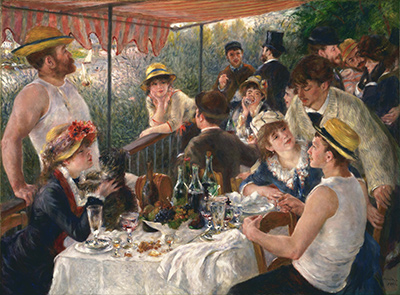
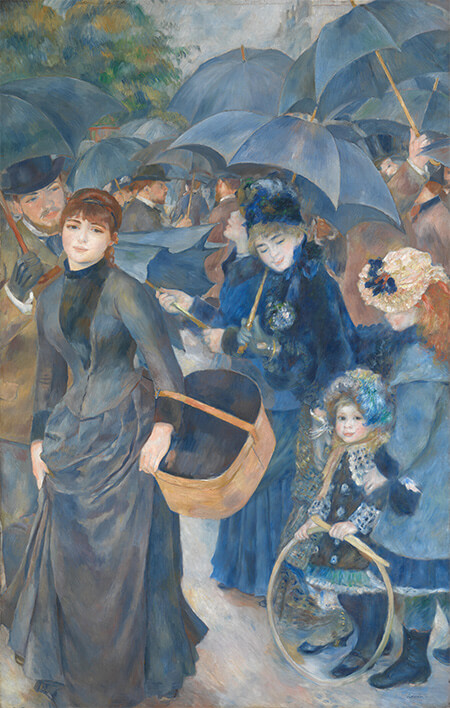
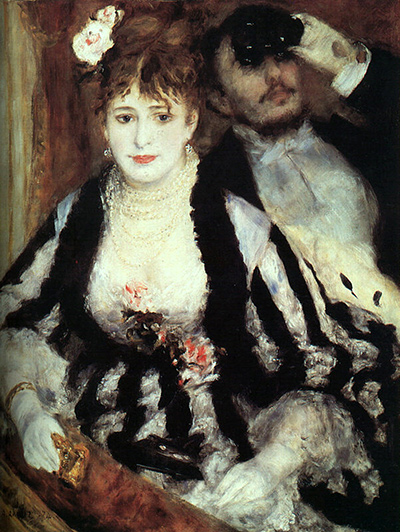
Explore a Montmartre dance, a gathering beside the Seine and the drawings behind Renoir’s paintings.
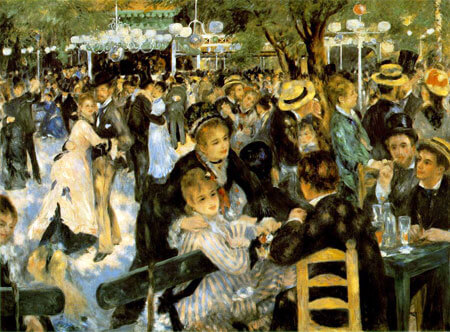
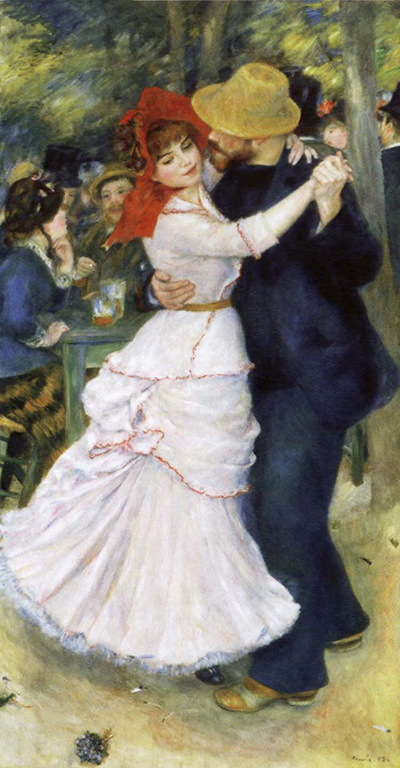
Renoir, Bal du moulin de la Galette
Dr. Beth Harris and Dr. Steven Zucker discuss Renoir’s 1876 Montmartre dance scene, its light and its crowds.
Watch on YouTubeA figure made for a changing composition
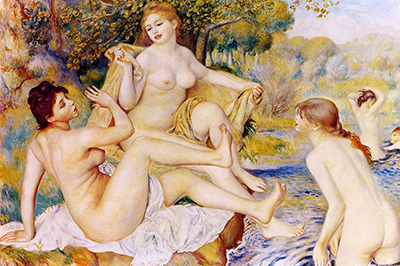
Renoir’s Philadelphia painting, titled The Great Bathers by its owner and often called The Large Bathers, places three larger women at the front of a wooded water scene and two much smaller figures beyond them. The Chicago drawing isolates a version of the figure at the far right. She leans forward, elbows down and hands brought together as if to splash water. The Art Institute counts this among three known studies of that figure. Her back, shoulder, braid and tilted head became a problem Renoir could work through at nearly life size before bringing the figures together on canvas. Art Institute cat. 19 [1]; Philadelphia Museum of Art, The Large Bathers. [2]
The differences matter. In the Chicago sheet, the far-right figure’s hands are cupped. The Art Institute notes that in the finished Philadelphia painting they are flat. Technical examination also found traces of another figure’s foot entering from the left, although it was later erased. The foot’s orientation, and other details of the figure group, point more closely to the earlier Great Bathers and the Louvre’s Three Bathers by the Water. Renoir was not simply copying a settled final composition. He was testing bodies and their relationships across a series of versions. Art Institute technical analysis. [1]
The museum cannot say with certainty who removed the foot. Renoir may have erased it while concentrating the sheet on one figure; someone else may have altered a once-larger composition later. The paper edges are hidden by tape and mounting, so the apparent cutting down of the support also remains an inference from the surviving evidence. What is secure is that ultraviolet and infrared examination revealed the foot and visible reworking elsewhere in the figure. Art Institute catalogue and technical reports. [1]
Three chalks on tan paper
Renoir used a version of the traditional three-chalk technique: white, red and black on a mid-toned ground. The Art Institute’s conservator reconstructs a broad working order from the material. Black chalk first set out the figure; a white chalk layer then occupied the body and some space around it. Renoir blended that pale layer into the paper with a stump or rag. Red and black marks supplied warmer skin colour, contours and shadow, while rubbed-down passages exposed the white underneath as highlights. This is why the figure can seem luminous although the paper around her is brown. Art Institute technical report. [1]
The white is not a neat outline. It spreads beyond the shoulders and torso in an irregular halo, with streaks where the chalk was moved across the paper. Darker strokes over white can read almost blue, an effect the museum connects with the sense of veins below skin. The sharply drawn strands near the ear and the thick braid contrast with broad, rubbed areas of back and shoulder. Renoir appears to have used a harder dark medium, possibly black chalk dampened or Conté crayon, for some fine details. Art Institute essay and technical report. [1]
The hands show revision more clearly than many other parts. The museum finds an earlier position underneath the current, higher and more acute cupped shape. It also documents changes to the arms, torso and the angle of the head. Even with a firmly outlined figure, the drawing is a record of choices still being made. The lower horizontal dark line hints at a waterline without requiring Renoir to develop an entire landscape on this sheet. Art Institute conservation report. [1]
Paper, mount and later history
The drawing is on thin tan wove paper, mounted overall onto canvas and stretched. The Art Institute says the paper has discoloured from an originally lighter tan and bears some surface wear. The exact paper dimensions are approximate because the edges are covered. The canvas mount helps explain how such a large chalk drawing survives as an object, but it can also conceal evidence about the sheet’s original extent. Art Institute support and condition report. [1]
Its later ownership runs from the dealer Ambroise Vollard through a documented 1925 sale to Bernheim-Jeune, then to Walter and Kate Brewster in 1926. Kate Brewster bequeathed the work to the Art Institute, which received it in 1949. This provenance is separate from the question of exactly how the drawing relates to the painting: the museum can document its modern journey more closely than every step of Renoir’s studio process. Art Institute provenance. [1]
Why the study matters
Renoir worked on bathers through numerous drawings and versions. Berthe Morisot recorded seeing a group of related studies in his studio in 1886, according to the Art Institute’s cited correspondence. The Chicago sheet gives a viewer evidence of that sustained work: areas built up, rubbed back and altered, alongside a trace of a neighbouring figure now absent. The final Philadelphia painting may look like a single settled image; this sheet shows how many decisions preceded it. Art Institute catalogue and notes. [1]
Renoir artworks directory
Questions about Splashing Figure
No. It is a large chalk drawing on tan paper, which was later mounted on canvas.
It belongs to the Large Bathers project, but its cupped hands and erased neighbouring foot align particularly closely with an earlier arrangement. The Art Institute does not present it as a simple, exact copy of the final canvas.
Renoir laid down and blended white chalk on tan paper. It helped him build light and separate the figure from the darker ground.
Museum imaging found a faint, erased foot at the lower left. Its former presence suggests that another figure once entered this part of the composition.
Discussion
What do you notice when you return to Splashing Figure (Study for The Large Bathers)?
How does the rough white chalk around the bather change the shape you perceive?
Reader Insights
How does the rough white chalk around the bather change the shape you perceive?
Art Institute imaging found a former foot at the left, and the sheet differs from the final Philadelphia canvas.
Which parts of the figure show Renoir changing the pose while he worked?
Join the Conversation
Share a close observation or a source-backed question about Renoir’s Splashing Figure (Study for The Large Bathers).
References
- Nancy Ireson and Kimberly Nichols, Art Institute of Chicago, cat. 19, essay and technical report. Identity, materials, changes, relation to other compositions and provenance View source.
- Philadelphia Museum of Art, The Large Bathers View source.
- api.artic.edu, Art Institute Open Access record 65814 View source.
- api.artic.edu, official IIIF image View source.