 by Tom Gurney
Tom Gurney BSc (Hons) is an art history expert with over 20 years experience
Published on June 19, 2020 / Updated on October 2, 2026
Email: tomgurney1@gmail.com / Phone: +44 7429 011000
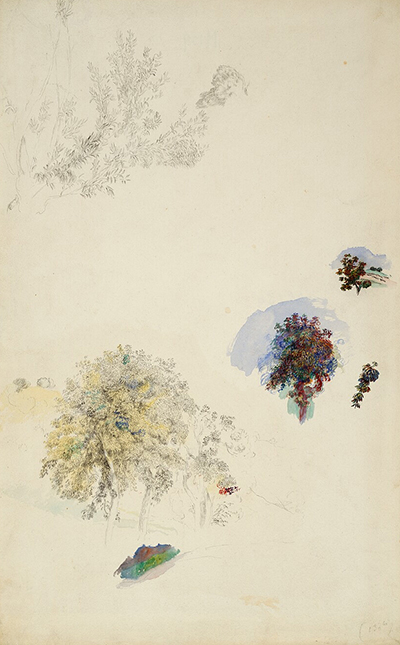
Renoir left generous spaces between separate clusters of branches, trees and coloured foliage. At the upper left, fine black ink describes leaves with little colour. Lower down, washed trees take shape. On the right, brighter red, blue and green marks create compact studies that look almost like flowers or jewels when seen from a distance. Studies of Trees and Foliage, dated 1884/87, is one sheet in the Art Institute of Chicago, accession 1948.75. The museum identifies five individual studies, each worked to a different degree. Art Institute of Chicago, cat. 20. [1]
The full-sheet view matters. Another old site page uses a crop of the lower-left trees under almost the same title and date. That crop is a detail of this same Chicago object, not a separately catalogued Renoir drawing. This page presents the full sheet so a reader can see how the pale ink trees, richer watercolours and open paper relate. Art Institute whole-sheet image and catalogue. [1]
At a glance
- ArtistPierre-Auguste Renoir
- Art Institute titleStudies of Trees and Foliage
- Date1884/87
- MediumPen and black ink, with transparent and opaque watercolour
- Support and sizeIvory wove paper, 49.7 × 30.9 cm
- CollectionArt Institute of Chicago, gift of Mrs Potter Palmer, 1948.75
Watch: Pierre-Auguste Renoir
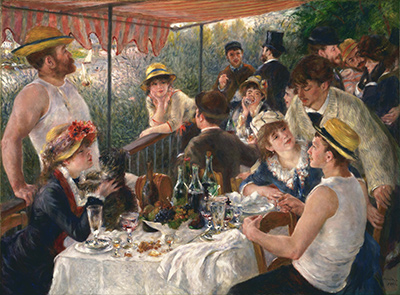
Explore a Montmartre dance, a gathering beside the Seine and the drawings behind Renoir’s paintings.
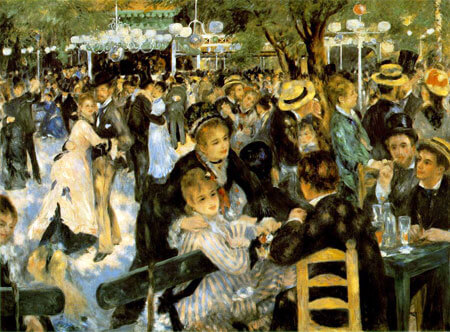
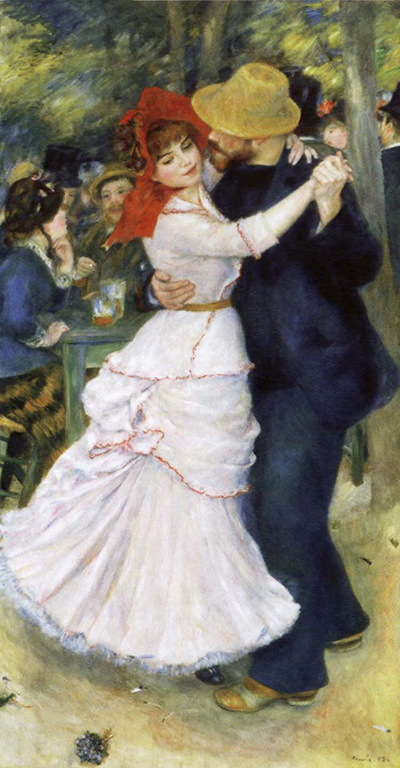
Renoir, Bal du moulin de la Galette
Dr. Beth Harris and Dr. Steven Zucker discuss Renoir’s 1876 Montmartre dance scene, its light and its crowds.
Watch on YouTubeFive different ways to describe growth
Look first to the upper left. A group of delicate branching forms is drawn in pen and black ink, with no watercolour added. Directly below, another tree grouping receives broad, pale yellow wash and touches of blue over the ink. The contrast is more than a change of palette: one study relies on line, the other starts to test how washes can give a cluster atmosphere or light. Art Institute technical report. [1]
On the right, three decorative foliage studies use more colour. The two smaller ones still have black pen lines beneath watercolour; the largest is built entirely from lines and dabs of red, blue and other colours in watercolour. Near the lower centre is a small group of washes that the museum thinks may be an early landscape trial or simply an exploration of colour. It does not claim a finished composition hidden in this area. The page rewards a slow look precisely because not all of its marks have the same purpose or finish. Art Institute technical report. [1]
The museum suggests Renoir may have worked on the sheet at different times. The upper ink drawing is delicate, while some right-hand groups are freer and much more colourful. He might also have returned to certain clusters after an interval. These are reasoned readings of varied handling, not documented entries in a studio diary. The broad 1884/87 date range should not be collapsed into one exact day or a single excursion. Art Institute catalogue essay. [1]
Ink, transparent wash and opaque colour
The support is moderately textured ivory wove paper. The Art Institute’s conservator distinguishes transparent watercolour from opaque watercolour, or gouache. Transparent wash lets underlying pen marks remain visible; the denser paint on the right can sit over earlier colour and build a more decorative surface. The five studies range from ink alone to layers of both types of watercolour. Comparing them on the same page makes Renoir’s decisions easier to see than a tight crop of one tree would. Art Institute media and support report. [1]
The colourful centre-right form is particularly dense. Blue contours and a pale blue surrounding wash hold red, orange and green marks together. The catalogue raises a possible visual link to the way Renoir’s friend Paul Cézanne outlined foliage in blue, but it does not claim that Cézanne taught him this specific technique or that the Chicago sheet was made during a particular joint trip. Such comparisons help a viewer notice a method while leaving the sheet’s production site open. Art Institute catalogue essay. [1]
Several of the pale areas can look empty at first. Their spacing is part of the sheet’s character. The museum finds no visible revisions under normal examination or magnification beyond the intended experiments in colouring, and no drawing on the reverse. Three edges preserve the paper’s natural deckle; the right side is straight-trimmed. The object was handled and mounted over time, with minor edge discoloration and handling traces recorded in the condition report. Art Institute technical and condition reports. [1]
An exercise, or preparation?
It is tempting to treat every Renoir study as a direct step toward a famous canvas. The Art Institute does not identify a strong link between this sheet and a specific larger work. Its curator proposes that the page may simply have been a playful exercise, while acknowledging that working intermittently on a sheet could help Renoir test ideas. A separate Sheet of Studies in the Louvre, and a Study of a Tree in New Orleans, offer comparisons for his interest in assorted motifs and ink marks. They are different objects, not parts of the Chicago page. Art Institute catalogue and comparative figures. [1]
The absence of an identified final painting does not reduce this sheet to a failed plan. It records a painter thinking through line, wash, density and colour around a familiar natural subject. The lower-left tree can look relatively observed, while the most brilliant cluster is nearly abstract in effect. That range is exactly what the full page preserves. The date and medium put the sheet within Renoir’s wider work of the mid-1880s, but the museum leaves its precise studio function open. Art Institute catalogue essay. [1]
From private hands to the Art Institute
The Art Institute lists Ambroise Vollard among earlier owners, then the Fraysse collection by 1938. New York dealers Durlacher Brothers sold the sheet to Philip Hofer in November 1938. After Hofer consigned it back in 1947, the firm sold it to the Art Institute in 1948. The museum also records a loan to Harvard’s Fogg Museum from 1944 to 1947. This chain helps identify and follow the same physical sheet across collections. Art Institute provenance and exhibition record. [1]
Looking again
Move from the ink-only group at the top left to the washed trees below, then across to the saturated right-hand forms. Notice how Renoir changes both the amount of information and the way colour sits on paper. The sheet does not need to resolve into one landscape. Its subject is the range of ways foliage might be drawn or painted.
Renoir artworks directory
Questions about Studies of Trees and Foliage
It is one part of the same Art Institute sheet, accession 1948.75. A second old page shows a crop of that part, which can make it look like another object.
The Art Institute identifies five individual studies in pen, ink and varying watercolour techniques, with a small additional area of colour trials near the lower centre.
The museum finds no strong connection to a particular larger work. It may have served as a working exercise or a place to test different ways of treating foliage.
The Art Institute dates the sheet 1884/87, a range rather than a documented single year.
Discussion
What do you notice when you return to Studies of Trees and Foliage?
How does your eye move among the five separate studies on the whole sheet?
Reader Insights
How does your eye move among the five separate studies on the whole sheet?
The second old tree-study URL shows only a crop of this same Chicago object.
What changes between ink-only foliage and the opaque watercolour at centre right?
Join the Conversation
Share a close observation or a source-backed question about Renoir’s Studies of Trees and Foliage.
References
- Nancy Ireson and Kimberly Nichols, Art Institute of Chicago, cat. 20, essay and technical report. Object identity, five studies, media, support and provenance View source.
- api.artic.edu, Art Institute Open Access record 62432 View source.
- api.artic.edu, official IIIF whole-sheet image View source.