by Tom Gurney
Tom Gurney BSc (Hons) is an art history expert with over 20 years experience
Published on June 19, 2020 / Updated on October 2, 2026
Email: tomgurney1@gmail.com / Phone: +44 7429 011000
Renoir placed a group of bathers in a loose circle. Some recline; two at the centre appear to prepare a splash; a woman at the right raises her hands to her hair. The wooded setting is reduced to a few upright lines and a faint suggestion of water. This broad graphite sheet is in the Art Institute of Chicago, accession 2013.1010, dated 1895/97. Its scholarly catalogue calls it Study for “Bathers in the Forest”. The exact full-sheet image matches the older splash at this URL. Art Institute of Chicago, cat. 23. [1]
“Study for” is a useful historical title, but it does not settle the sequence. A detailed museum comparison with Renoir’s related painting at the Barnes Foundation finds the compositions extraordinarily close. The drawing has few major changes, while an examination of the painting reveals earlier features not present on the sheet. The Art Institute therefore thinks the drawing may have recorded the finished painting, perhaps by tracing, rather than serving as the first design for it. That possibility makes this a particularly instructive example of how drawings can follow as well as precede paintings. Art Institute essay and technical report. [1]
At a glance
- ArtistPierre-Auguste Renoir
- Scholarly catalogue titleStudy for “Bathers in the Forest”
- Current Art Institute API titleBathers in a Forest
- Date1895/97
- MediumGraphite on tan wove paper, lined with ivory Japanese paper
- Size63.8 × 94.4 cm, as given by the museum’s current API and catalogue heading; one technical subsection prints 98.4 cm for the width
- CollectionArt Institute of Chicago, gift of Dorothy Braude Edinburg, 2013.1010
Watch: Pierre-Auguste Renoir
Explore a Montmartre dance, a gathering beside the Seine and the drawings behind Renoir’s paintings.
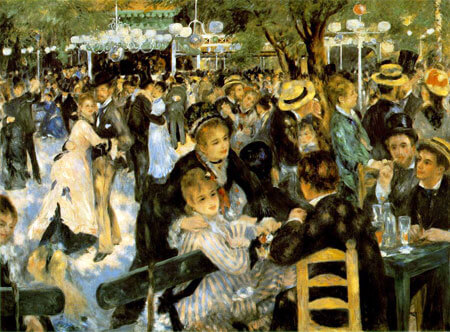
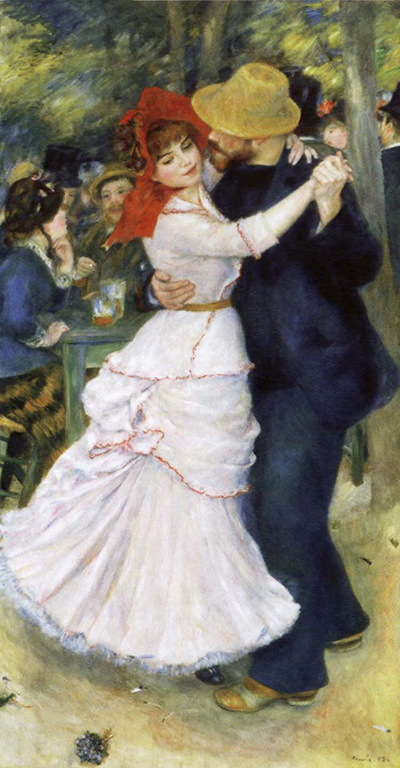
Renoir, Bal du moulin de la Galette
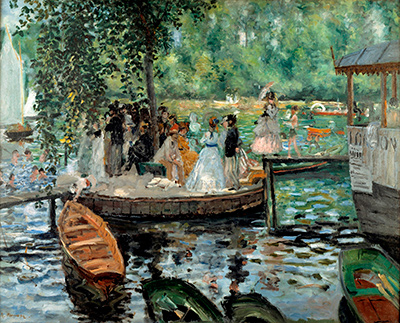
Dr. Beth Harris and Dr. Steven Zucker discuss Renoir’s 1876 Montmartre dance scene, its light and its crowds.
Watch on YouTubeA scene assembled from figures
The bathers’ bodies form a circular rhythm across the long sheet. A reclining figure opens the group at the lower left, while two women at the middle turn toward each other. At the right, a seated figure seen largely from behind reaches to her hair. The eye can move around this ring without finding a fully worked forest or pool. According to the Art Institute’s conservator, only slight marks suggest water at one figure’s thighs and trunks at upper left. Renoir’s attention is on the arrangement of people and gestures. Art Institute technical report. [1]
The museum’s curator describes the interaction as staged rather than a likely scene observed outdoors. One woman seems to shield herself from the coming splash, another helps set it up, and the outer figures turn their backs to frame the group. The drawing can read as playful, but its composition is deliberate. The Art Institute sees possible echoes of Titian’s Diana and Actaeon in two poses, with the directions reversed, and suggests Renoir may have known the earlier work through a print. That comparison is an interpretation of pose, not evidence that Renoir literally traced Titian. Art Institute catalogue essay. [1]
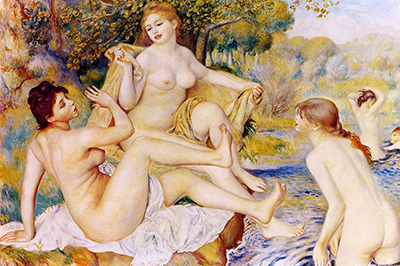
The related Barnes painting, Bathers in the Forest, gives the figures colour, setting and more visual unity. The Art Institute’s digital overlay compared the graphite lines with a scaled image of that canvas. Not only the overall arrangement, but smaller features such as limbs, faces and toes align closely. There is a slight shift at the far right. Such closeness is what prompted the museum to question the usual assumption that the paper version was a free, earlier sketch. Art Institute catalogue and technical reports. [1]
Why the order is uncertain
Preparatory studies often show alternatives and corrections as an artist searches for a composition. Here the lines are generally firm and deliberate, without major changes. A few contours are reinforced, and some features at the far right may have been adjusted. The museum’s imaging of the painting found early features that disappeared from its final surface and do not appear in the drawing. This supports the interpretation that the sheet represents a later state of the composition. It does not provide a dated instruction from Renoir specifying exactly why he made it. Art Institute technical report. [1]
The Art Institute suggests several possible functions. Renoir might have traced from the painting as a record, or he might have used a drawing to transfer an already worked-out arrangement. However, it found no pricking, embossing or clear transfer material on the reverse to establish a transfer to canvas. The painting’s infrared image likewise did not show a corresponding graphite underdrawing. We can say the two images are closely related; we should not claim a proven one-way transfer. The museum currently judges a drawing made to document the completed composition most likely. Art Institute technical analysis. [1]
The paper’s physical state adds to that reading. It is thin, with pinholes, tears, losses and surface wear consistent with studio use. The museum thinks it was wetted at some point, which could have made it more flexible and perhaps more transparent for tracing. Graphite would adhere to a damp support. These are material clues and a proposed method, not a demonstration that every line was actually copied through the sheet from the canvas. Art Institute catalogue and support report. [1]
Material details and later care
Renoir drew directly in graphite on smooth tan wove paper. The technical report finds little modelling beyond a few marks at backs and shoulders. Faint erasure beside many lines may have sharpened the contours by removing loose graphite, though the conservator cannot rule out later restoration for all of it. A graphite Renoir signature is recorded at lower right. The sheet has since been lined with Japanese paper, providing support to its damaged surface. Art Institute technical report. [1]
The Art Institute documents the drawing at a Paris sale in 1966, with later Paris and London gallery ownership. Dorothy Braude Edinburg bought it at Sotheby’s in 1991 and gave it to Chicago in 2013. That later record is firm; the exact order and function of the drawing and the Barnes painting remain a scholarly question. Art Institute provenance. [1]
Looking again
Follow the figures around the page before searching for a forest. Their gestures connect even where the background is almost blank. Then compare the confident graphite lines with the work’s torn and pinholed paper. This was a practical object that has survived heavy use, and its near-perfect agreement with the Barnes painting is the reason the word “study” needs explanation.
Renoir artworks directory
Questions about Study for Bathers in the Forest
No. It is an Art Institute graphite drawing closely related to a Barnes Foundation oil painting of the bathers.
The Art Institute says that is uncertain. Its technical comparison suggests the sheet may have recorded the finished composition, perhaps by tracing.
Renoir concentrated on figure outlines and their arrangement. The paper has only slight indications of trunks and water, with little tonal modelling.
The Art Institute’s current API and catalogue heading give 94.4 cm. A technical subsection prints 98.4 cm. This page reports the current object measurement and records that source discrepancy.
Discussion
What do you notice when you return to Study for Bathers in the Forest?
How do the bathers’ poses lead your eye around the otherwise spare sheet?
Reader Insights
How do the bathers’ poses lead your eye around the otherwise spare sheet?
The Art Institute’s overlay suggests this drawing may record the Barnes painting’s finished composition.
Which clues support that reading, and which steps in the sequence remain unproven?
Join the Conversation
Share a close observation or a source-backed question about Renoir’s Study for Bathers in the Forest.
References
- Nancy Ireson and Kimberly Nichols, Art Institute of Chicago, cat. 23, essay and technical report. Relation to Barnes painting, overlay and imaging findings, material, condition and provenance View source.
- api.artic.edu, Art Institute Open Access record 186400 View source.
- api.artic.edu, official IIIF image View source.