 by Tom Gurney
Tom Gurney BSc (Hons) is an art history expert with over 20 years experience
Published on June 19, 2020 / Updated on October 2, 2026
Email: tomgurney1@gmail.com / Phone: +44 7429 011000
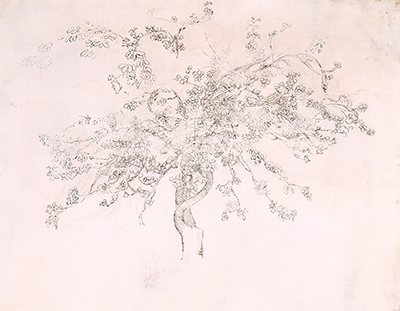
The tree in this drawing is at once a recognisable plant and a study in how lines can spread across a surface. Its trunk rises from near the lower centre, forks, and sends light branches through a broad canopy. Small loops and flicks of ink suggest leaves without describing every one. Most of the surrounding area is unmarked. The open space makes the branch structure, rather than a landscape setting, the subject of the picture.
The image on this route matches figure 6.14 in the Art Institute of Chicago’s scholarly catalogue. [1] That figure identifies Study of a Tree as a work by Pierre-Auguste Renoir in the New Orleans Museum of Art, accession 86.285, from the Muriel Bultman Francis Collection. The catalogue dates it circa 1884–86 and records pen and india ink on canvas, 54 × 64.8 cm.
At a glance
- ArtistPierre-Auguste Renoir
- Title in the Art Institute catalogueStudy of a Tree
- DateCirca 1884–86, as catalogued by the Art Institute
- Medium and supportPen and india ink on canvas
- Size54 × 64.8 cm
- CollectionNew Orleans Museum of Art, 86.285, Muriel Bultman Francis Collection
Watch: Pierre-Auguste Renoir
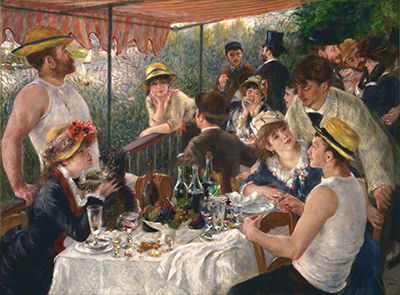
Explore a Montmartre dance, a gathering beside the Seine and the drawings behind Renoir’s paintings.
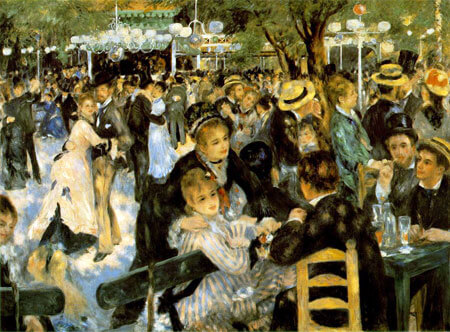
Renoir, Bal du moulin de la Galette
Dr. Beth Harris and Dr. Steven Zucker discuss Renoir’s 1876 Montmartre dance scene, its light and its crowds.
Watch on YouTubeFollowing the trunk and branches
Start at the narrow base of the trunk. The ink line climbs, bends, divides and divides again. It does not maintain a perfectly regular outline: a tree’s growth is presented through changing directions and thicknesses. On one side, the canopy extends in a long, low reach; elsewhere shorter sprays rise or curl back. The resulting crown is wide compared with the slender lower trunk. These are observations of the reproduced image, not evidence for a named species or an identifiable place.
The branches are easier to follow if the many small marks are set aside for a moment. Renoir did not draw a solid mass of foliage. He left large areas of the pale support visible among the dark lines. Groups of looped strokes collect at the branch tips, while lighter or less finished passages leave space around them. The airy result depends as much on what he omitted as on what he drew. Calling the work a “study” describes this concentrated investigation of form; it does not establish that it was a preparatory design for any one finished painting.
The canvas support is a useful surprise. A visitor might assume a pen drawing belongs on paper, but the Art Institute’s caption specifies ink on canvas for this New Orleans work. The weave cannot be assessed reliably from this reproduction. The material description comes from the catalogue rather than from an inference about visible texture. The medium also separates this object from the coloured paper study in Chicago with which the Art Institute compares it. Art Institute catalogue. [1]
Its relation to the Chicago tree studies
The Art Institute’s Studies of Trees and Foliage, accession 1948.75, is a different work: one sheet bearing five separate studies in pen, black ink and watercolour. It is dated 1884/87. Its curator, Nancy Ireson, observes that small looped lines in the sheet’s lower-left tree study resemble the marks in the New Orleans Study of a Tree. That is a comparison of handling, not an assertion that one is a fragment of the other or that both were drawn on the same day. Art Institute catalogue essay. [1]
The contrast tells us something about the choices in this image. Chicago’s sheet ranges from spare pen lines to washes of yellow, blue, green and warmer colour. The New Orleans drawing, as reproduced in its catalogue figure and inherited here, concentrates on the tree’s branching framework. Colour does not organise the effect in the same way. A viewer can compare the spring of a small ink loop in each work, then notice how differently a single large tree and five separate foliage experiments occupy their supports.
The Art Institute suggests that Renoir may have returned to different passages of its own sheet at separate moments. That discussion concerns the Chicago sheet; it does not provide a chronology for the New Orleans canvas. Likewise, their related handling cannot establish a shared site in southern France or a connection to a particular finished landscape. Their documented link is the curator’s visual comparison and the overlapping catalogue date ranges. Art Institute catalogue essay and technical report. [1]
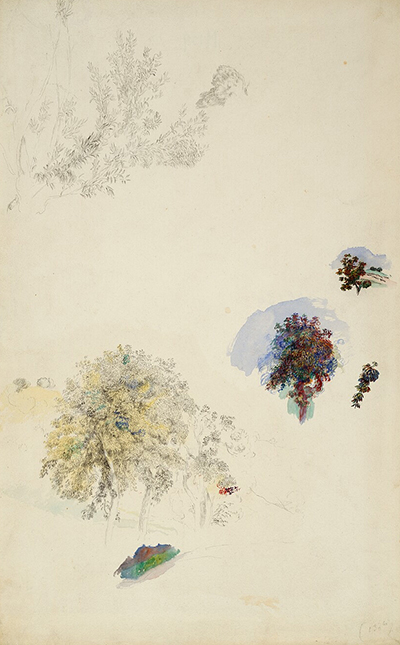
What the date can and cannot tell us
“Circa 1884–86” is a catalogue dating rather than a date written visibly across the small reproduction. It places the canvas near Renoir’s mid-1880s investigations of line and structure, but the image alone cannot fix a year, location or sequence of work. The adjacent Chicago sheet carries the broader 1884/87 designation. Keeping those two date ranges separate prevents a convenient comparison from becoming a false claim of simultaneous production.
The subject is also less specific than a named landscape. There is no building, figure or horizon that securely locates the tree. Even the suggestion of natural growth is filtered through an artist’s decisions about where to strengthen, repeat or leave out a line. The old title is therefore well suited to the image: it describes what Renoir studies without claiming a precise grove or later canvas.
The work has another distinct role within the Renoir cluster. The drawings hub includes several figural studies linked to the bathers, narrative illustrations, and the multi-motif Chicago foliage sheet. This route gives a single tree room to be examined on its own. The nearby /studies-of-trees-and-foliage/ page is the whole Chicago sheet.
Looking again
Follow one branch from trunk to outer edge, then try another. The eye meets places where ink accumulates and others where a few marks only imply leaves. That alternation is the drawing’s rhythm. Its apparent simplicity is not the absence of design: the crown spreads widely but still holds together around the central trunk. The reproduction does not permit confident claims about fine differences in ink tone, canvas texture or condition.
Renoir artworks directory
Questions about Study of a Tree
The Art Institute catalogue [1] identifies it as New Orleans Museum of Art 86.285, from the Muriel Bultman Francis Collection.
No. Study of a Tree is a single ink-on-canvas tree in New Orleans. Chicago’s Studies of Trees and Foliage is a paper sheet with five studies, including colour. The Art Institute compares the looped ink marks in the two works.
The sources used here do not establish a specific finished painting. The title and branch drawing support reading it as an investigation of form; they do not prove a later transfer into a canvas.
The Art Institute caption dates the New Orleans work circa 1884–86. That is an attributed range, not a precisely documented day or year.
Discussion
What do you notice when you return to Study of a Tree?
How does your eye follow the trunk into the widest branches?
Reader Insights
How does your eye follow the trunk into the widest branches?
The Art Institute identifies this New Orleans ink-on-canvas tree and compares its small looped marks with a separate Chicago sheet.
What makes this a distinct single-tree study rather than a crop of the Chicago sheet?
Join the Conversation
Share a close observation or a source-backed question about Renoir’s Study of a Tree.
References
- Nancy Ireson, Art Institute of Chicago, Studies of Trees and Foliage, cat. 20, especially the comparison in the essay and figure 6.14 caption. This supplies the New Orleans object identifier, date, medium, dimensions and collection credit View source.
- Art Institute of Chicago, Open Access data View source.
- Page image: inherited site reproduction of Study of a Tree, New Orleans Museum of Art 86.285.