 by Tom Gurney
Tom Gurney BSc (Hons) is an art history expert with over 20 years experience
Published on June 19, 2020 / Updated on October 2, 2026
Email: tomgurney1@gmail.com / Phone: +44 7429 011000
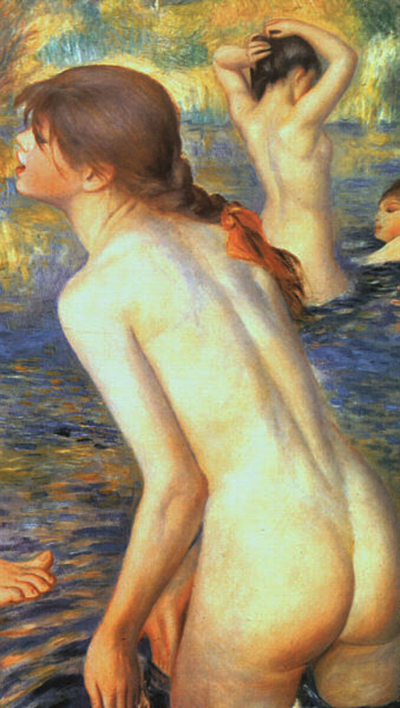
The image on this page shows a nude figure leaning forward at the edge of a stream, with a smaller bather behind her lifting both hands to her hair. It is a vertical crop of the right side of Renoir’s The Great Bathers, painted 1884–87 and now in the Philadelphia Museum of Art [1], accession 1963-116-13. “The Bathers II” is the established local route title. It is not a separate title used by the museum for another canvas.
The older page mixed two works: its image came from the Philadelphia composition, while its prose described the Musée d’Orsay’s Les Baigneuses of 1918–19 [2], accession RF 2795. Those paintings are separated by more than thirty years and have different groups of figures, histories and owners. This page now explains the cropped Philadelphia image. The full composition gives the essential context for seeing the figures together.
Contents
- What exactly does this image show?
- The leaning bather at the water’s edge
- The small figure behind her
- What the crop leaves out
- Why the title caused confusion
- How to use this page
Watch: Pierre-Auguste Renoir
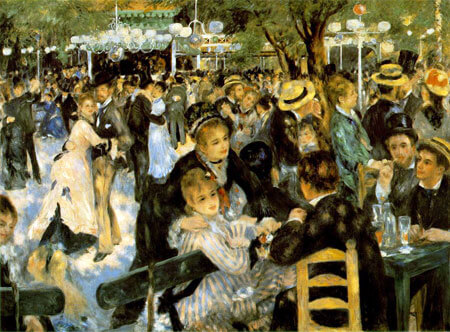
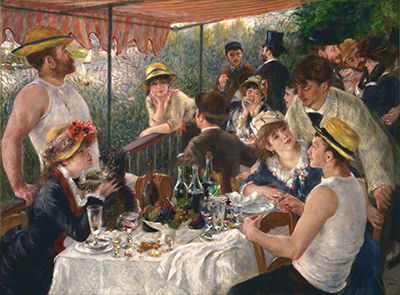
Explore a Montmartre dance, a gathering beside the Seine and the drawings behind Renoir’s paintings.
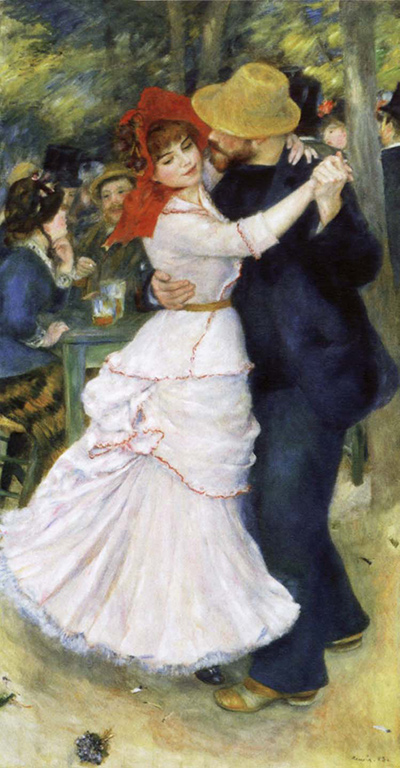
Renoir, Bal du moulin de la Galette
Dr. Beth Harris and Dr. Steven Zucker discuss Renoir’s 1876 Montmartre dance scene, its light and its crowds.
Watch on YouTubeWhat exactly does this image show?
| Artist | Pierre-Auguste Renoir (1841–1919) |
| Original painting | The Great Bathers, also called The Large Bathers |
| Date | 1884–87, in the Philadelphia owner record |
| Medium | Oil on canvas |
| Owner | Philadelphia Museum of Art, 1963-116-13 |
| Image on this route | A vertical crop of the original painting’s right-hand side, not a second work |
| Local route label | “The Bathers II”; no independent museum object under this name has been established |
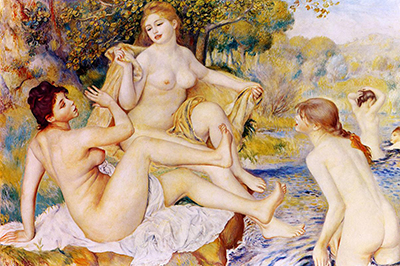
The fact box identifies the underlying painting, not the pixel dimensions of this cropped reproduction. The Philadelphia museum’s record discusses the full horizontal canvas, in which the right-hand figure is one of three larger women at the water’s edge. Two smaller figures are farther back in the water. The local crop removes most of the seated group to the left, changing the balance of the scene and making one bather appear to be the entire subject.
The leaning bather at the water’s edge
In the crop, the nearest woman bends forward with both arms lowered. Her face turns to the left, towards companions who are mostly outside the frame. Her back catches pale light; warmer strokes trace the shoulder and hair, and the surrounding blue water provides a strong colour contrast. At the lower left, only small fragments of another figure enter the crop. Those fragments are a reminder that the figure belongs to a larger arrangement.
In the complete painting, the leaning bather is at the right foreground, facing two women seated together on the left bank. One seated woman lifts a hand in response to her movement. The Philadelphia museum describes a fleeting moment in which the standing woman playfully threatens to splash her companion. A viewer who sees only the cropped picture misses the direction of that exchange and may read the pose simply as a solitary woman entering the water.
The body’s outline is carefully constructed. Its curve from shoulder down the back helps keep the figure visible against complex colour in the landscape and water. Darker strokes along the hair and arm give the eye a path to follow, while the pale skin stays distinct from the blue and green ripples. This contrast between firmly modelled figures and moving, loosely handled surroundings is central to the full work’s effect. The crop magnifies it but removes much of the dialogue among the bathers.
The small figure behind her
Farther back, a bather stands in the water with raised arms and hands at her head. The cropped format gives her considerable visual importance because she appears almost directly above the nearest woman’s shoulder. In the full painting she is one of two distant bathers. Renoir places them on a smaller scale, establishing depth behind the large foreground group.
The background figure’s gesture differs from the forward motion below. Her elbows form an arc over her head; the nearest woman’s back curves downward towards the water. Together, these shapes create a rhythm across the right side of the picture. The river’s horizontal ripples pass between them. They do not have to be named models to be read as deliberate compositional forms.
The Art Institute of Chicago’s research on a related drawing [3] explains that Renoir tested changes to the position of the right-hand foreground bather while developing The Great Bathers. Its discussion also distinguishes studies of the near figure from variants of the background group. This helps explain why the pose in the finished painting feels strongly designed even within an apparently spontaneous bathing scene. The studies are related works, not extra figures from a second canvas called “The Bathers II.”
What the crop leaves out
The full Philadelphia composition is horizontal and much broader than the image here. To the left, two large bathers sit on the bank, with pale cloth draped through their poses. Their bodies, crossing limbs and responding gestures balance the woman who leans towards them. Trees and distant foliage frame the scene; water continues between foreground and background. The cropped picture removes the entire interaction that gives the full work its narrative spark.
It also changes the visual hierarchy. In the full canvas, the central seated bather and her companions occupy the broad foreground. The woman at the right is one part of a larger grouping. Cropped into a tall rectangle, she becomes the dominant form, almost like a single-figure study. That can be useful for looking closely at her contour, but the reproduction should be labelled honestly so readers do not infer a separate Renoir painting.
The Philadelphia owner record [1] notes that Renoir laboured over the painting for about three years, preparing numerous drawings and at least two full-scale multifigure studies. The Morgan Library’s exhibition entry [4] places the finished work in Renoir’s 1887 submission to Georges Petit’s Exposition internationale. That history belongs to the complete Philadelphia canvas; the local crop has no independent date of painting, exhibition record or provenance.
Why the title caused confusion
Renoir returned to bathers throughout his career. Many English headings use “Bathers,” “Large Bathers” or “Great Bathers,” sometimes without dates or a museum name. The word “II” on this route suggests a second painting but does not tell us which one. The older article apparently treated the image as if it were Renoir’s late bathers at the Musée d’Orsay, drawing in the late painting’s gift by his sons and its 1918–19 date.
The Orsay canvas is easy to distinguish once seen in full. Its two broad foreground figures recline on land, while three smaller bathers appear in the background. It is dated 1918–19, measures 110 × 160 cm, and bears inventory RF 2795. Orsay records that Renoir’s sons donated it to the French state in 1923. None of those object facts describes the cropped image on this route. The two works have separate pages in this workspace so each can be identified from the correct image and owner record.
Philadelphia’s painting, by contrast, was made in the 1880s, with three large figures arranged at the water’s edge and two smaller ones in the stream. Its owner number is 1963-116-13. The local splash precisely includes its right foreground and background bathers. These visual features provide more reliable identification than an unspecific translated title.
How to use this page
Use this route as a close view of one part of The Great Bathers. Begin with the near woman’s forward bend, then look above her to the background figure’s raised arms. Notice how cool ripples separate their warm forms and how the near figure’s turned face points beyond the crop. Then open the full Philadelphia painting to see the seated group she faces.
The related late Bathers page covers the Musée d’Orsay’s separate RF 2795 canvas. Comparing the two full images is more informative than transferring facts between them. It shows how Renoir revisited a subject over decades while changing its poses, proportions and painterly handling.
This is a crop of the work treated on the main Large Bathers page. The image shows only part of the composition; the complete painting gives it the context needed for a fuller reading.
Renoir artworks directory
Questions about The Bathers II
No separate owner object has been established for this route. Its image is a crop of the right side of Renoir’s The Great Bathers in Philadelphia, 1963-116-13.
The Philadelphia Museum of Art dates The Great Bathers 1884–87. The crop is a later reproduction of part of that painting, not an independently dated work.
The large foreground woman leans towards the seated group outside the crop. A smaller bather in the water behind her raises her hands to her hair. Their names are not established by the owner record used here.
No. Orsay’s Les Baigneuses, RF 2795, was painted in 1918–19 and has a different composition with two reclining foreground women.
The full Great/Large Bathers belongs to the Philadelphia Museum of Art. Check its current object record for display information; the full composition is also shown on this site’s main page.
Discussion
What do you notice when you return to The Bathers II?
What do you notice about the leaning bather’s pose?
Reader Insights
What do you notice about the leaning bather’s pose?
Philadelphia identifies the underlying canvas as its 1884–87 Great Bathers, 1963-116-13.
What becomes clear when you return to the full painting?
Join the Conversation
Share a close observation or a source-backed question about Renoir’s cropped Bathers detail.
References
- Philadelphia Museum of Art, Renoir, The Great Bathers, 1963-116-13: owner identification, date, composition and painting process View source.
- Musée d’Orsay, Renoir, Les Baigneuses, RF 2795: the separate 1918–19 canvas; its facts are cited solely to correct the old route’s conflation View source.
- Art Institute of Chicago, Splashing Figure research: the right-hand bather’s development and distinct background group View source.
- Morgan Library & Museum, Great Bathers exhibition entry: 1887 exhibition context and preparatory work for the Philadelphia canvas View source.
- Wikimedia Commons, Wikimedia Commons, Google Art Project reproduction of the complete Great Bathers View source.
- Creative Commons, Public Domain Mark View source.
- Lead image credit. Image: right-hand crop of Renoir’s Great Bathers, Philadelphia Museum of Art, from the Google Art Project file on Wikimedia Commons, marked Public Domain; cropped and resized JPEG. See the complete painting.