by Tom Gurney
Tom Gurney BSc (Hons) is an art history expert with over 20 years experience
Published on June 19, 2020 / Updated on October 2, 2026
Email: tomgurney1@gmail.com / Phone: +44 7429 011000
Three bathers occupy a broad, lightly worked sheet. The group already suggests Pierre-Auguste Renoir's ambitious Great Bathers, but the central figure and the arrangement are still open to change. The work is catalogued by the Musée d'Orsay as Three Bathers (Study for “Bathers: An Essay in Decorative Painting”) and held in the Louvre's Department of Prints and Drawings, inventory RF 29660, recto. The Louvre's short title Three Bathers by the Water supplies this retained page address. Musée d'Orsay object record [1]; Louvre record. [2]
This is a large drawing, 108 × 162 cm, in red chalk and black chalk or crayon with white chalk highlights, on paper mounted to canvas. Its breadth matters: Renoir could test the relation of several figures at near-painting scale rather than only sketch a single pose. The records agree on the object and measurements, while the date needs care. The current Orsay and Louvre object notices say c. 1881–82; Orsay's 2026 Sylvie Patry lecture transcript describes the same RF 29660 sheet as c. 1886. This page reports that difference rather than silently treating either date as settled. Orsay object record [1]; Louvre record [2]; Orsay, Les Grandes Baigneuses de A à Z. [3]
At a glance
- ArtistPierre-Auguste Renoir
- Retained English titleThree Bathers by the Water
- Orsay titleTrois baigneuses (étude pour “Baigneuses. Essai de peinture décorative”)
- Datec. 1881–82 in current object notices; c. 1886 in two Orsay 2026 curatorial sources
- MaterialsRed chalk, black chalk or crayon, white chalk highlights on paper mounted to canvas
- Size108 × 162 cm
- CollectionMusée d'Orsay; held in the Louvre's Department of Prints and Drawings
- InventoryRF 29660, recto
Watch: Pierre-Auguste Renoir
Explore a Montmartre dance, a gathering beside the Seine and the drawings behind Renoir’s paintings.
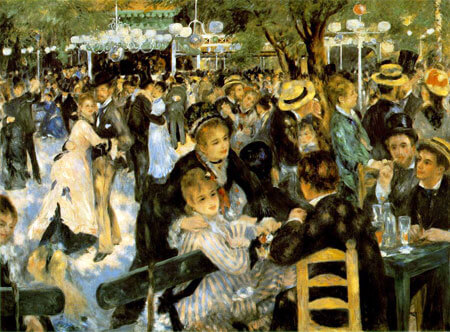
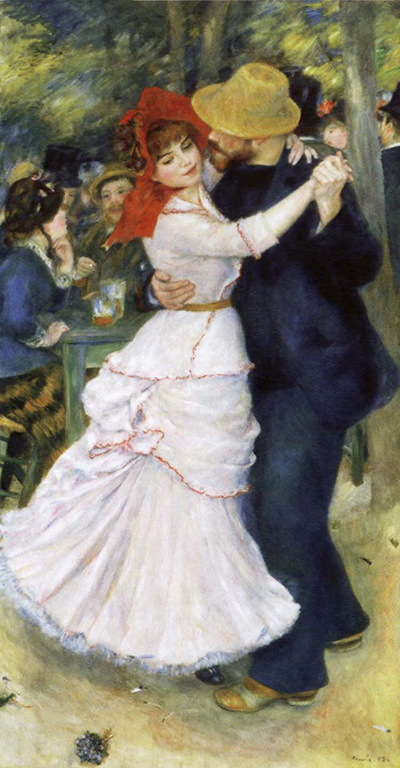
Renoir, Bal du moulin de la Galette
Dr. Beth Harris and Dr. Steven Zucker discuss Renoir’s 1876 Montmartre dance scene, its light and its crowds.
Watch on YouTubeReading the three figures
The three women do not stand like independent portraits. Their poses connect across the horizontal sheet, and the gestures make the viewer move from one body to the next. Red chalk supplies much of the form, with darker marks defining selected contours and white highlights lifting parts of the figures from the paper. The drawn setting remains sparse, leaving room to understand the bodies as a compositional problem. The precise balance of the figures is more important here than the details of an actual riverbank. Orsay object description [1]; Louvre object record. [2]
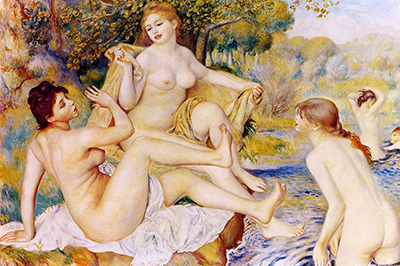
The Louvre notice says this study comes close to the final composition of the Philadelphia Great Bathers, except for the central figure. That qualification makes the drawing worth comparing rather than simply calling it a smaller copy. Looking from the study to the oil painting, a reader can test which relationships survived and where Renoir changed a pose. The paper does not record every intermediate decision, and “study for” does not mean all of its marks were transferred directly to the canvas. Louvre record [2]; Philadelphia Museum of Art, Great Bathers. [4]
The Louvre also notes a proposed connection to François Girardon's Bath of Diana relief at Versailles. That source belongs to the history of interpreting the bathers composition; the drawing itself does not label the sculpture. It is best treated as an art-historical comparison rather than a claim that Renoir made this sheet while standing before the relief. Louvre catalogue commentary. [2]
A contested place in the sequence
Renoir worked on bathers drawings and painted versions through much of the 1880s. An early date for RF 29660 would make this sheet a strikingly developed composition ahead of the later studies. The 1886 date in Orsay's 2026 curatorial material instead places it much closer to the completion of the Philadelphia painting. None of these public records explains the discrepancy in enough detail to resolve it here. The stable facts are the inventory, scale, materials and relationship to the bathers project; the precise position of this sheet in the sequence remains a point for further catalogue review. Orsay object record [1]; Orsay lecture. [3]
This is a disagreement within current museum material, rather than a case where a new label simply replaces an obsolete one. Orsay's object notice still lists c. 1881–82, while both Patry's lecture and a 2026 interview with curator Paul Perrin caption RF 29660 at c. 1886. The shared inventory and 108 × 162 cm dimensions show that these are claims about the same sheet. Neither caption supplies the reasoning behind the later date, so the public record does not justify silently choosing it over the live object notice. Orsay object record [1]; Patry lecture [3]; Perrin interview. [5]
The Art Institute of Chicago's scholarly catalogue illustrates RF 29660 in its discussion of Renoir's Splashing Figure. It dates the Louvre/Orsay sheet c. 1882 in that comparison and gives the same 108 × 162 cm measurement. The Chicago sheet is a separate, narrower drawing, with its own accession 1949.514. It contributes to a wider map of Renoir's attempts, not a licence to merge different studies under one image or title. Art Institute scholarly catalogue. [6]
The title can also mislead. “By the water” sounds like a report of an observed bathing place. Orsay's fuller title emphasizes a decorative-painting project. Both titles refer to the same sheet, and neither supplies a real geographical site. The page keeps the legacy route while identifying the object through its museum inventory. Orsay object record [1]; Louvre record. [2]
From the Alexandre and Laroche collections
Orsay's detailed provenance places the drawing with Arsène Alexandre before a 1903 sale, then with dealer Georges Petit and Bernheim-Jeune. It later passed to Henri-Jean Laroche and to his son Jacques Laroche. Jacques arranged a donation to the French state with a reserved lifetime interest. Orsay records state acceptance in 1947 and the end of the usufruct in 1976. The Louvre's short database gives 1946, reflecting the donation act and earlier administrative steps. The distinction between a signed act and formal acceptance explains the two dates more clearly than calling one record wrong. Orsay provenance [1]; Louvre acquisition summary. [2]
Orsay is the responsible museum today; the graphic-arts department of the Louvre is the recorded place of conservation. The Louvre says the sheet may be viewed by appointment in its graphic-arts study room. Exhibition and consultation arrangements can change, so visitors should use the institutions' current notices to plan a viewing. Orsay object record [1]; Louvre collection record. [2]
Looking again
Follow the bathers as a group, then compare the centre figure with the Philadelphia painting. The changes make this large sheet more than a preparatory footnote. It shows Renoir testing a way to make separate bodies hold together across a wide composition, even while the dating of this particular step remains disputed in current museum materials.
Renoir artworks directory
Questions about Three Bathers by the Water
It is Musée d'Orsay RF 29660, held in the Louvre's Department of Prints and Drawings.
The current object records give c. 1881–82. Two Orsay 2026 curatorial sources date the same sheet c. 1886. The precise chronology needs a specialist catalogue check.
No. It is a red-, black- and white-chalk study. The finished oil painting is a different object in the Philadelphia Museum of Art.
The donation act was made in 1946; Orsay records formal state acceptance in 1947, with the donor's reserved use ending later.
Discussion
What do you notice when you return to Three Bathers by the Water?
How do the three figures work as a group across the wide chalk sheet?
Reader Insights
How do the three figures work as a group across the wide chalk sheet?
Orsay and Louvre object notices date RF 29660 c. 1881–82, but Orsay’s 2026 curatorial captions say c. 1886.
Which change to the central figure separates this study from the Philadelphia painting?
Join the Conversation
Share a close observation or a source-backed question about Renoir’s Three Bathers by the Water.
References
- Musée d'Orsay, Trois baigneuses, RF 29660. Current object title, materials, measurements, object-record date and detailed provenance View source.
- Louvre collections, Trois baigneuses au bord de l'eau, RF 29660. Retained title, graphic-arts holding, Girardon comparison and composition note View source.
- Musée d'Orsay, Les Grandes Baigneuses de A à Z. 2026 lecture caption giving c. 1886 for the same sheet View source.
- Philadelphia Museum of Art, Great Bathers. Finished painting for comparison View source.
- Musée d’Orsay, Paul Perrin interview, 2026. Independent curatorial caption giving c. 1886 for RF 29660 View source.
- Art Institute of Chicago, scholarly catalogue for Splashing Figure. Comparative illustration and earlier date for RF 29660 View source.
- Page image: inherited site reproduction of Three Bathers by the Water, Musée d’Orsay RF 29660, recto.