Pierre-Auguste Renoir.jpg)
 by Tom Gurney
Tom Gurney BSc (Hons) is an art history expert with over 20 years experience
Published on June 19, 2020 / Updated on October 2, 2026
Email: tomgurney1@gmail.com / Phone: +44 7429 011000
Two women sit close together on a broad sheet of paper. One leans back and raises an arm; the other sits higher, surrounded by lines of drapery. They are recognizable as part of Pierre-Auguste Renoir's long work towards The Great Bathers, yet the drawing holds choices that did not survive into the finished canvas. Harvard Art Museums / Fogg Museum owns Two Nude Women, Study for the “Great Bathers”, accession 1951.77. Harvard dates it c. 1884–87; the Morgan Library & Museum's more specific exhibition label proposes c. 1886–87. Harvard object record [1]; Morgan Renoir Drawings labels. [2]
This is a substantial sheet, 110.6 × 124.7 cm, in red and white chalk on buff wove paper. It is neither a tiny notebook sketch nor the final painting. The dimensions allow Renoir to work at a scale where the women's bodies and the space between them can be considered together. Harvard records a red-chalk signature at the lower right. Harvard object record. [1]
At a glance
- ArtistPierre-Auguste Renoir
- Owner titleTwo Nude Women, Study for the “Great Bathers”
- Datec. 1884–87 (Harvard); c. 1886–87 (Morgan exhibition)
- MediumRed and white chalk on buff wove paper
- Size110.6 × 124.7 cm
- CollectionHarvard Art Museums / Fogg Museum, 1951.77
- AcquisitionMaurice Wertheim bequest, received 1951
Watch: Pierre-Auguste Renoir
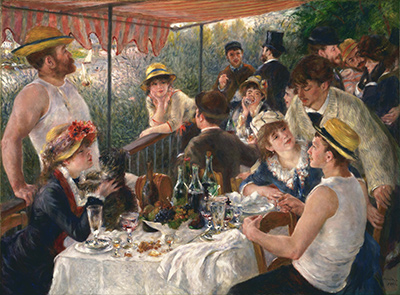
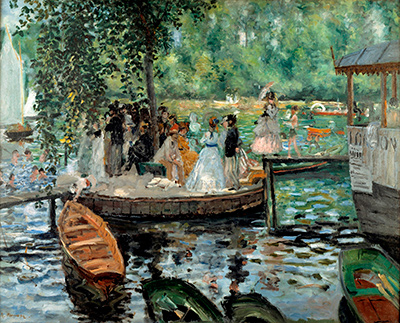
Explore a Montmartre dance, a gathering beside the Seine and the drawings behind Renoir’s paintings.
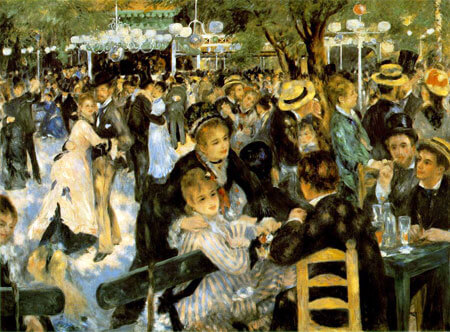
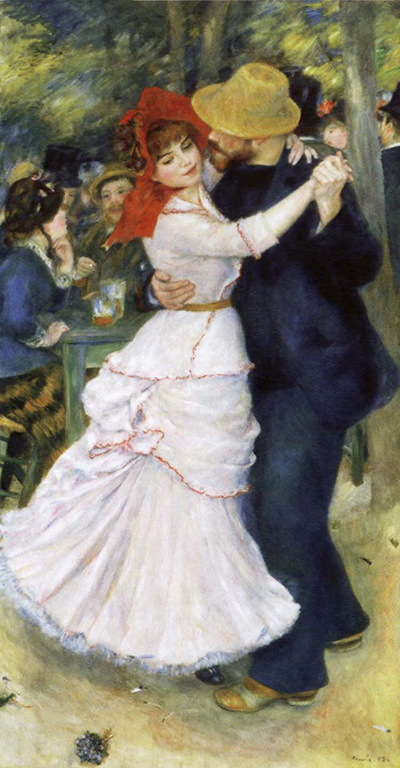
Renoir, Bal du moulin de la Galette
Dr. Beth Harris and Dr. Steven Zucker discuss Renoir’s 1876 Montmartre dance scene, its light and its crowds.
Watch on YouTubeA composition still changing
The left figure's body forms a broad curve across the lower half of the sheet. Her supported arm and raised hand draw the eye into the space between the women. The central figure faces us more directly, with one leg lifted and drapery spreading around her. Red chalk builds the flesh in many overlapping lines; touches of white lift selected parts from the buff paper. The figures are detailed enough to compare with a painting, but the surrounding setting is only lightly indicated. Harvard object image and record. [1]
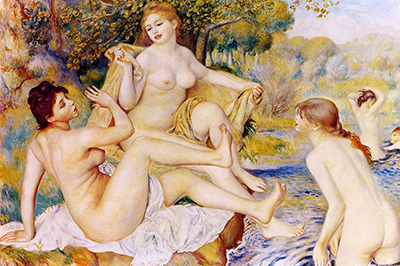
The Morgan's exhibition label gives an especially useful comparison. It says Renoir revisited the two leftmost figures of the larger composition here and worked out the central bather's legs, feet and drapery more fully than in an earlier large drawing held by the Morgan. Some of those solutions appear in the final canvas. Other ideas changed: the figure was not yet shown drying her back with the towel that appears in the completed picture. The Morgan also sees the neck of a flask or bottle between her fingers, an attribute later abandoned. Those details are easy to miss in a modest reproduction; they are curatorial findings to check against a larger image when available. Morgan exhibition labels [2]; Philadelphia Museum of Art, Great Bathers. [3]
This drawing therefore captures an intermediate stage, not a prediction of a finished work. It preserves both decisions that Renoir kept and possibilities that he set aside. Looking for one-to-one matches can be misleading. The artist could change a hand, shift a leg or remove an object while keeping the overall relationship of the bathers. The scale of the sheet shows how seriously he worked through that relationship before settling on the Philadelphia canvas. Morgan exhibition labels. [2]
Red chalk, white chalk and the paper between
The paper is not a neutral white ground. Its buff tone sits between the dark red modelling and pale white highlights, helping make the figures legible without every surface being filled. Around the outer edges, lighter marks hint at surrounding forms rather than describing them completely. The technique differs from a finished oil painting's layered colour, but it is not simply a diagram. Chalk allows broad areas of flesh, delicate contours and revisions to share one surface. Harvard materials and image. [1]
The Art Institute of Chicago's scholarly catalogue places this Harvard sheet in a network of bathers studies. It illustrates Harvard 1951.77 at 110.6 × 124.7 cm and compares it with Renoir's smaller Splashing Figure in Chicago, which had been cut down from a larger drawing. The two sheets address related figures, but they are separate objects. The Chicago drawing's title and pose should not be used as a replacement image for the Harvard work. Art Institute scholarly catalogue, Splashing Figure. [4]
The different date ranges in the sources are not necessarily a contradiction about authorship. Harvard's c. 1884–87 spans the longer planning period for the bathers composition. The Morgan's c. 1886–87 places this particular large sheet later in that process, based on its comparison with other drawings and the final painting. The page reports both rather than silently choosing a single year. Harvard object record [1]; Morgan exhibition labels. [2]
From private hands to the Fogg Museum
Harvard's recorded ownership history begins with Madame Abel Desjardin in Paris. It then lists César de Hauke and a sale through Knoedler & Co. in New York to Maurice Wertheim in 1947. Harvard received the sheet through Wertheim's bequest in 1951. The record provides these landmarks, not a full history reaching back to Renoir's studio; it is better to preserve the documented gaps than invent a seamless chain. Harvard provenance. [1]
Looking again
Trace the lifted arm from the left figure into the central bather's face, then follow her legs back through the open space. The drawing is both a study of bodies and an experiment in how they fit together. Comparing it with Great Bathers reveals the value of an abandoned idea: the final work looks more deliberate once we can see some of the options Renoir tested.
Renoir artworks directory
Questions about Two Nude Women
It is in Harvard Art Museums / Fogg Museum, accession 1951.77.
No. It is a large red- and white-chalk study for the group of figures. The completed oil painting belongs to the Philadelphia Museum of Art.
Harvard uses c. 1884–87 for the sheet; the Morgan exhibition proposes c. 1886–87 within that wider span. Both are approximate datings, and the page presents both.
The Morgan highlights changes to the central bather's legs, drapery and towel, and an early flask or bottle motif that was dropped.
Discussion
What do you notice when you return to Two Nude Women (Study for The Great Bathers)?
How do the women’s arms and legs connect across the broad chalk sheet?
Reader Insights
How do the women’s arms and legs connect across the broad chalk sheet?
Harvard dates 1951.77 c. 1884–87; the Morgan exhibition places it c. 1886–87.
Which details of the central bather changed before the Philadelphia painting?
Join the Conversation
Share a close observation or a source-backed question about Renoir’s Two Nude Women (Study for The Great Bathers).
References
- Harvard Art Museums, Two Nude Women, Study for the “Great Bathers”, 1951.77. Owner title, date, material, measurements, provenance View source.
- Morgan Library & Museum, Renoir Drawings large-print labels. The drawing's position in the bathers sequence and specific changes in the central figure View source.
- Philadelphia Museum of Art, Great Bathers. Finished painting for comparison View source.
- Art Institute of Chicago, scholarly catalogue for Splashing Figure. Comparison with Harvard 1951.77 and another distinct drawing View source.
- Page image: inherited site reproduction of Two Nude Women, Study for the “Great Bathers”, Harvard Art Museums 1951.77.